Page 256 of 378
Downloaded from www.Manualslib.com manuals search engine A. Coolant Surge Tank and Pressure Cap
B. Battery
C. Engine Oil Dipstick
D. Engine Oil Fill Cap
E. Air Cleaner
E Power Steering Fluid Reservoir
G. Brake Fluid Reservoir
H. Hydraulic Clutch Fluid Reservoir (If Equipped)
I. Windshield Washer Fluid Reservoir
Before closing the hood, be sure all the filler caps
are on properly. Then, just pull the hood down and
close it firmly.
!
: ,:: '3 :
6-11
Page 263 of 378
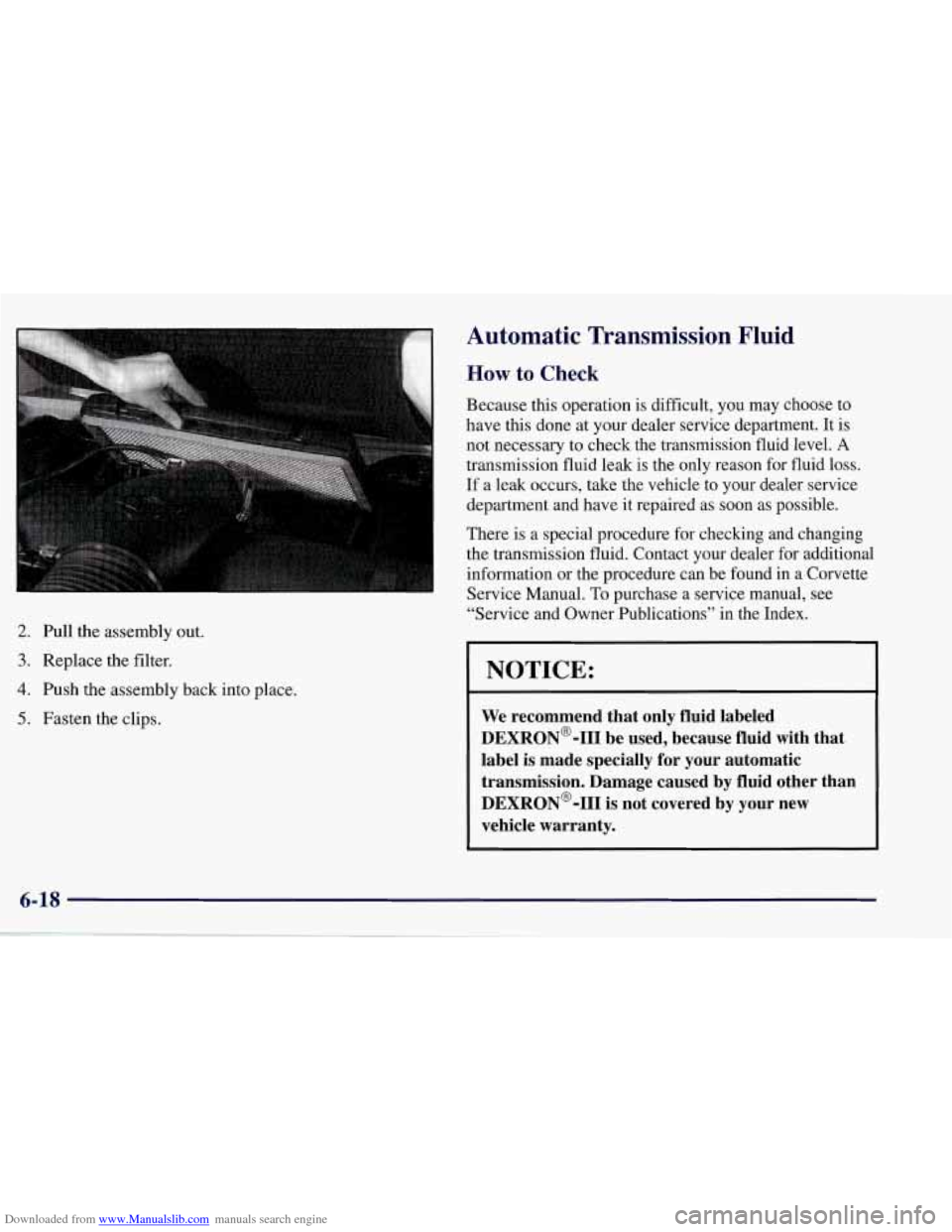
Downloaded from www.Manualslib.com manuals search engine 2. Pull the assembly out.
3. Replace the filter.
4. Push the assembly back into place.
5. Fasten the clips.
Automatic Transmission Fluid
How to Check
Because this operation is difficult, you may choose to
have this done at your dealer service department. It is
not necessary to check the transmission fluid level.
A
transmission fluid leak is the only reason for fluid loss.
If a leak occurs, take the vehicle to your dealer service
department and have it repaired as soon as possible.
There is a special procedure for checking and changing
the transmission fluid. Contact your dealer for additional
information or the procedure can be found in a Corvette
Service Manual. To purchase a service manual, see
“Service and Owner Publications’’ in the Index.
I NOTICE: I
We recommend that only fluid labeled
DEXRON@-111 be used, because fluid with that
label
is made specially for your automatic
transmission. Damage caused by fluid other than
DEXRON@-111
is not covered by your new
vehicle warranty.
Page 264 of 378
Downloaded from www.Manualslib.com manuals search engine Change both the fluid and filter every 50,000 miles
(80 000 km) if the vehicle is mainly driven under one of
these conditions:
In heavy city traffic where the outside temperature
regularly reaches
90 OF (32 O C) or higher.
In hilly or mountainous terrain.
High performance operation.
If you do not use your vehicle under one of
these conditions. Change the fluid and filter every
100,000 miles (166 000 km).
See “Scheduled Maintenance Services” in the Index for
the proper service intervals for the transmission fluid
and filter.
Manual Transmission Fluid
When to Check
How to Check
Because this operation can be difficult, you may
choose to have this done at your Chevrolet dealership
Service Department.
If you do it yourself, be sure to follow all the
instructions here, or you could get a false reading.
NOTICE:
Too much or too little fluid can damage your
transmission. Too much can mean that some
of the fluid could come out and fall on hot exhaust system parts, starting a fire. Be sure
to
get an accurate reading if you check your
transmission fluid.
A good time to have it checked is when the engine oil
is changed. However, the fluid in your manual
transmission doesn’t require changing. Check the fluid level
only when your engine is off, the
vehicle
is parked on a level place and the transmission is
cool enough for you to rest your fingers on the
transmission case.
6-19
Page 265 of 378
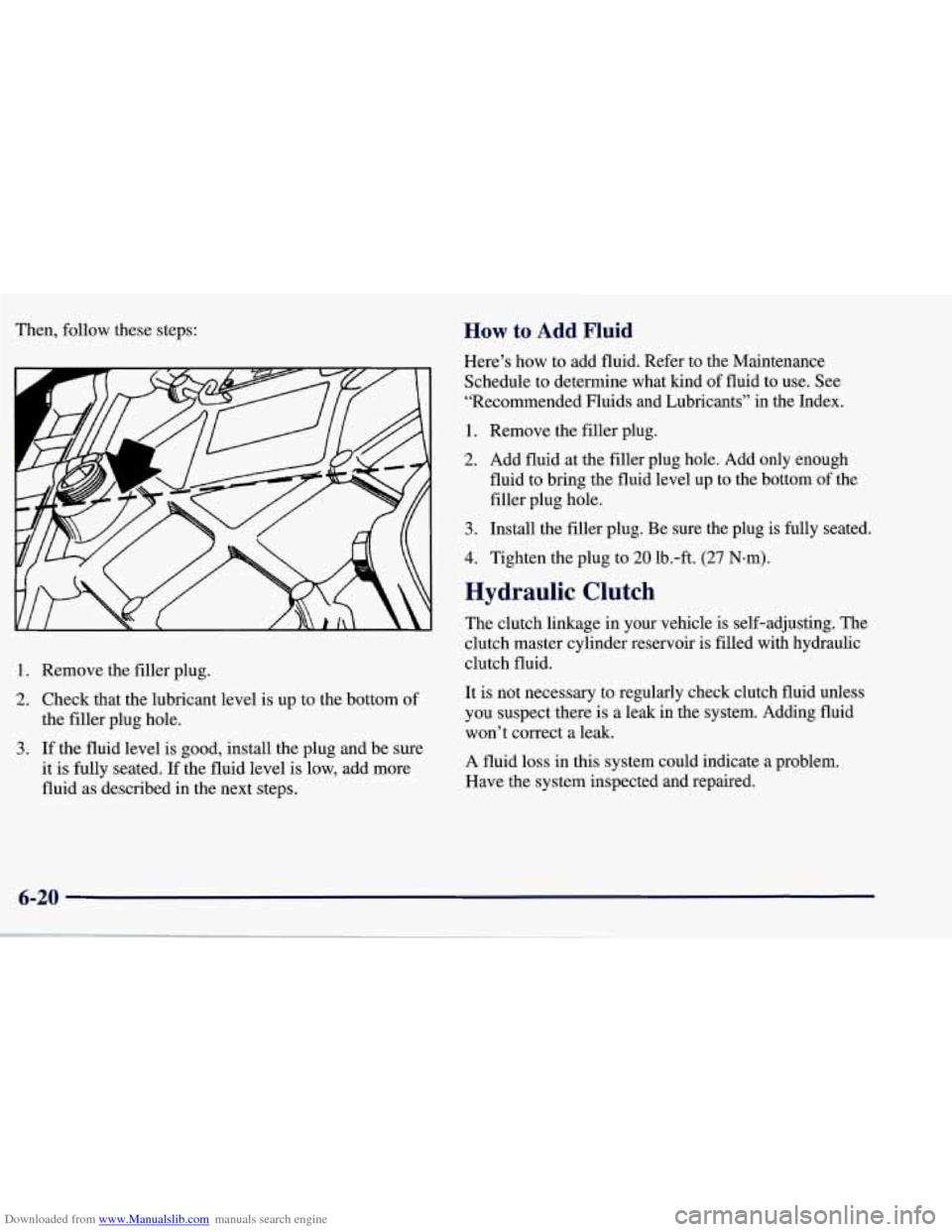
Downloaded from www.Manualslib.com manuals search engine Then, follow these steps:
4
1. Remove the filler plug.
2. Check that the lubricant level is up to the bottom of
the filler plug hole.
3. If the fluid level is good, install the plug and be sure
it is fully seated. If the fluid level is low, add more
fluid as described in the next steps.
How to Add Fluid
Here’s how to add fluid. Refer to the Maintenance
Schedule to determine what kind of fluid to use. See
“Recommended Fluids and Lubricants” in the Index.
1. Remove the filler plug.
2. Add fluid at the filler plug hole. Add only enough
fluid to bring the fluid level up to the bottom of the
filler plug hole.
3. Install the filler plug. Be sure the plug is fully seated.
4. Tighten the plug to 20 1b.-ft. (27 N-m).
Hydraulic Clutch
The clutch linkage in your vehicle is self-adjusting. The
clutch master cylinder reservoir is filled with hydraulic
clutch fluid.
It is not necessary to regularly check clutch fluid unless
you suspect there is a leak in the system. Adding fluid
won’t correct a leak.
A fluid loss in this system could indicate a problem.
Have the system inspected and repaired.
Page 266 of 378
Downloaded from www.Manualslib.com manuals search engine When to Check and What to Use
Refer to the Maintenance Schedule to determine how
often you should check the fluid level in your clutch
master cylinder reservoir and for the proper fluid. See
“Owner Checks and Services” and “Recommended
Fluids and Lubricants” in the Index.
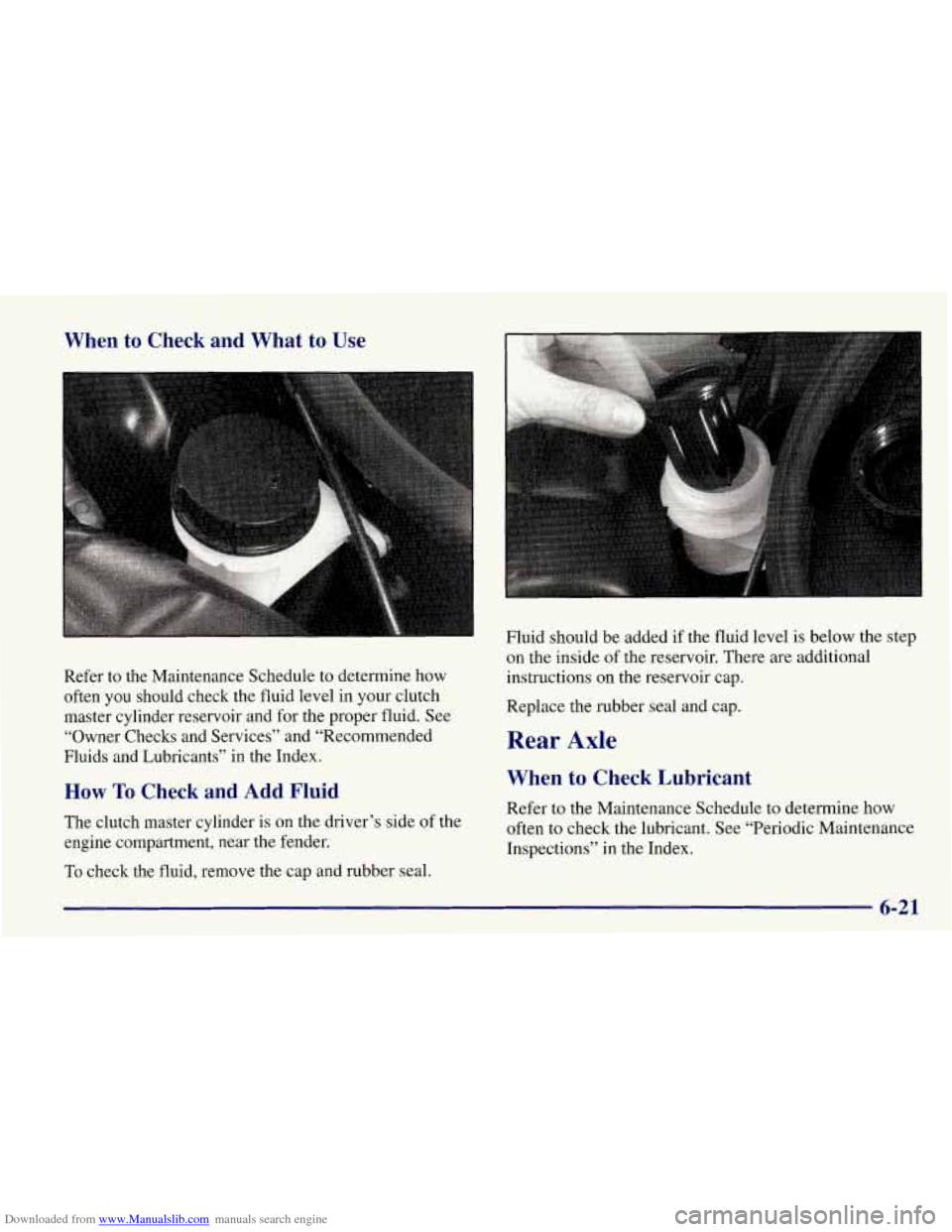
How To Check and Add Fluid
The clutch master cylinder is on the driver’s side of the
engine compartment, near the fender.
To check the fluid, remove the cap and rubber seal. Fluid should be
added
if the fluid level is below the step
on the inside of the reservoir. There are additional
instructions on the reservoir cap.
Replace the rubber seal and cap.
Rear Axle
When to Check Lubricant
Refer to the Maintenance Schedule to determine how
often
to check the lubricant. See “Periodic Maintenance
Inspections” in the Index.
6-21
Page 270 of 378
Downloaded from www.Manualslib.com manuals search engine Turning the surge tank pressure cap when the
engine and radiator are hot can allow steam and
i
scalding liquids to blow out and burn you badly.
Never turn the surge tank pressure cap
-- even a
little
-- when the engine and radiator are hot.
I
When your engine is cold, the coolant level should be at
the
FULL COLD mark. Don’t overfill the surge tank.
Too much coolant can result in an ovefflow when the
fluid is hot.
If the LOW COOLANT message comes on, it means
you’re low
on engine coolant.
Adding Coolant
If you need more coolant, add the proper DEX-COOL@
coolant mixture
at the surge tank, but only when the
engine is cool.
A CAUTION:
r
You can be burned if you spill coolant on hot
engine parts. Coolant contains ethylene glycol,
and
it will burn if the engine parts are hot
enough. Don’t spill coolant on a hot engine.
When replacing the pressure cap, make sure it is tight.
6-25
Page 271 of 378
Downloaded from www.Manualslib.com manuals search engine Surge Tank Pressure Cap
NOTICE:
The surge tank pressure cap is a 15 psi (105 kPa)
pressure-type cap and must be tightly installed to prevent coolant
loss and possible engine damage
from overheating.
When you replace the surge tank pressure cap, a GM cap
is recommended.
Thermostat
Engine coolant temperature is controlled by a thermostat
in the engine coolant system. The thermostat stops the
flow of coolant through the radiator until the coolant
reaches a pre-set temperature.
When you replace the thermostat, a GM thermostat
is recommended.
Power Steering Fluid
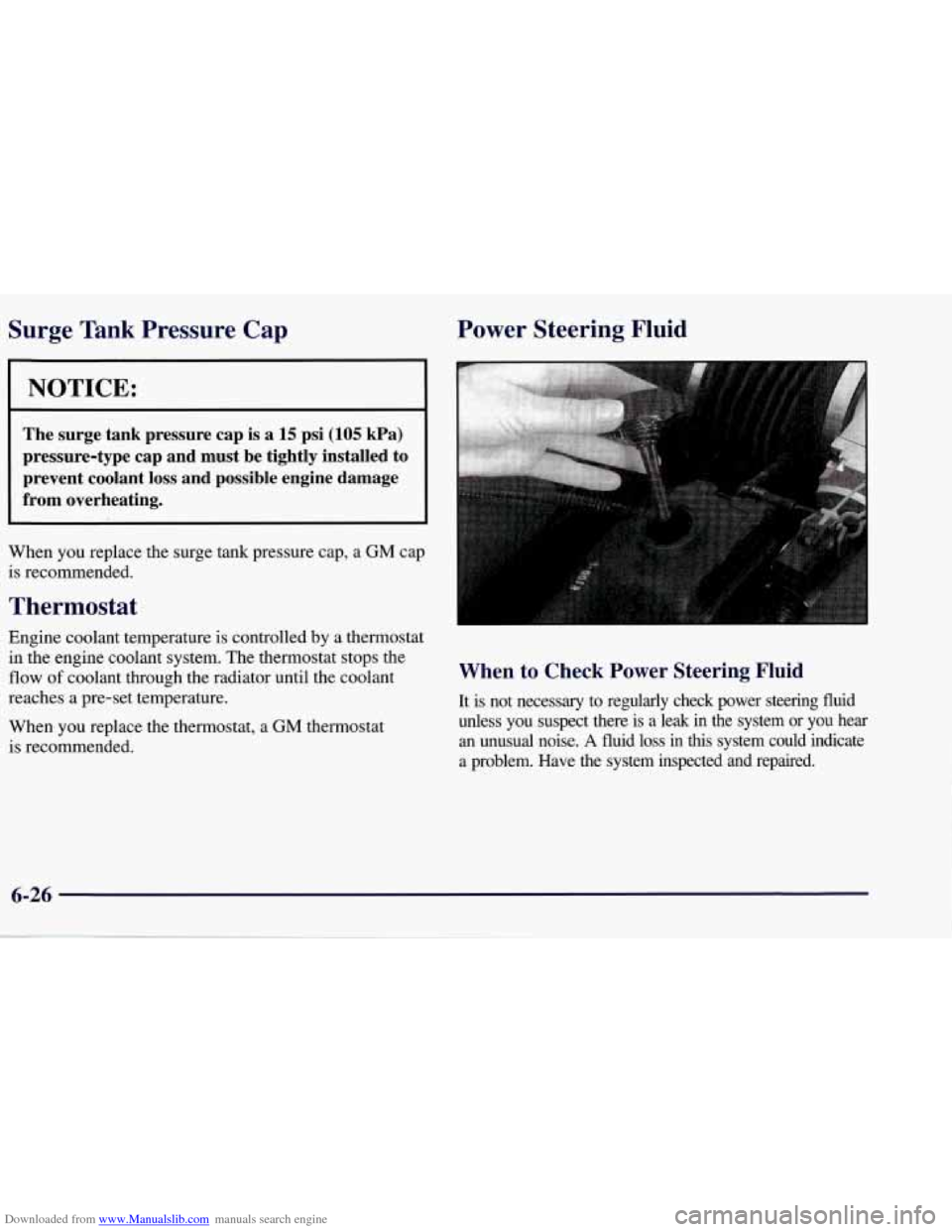
When to Check Power Steering Fluid
It is not necessary to regularly check power steering fluid
unless you suspect there is a leak
in the system or you hear
an unusual noise. A fluid loss in this system could indicate
a problem. Have the system inspected
and repaired.
Page 272 of 378
Downloaded from www.Manualslib.com manuals search engine How To Check Power Steering Fluid
When the engine compartment is cool, wipe the cap and
the top of the reservoir clean, then unscrew the cap and
wipe the dipstick with a clean rag. Replace the cap and
completely tighten it. Then remove the cap again and
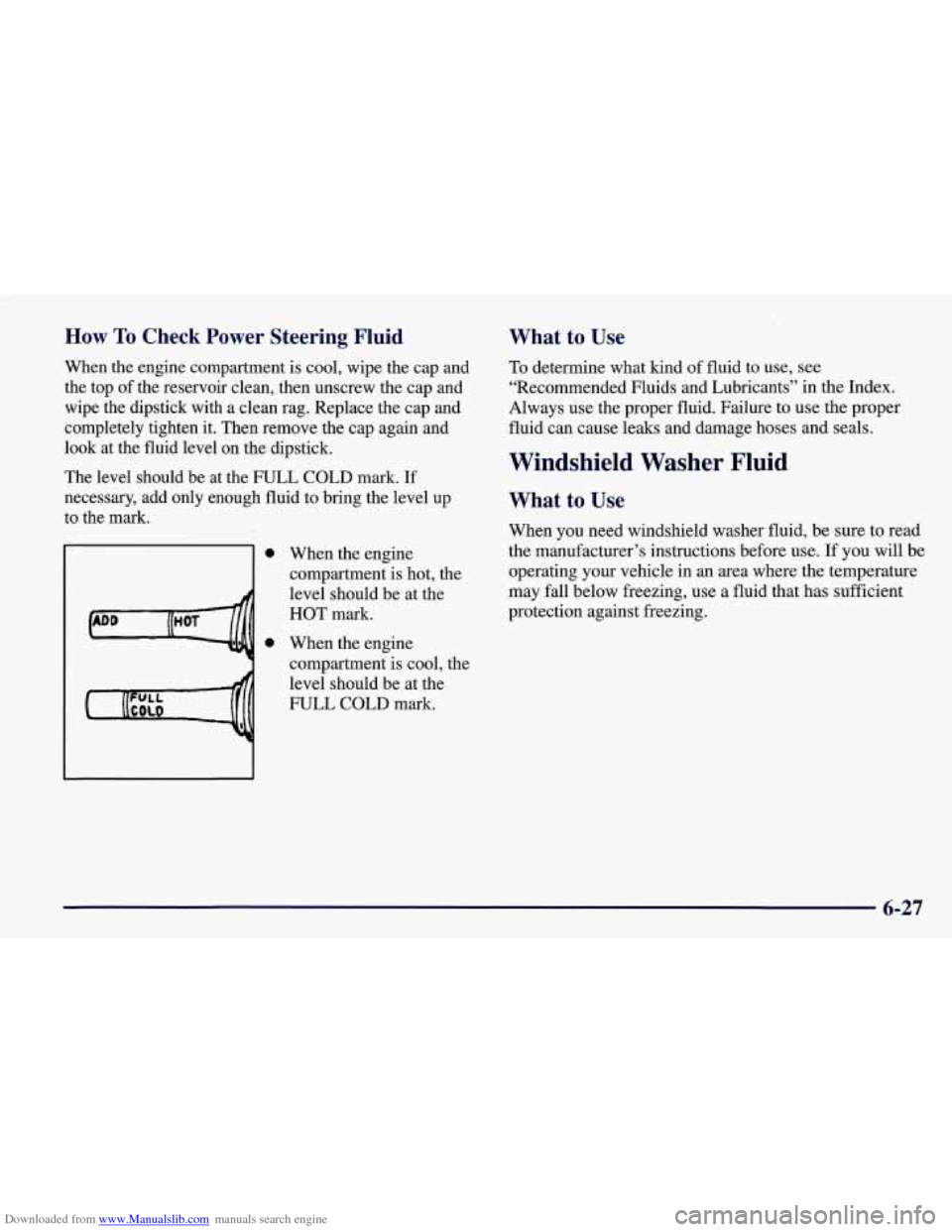
look at the fluid level on the dipstick.
The level should be at the FULL COLD mark. If
necessary, add only enough fluid to bring the level up
to the mark.
0 When the engine
compartment is hot, the
level should be at the
HOT mark.
When the engine compartment is cool, the
level should be at the
FULL COLD mark.
What to Use
To determine what kind of fluid to use, see
“Recommended Fluids and Lubricants” in the Index.
Always use the proper fluid. Failure to use the proper
fluid can cause leaks and damage hoses and seals.
Windshield Washer Fluid
What to Use
When you need windshield washer fluid, be sure to read
the manufacturer’s instructions before use. If you will be
operating your vehicle in
an area where the temperature
may fall below freezing, use a fluid that has sufficient
protection against freezing.
6-27