Page 282 of 400
Downloaded from www.Manualslib.com manuals search engine How to Add Fluid
Here’s how to add fluid. Refer to the Maintenance Schedule to determine what kind
of fluid to use. See
“Recommended Fluids and Lubricants” in the Index.
1. Remove the dipstick by flipping the handle up and
2. Add fluid at the dipstick hole. then pulling the dipstick out.
Add only enough fluid to bring the fluid level up to
the FULL mark on the dipstick.
handle down to lock the dipstick in place.
3. Push the dipstick back in all the way; then flip the
Hydraulic Clutch
The hydraulic clutch linkage in your vehicle is
self-adjusting. The clutch master cylinder reservoir is
filled with hydraulic clutch fluid.
It isn’t a good idea to “top off’ your clutch fluid. Adding
fluid won’t correct a leak.
A fluid loss in this system could indicate a problem.
Have the system inspected and repaired.
When to Check and What to Use
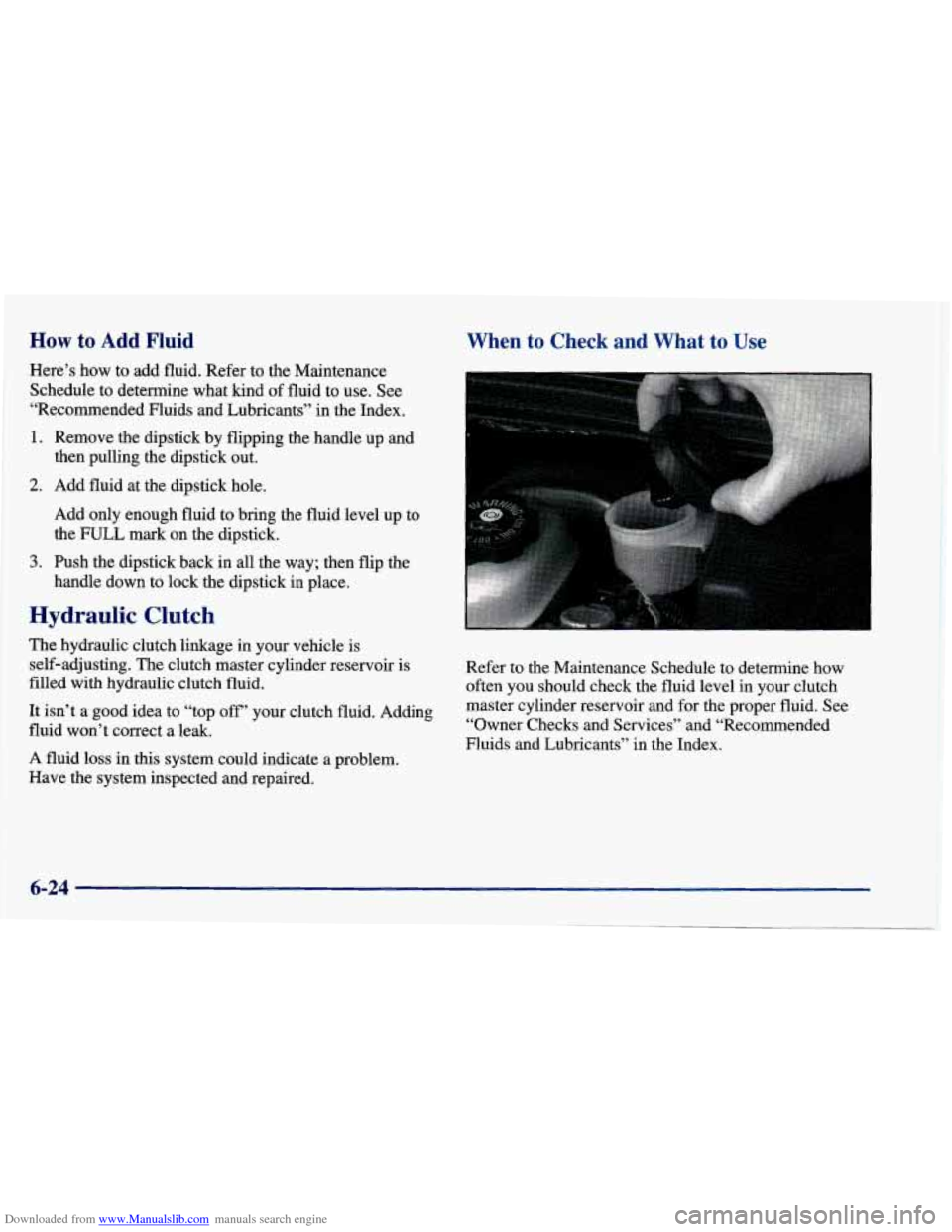
Refer to the Maintenance Schedule to determine how
often you should check the fluid level in your clutch
master cylinder reservoir and for the proper fluid. See
“Owner Checks and Services” and “Recommended
Fluids and Lubricants” in the Index.
6-24
Page 283 of 400
Downloaded from www.Manualslib.com manuals search engine How to Check
You do not need to check the fluid level unless you
suspect a clutch problem.
To check the fluid level, take
the cap
off. If the fluid reaches the step inside the
reservoir, the fluid level is correct.
Engine Coolant
The cooling s stem in your vehicle is filled with
DEX-COOL
8 engine coolant. This coolant is designed
to remain in your vehicle for
5 years or 150,000 miles
(240 000 km) whichever occurs first, if you add only
DEX-COOL’ extended life coolant.
The following explains your cooling system and how
to add coolant when it is low. If you have a problem
with engine overheating, see “Engine Overheating” in
the Index.
A 50/50 mixture of water and DEX-COOL@
coolant will:
Give freezing protection down to -34°F (-37°C).
Give boiling protection up to 265 “F (129°C).
Protect against rust and corrosion.
Help keep the proper engine temperature.
Let the warning lights and gages work as
they should.
NOTICE:
When adding coolant, it is important that you
use only
DEX-COOL@ (silicate-free) coolant.
If coolant other than DEX-COOL is added to
the system, premature engine, heater core or
radiator corrosion may result. In addition, the
engine coolant will require change sooner
-- at
30,000 miles (50 000 km) or 24 months,
whichever occurs first. Damage caused by the
use of coolant other than DEX-COOL@ is not
covered by your new vehicle warranty.
6-25
Page 284 of 400
Downloaded from www.Manualslib.com manuals search engine What to Use
Use a mixture of one-half clean water (preferably
distilled) and one-half
DEX-COOL@ coolant which
won’t damage aluminum parts.
If you use this mixture,
you don’t need to add anything else.
Adding only plain water to your cooling system
can be dangerous. Plain water,
or some other
liquid like alcohol, can boil before the proper
coolant mixture will. Your vehicle’s coolant
warning system is set for the proper coolant
mixture. With plain water or the wrong mixture,
your engine could get too hot but you wouldn’t
get the overheat warning. Your engine could
catch fire and you or others could be burned.
Use
a 50/50 mixture of clean water and
DEX-COOL@ coolant.
NOTICE:
If you use an improper coolant mixture, your
engine could overheat and be badly damaged.
The repair cost wouldn’t be covered by your
warranty.
Too much water in the mixture can
freeze and crack the engine, radiator, heater core
and other parts.
If you have to add coolant more than four times a year,
have your dealer check your cooling system.
NOTICE:
If you use the proper coolant, you don’t have to
add extra inhibitors or additives which claim to
improve the system. These can be harmful.
6-26
Page 285 of 400
Downloaded from www.Manualslib.com manuals search engine Checking Coolant
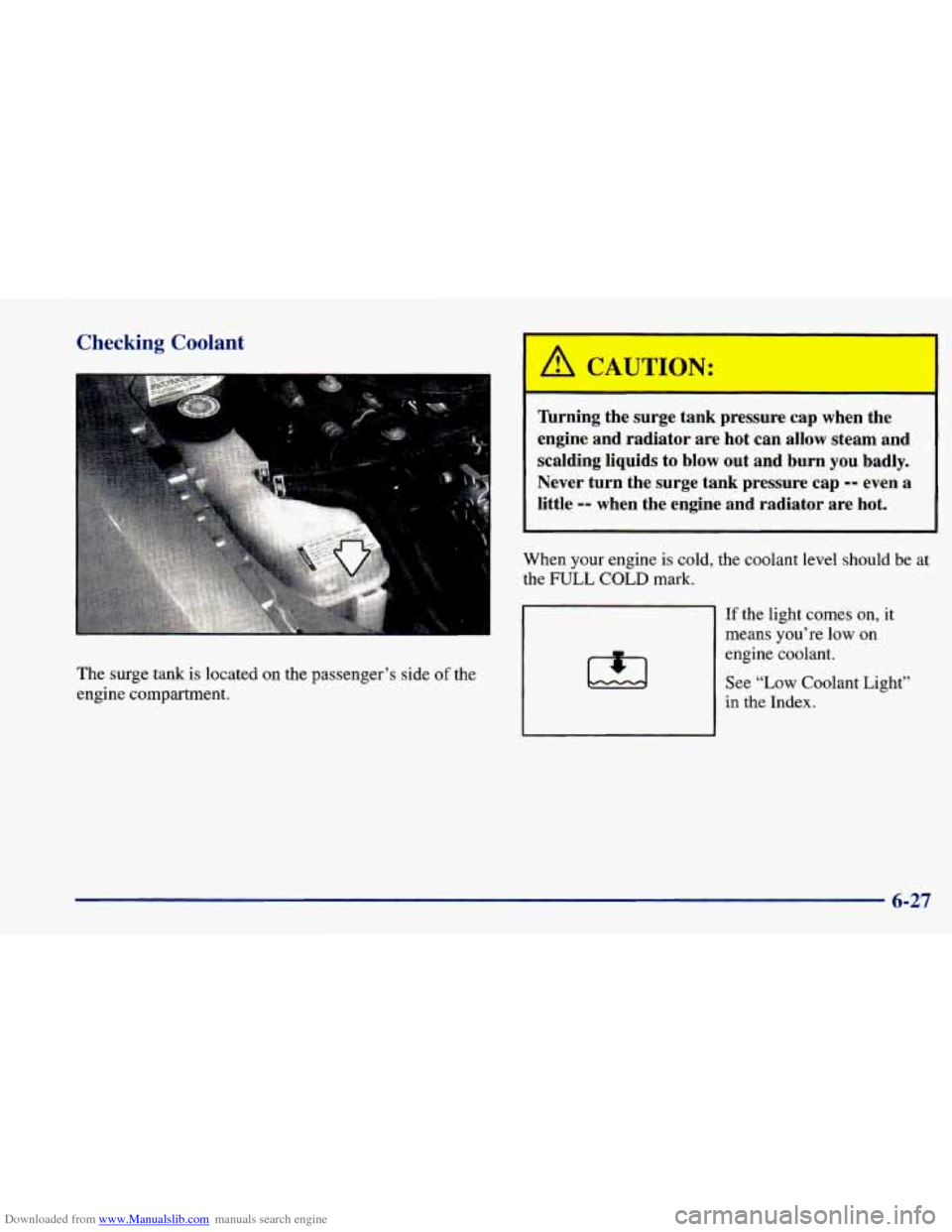
The surge tank is located on the passenger’s side of the
engine compartment.
A CAUTION:
Thrning the surge tank pressure cap when the
engine and radiator are hot can allow steam and
scalding liquids to blow out and burn you badly.
Never turn the surge tank pressure cap
-- even a
little
-- when the engine and radiator are hot.
When your engine is cold, the coolant level should be at
the FULL
COLD mark.
If the light comes on, it
means you’re low
on
engine coolant.
See “Low Coolant Light”
in the Index.
6-27
Page 287 of 400
Downloaded from www.Manualslib.com manuals search engine Power Steering Fluid
When to Check Power Steering Fluid
It is not necessary to regularly check power steering
fluid unless
you suspect there is a leak in the system or
you hear an unusual noise. A fluid loss in this system
could indicate a problem. Have the system inspected
and repaired.
How To Check Power Steering Fluid
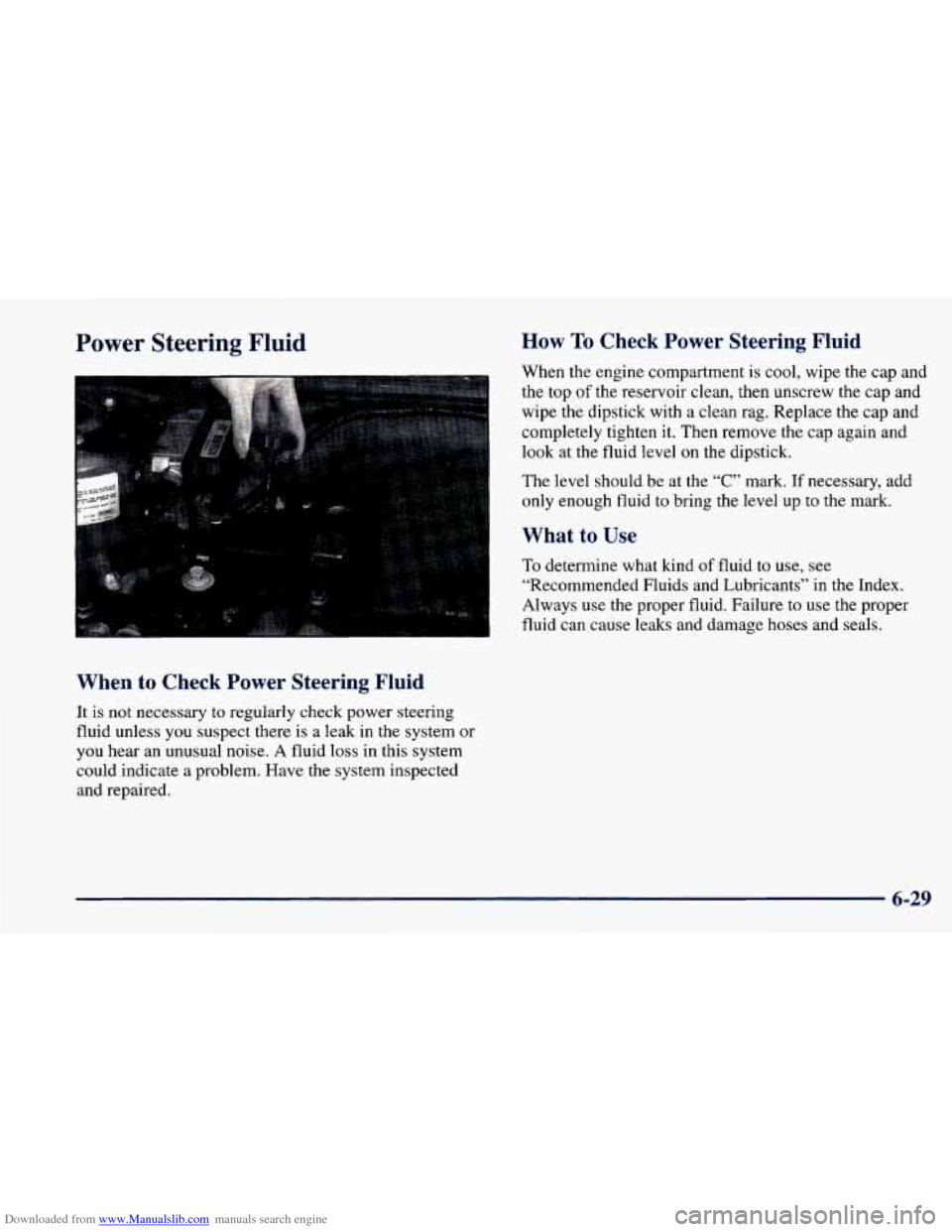
When the engine compartment is cool, wipe the cap and
the top
of the reservoir clean, then unscrew the cap and
wipe the dipstick with a clean rag. Replace the cap and
completely tighten it. Then remove the cap again and
look at the fluid level
on the dipstick.
The level should be at the
“C” mark. If necessary, add
only enough fluid to bring the level up
to the mark.
What to Use
To determine what kind of fluid to use, see
“Recommended Fluids and Lubricants” in the Index.
Always
use the proper fluid. Failure to use the proper
fluid can cause leaks and damage hoses and seals.
6-29
Page 298 of 400
Downloaded from www.Manualslib.com manuals search engine Windshield Wiper Blade Replacement Tires
Your new vehicle comes with high-quality tires made by
a leading tire manufacturer. If you ever have questions
about your tire warranty and where to obtain service, see
your Chevrolet Warranty booklet for details.
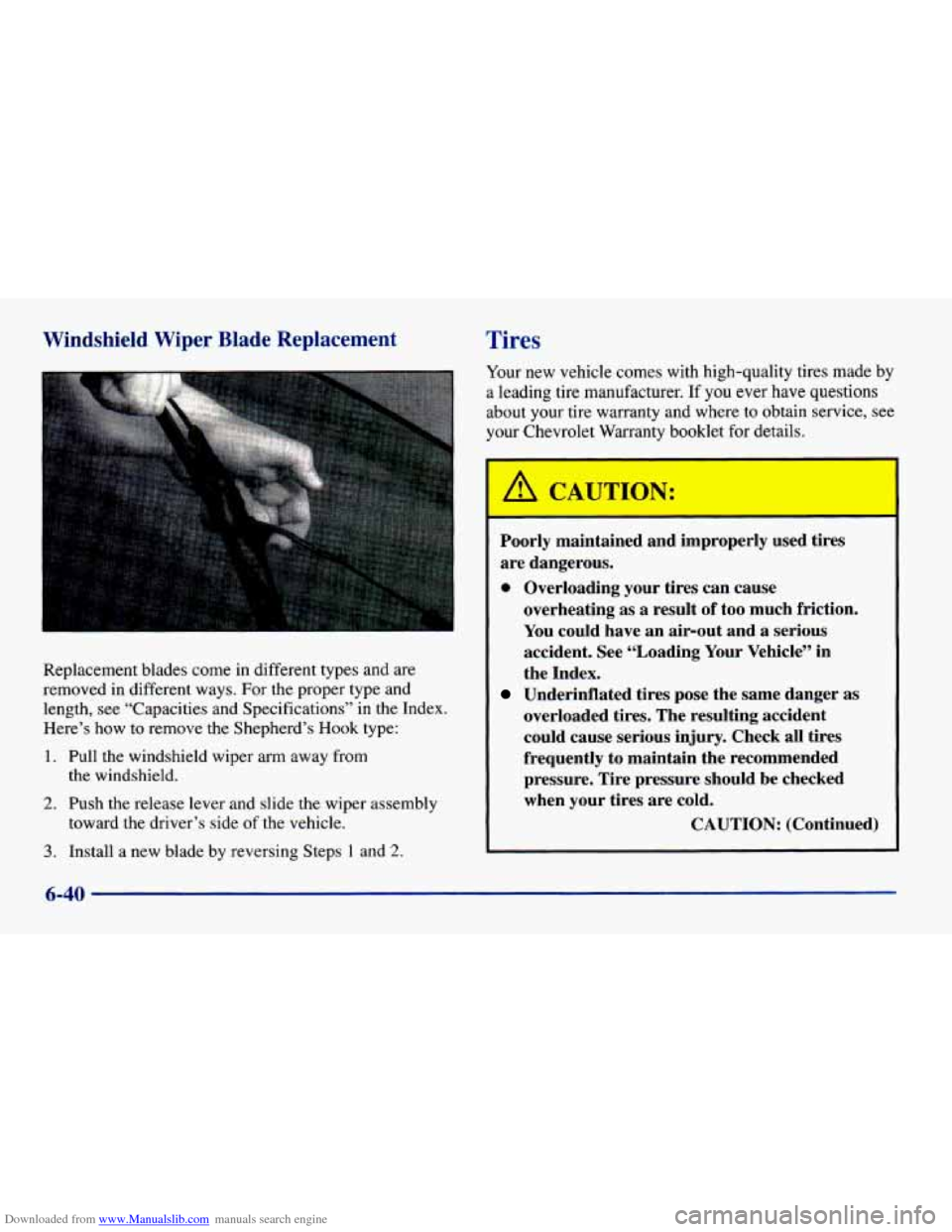
Replacement blades come in different types and are
removed in different ways. For the proper type and
length, see “Capacities and Specifications” in the Index.
Here’s how to remove the Shepherd’s
Hook type:
1. Pull the windshield wiper arm away from
2. Push the release lever and slide the wiper assembly
the
windshield.
toward the driver’s side
of the vehicle.
3. Install a new blade by reversing Steps 1 and 2.
Poorly maintained and improperly used tires
are dangerous.
0 Overloading your tires can cause
overheating as a result
of too much friction.
You could have an air-out and a serious
accident. See (‘Loading Your Vehicle” in
the Index.
Underinflated tires pose the same danger as
overloaded tires. The resulting accident
could cause serious injury. Check all tires
frequently to maintain the recommended
pressure. Tire pressure should be checked
when your tires are cold.
CAUTION: (Continued)
6-40
Page 300 of 400
Downloaded from www.Manualslib.com manuals search engine When to Check
Check your tires once a month or more.
Don’t forget your compact spare tire. It should be at
60 psi (420 kPa). The purpose
of regular rotation is to achieve more
uniform wear for all tires on the vehicle. The first
rotation is the most important. See “Scheduled
Maintenance Services”
in the Index for scheduled
rotation intervals.
How to Check
Use a good quality pocket-type gage to check tire
pressure. You can’t tell if your tires are properly inflated
simply by looking at them. Radial tires may look
properly inflated even when they’re underinflated.
Be sure to put the valve caps back on the valve stems.
They help prevent leaks by keeping out
dirt and moisture.
Tire Inspection and Rotation
Tires should be rotated every 6,000 to 8,000 miles
( 10 000 to 13 000 km). Any time you notice unusual
wear, rotate your tires
as soon as possible and check
wheel alignment. Also check for damaged tires or
wheels. See “When It’s Time for New Tires” and
“Wheel Replacement” later in this section for
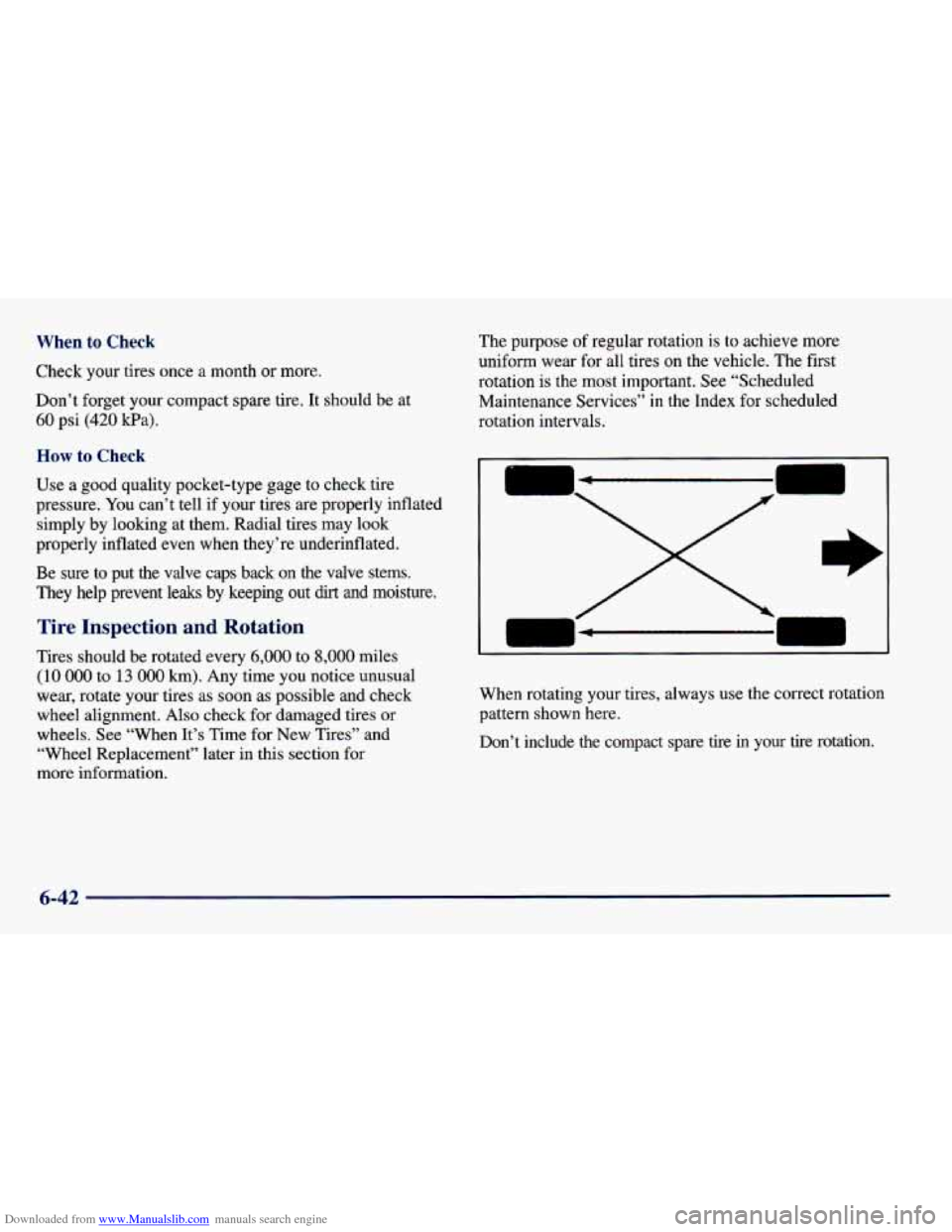
more information. When rotating your tires, always use the correct rotation
pattern shown here.
Don’t include the compact
spare tire in your tire rotation.
6-42
Page 301 of 400
Downloaded from www.Manualslib.com manuals search engine After the tires have been rotated, adjust the front and
rear inflation pressures as shown on the Tire-Loading Information label. Make certain that all wheel nuts are
properly tightened. See “Wheel Nut Torque”
in
the Index.
Rust or dirt on a wheel, or on the parts to which
it is fastened, can make wheel nuts become loose
after a time. The wheel could come
off and cause
an accident. When you change a wheel, remove
’ any rust or dirt from places where the wheel
1 attaches to the vehicle. In an emergency, you can
use a cloth or a paper towel to do this; but be
~ sure to use a scraper or wire brush later, if you
1 need to, to get all the rust or dirt off. (See
“Changing a
Flat Tire” in the Index.) When It’s Time
for
New Tires
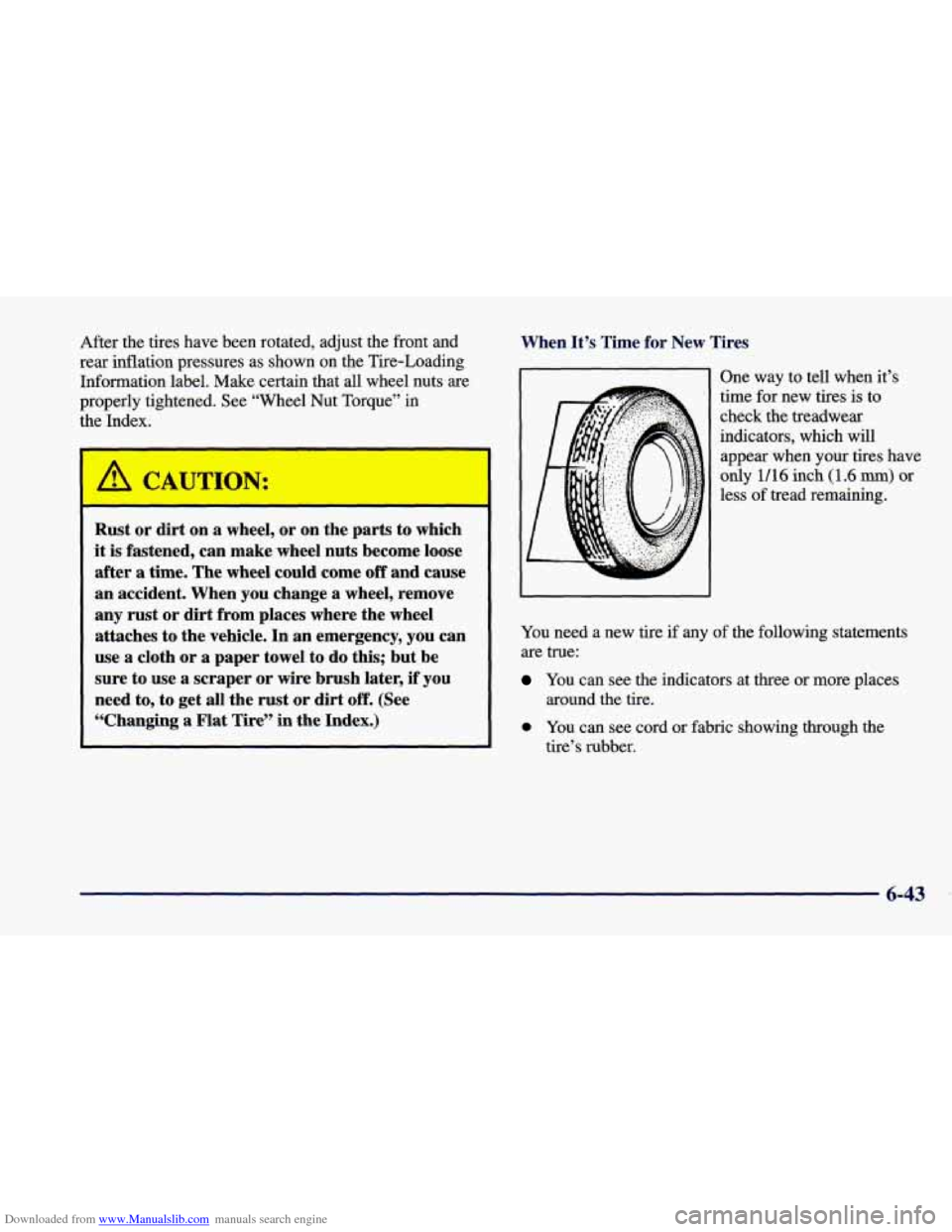
One way to tell when it’s
time for new tires is to
check
the treadwear
indicators, which will appear when your tires have
only
1/16 inch (1.6 mm) or
less of tread remaining.
You need a new tire if any of the following statements
are true:
You can see the indicators at three or more places
around the tire.
0 You can see cord or fabric showing through the
tire’s rubber.