1998 CHEVROLET CAVALIER seats
[x] Cancel search: seatsPage 61 of 400
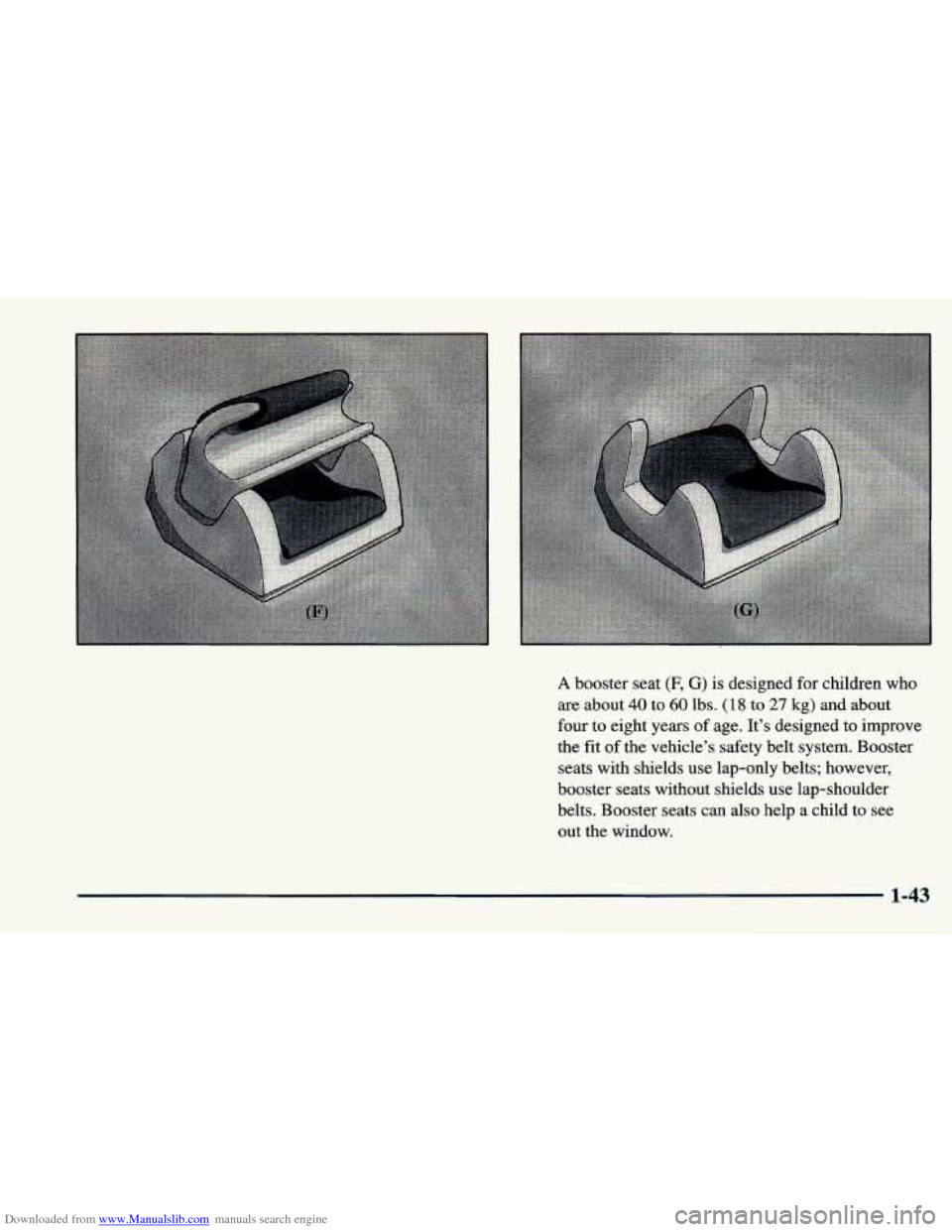
Downloaded from www.Manualslib.com manuals search engine A booster seat (F, G) is designed for children who
are about 40 to 60 lbs. (18 to 27 kg) and about
four to eight years
of age. It’s designed to improve
the fit of the vehicle’s safety belt system. Booster
seats with shields use lap-only belts; however,
booster seats without shields use lap-shoulder
belts. Booster seats can also help a child to see
out the window.
1-43
Page 68 of 400
Downloaded from www.Manualslib.com manuals search engine Securing a Child Restraint in the Right
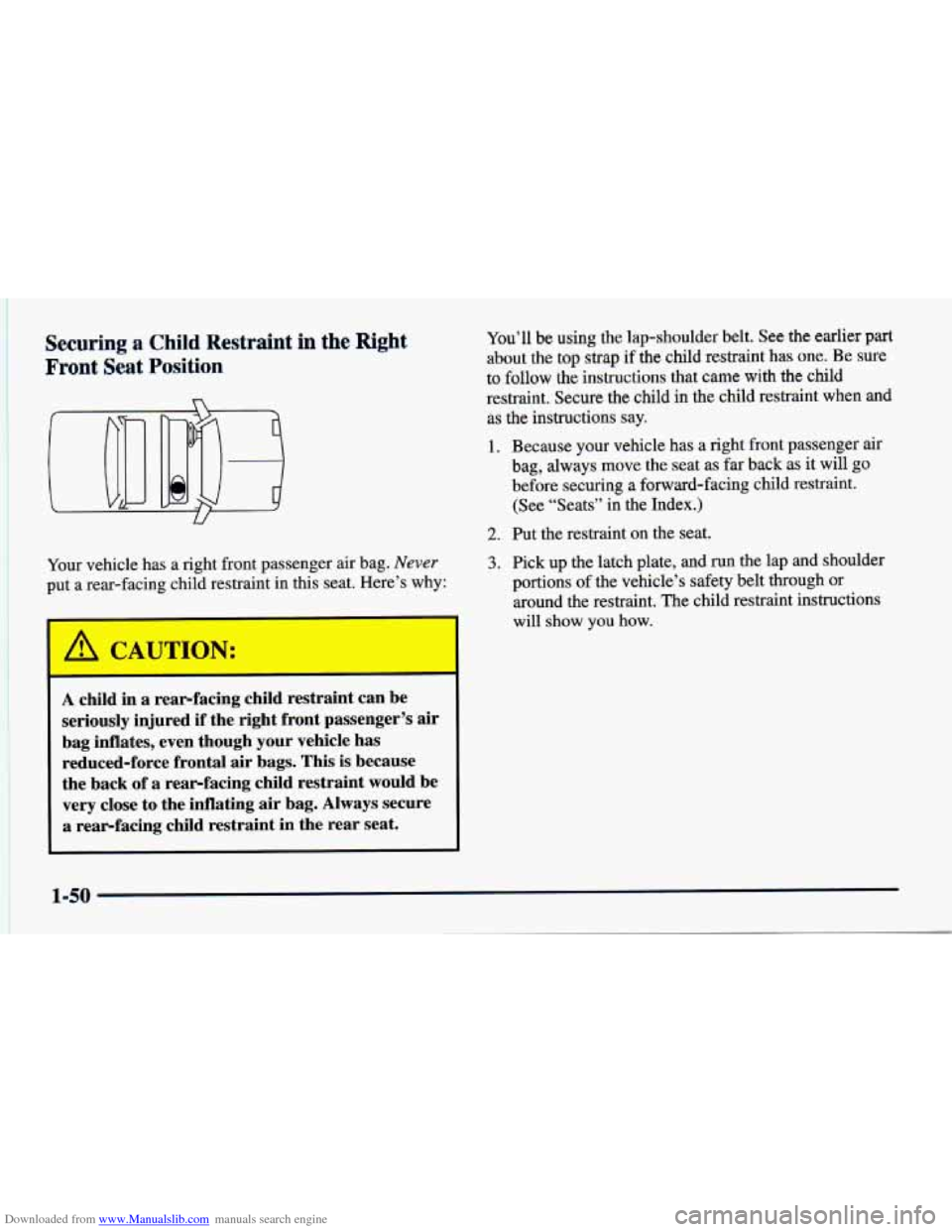
Front Seat Position
Your vehicle has a right front passenger air bag. Never
put a rear-facing child restraint in this seat. Here’s why: \
I
A CAUTION:
A child in a rear-facing child restraint can be
seriously injured if the right front passenger’s air
bag inflates, even though your vehicle has reduced-force frontal
air bags. This is because
the back
of a rearfacing child restraint would be
very close to the inflating air bag. Always secure
a rearfacing child restraint in the rear seat.
You’ll be using the lap-shoulder belt. See the earlier part
about the top strap if the child restraint has one. Be sure
to follow the instructions that came with the child
restraint. Secure the child in the child restraint when
and
as the instructions say.
1. Because your vehicle has a right front passenger air
bag, always move the seat as far back as it will go
before securing a forward-facing child restraint.
(See “Seats”
in the Index.)
2. Put the restraint on the seat.
3. Pick up the latch plate, and run the lap and shoulder
portions of the vehicle’s safety belt through or
around the restraint. The child restraint instructions
will show you how.
Page 95 of 400
Downloaded from www.Manualslib.com manuals search engine To Use the Engine Coolant Heater
1. Turn off the engine.
2. Open the hood and unwrap the electrical cord. On
vehicles
with a 2.2L engine, the electrical cord is
located near the engine oil dipstick.
On vehicles
with a
2.4L engine, the electrical cord is located in
front of the engine coolant surge tank on the
passenger’s side.
3. Plug it into a normal, grounded 1 10-volt AC outlet.
Pluggmg me cord into an ungrounded outlet
could cause an electrical shock. Also, the wrong
kind of extension cord could overheat and cause
a fire. You could be seriously injured. Plug the
cord into a properly grounded three-prong 110-volt AC outlet. If the cord won’t reach, use a
heavy-duty three-prong extension cord rated for
at least
15 amps.
4. Before starting the engine, be sure to unplug
and store the cord as it was before to keep it away
from moving engine parts. If you don’t, it could
be damaged.
How long should you keep the coolant heater plugged
in? The answer depends
on the outside temperature, the
kind
of oil you have, and some other things. Instead of
trying to list everything here, we ask that you contact
your dealer in the area where you’ll be parking your
vehicle. The dealer can give you
the best advice for that
particular area.
Automatic Transaxle Operation
Your vehicle may be equipped with a three-speed
automatic or a four-speed automatic transaxle. The shift
lever is located on the console between the seats.
There are six different positions for the shift lever on
the three-speed automatic and seven positions for the
four-speed automatic transaxles. While PARK
(P),
REVERSE (R) and NEUTRAL (N) operate identically
for both transaxles, the forward gear positions represent
different gearing and operation. See “Forward Gears
(3-Speed)” or “Forward Gears (4-Speed)” later
in this section.
2-19
Page 102 of 400
Downloaded from www.Manualslib.com manuals search engine Up Shift Light (Manual Transaxle)
I SHIFT 1
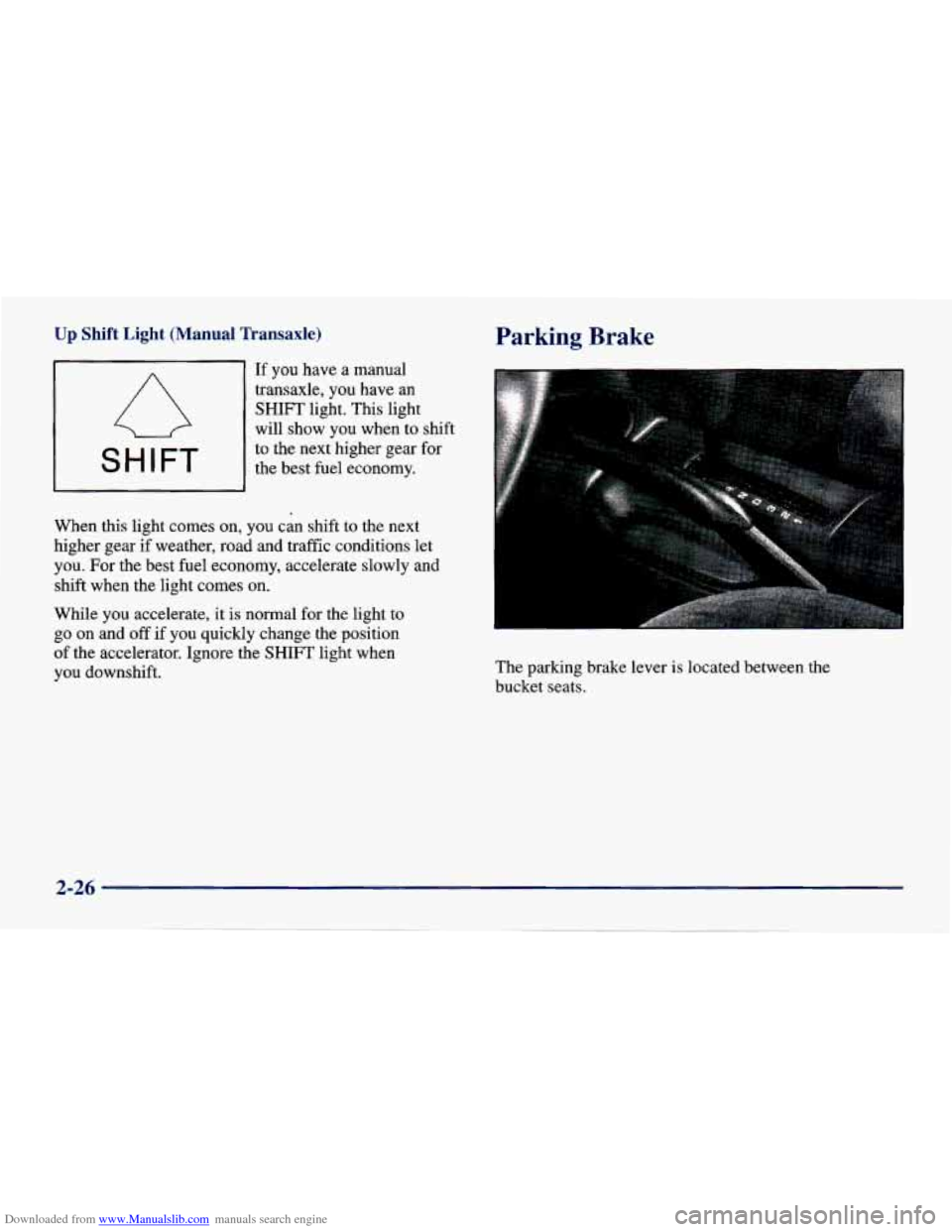
If you have a manual
transaxle, you
have an
SHIFT light. This light
will show you when to shift
to the next higher gear for
the best fuel economy.
When this light comes on, you can shift to the next
higher gear if weather, road and traffic conditions let
you. For the best fuel economy, accelerate slowly and
shift when the light comes on.
While you accelerate, it i! ~ ormal for the light to
go
on and off if you quickly change the position
of the accelerator. Ignore the SHIFT light when
you downshift.
Parking Brake
The parking brake lever is located between the
bucket seats.
Page 131 of 400
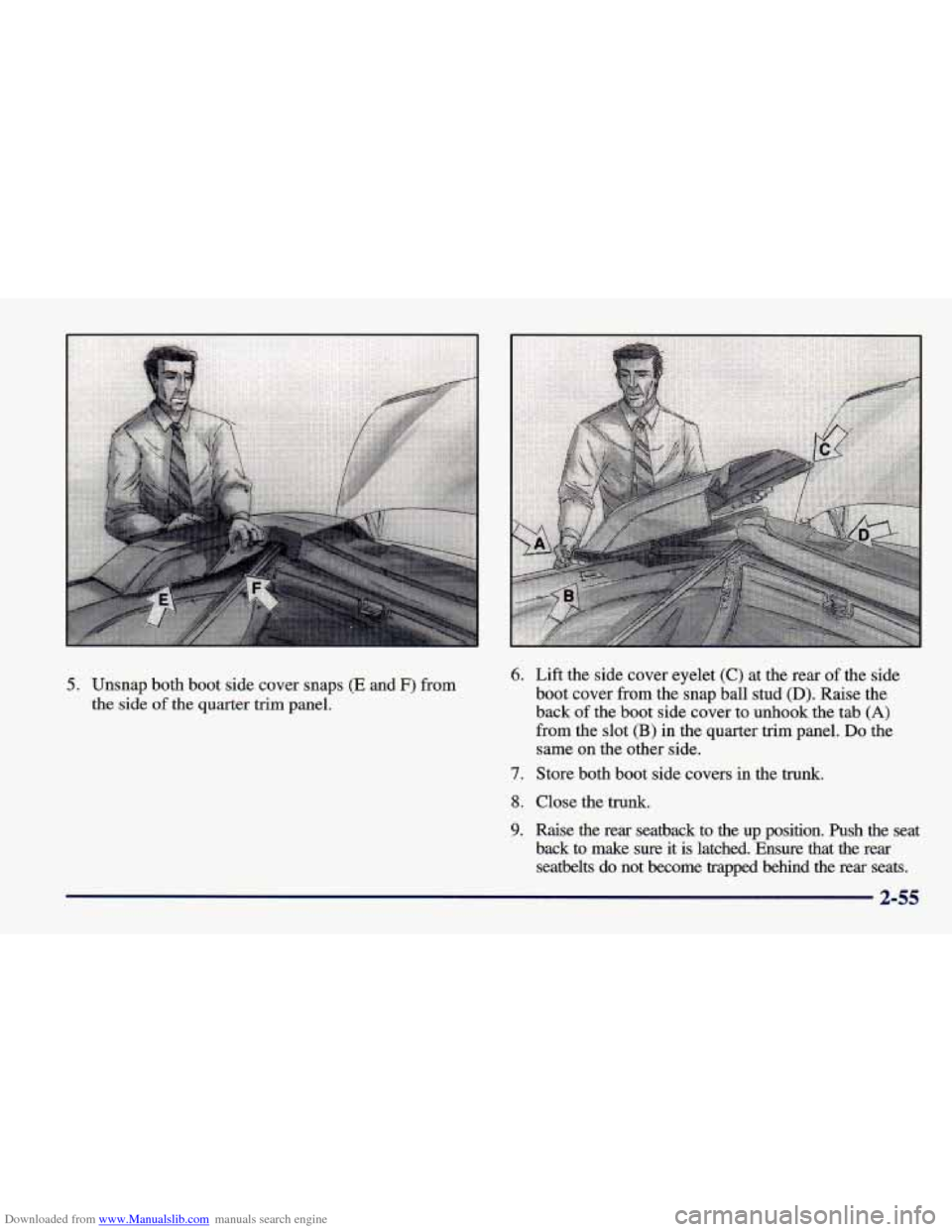
Downloaded from www.Manualslib.com manuals search engine 5. Unsnap both boot side cover snaps (E and F) from
the side of the quarter trim panel.
6. Lift the side cover eyelet (C) at the rear of the side
boot cover from the snap ball stud
(D). Raise the
back of the boot side cover to unhook the tab
(A)
from the slot (B) in the quarter trim panel. Do the
same on the other side.
7. Store both boot side covers in the trunk.
8. Close the trunk.
9. Raise the rear seatback to the up position. Push the seat
back to make sure it is latched. Ensure that the rear
seatbelts do not become trapped behind the rear seats.
2-55
Page 159 of 400
Downloaded from www.Manualslib.com manuals search engine Heating
On cold days, use FLOOR with the temperature knob all
the way in the red area. The system will bring in outside
air, heat it and send it to the floor ducts.
Your vehicle has heat ducts that are directed toward
the rear seat. Keep the area under the front seats clear
of obstructions
so the heated air can reach the rear
seat passengers.
If your vehicle has an engine coolant heater, you can use
it to help your system provide warm air faster when it’s
cold outside
(0°F (-18°C) or lower). An engine coolant
heater warms the coolant your engine and heating
system use to provide heat. See “Engine Coolant
Heater” in the Index.
Ventilation System
For mild outside temperatures when little heating or
cooling
is needed, use VENT to direct outside air
through your vehicle. Your vehicle also has
the
flow-through ventilation system described later in
this section.
Your vehicle’s flow-through ventilation system supplies
outside
air into the vehicle when it is moving. Outside
air will also enter the vehicle when the air conditioning
fan is running. Ventilation
Tips
Keep the hood and
front air inlet free of ice, snow or
any other obstruction, such as leaves. The heater and
defroster will work far better, reducing the chance of
fogging the inside of your windows.
When you enter a vehicle in cold weather, adjust the
mode knob to
FLOOR and the fan to the highest
speed for a few moments before driving
off. This
helps clear the intake ducts of snow and moisture
and reduces the chance
of fogging the inside of
your windows.
Keep the air path under the front seats clear of
objects. This helps air circulate throughout
your vehicle.
3-5
Page 212 of 400
Downloaded from www.Manualslib.com manuals search engine A CAUTION:
Do not load your vehicle any heavier than the
GVWR, or either the maximum front or rear
GAWR.
If you do, parts on your vehicle can
break, or it can change the
way your vehicle
handles. These could cause you to lose control.
Also, overloading can shorten the life of
your vehicle.
If you put things inside your vehicle -- like suitcases,
tools, packages,
or anything else -- they will go as fast
as the vehicle goes. If you have to stop or turn quickly,
or if there is a crash, they’ll keep going.
Things you put inside your vehicle can strike and
injure people in a sudden stop or turn, or in a crash.
0
0
Put things in the trunk or rear area of your
vehicle. In a trunk, put them
as far forward
as you can. Try to spread the weight evenly.
If you have fold-down rear seats, you’ll find
four anchors on the back
wall of your trunk.
You
can use these anchors to tie down lighter
loads. They’re not strong enough
for heavy
things, however,
so put them as far forward
as you can in the trunk or rear area.
Never stack heavier things, like suitcases,
inside the vehicle
so that some of them are
above the tops of the seats.
Don’t leave an unsecured child restraint in
your vehicle.
When you carry something inside the
vehicle, secure
it whenever you can.
Don’t leave a seat folded down unless you
need to.
4-32
Page 391 of 400
Downloaded from www.Manualslib.com manuals search engine Replacement Bulbs
...................................... 6-63
Parts
....................................... 6-64
Wheel
...................................... 6-46
Replacing Safety Belts
........................... 1-55
Reporting Safety Defects
......................... 8-10
Restraints Checking
................................... 1-55
Child
....................................... 1-40
Head
........................................ 1-5
Replacing Parts After a Crash
................... 1-55
Reverse. Automatic Transaxle
..................... 2-2 1
Reverse. Manual Transaxle
....................... 2-25
Right Front Passenger Position
.................... 1-23
Roadside Assistance
.............................. 8-5
Roadside Assistance. Canadian
..................... 8-7
Rocking Your Vehicle
........................... 5-34
Rotation. Tires
................................. 6-42
Systemcheck
................................ 7-31
Safety Belt Extender
............................ 1-55
Safety Belts
.................................... 1-8
Adults
...................................... 1-13
Care
....................................... 6-51
Center Rear Passenger Position
.................. 1-36
Children
.................................... 1-37
DriverPosition
............................... 1-14
Extender
.................................... 1-55
How to Wear Properly ......................... 1-13
Incorrect Usage
.................... 1-18, 1-53, 1-54 LapBelt
.................................... 1-36
Lap-Shoulder
........................... 1.14. 1.30
Larger Children
.............................. 1-52
Passenger Position
.................. 1.23. 1.30. 1.36
Questions and Answers
........................ 1-12
Rear Comfort Guides
.......................... 1-33
Rear Seat Outside Passenger Positions
............ 1-30
Rear Seat Passengers
.......................... 1-30
Reminder Light
.......................... 1-8. 2-66
Replacing After a Crash
........................ 1-55
Right Front Passenger Position
.................. 1-23
Shoulder Belt Height Adjuster
................... 1-17
Smaller Children and Babies
.................... 1-37
WhyTheyWork
............................... 1-9
Safety Chains
.................................. 4-36
Safety Defects. Reporting
........................ 8-10
Safety Warnings and Symbols
....................... vi
Scheduled Maintenance Services
.................... 7-4
Seatback
Latches
...................................... 1-5
Reclining Front
............................... 1-4
Easy Entry
................................... 1-6
ManualFront
................................. 1-2
Rear
........................................ 1-7
Restraint Systems
.............................. 1-1
Seat Controls
................................. 1-2
Securing
a Child Restraint ............ 1-45. 1-48. 1-50
Second Gear. Automatic Transaxle ............ 2-22. 2-23
Use During Pregnancy
......................... 1-22
Seats Manual Lumbar Support
........................ 1-3
9-9