Downloaded from www.Manualslib.com manuals search engine Fuses and Circuit Breakers
The wiring circuits in your vehicle are protected from
short circuits by a combination of fuses, circuit breakers
and fusible thermal links. This greatly reduces the
chance of damage caused by electrical problems.
Look at the silver-colored band inside the fuse. If the
band is broken or melted, replace the fuse.
Be sure you
replace a bad fuse with a new one of the identical size
and rating.
If you ever have a problem on the road and don’t have a
spare fuse, you can borrow one that has the same
amperage. Just pick some feature of your vehicle that
you can get along without
-- like the radio or cigarette
lighter
-- and use its fuse if it is the correct amperage.
Replace it as soon
as you can.
There are two fuse blocks in your vehicle: the
instrument panel
fuse block and the engine compartment
fuse block.
Instrument Panel Fuse Block
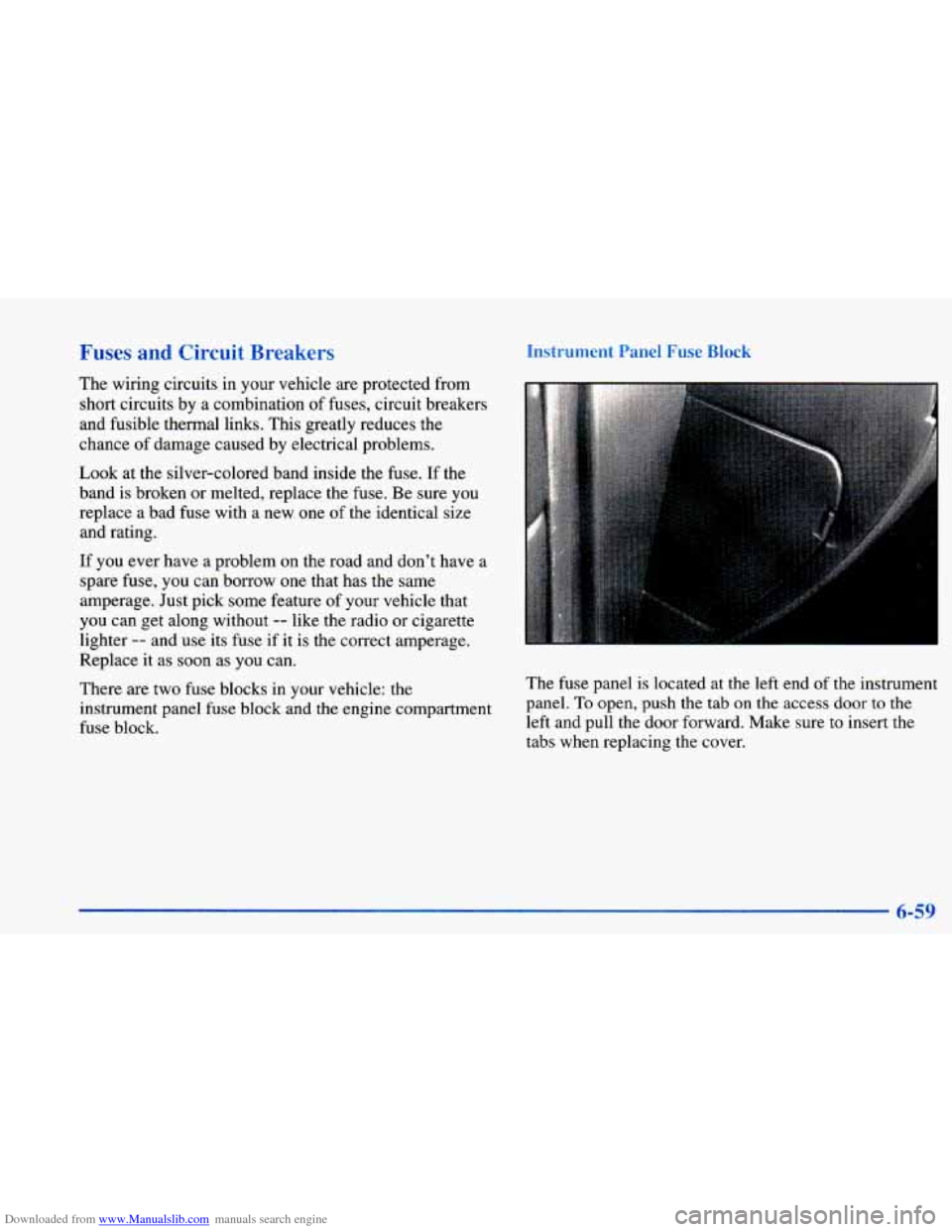
The fuse panel is located at the left end of the instrument
panel.
To open, push the tab on the access door to the
left and pull the door forward.
Make sure to insert the
tabs when replacing the cover.
6-59
Downloaded from www.Manualslib.com manuals search engine Engine Compartment Fuse Block
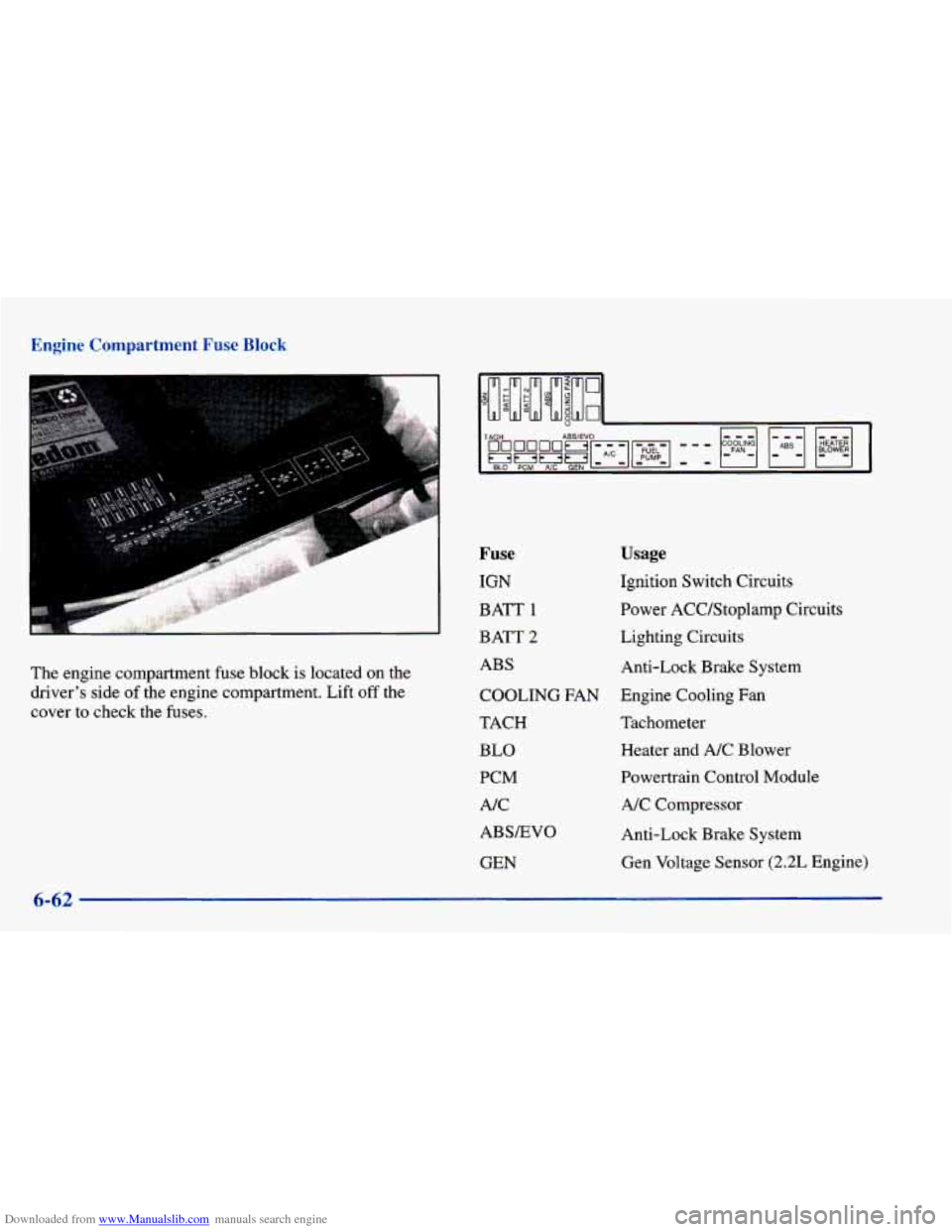
The engine compartment fuse block is located on the
driver’s side
of the engine compartment. Lift off the
cover to check the fuses.
Fuse
IGN
BATT 1
BATT 2
ABS
COOLING FAN
TACH
BLO
PCM AIC
ABSEVO
GEN
Usage
Ignition Switch Circuits
Power ACC/Stoplamp Circuits
Lighting Circuits
Anti-Lock Brake System
Engine Cooling Fan
Tachometer
Heater and
A/C Blower
Powertrain Control Module
A/C Compressor
Anti-Lock Brake System
Gen Voltage Sensor (2.2L Engine)
6-62