1998 CHEVROLET BLAZER brake fluid
[x] Cancel search: brake fluidPage 111 of 416

Downloaded from www.Manualslib.com manuals search engine Rear Window WasherWiper
To turn the rear wiper on, slide the switch to either LO
or HI. To turn the wiper off, slide the switch to OFF.
To wash the window, press the wash button located on
the switch. The switch must
be in either LO or HI.
The rear window washer uses the same fluid bottle as
the windshield washer. However, the rear window
washer will run out of fluid before the windshield
washer.
If you can wash your windshield but not your
rear window, check your fluid level.
Cruise Control (If Equipped)
11 With cruise control, you can
I maintain a speed of about
25 mph (40 km/h) or more
without keeping your foot
on the accelerator. This can
really help on long trips.
Cruise control does
not
work at speeds below about
If you have an automatic transmission and you apply
your brakes, the cruise control will shut
off.
2-37
Page 211 of 416

Downloaded from www.Manualslib.com manuals search engine The heavier the rain, the harder it is to see. Even if your
windshield wiper blades are
in good shape, a heavy rain
can make
it harder to see road signs and traffic signals,
pavement markings, the edge
of the road and even
people walking.
It's wise to keep your wiping equipment
in good shape
and keep your windshield washer tank filled with
washer fluid. Replace your windshield wiper inserts
when they show signs of streaking or missing areas on
the windshield, or when strips of rubber start to separate
from the inserts. Driving too
fast through large water puddles or even
going through some car washes can cause problems, too.
The water may affect your brakes. Try to avoid puddles.
But
if you can't, try to slow down before you hit them.
Wet brakes can cause accidents. They won't work
as well in a quick stop and may cause pulling to
one side. You could lose control of the vehicle.
After driving through a large puddle of water or
a car wash, apply your brake pedal lightly until
your brakes work normally.
Page 217 of 416

Downloaded from www.Manualslib.com manuals search engine 0 Keep your vehicle in good shape. Check all fluid
levels and also the brakes, tires, cooling system and
transmission. These parts can work hard
on
mountain roads.
Know how to go down hills. The most important
thing to know is this: let your engine do some
of the
slowing down. Shift to a lower gear when
you go
down a steep or long hill.
If you don’t shift down, your brakes could get so
hot that they wouldn’t work well. You would then
have poor braking or even none going down
a
hill. You could crash. Shift down to let your
engine assist your brakes on a steep
, downhill slope.
0
0
A CAUTION:
Coasting downhill in NEUTRAL (N) or with the
ignition off
is dangerous. Your brakes will have to
do all the work
of slowing down. They could get
so hot that they wouldn’t work well. You would
then have poor braking or even none going down
a hill. You could crash. Always have your engine
running and your vehicle in gear when you
go downhill.
Know how to go uphill. You may want
to shift down
to a lower gear. The lower gears help cool your
engine and transmission, and
you can climb the
hill better.
Stay in your own lane when driving on two-lane
roads in hills or mountains. Don’t swing wide or cut
across the center
of the road. Drive at speeds that let
you stay in your own lane.
e As you go over the top of a hill, be alert. There could
be something in your lane, like a stalled car or
an accident.
4-35
Page 228 of 416

Downloaded from www.Manualslib.com manuals search engine Safety Chains
You should always attach chains between your vehicle
and your trailer. Cross the safety chains under the tongue
of the trailer
so that the tongue will not drop to the road
if it becomes separated from the hitch. Instructions
about safety chains may be provided by the hitch
manufacturer or by the trailer manufacturer. Follow the
manufacturer’s recommendation for attaching safety
chains and do not attach them to the bumper. Always
leave just enough slack
so you can turn with your rig.
And, never allow safety chains
to drag on the ground.
Trailer Brakes
If your trailer weighs more than 1,000 lbs. (450 kg)
loaded, then it needs its own brakes -- and they must be
adequate. Be sure to read and follow the instructions for
the trailer brakes
so you’ll be able to install, adjust and
maintain them properly. Your
trailer’s brake system
can tap into the vehicle’s
hydraulic brake system
only if
The trailer parts can withstand 3,000 psi
(20 650 kPa) of pressure.
The trailer’s brake system will use less than
0.02 cubic inch (0.3 cc) of fluid from your vehicle’s
master cylinder. Otherwise, both braking systems
won’t work well. You could even lose your brakes.
If everything checks out this far, then make the brake
fluid tap at the
port on the master cylinder that sends
fluid to the rear brakes. But don’t use copper tubing for
this.
If you do, it will bend and finally break off. Use
steel brake tubing.
4-46
Page 232 of 416

Downloaded from www.Manualslib.com manuals search engine 2. Let up on the brake pedal.
3. Drive slowly until the trailer is clear of the chocks.
4. Stop and have someone pick up and store the chocks.
Maintenance When Trailer Towing
Your vehicle will need service more often when you’re
pulling
a trailer. See the Maintenance Schedule for more
on this. Things that are especially important
in trailer
operation are automatic transmission fluid (don’t
overfill), engine oil, axle lubricant, belt, cooling system
and brake adjustment. Each
of these is covered in this
manual, and the Index will help
you find them quickly.
If
you’re trailering, it’s a good idea to review these
sections before you start your trip.
Check periodically to see that all hitch nuts and bolts
are tight.
Trailer Wiring H-T--- ess
The light duty trailer wir is a six-wire harness
assembly. The optional heavy-duty trailer wiring
is an
eight-wire harness assembly. The harnesses are stored under the vehicle, along the passenger-side frame
crossmember on two-door vehicles or on the driver’s side
corner frame rear crossmember on four-door vehicles. The
heavy-duty trailer wiring has a 30-amp feed wire with
an
inline fuse located by the junction block. See
“Fuses and Circuit Breakers” in the Index. Both
harnesses have
no connector and should be wired by a
qualified electrical technician. The technician
can use
the following color code chart when connecting the
wiring harness to your trailer.
0
0
0
0
0
0
0
0
Dark Blue: Use for electric trailer brakes or
auxiliary wiring.
Red: Use for battery charging; it connects to the
starter solenoid (eight-wire harness only).
Light Green: Back-up lamps (eight-wire
harness only).
Brown: Taillamps and parking lamps. Yellow: Left stoplamp and turn signal.
Dark Green: Right stoplamp and turn signal.
White (Heavy Gage): Ground wire.
White (Light Gage): Auxiliary stoplamp.
Securely attach the harness to the trailer, then tape or
strap
it to your vehicle’s frame rail. Be sure you leave
it loose enough
so the wiring doesn’t bend or break,
but not
so loose that it drags on the ground. Store the
harness in its original place. Wrap the harness together
and tie it neatly
so it won’t be damaged.
Page 236 of 416
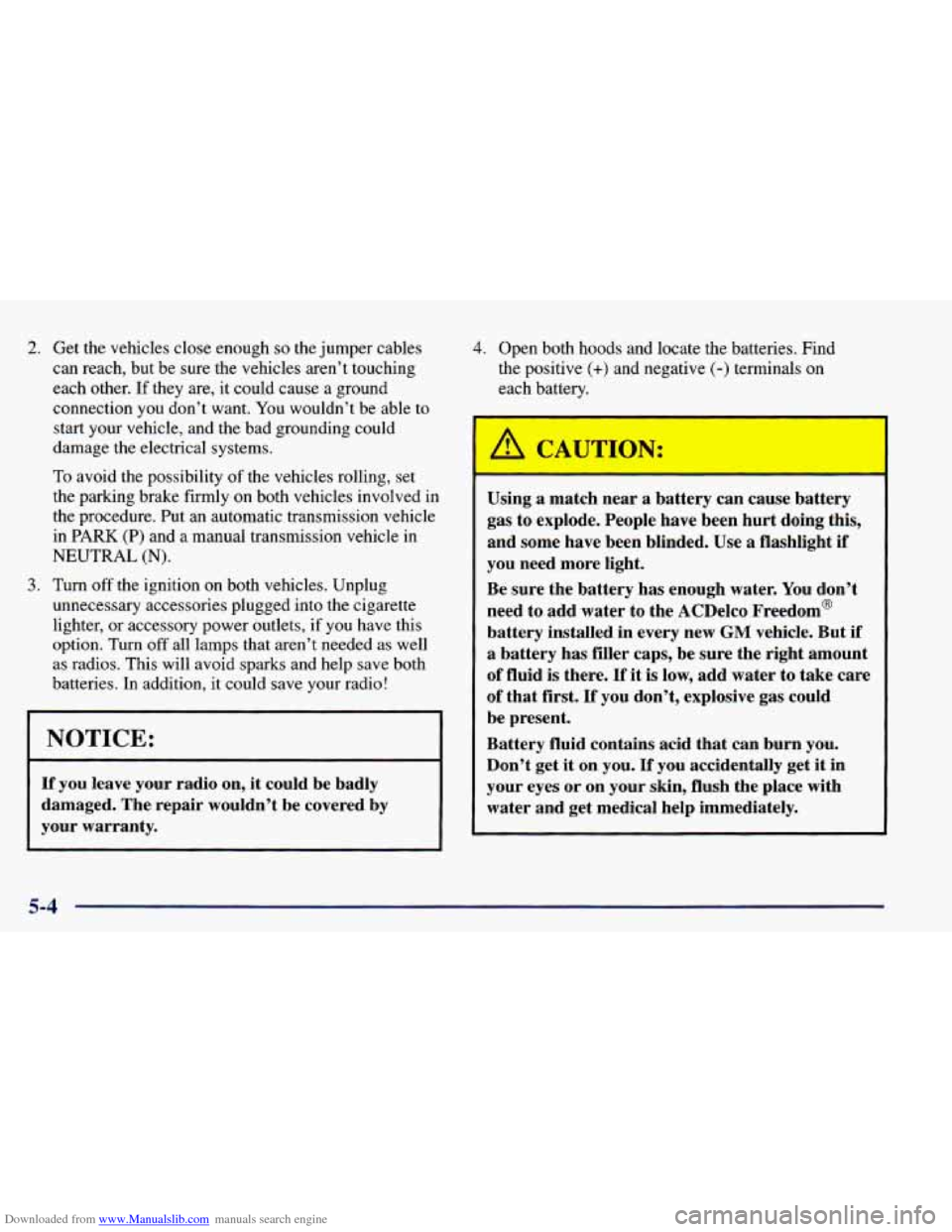
Downloaded from www.Manualslib.com manuals search engine 2. Get the vehicles close enough so the jumper cables
can reach, but be sure the vehicles aren’t touching
each other.
If they are, it could cause a ground
connection you don’t want. You wouldn’t be able to
start your vehicle, and the bad grounding could
damage the electrical systems.
To avoid the possibility of the vehicles rolling, set
the parlung brake firmly on both vehicles involved in
the procedure. Put an automatic transmission vehicle
in
PARK (P) and a manual transmission vehicle in
NEUTRAL (N).
3. Turn off the ignition on both vehicles. Unplug
unnecessary accessories plugged into the cigarette
lighter, or accessory power outlets, if you have this
option. Turn off all lamps that aren’t needed as well
as radios. This will avoid sparks and help save both
batteries. In addition, it could save your radio!
NOTICE:
If you leave your radio on, it could be badly
damaged. The repair wouldn’t be covered
by
your warranty.
4. Open both hoods and locate the batteries. Find
the positive
(+) and negative (-) terminals on
each battery.
AUTION:
I
Using a match near a battery can cause battery
gas to explode. People have been hurt doing this,
and some have been blinded.
Use a flashlight if
you need more light.
Be sure the battery has enough water.
You don’t
need to add water to the ACDelco Freedom@
battery installed in every new
GM vehicle. But if
a battery has filler caps, be sure the right amount
of fluid is there. If it is low, add water to take care
of that first.
If you don’t, explosive gas could
be present.
Battery fluid contains acid that can burn you.
Don’t get it on you.
If you accidentally get it in
your eyes or on your
skin, flush the place with
water and get medical help immediately.
5-4
Page 271 of 416

Downloaded from www.Manualslib.com manuals search engine Section 6 Service and Appnara-- ~2 Care
Here you will find information about the care of your vehicle. This section begins with service and fuel information,
and then it shows how to check important fluid and lubricant levels. There is also technical information about your
vehicle, and a part devoted to its appearance care.
6-2
6-3
6-5
6-5
6-7
6-8
6-10
6- 14
6-15
6-1 9
6-20
6-2
1
6-22 6-23
6-26 6-27
6-27
Service
Fuel
Fuels
in Foreign Countries
Filling Your Tank
Filling a Portable Fuel Container
Checking Things Under the Hood
Engine Oil
Air Cleaner
Automatic Transmission Fluid
Manual Transmission Fluid
Hydraulic Clutch
Rear Axle
Four-wheel Drive
Engine Coolant
Radiator Pressure Cap
Thermostat Power Steering Fluid 6-28
6-29
6-32
6-33
6-38
6-40
6-49
6-50
6-52
6-54
6-57
6-58
6-58
6-58
6-64 6-64
6-65 Windshield Washer Fluid
Brakes
Battery
Bulb Replacement
Windshield Wiper Blade Replacement
Tires
Appearance Care
Cleaning the Inside of Your Vehicle
Care
of Safety Belts
Cleaning the Outside
of Your Vehicle
Appearance Care Materials Chart
Vehicle Identification Number (VTN)
Service Parts Identification Label
Electrical System
Replacement Bulbs Capacities and Specifications
Air Conditioning Refrigerants
Page 278 of 416

Downloaded from www.Manualslib.com manuals search engine Checking Things Under the Hood
' A CAUTION: I
Things that burn can get on hot engine parts and
start a fire. These include liquids like gasoline,
oil, coolant, brake fluid, windshield washer and
other fluids, and plastic or rubber. You or others
could be burned. Be careful not to drop
or spill
things that will burn onto
a hot engine.
To open the hood, first pull
the handle inside the vehicle
on the lower driver's side
of
the instrument panel. Then
go to the front of the vehicle and release the
secondary
hood release.
Lift the hood, release the hood prop from its retainer and
put the hood prop into the slot in the hood.
You may
have a lamp that comes on when you lift the hood.