Page 7 of 380
Downloaded from www.Manualslib.com manuals search engine 1-1
2- 1
Seats and Restraint Systems
This section tells you how to use your seats and safety belts properly. It also explains the "SIR" system.
Features and Controls
This section explains how to start and operate your vehicle.
3- 1
4-1
5- 1
6-1
7-1
8- 1
Comfort Controls and Audio Systems
This section tells you how to adjust the ventilation and comfort controls and how to operate your audio system.
Your Driving and the Road
Here you'll find helpful information and tips about the road and how to drive under different conditions.
Problems on the Road
This section tells what to do if you have a problem while driving. such as a flat tire or overheated engine, etc.
Service and Appearance Care
Here the nlanual tells you how to keep your vehicle running properly and looking good.
Customer Assistance Information
This section tells you how to contact Cadillac for assistance and how to get service and owner publications.
It also gives you information
on "Reporting Safety Defects" on page 7- 12.
Index
Here's an alphabetical listing of almost every subject in this manual. You can use it to quickly find
something
you want to read.
i
Page 19 of 380
Downloaded from www.Manualslib.com manuals search engine For example, these
symbols
are used on an
original battery:
POSSIBLE A
CAUTION
INJURY
PROTECT EYES BY
SHIELDING
CAUSTIC
ACID COULD
BAlTERY
CAUSE
BURNS
SPARK
OR ,\I/,
COULD FLAME
EXPLODE BAllERY
These symbols
are important
for you and
your passengers
whenever your
vehicle
is
driven:
DOOR LOCK
UNLOCK
FASTEN SEAT
BELTS
These symbols
have
to do with
your lamps:
SIGNALS e
TURN
FOG LAMPS
# 0
These symbols
are
on some of
your controls:
WINDSHIELD
WIPER
WINDSHIELD DEFROSTER
WINDOW
DEFOGGER
These symbols
are used on
warning and
indicator lights:
COOLANT -
TEMP -
CHARGING I-1
BAlTERY
SYSTEM
BRAKE
(0)
COOLANT a
ENGINE OIL e,
PRESSURE
ANTI-LOCK
(@)
BRAKES
Here are some
other symbols
you may see:
FUSE
t
LIGHTER
HORN tcr
SPEAKER
cr
FUEL p3
Page 21 of 380
Downloaded from www.Manualslib.com manuals search engine Section 1 Seats and Restraint Systems
Here you’ll find information about the seats in your Cadillac and how to use your safety belts properly. You can also
learn about some things you should
not do with air bags and safety belts.
1- 2
1- 6
1- 11
1- 12
1- 12
1-
19
1- 20
1- 20
Seats and Seat Controls
Safety Belts: They’re for Everyone
Here Are Questions Many People Ask
About Safety Belts
-- and the Answers
How
to Wear Safety Belts Properly
Driver Position
Safety Belt Use During Pregnancy
Right Front Passenger Position
Supplemental Inflatable
Restraint
(SIR) System
1- 26
I- 29
I- 30
1- 33
1- 45
1- 48
1- 48
1- 48 Rear Seat
Passengers
Center Passenger Position
Children
Child Restraints
Larger Children
Safety Belt Extender
Checking Your Restraint Systems
Repiacing Restraint System Parts
After a Crash
1-1
Page 25 of 380
Downloaded from www.Manualslib.com manuals search engine L
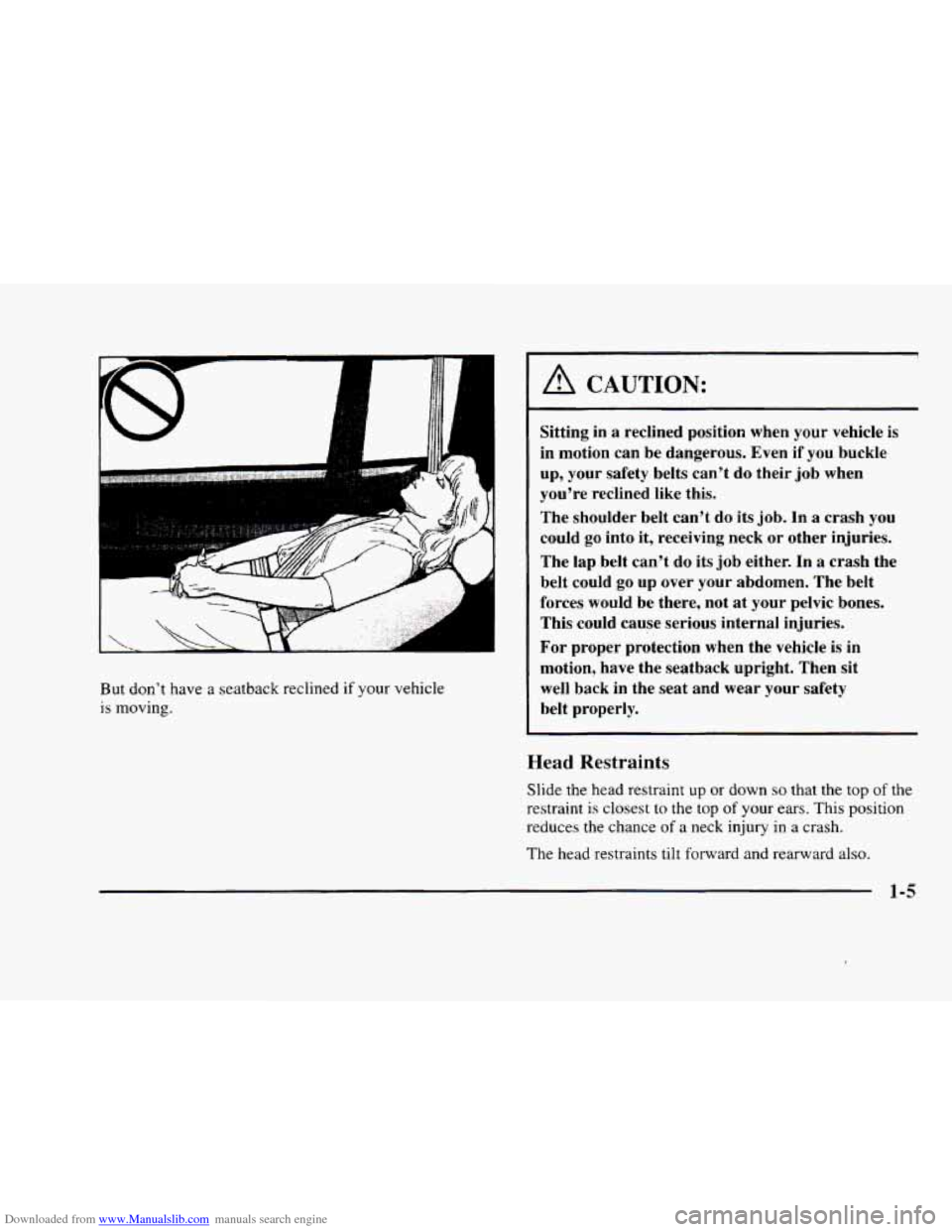
But don’t have a seatback reclined if your vehicle
is moving.
A CAUTION:
Sitting in a reclined position when your vehicle is
in motion can be dangerous. Even if you buckle
up, your safety belts can’t do their job when
you’re reclined like this.
The shoulder belt can’t do
its job. In a crash you
could
go into it, receiving neck or other injuries.
The lap belt can’t do its job either. In
a crash the
belt could
go up over your abdomen. The belt
forces would be there, not at your pelvic bones.
This could cause serious internal injuries.
For proper protection when the vehicle is in
motion, have the seatback upright. Then sit
, well back in the seat and wear your safety
~ belt properly.
Head Restraints
Slide the head restraint up or down so that the top of the
restraint
is closest to the top of your ears. This position
reduces the chance
of a neck injury in a crash.
The head restraints tilt forward and rearward also.
1 -5
Page 26 of 380
Downloaded from www.Manualslib.com manuals search engine Seatback Latches
I A CAUTION:
If the seatback isn’t locked, it could move
forward in a sudden stop or crash. That could
cause injury to the person sitting there. Always
press rearward on the seatback to be sure it
is locked.
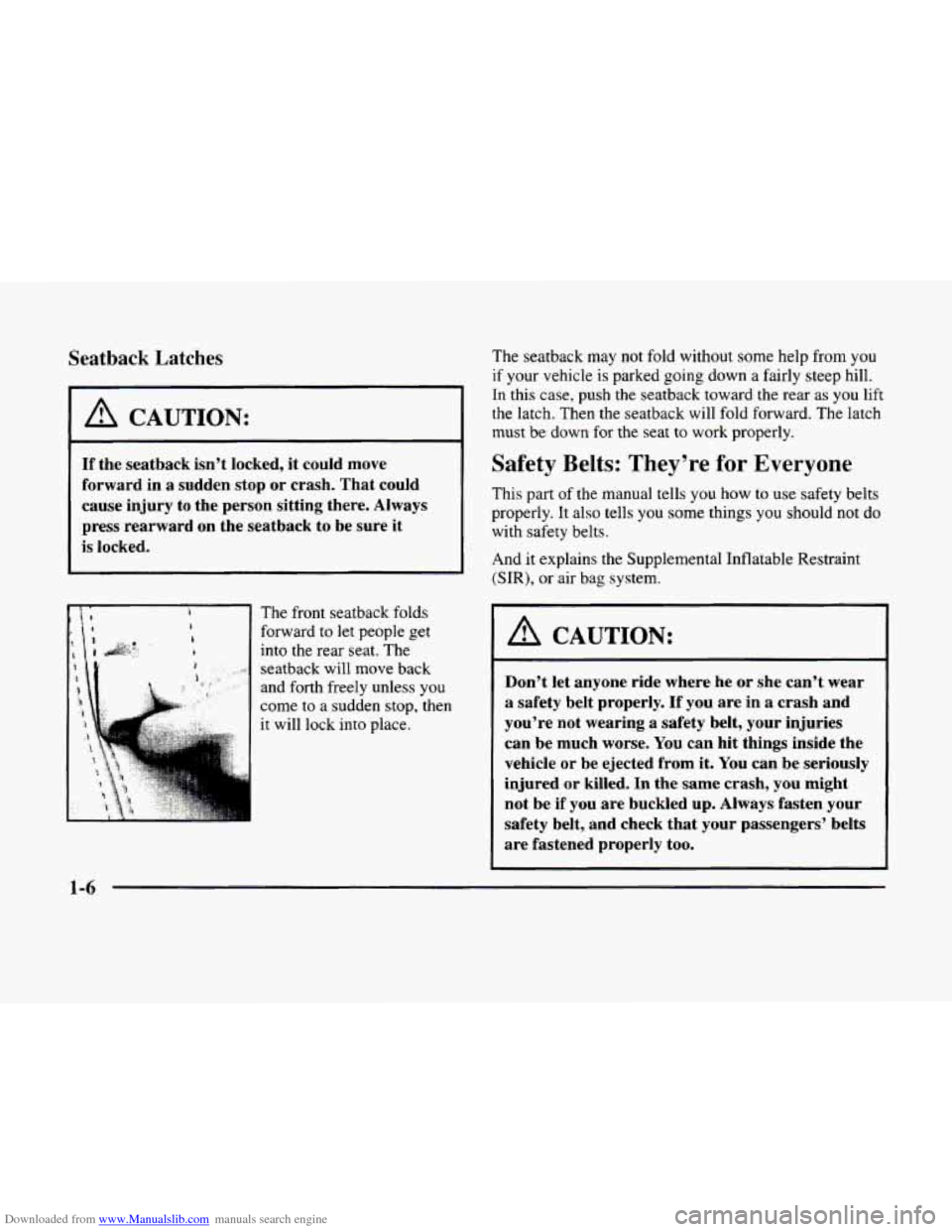
The front seatback folds
forward to
let people get
into the rear seat. The
seatback will move back
and forth freely unless you
come to a sudden stop, then
it will lock into place. The
seatback may not fold without some help from
you
if your vehicle is parked going down a fairly steep hill.
In this case, push the seatback toward the rear as you lift
the latch. Then the seatback will fold forward. The latch
must be
down for the seat to work properly.
Safety Belts: They’re for Everyone
This part of the manual tells you how to use safety belts
properly. It also tells you some things
you should not do
with safety belts.
And it explains the Supplemental Inflatable Restraint
(SIR), or air bag system.
A CAUTION:
Don’t let anyone ride where he or she can’t wear
a safety belt properly.
If you are in a crash and
you’re not wearing a safety belt, your injuries
can be much worse.
You can hit things inside the
vehicle
or be ejected from it. You can be seriously
injured
or killed. In the same crash, you might
not be
if you are buckled up. Always fasten your
safety belt, and check that your passengers’ belts
are fastened properly too.
1-6
Page 27 of 380
Downloaded from www.Manualslib.com manuals search engine A CAUTION:
It is extremely dangerous to ride in a cargo area,
inside
or outside of a vehicle. In a collision,
people riding in these areas are more likely to be
seriously injured or killed.
Do not allow people to
ride in any area of your vehicle that is not
equipped with seats and safety belts. Be sure
everyone in your vehicle
is in a seat and using a
safety belt properly.
Your vehicle has a light
that comes on as a reminder
to buckle up. (See “Safety
Belt Reminder Light”
in
the Index.) In
most states and Canadian provinces, the law says
to
wear safety belts. Here’s why: They work.
You never know if you’ll be in a crash. If you do have a
crash, you don’t know
if it will be a bad one.
A few crashes are mild, and some crashes can be so
serious that even buckled up a person wouldn’t survive.
But most crashes are
in between. In many of them,
people who buckle up can survive and sometimes walk
away. Without belts they could have been badly hurt
or killed.
After more than
30 years of safety belts in vehicles,
the facts are clear. In most crashes buckling up does
matter
... a lot!
1-7
Page 28 of 380
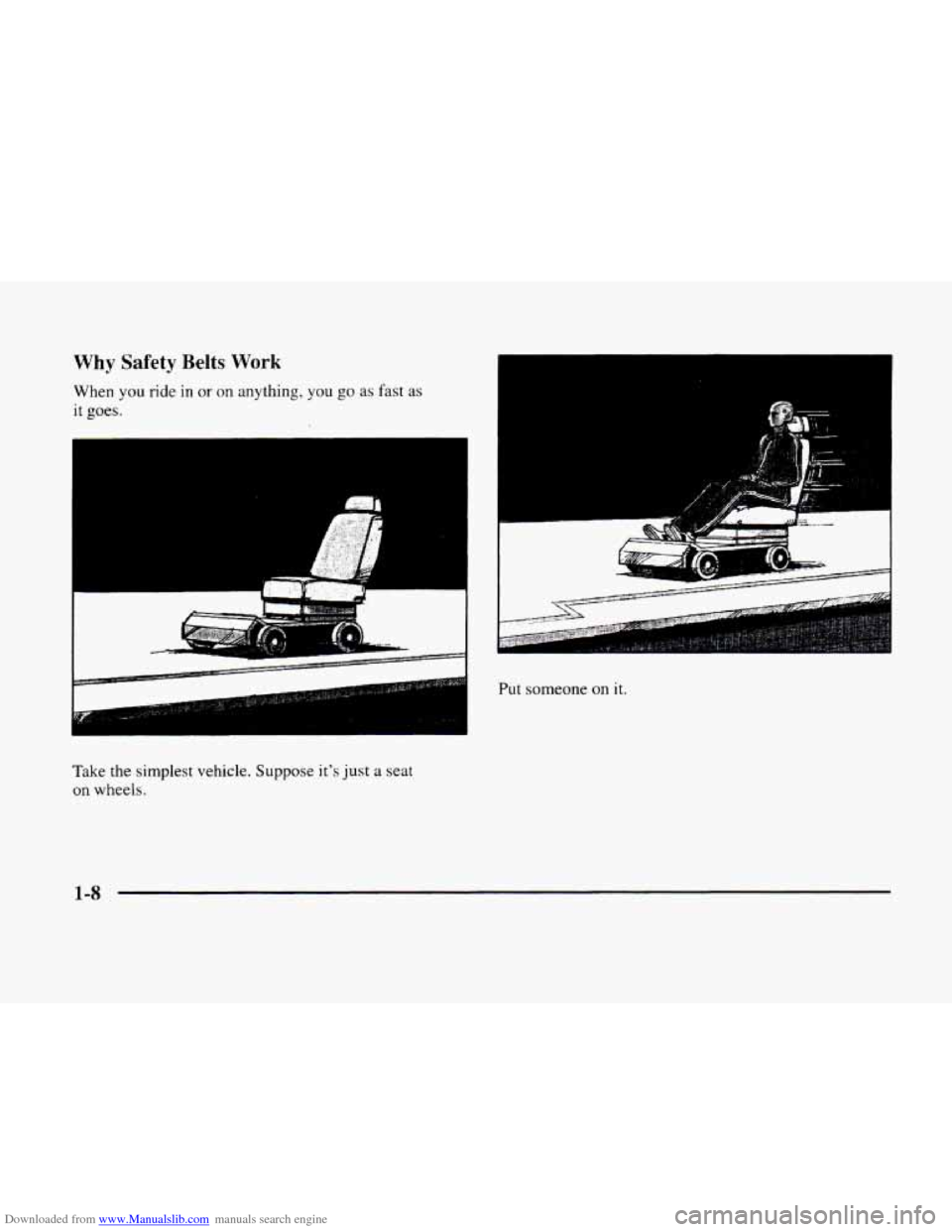
Downloaded from www.Manualslib.com manuals search engine Why Safety Belts Work
When you ride in or on anything, you go as fast as
it goes.
i
k-
Take the simplest vehicle. Suppose it's just a seat
on wheels.
Put someone on it.
I
1-8
Page 30 of 380
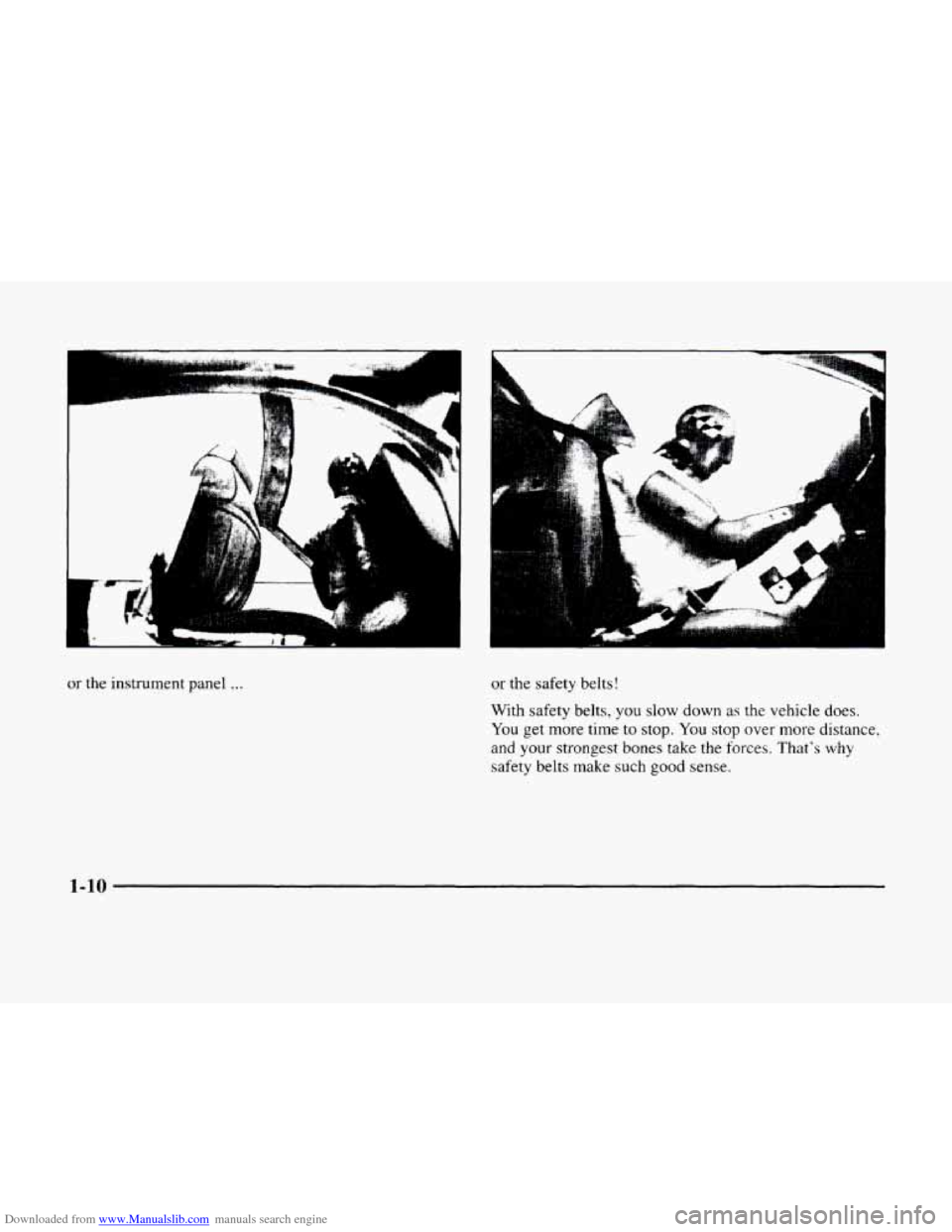
Downloaded from www.Manualslib.com manuals search engine or the instrument panel ... or the safety belts!
With safety belts,
you slow down as the vehicle does.
You get more time to stop. You stop over more distance,
and
your strongest bones take the forces. That's why
safety belts make
such good sense.
1-10