1998 CADILLAC CATERA light
[x] Cancel search: lightPage 121 of 346

Downloaded from www.Manualslib.com manuals search engine Sun Visors
Illuminated Visor Vanity Mirror
Turn the sunshade down and lift the cover to see the
mirror. Lighting is automatic.
Power Rear Sunshade (Option)
The power rear sunshade helps reduce the amount of
heat and light from the sun entering through the rear
window. This sunshade increases the comfort level of
the rear seat passengers as well as keeping your vehicle
a little cooler when it’s parked in a sunny area.
This button is located to the
right of the
shift lever on the
center console. To use, slide
this button rearward -- the
button returns to its original
position when released. The
rear sunshade automatically
raises.
To lower the
sunshade, slide the button
rearward again.
Cellular Telephone (Option)
Your vehicle has been prewired for dealer installation of
a dual-mode (analog/digital) cellular portable telephone.
Voice activation and hands-free operation are standard
features. For more information, contact your dealer. A
user’s guide is provided with the telephone.
OnStar System (Option)
This system may be ordered if you have the optional
fixed cellular telephone. The following services are
available
24 hours a day:
0 Roadside Service with Location
0 Emergency Services Button
Remote Door Unlock
Theft DetectiodNotification and Stolen-Vehicle
Tracking
Automatic Notification of Air Bag Deployment
Concierge/Customer Convenience Services
For more information, contact your dealer.
Page 126 of 346
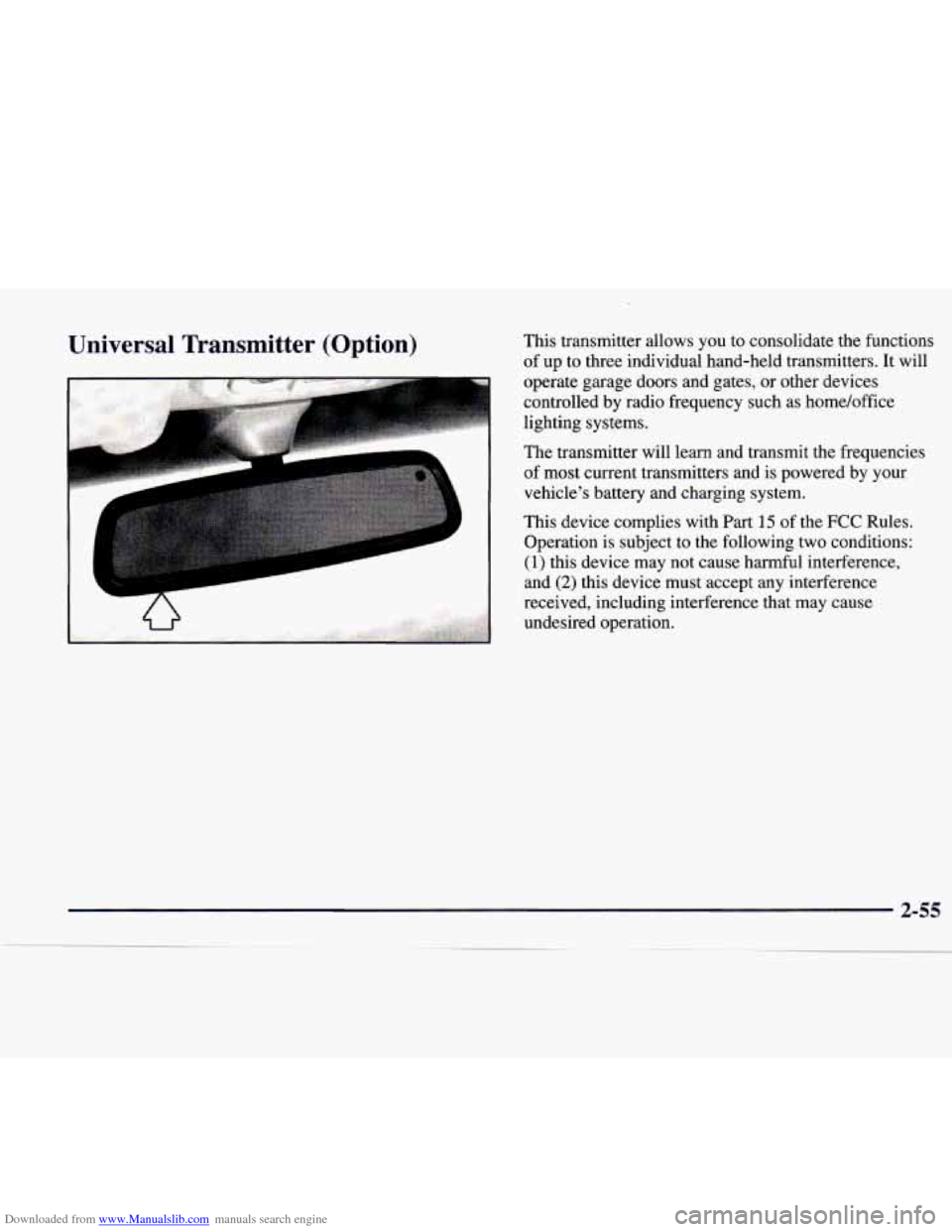
Downloaded from www.Manualslib.com manuals search engine Universal Transmitter (Option) This transmitter allows you to consolidate the functions
of up to three individual hand-held transmitters. It will
operate garage doors and gates, or other devices
controlled by radio frequency such as home/office
lighting systems.
The transmitter will learn and transmit the frequencies
of most current transmitters and is powered
by your
vehicle's battery and charging system.
This device complies with Part
15 of the FCC Rules.
Operation is subject to the following two conditions:
(1) this device may not cause harmful interference,
and
(2) this device must accept any interference
received, including interference that may cause
undesired operation.
Page 127 of 346

Downloaded from www.Manualslib.com manuals search engine This device complies with RSS-210 of Industry
Canada. Operation is subject to the following two
conditions:
(1) this device may not cause interference,
and
(2) this device must accept any interference,
including interference that may cause undesired
operation of the device.
Changes and modifications to this system by other than
an authorized service facility could void authorization to
use this equipment.
Programming the Transmitter
Do not use the universal transmitter with any garage
door opener that does not have the “stop and reverse”
safety feature. This includes any garage door opener
model manufactured before April
1, 1982.
Be sure that people and objects are clear of the garage
door
you are programming. Your
vehicle’s ignition should be on and the engine
should be off while programming the transmitter. Follow
these steps to program up to three channels:
1. If you have previously programmed a transmitter
channel, proceed to Step
2. Otherwise, hold down
the two outside buttons on the universal transmitter
until the indicator light begins to flash rapidly
(approximately
20 seconds). Then release the
buttons. This procedure initializes the memory and
erases any previous settings for all three channels.
2. Decide which one of the three channels you want
to program.
3. Hold the end of the hand-held transmitter about one
inch
(2.5 cm) away from the rear surface of the
mirror
so that you can still see the indicator light.
Page 128 of 346

Downloaded from www.Manualslib.com manuals search engine 4. Using both hands, press the hand-held transmitter
button and the desired button on the universal
transmitter. Continue to hold both buttons
through Step
5.
light on the universal transmitter flash slowly and
then rapidly. The rapid flashing, which could take up
to
90 seconds, indicates that the universal transmitter
has been programmed. Release both buttons once the
light starts to flash rapidly.
5. Hold down both buttons until you see the indicator
If you have trouble programming the universal
transmitter, make sure that you have followed the
directions exactly as described and that the battery in the
hand-held transmitter is not dead. If you still cannot
program it, rotate the hand-held transmitter end over end
and
try again. The universal transmitter may not work
with older garage door openers that do not meet current
Federal Consumer Safety Standards.
If you cannot
program the transmitter after repeated attempts, consult
the manufacturer of the unit at 1-800-335-3515. Be sure
to keep the original hand-held transmitter
in case
you need to erase and reprogram the universal transmitter.
Note to Canadian Owners: During programming, the
hand-held transmitter may stop transmitting after one or
two seconds. If you are programming from one of these
transmitters,
you should press and re-press the button on
the hand-held transmitter every
two seconds without ever
releasing the button on the universal transmitter.
You may
have to repeat
this step several times while programming.
Page 129 of 346

Downloaded from www.Manualslib.com manuals search engine Operating the Transmitter
Press and hold the appropriate button on the universal
transmitter. The indicator light comes on while the
signal is being transmitted.
Note that the effective transmission range of the
universal transmitter may differ from your hand-held
transmitter and from one channel to another.
Also note that if the hand-held transmitter appears to
program the universal transmitter but does not open
your garage door, and if the garage door opener was
manufactured after
1995, the garage door opener may
have a “rolling code” system.
A rolling code system
changes the code of the garage door opener every time
you open or close the garage door.
To determine if you have this system, press the button
on the universal transmitter that you have programmed
already. If the indicator light on the universal transmitter
flashes rapidly for one
or two seconds and then stops
flashing, the garage door opener has a rolling code
system. In a rolling code system, the garage door
receiver must be trained to the universal transmitter.
Training a Garage Door Opener with
“Rolling
Codes” (If Equipped)
If you have not previously programmed the hand-held
transmitter to the universal transmitter, see “Programming the Transmitter” earlier in this section.
If
you have completed this programming already, you now
need to train the garage door opener receiver to
recognize the universal transmitter. Refer
to your garage
door opener owner’s manual for the proper transmitter
training procedure for your garage door opener brand.
1.
2.
Locate the training button on the garage door opener
receiver. The exact location and color of the button
may vary by garage door opener brand. If you have
difficulty locating the training button, refer to your
garage door opener manual.
Press the training button on the garage door opener
receiver for one or
two seconds. An indicator light will
begin to flash when the receiver enters the
train mode.
2-58
Page 130 of 346

Downloaded from www.Manualslib.com manuals search engine 3. Return to the universal transmitter in your vehicle and
press the universal transmitter button you have already
programmed for
two to three seconds. Press the button
again to make sure that the universal transmitter has
been trained to the garage door opener receiver. Check that the training
was successful. The receiver light
should no longer be
flashing.
The garage door opener should now recognize the
universal transmitter. You may either use the universal
transmitter or the hand-held transmitter to open the
garage door.
If after following these instructions you still have
problems training the garage door opener, consult
your dealer.
Erasing Channels
To erase all three programmed channels, hold down the
two outside buttons until the indicator light begins to
flash. Individual channels cannot be erased, but can be
reprogrammed using the procedure for programming the
transmitter explained earlier.
Accessories
Accessories for the universal transmitter are available
from the manufacturer
of the unit. If you would like
additional information, please call
1-800-355-35 15.
2-59
Page 134 of 346

Downloaded from www.Manualslib.com manuals search engine Speedometer and Odometer
The speedometer lets you see your speed in both miles
per
hour (rnph) and kilometers per hour (km/h). The
odometer shows how
far your vehicle has been driven,
in either miles (used in the United States) or kilometers
(used in Canada).
Trip Odometer
The trip odometer tells how far you have driven since
you last reset it. To set it to zero, press the knob located
below the speedometer on the instrument cluster.
m RPM x 1000
This gage indicates the
engine speed in revolutions
per minute
(rpm).
I NOTICE:
Do not operate the engine with the tachometer in
the red area
or engine damage may occur.
Engine Speed Limiter
This feature prevents the engine from operating at too
many revolutions per minute
(rpm). When the engine’s
rpm are critically high, the fuel supply to the engine
is
shut off. When the engine speed slows, the fuel supply
will come on again. This helps prevent damage to
the engine.
Warning Lights, Gages and Indicators
This part describes the warning lights and gages that
may be
on your vehicle. The pictures will help you
locate them.
Warning lights and gages can signal that something is
wrong before it becomes serious enough to cause an
expensive repair or replacement. Paying attention to
your warning lights and gages could also save you or
others from injury.
Page 135 of 346

Downloaded from www.Manualslib.com manuals search engine Warning lights come on when there may be or is a
problem with one of your vehicle’s functions. As you
will see in the details on the next few pages,
some
warning lights come on briefly when you start the
engine just to let you know they’re working. If you are
familiar with this section, you should not be alarmed
when this happens.
Gages can indicate when there may be
or is a problem
with one of your vehicle’s functions. Often gages and
warning lights work together to
let you know when
there’s
a problem with your vehicle.
When one of the warning lights comes on and stays on
when you are driving, or when one of the gages shows
there may be a problem, check the section that tells
you
what to do about it. Please follow this manual’s advice.
Waiting to do repairs can be costly
-- and even
dangerous.
So please get to know your warning lights
and gages. They’re a big help.
Safety Belt Reminder Light
When the key is turned to ON or START, a chime will
come on for about eight seconds to remind people to
fasten their safety belts, unless the driver’s safety belt i\
s
already buckled.
The safety belt light will
also come on and
stay on
for about four seconds,
then it
will flash for about
60 seconds. If the driver’s
belt is already buckled,
neither the chime nor the light will come on.