Page 147 of 346

Downloaded from www.Manualslib.com manuals search engine Low Fuel Light
If the fuel level is low,
approximately two gallons
(7.57 L) of fuel remaining
in the fuel tank, a light will
come
on and stay on until
you add fuel.
It will also come on for a few seconds when
you first
turn on the ignition as a check to show it’s working. If
it
doesn’t come on then, have it fixed.
Automatic Transmission Warning Light
0
This light comes on briefly
when the ignition
is turned
on. If the light remains on
or lights up while driving,
there may be a fault in the
automatic transmission.
Have your vehicle serviced.
Leveling Indicator Light
LEVELING
This light comes on steady
when the rear load level in
your vehicle changes.
Do not drive your vehicle when this light is on. The rear
of your vehicle is too low and part of the body or the rear
axle may be damaged when driving over bumpy roads.
When the light goes out, leveling is complete.
This
procedure is automatic -- you don’t have to do anytlmng.
If the light comes on flashing, there may be a problem
with the leveling system. You should reduce your
vehicle speed and have your vehicle serviced soon.
Brake Pad Wear Indicator Light
This light comes on when
the brake pads
on your
vehicle have significantly
worn. The pads will have to
be replaced,
so have your
vehicle serviced soon.
Page 186 of 346

Downloaded from www.Manualslib.com manuals search engine Avoid needless heavy braking. Some people drive
in spurts
-- heavy acceleration followed by heavy
braking
-- rather than keeping pace with traffic. This
is a mistake. Your brakes may not have time to cool
between hard stops. Your brakes will wear out much
faster if you do
a lot of heavy braking. If you keep pace
with the traffic and allow realistic following distances,
you will eliminate a lot of unnecessary braking. That
means better braking and longer brake life.
If your engine ever stops while you’re driving, brake
normally but don’t pump your brakes. If you do, the
pedal may get harder to push down. If your engine
stops, you will still have some power brake assist. But
you will use it when you brake. Once the power assist
is used up, it may take longer to stop and the brake
pedal will be harder to push.
Anti-Lock Brakes (ABS)
Your vehicle has anti-lock brakes (ABS). ABS is an
advanced electronic braking system that will help
prevent a braking skid.
When you start your engine and begin
to drive away,
your anti-lock brake system will check itself. You may
hear a momentary motor or clicking noise while this test
is going on, and you may even notice that your brake
pedal moves a little. This is normal.
ABS
If there’s a problem with
the anti-lock brake system,
this warning light will stay on. See “Anti-Lock Brake
System Warning Light” in
the Index.
Page 188 of 346

Downloaded from www.Manualslib.com manuals search engine Using Anti-Lock
Don’t pump the brakes. Just hold the brake pedal down
firmly and let anti-lock work for you. You may hear the
anti-lock pump or motor operate, and feel the brake
pedal pulsate, but this
is normal.
Traction Control System
Your vehicle has a traction control system that limits
wheel spin. This is especially useful in slippery road
conditions. The system operates only
if it senses that
one or both
of the rear wheels are spinning or beginning
to lose traction. When this happens, the system brakes
the spinning wheel and/or reduces engine power to
limit wheel spin.
You may feel or hear the system working, but this is normal.
This warning light will
come on to let you know if
there’s a problem with your traction control system.
See “Traction Control System Warning Light” in the
Index. When this warning light is on, the system will
not
limit wheel spin. Adjust your driving accordingly. The
traction control system automatically comes
on
whenever you start your vehicle. To limit wheel spin,
especially in slippery road conditions, you should
always leave the system on. But you can turn the
traction control system off if you ever need to.
(You
should turn the system off if your vehicle ever gets
stuck in sand, mud, ice or snow. See “Rocking Your
Vehicle” in the Index.)
To turn the system off, press the TCS
OFF button located
next to the radio on the
center console.
Braking in Emergencies
With anti-lock, you can steer and brake at the same
time. In many emergencies, steering can help you more
than even the very best braking.
4-9
Page 198 of 346
Downloaded from www.Manualslib.com manuals search engine City Driving
1
One of the biggest problems with city streets is the
amount of traffic on them. You’ll want to watch out for
what the other drivers are doing and pay attention to
traffic signals. Here
are ways to increase your safety in city driving:
Know
the best way to get to where you are
going. Get
a city map and plan your trip into an
unknown part of the city just as you would for a
cross-country trip.
Try to use the freeways that rim and crisscross most large cities. You’ll save time and energy.
(See the next part, “Freeway Driving.”)
Treat a green light as a warning signal. A traffic
light is there because the corner is busy enough to
need it. When’a light turns green, and just before you
start to move, check both ways for vehicles that have
not cleared the intersection or may be running the
red light.
Page 203 of 346
Downloaded from www.Manualslib.com manuals search engine Winter Driving
Here are some tips for winter driving:
0 Have your vehicle in good shape for winter.
You may want to put winter emergency supplies in
your
truok
Include an ice scraper, a small brush or broom, a supply
of windshield washer fluid, a rag, some winter outer
clothing, a small shovel,
a flashlight, a red cloth and a
couple of reflective warning triangles. And, if you will
be driving under severe conditions, include a small bag
of sand, a piece
of old carpet or a couple of burlap bags
to help provide traction. Be sure
you properly secure
these items in your vehicle.
4-24
Page 217 of 346
Downloaded from www.Manualslib.com manuals search engine Hazard Warning Flashers
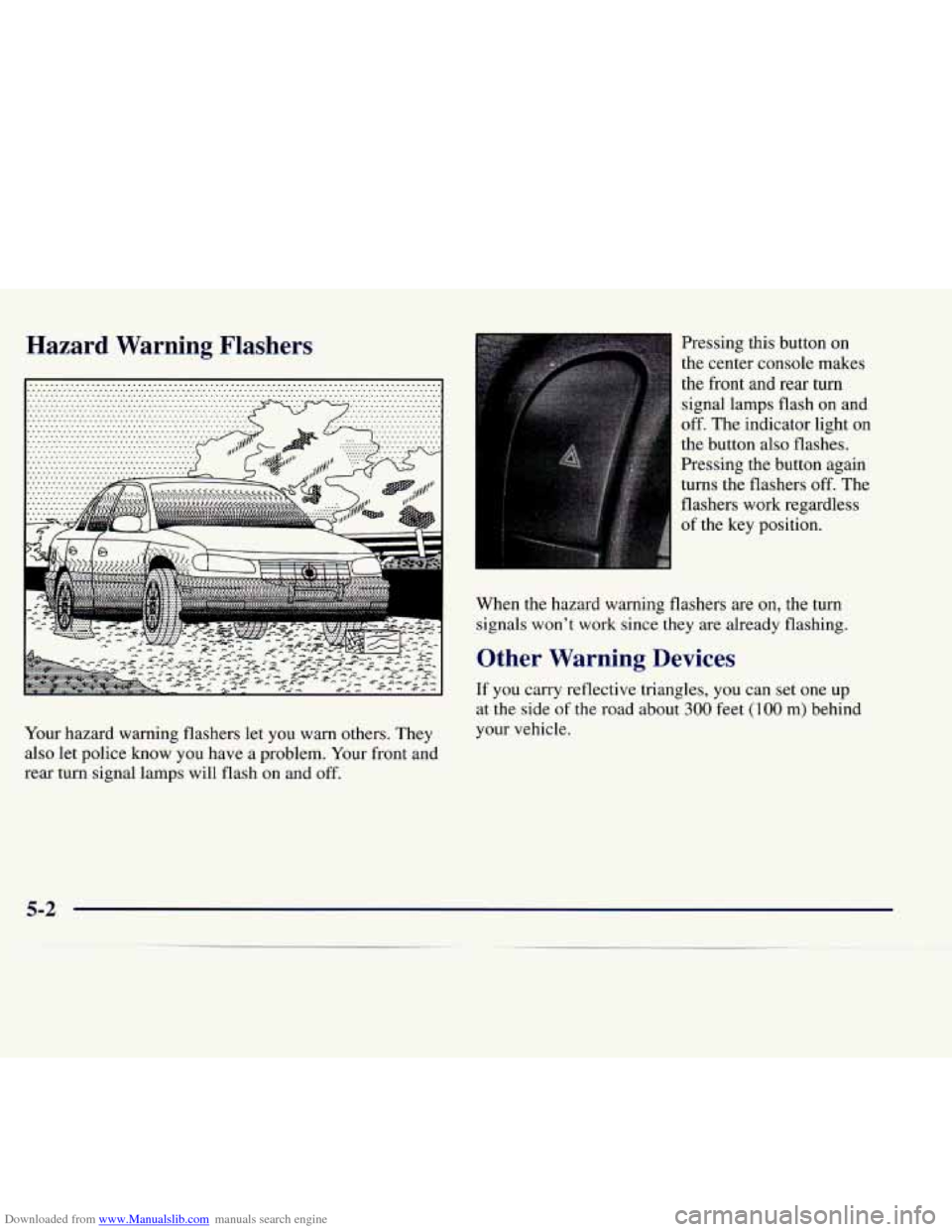
Your hazard warning flashers let you warn others. They
also let police know you have a problem. Your front and
rear turn signal lamps will flash
on and off.
Pressing this button on
the center console makes
the front and rear turn signal lamps flash
on and
off. The indicator light on
the button also flashes.
Pressing the button again
turns the flashers off.
The
flashers work regardless
of the key position.
When the hazard warning flashers are on, the turn signals
won’t work since they are already flashing.
Other Warning Devices
If you carry reflective triangles, you can set one up
at the side
of the road about 300 feet (100 m) behind
your vehicle.
5-2
Page 227 of 346
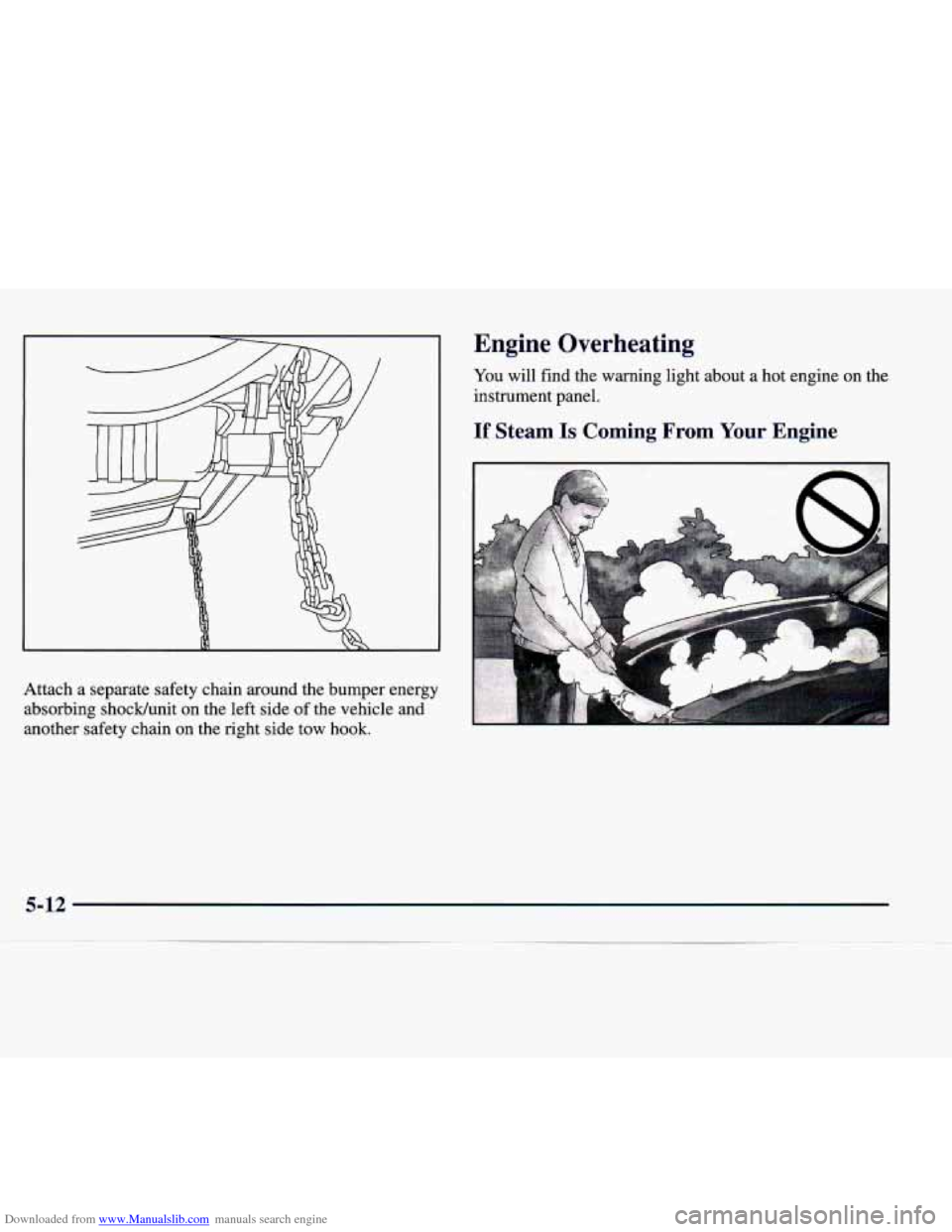
Downloaded from www.Manualslib.com manuals search engine Attach a separate safety chain around the bumper energy
absorbing shockhnit on the left side of the vehicle and
another safety chain on the right side tow hook.
Engine Overheating
You will find the warning light about a hot engine on the
instrument panel.
If Steam Is Coming From Your Engine
5-12
Page 269 of 346

Downloaded from www.Manualslib.com manuals search engine What to Use
Refer to the Maintenance Schedule to determine what
kind of lubricant to use. See “Recommended Fluids and
Lubricants” in the Maintenance Schedule booklet.
Engine Coolant
The cooling s stem in your vehicle is filled with
DEX-COOL engine coolant.
This coolant is designed
to remain in your vehicle for
5 years or 150,000 miles
(240 000 krnb whichever occurs first, if you add only
DEX-COOL extended life coolant.
J
The following explains your cooling system and how to
add coolant when it is low. If you have
a problem with
engine overheating, see “Engine Overheating” in
the Index.
A 50/50 mixture of water and DEX-COOL’
coolant will:
a Give freezing protection down to -34°F (-37°C).
Give boiling protection up to 265 OF (129°C).
Protect against rust and corrosion.
Help keep the proper engine temperature.
Let the warning lights and gages work as
they should.
NOTICE:
When adding coolant, it is important that you use
only
DEX-COOL@ (silicate-free) coolant.
If coolant other than DEX-COOL is added to the
system, premature engine, heater core or
radiator corrosion may result. In addition, the
engine coolant
will require change sooner -- at
30,000 miles (50 000 km) or 24 months,
whichever occurs
first. Damage caused by the use
of coolant other than DEX-COOL@
is not
covered
by your new vehicle warranty.
6-20
-