Page 223 of 346
Downloaded from www.Manualslib.com manuals search engine Front and Rear Towing This
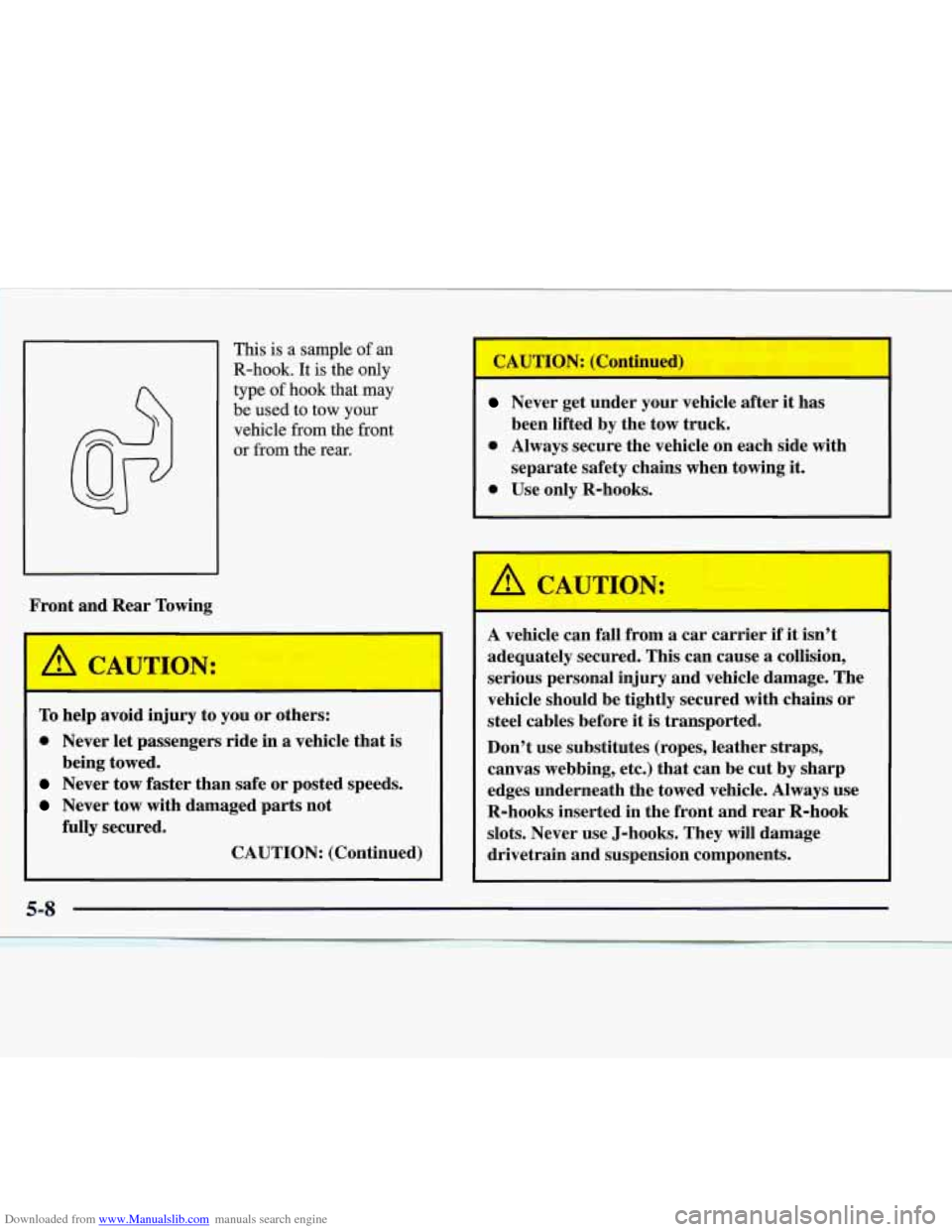
is a sample of an
R-hook. It
is the only
type of hook that may
be used to tow your
vehicle from the front or from the rear.
A CAUTION:
To help avoid injury to you or others:
0 Never let passengers ride in a vehicle that is
Never tow faster than safe or posted speeds.
Never tow with damaged parts not
being
towed.
fully secured.
CAUTION: (Continued)
Never get under your vehicle after it has
0 Always secure the vehicle on each side with
0 Use only R-hooks.
been
lifted by the tow truck.
separate safety chains when towing it.
A CAUTION:
A vehicle can fall from a car carrier if it isn’t
adequately secured. This can cause a collision,
serious personal injury and vehicle damage. The
vehicle should be tightly secured with chains or
steel cables before it
is transported.
Don’t use substitutes (ropes, leather straps,
canvas webbing, etc.) that can be cut by sharp
edges underneath the towed vehicle. Always use
R-hooks inserted in the front and rear R-hook
slots. Never use J-hooks. They will damage
drivetrain and suspension components.
5-8
Page 224 of 346
Downloaded from www.Manualslib.com manuals search engine When your vehicle is being towed, have the ignition key
turned to
OFF. The steering wheel should be clamped in
a straight-ahead position, with a clamping device
designed for towing service. Do not use the vehicle’s
steering column lock for this. The transmission should
be in
NEUTRAL (N) and the parking brake released,
Don’t have your vehicle towed on the drive wheels.
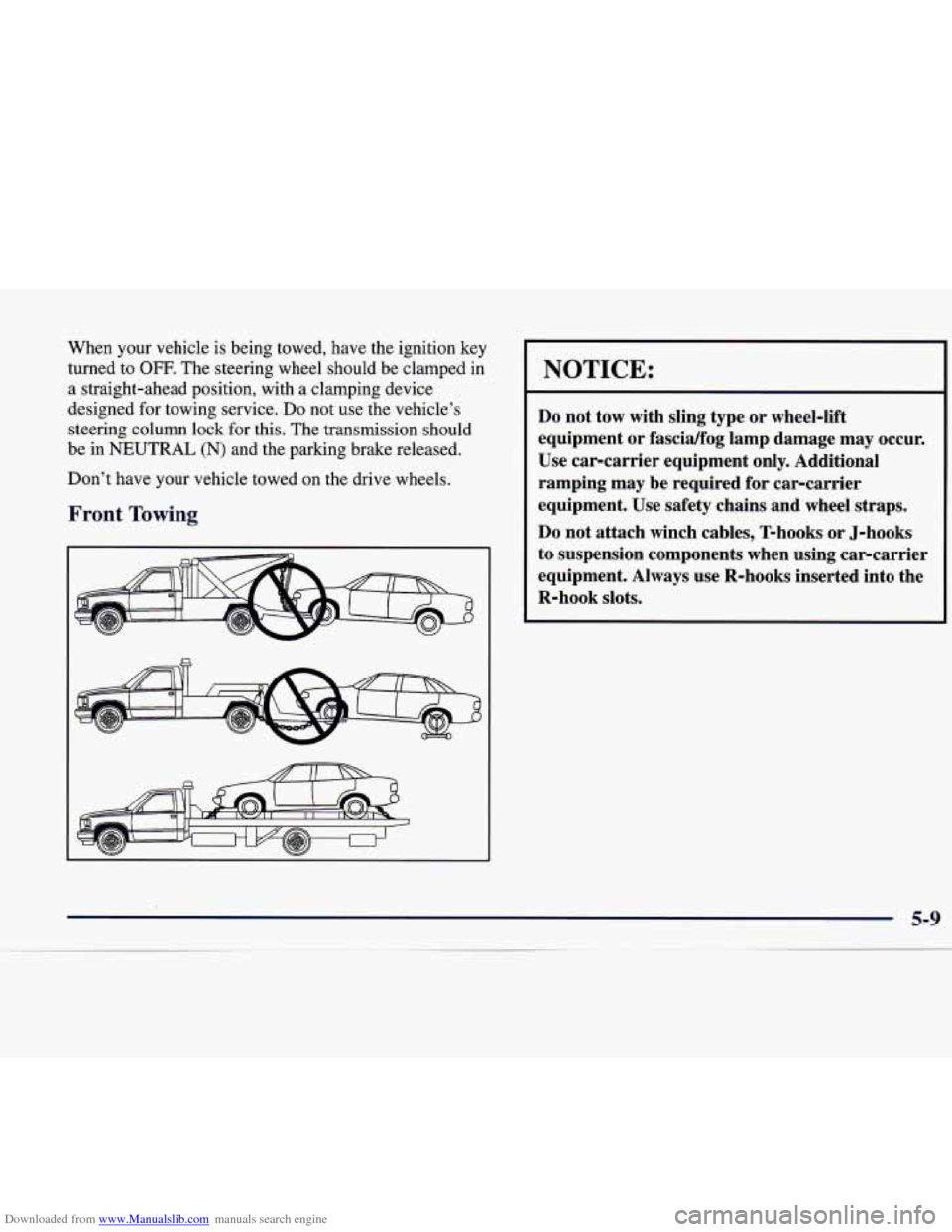
Front Towing
I
NOTICE:
Do not tow with sling type or wheel-lift
equipment or fascidfog lamp damage may occur.
Use car-carrier equipment only. Additional
ramping may be required for car-carrier
equipment. Use safety chains and wheel straps.
Do not attach winch cables, T-hooks or J-hooks
to suspension components when using car-carrier
equipment. Always use R-hooks inserted into the
R-hook slots.
Page 225 of 346
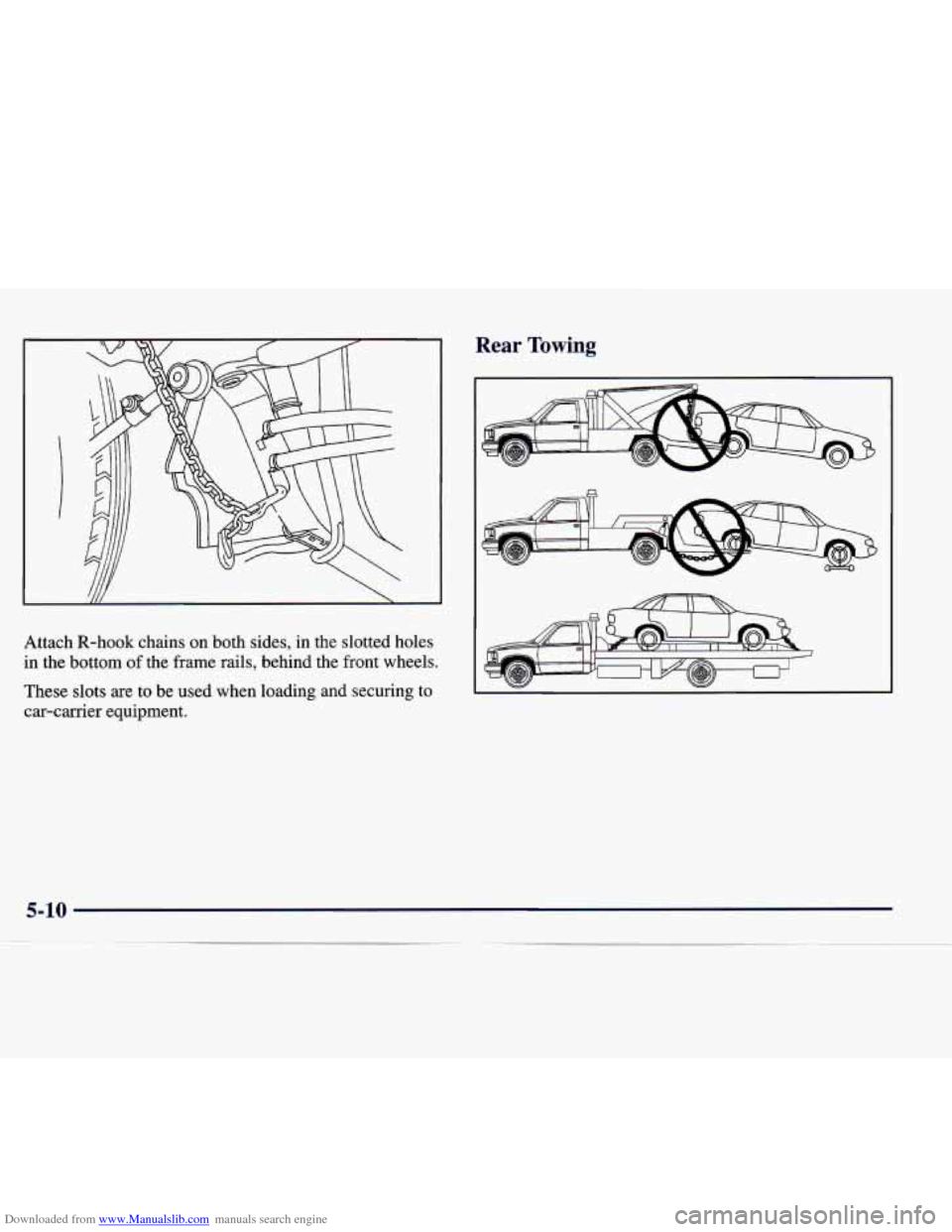
Downloaded from www.Manualslib.com manuals search engine Rear Towing
Attach R-hook chains on both sides, in the slotted holes
in the bottom of the frame rails, behind the front wheels.
These slots
are to be used when loading and securing to
car-carrier equipment.
Page 247 of 346
Downloaded from www.Manualslib.com manuals search engine NOTICE:
Spinning your wheels can destroy parts of your
vehicle as well as the tires.
If you spin the wheels
too fast while shifting your transmission back
and forth, you can destroy your transmission.
For information about using tire chains on your vehicle,
see “Tire Chains” in the Index.
Rocking Your Vehicle To Get It Out
First, turn your steering wheel left and right. That will
clear the area around your front wheels. You should
turn your traction control system
off. (See “Traction
Control System” in the Index.) Then shift back and forth
between REVERSE (R) and a forward gear, spinning
the
wheels as little as possible. Release the accelerator pedal
while you shift, and press lightly on the accelerator
pedal when the transmission is in gear. If that doesn’t
get you out after a few tries, you may need
to be towed
out.
If you do need to be towed out, see “Towing Your
Vehicle’’ in the Index.
5-32
Page 268 of 346

Downloaded from www.Manualslib.com manuals search engine Change both the fluid and filter every 50,000 miles
(83 000 km) if the vehicle is mainly driven under one or
more
of these conditions:
In heavy city traffic where the outside temperature
In hilly or mountainous terrain.
When doing frequent trailer towing.
Uses such as found in taxi, police or delivery service.
If you do not use your vehicle under any of these
conditions, the fluid and filter do not require changing.
regularly
reaches
90” F (32” C) or higher.
NOTICE:
We recommend you use only fluid labeled
DEXRON@-m, because fluid with that label
is
made especially for your automatic transmission.
Damage
caused by fluid other than DEXRON@-III
is not covered by your new vehicle warranty.
Rear Axle
When to Check Lubricant
Refer to the Maintenance Schedule to determine how
often to check the lubricant. See “Periodic Maintenance
Inspections” and “Scheduled Maintenance Services” in
the Maintenance Schedule booklet.
How to Check Lubricant
If the level is below the bottom of the filler plug hole,
you’ll need to add some lubricant. Add enough lubricant
to raise the level to the bottom of the filler plug hole.
Page 318 of 346
Downloaded from www.Manualslib.com manuals search engine Roadside Service
[email protected] HOTLINE
1=800-882=1112
Cadillac’s exceptional Roadside Service is more than an
auto club
or towing service. It provides every Catera
owner with the advantage
of contacting a Cadillac
advisor and, when appropriate, a Catera trained dealer
technician who can provide on-site service. Each technician travels with
a specially equipped
service vehicle complete with the necessary Catera parts
and tools required to handle most roadside repairs.
Cadillac Roadside Service can be reached by dialing
1-800-882- 11 12,24 hours a day, 365 days a year.
This service is provided at no charge for any
warranty-covered situation and for a nominal
charge if the Catera is no longer under warranty.
Roadside Service is available only in the United
States and Canada.
Cadillac Owner Privileges TM
Roadside Service provides several Cadillac Owner
Privileges at “no charge,” throughout your
1998
Cadillac Warranty Period
-- 48 months/50.000 miles
(80 000 krn).
Page 319 of 346
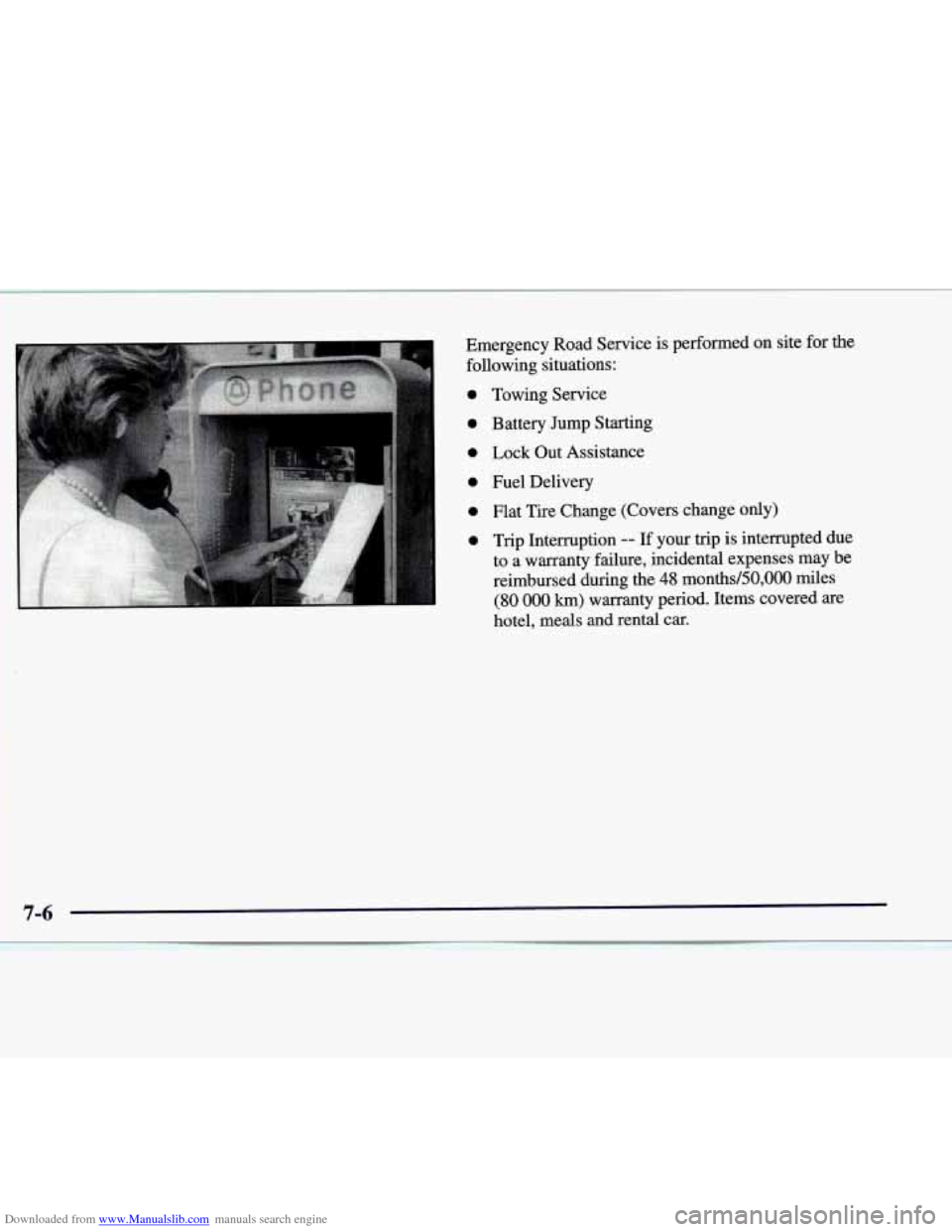
Downloaded from www.Manualslib.com manuals search engine Emergency Road Service is performed on site for the
following situations:
0
0
e
0
0
0
Towing Service Battery Jump Starting
Lock Out Assistance
Fuel Delivery
Flat Tire Change (Covers change only) Trip Interruption
-- If your trip is interrupted due
to a warranty failure, incidental expenses may be
reimbursed during the
48 months/50,000 miles
(80 000 km) warranty period. Items covered are
hotel, meals and rental
car.
7-6
Page 333 of 346
Downloaded from www.Manualslib.com manuals search engine Driving City
........................................ 4-19
Defensive
.................................... 4-2
Drunken
..................................... 4-3
Freeway
.................................... 4-20
In a Blizzard ................................. 4-26
In Foreign Countries
........................... 6-5
In the Rain and on Wet Roads ................... 4-16
Night
...................................... 4-15
OnCurves
.................................. 4-10
On Grades While Towing a Trailer
............... 4-35
On Hill and Mountain Roads
.................... 4-22
OnSnowandIce
............................. 4-25
Through Deep Standing Water
................... 4- 18
Winter
...................................... 4-24
With a Trailer
................................ 4-34
DRL ......................................... 2-41
ECC ......................................... 3-2
Electrical Equipment. Adding
..................... 2- 18
Electrochromic Daymight Rearview Mirror
.......... 2-46
Electronic Climate Control (ECC)
................... 3-2
Electronic Level Control
......................... 4-30
Engine
....................................... 6-10
Coolant
..................................... 6-20
Coolant Heater
............................... 2- 19
Electrical System
............................... 6-55
Emergency Trunk Release
........................ 2- 12
Compartment Relay Center
..................... 6-61 Coolant Temperature Gage
..................... 2-69
Cooling When Trailer Towing
................... 4-36
Overheating
................................. 5-12
Running While You’re Parked
................... 2-30
Specifications
................................ 6-63
Speed Limiter
................................ 2-63
StartingYour
................................ 2-17
Engine Oil
.................................... 6-11
Adding ..................................... 6-12
Additives
................................... 6-14
Checking
................................... 6-12
Used
....................................... 6-15
What Kind to Use
............................. 6-13
Whentochange
.............................. 6-14
EnglishMetric Display
........................... 3-3
Ethanol ........................................ 6-4
Exhaust. Engine
................................ 2-29
Coolant Temperature Warning Light
.............. 2-69
Exhaust
..................................... 2-29
Identification
................................ 6-54
Exterior Lamps
................................. 2-39
Fabric Cleaning
.......................... 6.46. 6.47
Fan Button. Climate Control System
................. 3-2
Filling a Portable Fuel Container
.................... 6-8
Filter. Air
..................................... 6-15
Filter Replacement. Passenger Compartment Air
...... 6-17
Finish Care
.................................... 6-50
Filling
Your Tank
................................ 6-5