1998 CADILLAC CATERA maintenance
[x] Cancel search: maintenancePage 264 of 346

Downloaded from www.Manualslib.com manuals search engine If none of them is true, use the long triphighway
maintenance schedule. Change the oil and filter at the
first
5,000 miles (8 000 km) or 3 months -- whichever
occurs first. Then, change the oil and filter every
10,000 miles (16 000 km) or 12 months -- whichever
occurs first. Driving a vehicle with a fully warmed
engine under highway conditions causes engine oil to
break down slower.
What to Do with Used Oil
Did you know that used engine oil contains certain
elements that may be unhealthy for your skin and could
even cause cancer? Don't let used oil stay on your skin
for very long. Clean your skin and
nails with soap and
water, or a good hand cleaner. Wash or properly throw
away clothing or rags containing used engine oil. (See
the manufacturer's warnings about the use and disposal
of oil products.)
Air Cleaner
The air cleaner is located behind the headlamps on
the passenger's side
of the engine. Be sure the engine
has cooled before following these steps to replace the
air filter.
Used
oil can be a real threat to the environment. If you
change your own oil, be sure to drain all free-flowing oil
from the filter before disposal. Don't ever dispose of oil
by putting it
in the trash, pouring it on the ground, into
sewers,
or into streams or bodies of water. Instead,
recycle
it by taking it to a place that collects used oil. If
you have a problem properly disposing
of your used oil,
ask your dealer, a service station or a local recycling
center for help.
6-15
Page 265 of 346
Downloaded from www.Manualslib.com manuals search engine I
r- I 1 L
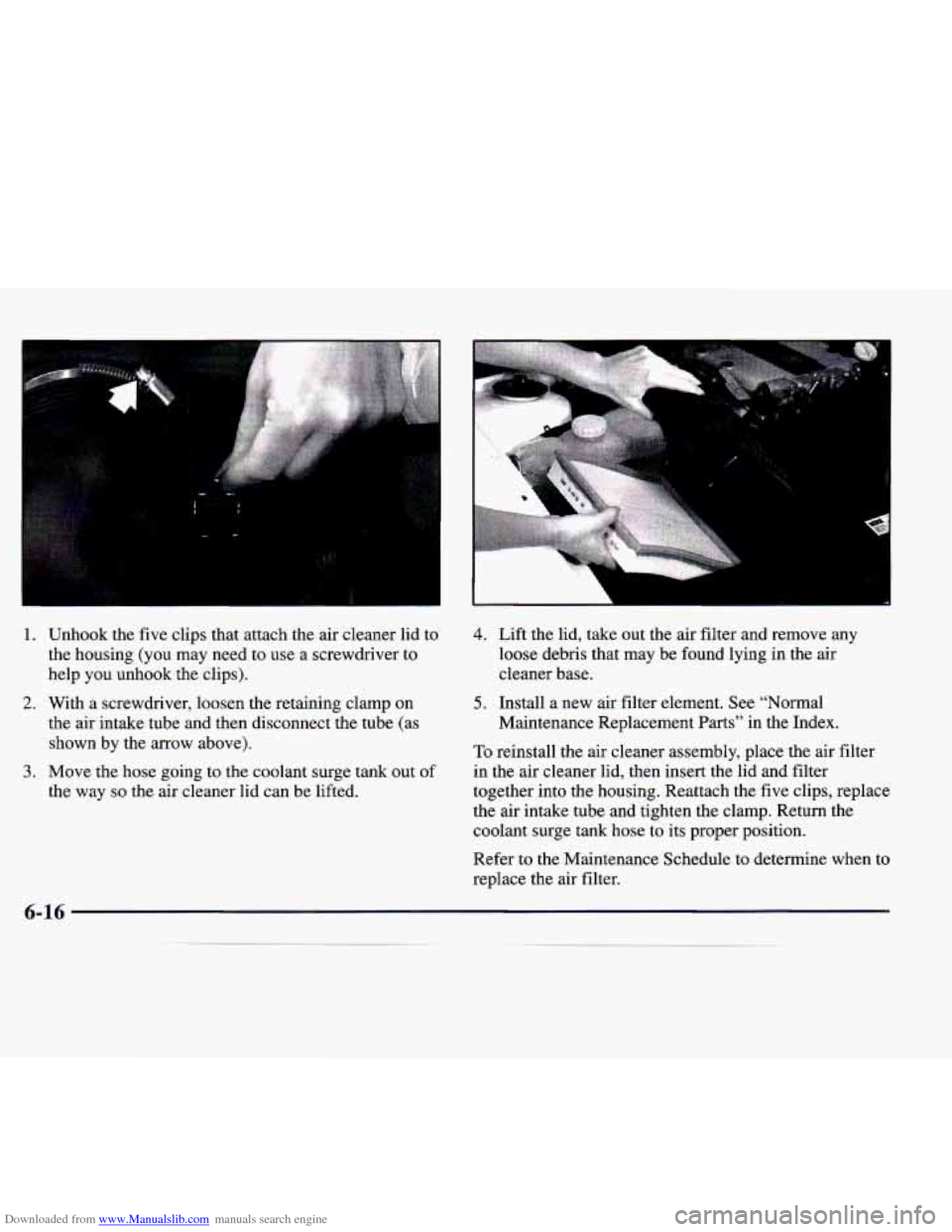
1. Unhook the five clips that attach the air cleaner lid to
the housing (you may need to use a screwdriver to
help
you unhook the clips).
2. With a screwdriver, loosen the retaining clamp on
the air intake tube and then disconnect the tube (as
shown by the arrow above).
the way
so the air cleaner lid can be lifted.
3. Move the hose going to the coolant surge tank out of
4. Lift the lid, take out [ne air filter and remove any
loose debris that may be found lying in the air
cleaner base.
5. Install a new air filter element. See “Normal
Maintenance Replacement
Parts” in the Index.
To reinstall the air cleaner assembly, place the air filter
in the air cleaner lid, then insert the lid and filter
together into the housing. Reattach the five clips, replace
the air intake tube and tighten the clamp. Return the
coolant surge tank hose to its proper position.
Refer
to the Maintenance Schedule to determine when to
replace the air filter.
Page 266 of 346

Downloaded from www.Manualslib.com manuals search engine See “Scheduled Maintenance Services” in the
Maintenance Schedule booklet.
Operating the engine with the air cleaner off can
cause you or others
to be burned. The air cleaner
not only cleans the air, it stops flame if the engine
backfires.
If it isn’t there, and the engine
backfires,
you could be burned. Don’t drive with
it off, and be careful working on the engine with
the air cleaner
off.
NOTICE: I
If the air cleaner is off, a bachfire can cause a
damaging engine fire. And, dirt can easily get
into your engine, which will damage it. Always
have the air cleaner in place when you’re driving.
Passenger Compartment Air
Filter Replacement
The passenger compartment air filter traps most of the
pollen from the air entering your vehicle. Like your
vehicle’s air cleaner filter, it may need to be changed periodically. For
how often to change the passenger
compartment air filter, see your Maintenance
Schedule booklet.
B
The access panel for the passenger compartment air
filter
is on the grille, at the base of the windshield, on
the passenger’s side.
Page 267 of 346
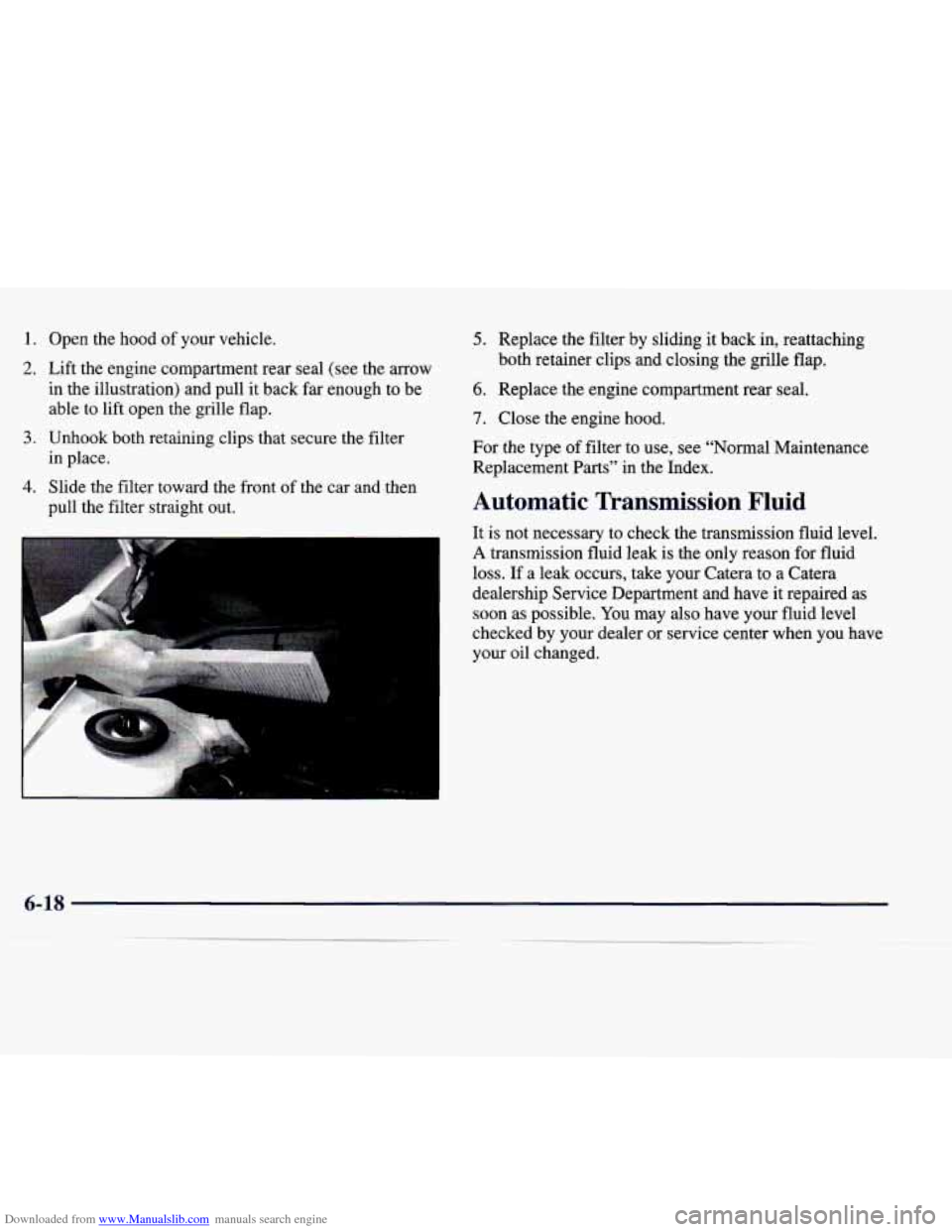
Downloaded from www.Manualslib.com manuals search engine 1. Open the hood of your vehicle.
2. Lift the engine compartment rear seal (see the arrow
in the illustration) and pull it back far enough to be
able to lift open the grille flap.
in place.
pull the filter straight out.
3. Unhook both retaining clips that secure the filter
4. Slide the filter toward the front of the car and then
5. Replace the filter by sliding it back in, reattaching
6. Replace the engine compartment rear seal.
7. Close the engine hood.
both retainer clips and closing the grille flap.
For the type of filter to use, see “Normal Maintenance
Replacement Parts” in the Index.
Automatic Transmissio~ Fluid
It is not necessary to check the transmission fluid level.
A transmission fluid leak is the only reason for fluid
loss. If a leak occurs, take your Catera to
a Catera
dealership Service Department and have it repaired as
soon as possible. You may
also have your fluid level
checked by your dealer
or service center when you have
your oil changed.
Page 268 of 346

Downloaded from www.Manualslib.com manuals search engine Change both the fluid and filter every 50,000 miles
(83 000 km) if the vehicle is mainly driven under one or
more
of these conditions:
In heavy city traffic where the outside temperature
In hilly or mountainous terrain.
When doing frequent trailer towing.
Uses such as found in taxi, police or delivery service.
If you do not use your vehicle under any of these
conditions, the fluid and filter do not require changing.
regularly
reaches
90” F (32” C) or higher.
NOTICE:
We recommend you use only fluid labeled
DEXRON@-m, because fluid with that label
is
made especially for your automatic transmission.
Damage
caused by fluid other than DEXRON@-III
is not covered by your new vehicle warranty.
Rear Axle
When to Check Lubricant
Refer to the Maintenance Schedule to determine how
often to check the lubricant. See “Periodic Maintenance
Inspections” and “Scheduled Maintenance Services” in
the Maintenance Schedule booklet.
How to Check Lubricant
If the level is below the bottom of the filler plug hole,
you’ll need to add some lubricant. Add enough lubricant
to raise the level to the bottom of the filler plug hole.
Page 269 of 346

Downloaded from www.Manualslib.com manuals search engine What to Use
Refer to the Maintenance Schedule to determine what
kind of lubricant to use. See “Recommended Fluids and
Lubricants” in the Maintenance Schedule booklet.
Engine Coolant
The cooling s stem in your vehicle is filled with
DEX-COOL engine coolant.
This coolant is designed
to remain in your vehicle for
5 years or 150,000 miles
(240 000 krnb whichever occurs first, if you add only
DEX-COOL extended life coolant.
J
The following explains your cooling system and how to
add coolant when it is low. If you have
a problem with
engine overheating, see “Engine Overheating” in
the Index.
A 50/50 mixture of water and DEX-COOL’
coolant will:
a Give freezing protection down to -34°F (-37°C).
Give boiling protection up to 265 OF (129°C).
Protect against rust and corrosion.
Help keep the proper engine temperature.
Let the warning lights and gages work as
they should.
NOTICE:
When adding coolant, it is important that you use
only
DEX-COOL@ (silicate-free) coolant.
If coolant other than DEX-COOL is added to the
system, premature engine, heater core or
radiator corrosion may result. In addition, the
engine coolant
will require change sooner -- at
30,000 miles (50 000 km) or 24 months,
whichever occurs
first. Damage caused by the use
of coolant other than DEX-COOL@
is not
covered
by your new vehicle warranty.
6-20
-
Page 273 of 346

Downloaded from www.Manualslib.com manuals search engine Power Steering Fluid
The power steering fluid reservoir is located between
the battery and the brake master cylinder on the driver’s
side of the engine.
How To Check Power Steering Fluid
When the engine compartment is cool, wipe the cap and
the top
of the reservoir clean, then unscrew the cap and
wipe the dipstick with
a clean rag. Replace the cap and
completely tighten it. Then remove the cap again and
look at the fluid level on the dipstick.
The level should be at the full mark. There are two lines
on the dipstick. The top line is the “full” mark and th\
e
bottom line is the “add” mark (which means that fluid
should be added). If necessary, add only enough fluid to
bring the level up to the full mark.
What to Use
To determine what kind of fluid to use, see
“Recommended Fluids and Lubricants” in the
Maintenance Schedule booklet. Always use the proper
fluid. Failure to use the proper fluid can cause leaks and
damage hoses and seals.
When to Check Power Steering Fluid
It is not necessary to regularly check power steering
fluid unless you suspect there is a leak in the system or
you hear an unusual noise. A fluid loss in this system
could indicate a problem. Have the system inspected
and repaired.
6-24
Page 277 of 346

Downloaded from www.Manualslib.com manuals search engine Brake Wear
Your vehicle has four-wheel disc brakes.
Your vehicle has electronic wear sensors that let you
know when the front brake pads are significantly worn
and new pads are needed. The brake pad wear indicator
light
will come on and stay on when the brake pads are
worn and need to be replaced. (See “Brake Pad Wear
Indicator Light” in the Index.)
I A CAUTION: I
The brake pad wear indicator light means that
soon your brakes won’t work well. That could
lead to an accident. When the brake pad wear
indicator light comes on and stays on, have your
vehicle serviced.
NOTICE:
Continuing to drive with worn-out brake pads
could result in costly brake repair.
Some driving conditions or climates may cause a brake
squeal when the brakes are first applied
or lightly
applied. This does not mean something is wrong with
your brakes.
Properly torqued wheel bolts are necessary to help
prevent brake pulsation. When tires are rotated, inspect
brake pads for wear and evenly torque wheel bolts in the
proper sequence to GM specifications.
Brake linings should always be replaced as complete
axle sets.
See “Brake System Inspection” in the Maintenance
Schedule booklet under
Part C “Periodic Maintenance
Inspections.”
6-28