1998 BMW CONVERTIBLE oil
[x] Cancel search: oilPage 124 of 179

12 3
At a glanceControlsCar careRepairsTechnicalDataIndex
1 Fuse box
2 Engine oil dipstick
3 Brake ßuid reservoir
4 Power steering oil reservoir
5 Coolant expansion tank
6 Engine oil Þller neck
7 Supply tank for headlamp washer
*
and windshield washer system
8 Auxiliary terminal for jump starting
Engine compartment BMW 323i, 323is, 328i, 328is
Page 125 of 179

12 4
Headlamp washer
* and
windshield washer
Capacity approx. 2.65 US quarts
(2.5 liters) for the windshield washer or
5.3 US quarts (5 liters) in conjunction
with the headlamp cleaning system.
Fill with water and - if required - with
antifreeze (according to the manufac-
turer's recommendations).b
We recommend that you mix the
washer fluid before adding it to the res-
ervoir.c
Windshield washer spray
nozzles The spray from the nozzles should be
directed so as to ensure effective
cleaning, even at high speeds.
Use a needle to adjust the nozzles as
required, or have them adjusted by your
BMW Retailer.
Checking oil level As with fuel economy, oil consumption
is directly influenced by your driving
style and vehicle operating conditions.
Consequently you should check the oil
level regularly with the vehicle posi-
tioned on a level surface - approx. every
600 miles (1,000 km), or more fre-
quently if your vehicle is driven under
increased demands.
To obtain precise readings:
dCheck with engine cold, before start-
ing.
dWhen checking with the engine
warm, wait briefly for the oil to drain
back down into the oil pan (e.g.,
while refueling).
360de100
360de095
Washer fluids Engine oil
Page 126 of 179

12 5
At a glanceControlsCar careRepairsTechnicalDataIndex
Measure the oil level:
1 Pull out dipstick and wipe off with a
lint-free cloth, paper tissue, etc.
2 Push the dipstick all the way into the
guide tube and pull it out again.
3 The oil level should be between the
two marks on the dipstick.
Add oil Wait until the level has dropped to just
above the lower graduation before add-
ing oil. Never wait until the oil drops
below the lower mark.
The space between the two marks on
the dipstick corresponds to approxi-
mately 1.1 US quarts (1 liter). Do not fill
to beyond the upper mark on the dip-
stick. Excess oil harms the engine.
Because it would be consumed within a
short period, it would also result in an
abnormally high rate of oil consump-
tion.a
BMW engines are designed to op-
erate without oil additives; the use of ad-
ditives could lead to damage in some
cases. This also applies to the manual
and automatic transmissions, the differ-
ential and the power steering system.c
Engine oil specificationsAlways refer to the API specifications
when selecting oil.
Required quality:
API SH
API-SH/CD
API-SH/CEViscosity ratingsViscosity = Oil flow rating according to
SAE class.
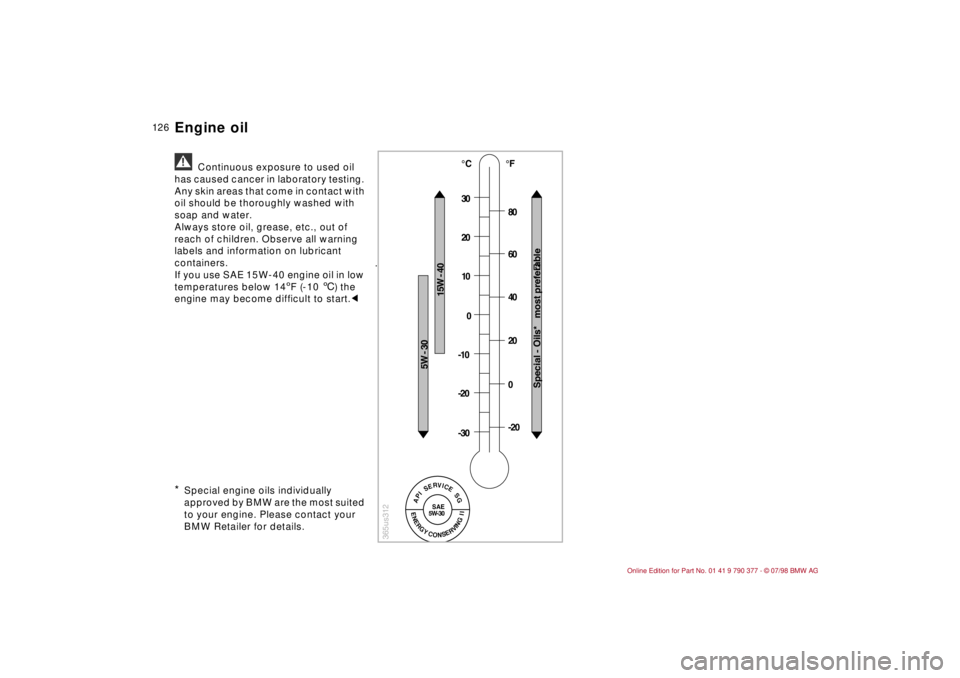
Select the SAE viscosity rating accord-
ing to the average seasonal air temper-
ature.
Consult the table on the following page
to determine the correct SAE viscosity.
You can continue to operate the vehicle
for short periods of time at tempera-
tures beyond the range for the SAE rat-
ing of the oil being used.A
Always observe all environmental
protection guidelines and regulations
when disposing of used oil.c
Recommendation: have the oil changed
by your BMW Retailer.
360de096
Engine oil
Page 127 of 179
12 6
a
Continuous exposure to used oil
has caused cancer in laboratory testing.
Any skin areas that come in contact with
oil should be thoroughly washed with
soap and water.
Always store oil, grease, etc., out of
reach of children. Observe all warning
labels and information on lubricant
containers.
If you use SAE 15W-40 engine oil in low
temperatures below 145F (-10 6) the
engine may become difficult to start.c
*Special engine oils individually
approved by BMW are the most suited
to your engine. Please contact your
BMW Retailer for details..Engine oil
Special - Oils* most preferable
15W - 40
5W - 30
30
20
10
0
-10
-20
-30-20 0 20 40 60 80 °C°F
APISERVICESG
ENERGYCONSERVINGII
SAE
5W-30
365us312
Page 130 of 179

12 9
At a glanceControlsCar careRepairsTechnicalDataIndex
High steering effort:
Check oil level, refer to previous page.
High steering effort during sudden tran-
sitions:
Please contact your BMW Retailer for
an immediate inspection.a
If the power steering fails, in-
creased effort will be required to steer
the vehicle.c
In the engine compartment on the right-
hand side of the heater partition panel
(arrow).
The information on the type plate and
the Vehicle Identification Number must
match those contained in the vehicle
papers.
These data are essential for processing
inquiries, expediting service procedures
and when ordering replacement parts.
360de310
Power steering fluid Vehicle Identification Number
Page 131 of 179

13 0
The BMW Maintenance System has
been designed as a reliable means of
providing the customer with maximum
vehicle safety and reliability with mini-
mum complication and expense.
Please remember that regular periodic
maintenance plays an essential part in
ensuring continued vehicle security. It
also helps maintain the resale value of
the vehicle.
Service Interval DisplayAdvanced technology is employed to
calculate the optimal maintenance
intervals, which are then indicated in
the Service Interval Display. While con-
ventional maintenance systems rely on
mileage alone to determine when ser-
vice is due, the BMW Maintenance Sys-
tem reflects the actual conditions under
which the vehicle is operated, because
mileage is not simply mileage:
From the point of view of maintenance,
62,000 miles (100,000 km) accumulated
in short-distance driving are not the
equivalent of the same distance cov-
ered in long-distance highway travel.
The BMW Maintenance System
includes the Engine Oil Service as well
as Inspections I and II.
Determining the maintenance intervals
according to the actual loads on the car
covers every kind of operating situation.
However, drivers who cover only
extremely short distances - substantially
less than 6,200 miles (10,000 km) annu-
ally - should have the engine oil changed
at least once a year, as it continues to
age whether or not the car is used on a
regular basis.
Service and Warranty Information
bookletPlease refer to the Service and War-
ranty Information booklet for additional
information on maintenance intervals
and procedures.
Depending on operating conditions, as
a precaution against rust it may be a
good idea to have the body checked for
stone damage and chips at the same
time.
Please ensure that all maintenance
operations are entered in the Service
and Warranty Information booklet upon
completion. These entries will consti-
tute your proof that the vehicle has
received regular maintenance. They
are also required for warranty claims.b
Have your BMW Retailer carry out
the maintenance and repair. Your BMW
Retailer is always informed on the latest
maintenance work and repair tech-
niques and equipped with the required
special tools. In addition, the testing of
parts known from experience to be sub-
ject to wear is a permanent part of the
maintenance specifications.c
360us009The BMW Maintenance System
Page 132 of 179

13 1
At a glanceControlsCar careRepairsTechnicalDataIndex
Washing your carRight from the start, you can wash your
new BMW either by hand or in an auto-
matic car wash. BMW Convertible: For
instructions on cleaning and care of the
convertible top, refer to page 136 ff.
To prevent spots, avoid washing when
the hood is still warm, or immediately
after and during exposure to strong
sunlight.
When using an automatic car wash,
ensure that
dno damage occurs to vehicles with
add-on body elements (e.g., spoilers,
telephone aerials). Consult the car
wash operator if necessary
dthe vehicle is cleaned with minimum
brush pressure, and that ample water
is available for washing and rinsing.
Loosen and remove stubborn dirt and
dead insects before washing the car.
a
Always maintain an adequate dis-
tance between the spray source and the
vehicle's surface when using spray
wands and high-pressure washers. In-
adequate distance and excessive pres-
sure can damage or weaken the finish,
making it more susceptible to subse-
quent attack. In addition, moisture could
penetrate to vehicle components, lead-
ing to long-term damage.c
Parts of the car which are inaccessible
to the automatic washer - such as door
sills, door and hood edges, etc. -
should be cleaned by hand.
b
Please observe the following
when cleaning the headlamp covers:
dDo not clean by wiping with a dry
cloth (scratches). Never use abra-
sives or strong solvents to clean the
covers.
dRemove dirt and contamination (such
as insects) by soaking with BMW Car
Shampoo and then rinsing with
plenty of water.
dAlways use a de-icer spray to remove
accumulated ice and snow Ð Never
use a scraper!cIn the winter months, it is especially
important to ensure that the car is
washed on a regular basis. Large quan-
tities of dirt and road salt are difficult to
remove, and they also cause damage to
the vehicle.
a
After washing, the brakes may be
wet and thus less effective! Apply the
brakes briefly to dry them.c
Caring for your car
Page 133 of 179

13 2
Exterior finishTo provide effective corrosion protec-
tion, multilayer paintwork is applied at
the factory. Cataphoretic immersion
priming techniques are supplemented
using special body-cavity protectants,
with the application of specially-devel-
oped and extensively tested materials.
The entire underbody is sprayed with a
flexible PVC layer before final compre-
hensive application of a wax-based
protectant.
Regular maintenance makes an impor-
tant contribution to maintaining the
safety and value of your vehicle.
Increasing awareness of the effects of
harmful environmental factors on vehi-
cle finishes have led paint and vehicle
manufacturers to initiate ongoing pro-
grams designed to further improve the
durability of their finishes. Despite the
high quality of the resulting products,
local and regional factors can still have
a negative effect on your car's paint-
work. These should guide you in deter-
mining the frequency and extent of your
efforts to maintain the vehicle finish.
Depending upon material and type of
impact (perforation of paint layer), phys-
ical stresses from sand, road salt,
gravel, etc. can cause corrosion to start extending beneath the finish, starting at
the point of impact.
Road dirt, tar spots, dead insects, ani-
mal droppings (strong alkali effect) and
tree excretions (resins and pollen) all
contain substances capable of causing
damage when allowed to remain on
your car's finish for any period of time
(spots, etching, flaking, separation in
the top coat).
In industrial areas, deposits from ßy ash,
lime, oily soot, sulphur dioxide in pre-
cipitation (acid rain) and other environ-
mental pollutants will damage the car's
surface (usually limited to the external
horizontal surfaces) unless adequate
protection is provided.
In coastal regions, high levels of atmo-
spheric salt and humidity promote cor-
rosion.
In tropical zones, temperatures of over
100 5F (approx. 406) in the shade pre-
vail, in addition to heavy ultraviolet radi-
ation and high humidity. Under those
circumstances, light-colored paints
reach temperatures of up to 175 5F
(approx. 806) and dark paints up to
250 5F (approx. 1206).
Caring for the vehicle finishAs a precaution against damage result-
ing from exposure to aggressive sub-
stances, we recommend that you wash
the car weekly when it is used in an
area with high levels of air pollution or
aggressive natural substances (tree
resin, pollen).
Remove particularly aggressive sub-
stances immediately in order to prevent
changes to, and discoloration of, the
paint. Such substances are e.g., gaso-
line spilled during refueling, oil, grease,
brake fluid and bird droppings.
Any contamination remaining on the
surface of the vehicle will be especially
conspicuous after washing. Use clean-
ing fluid or alcohol with a clean cloth or
cotton pad to remove. You can use tar
remover to remove any spots on the fin-
ish of the vehicle, but should never
apply it or any other aggressive
cleanser to lenses or headlamp covers.
These areas should then be waxed to
maintain protection.b
A full range of car-care products is
available from your BMW Retailer.c
Caring for your car