1998 BMW CONVERTIBLE brake light
[x] Cancel search: brake lightPage 104 of 179

10 3
At a glanceControlsCar careRepairsTechnicalDataIndex
ABS enhances active safety by helping
to prevent the wheels from locking under
braking. When the front wheels slide, the
driver loses steering control over the
vehicle. Traction loss at the rear wheels
can cause the rear end to break into
uncontrolled oversteer.
ABS is designed to meet two essential
requirements during every application:
dto help provide vehicle stability on all
types of road surface (asphalt,
cement, dirt, moisture, snow and ice).
dto help to retain steering and maneu-
vering capability under the same con-
ditions.
However, certain important consider-
ations must be borne in mind in connec-
tion with these requirements:
Not even ABS can suspend the normal
laws of physics. ABS alone can not pre-
vent accidents when the brakes are
applied without an adequate safety
interval between vehicles, when the car
reaches excessive rates of lateral accel-
eration in curves, or if aquaplaning
occurs. Responsibility for these types of
situations remains in the hands (and feet)
of the driver. You should never allow the
added safety of ABS to lull you into a
false sense of security, or mislead you
into taking increased risks that could
affect your own safety and that of others.
Driving with ABSThe yellow ABS warning in the instru-
ment panel goes out as soon as the
engine is started.
The system becomes operative once the
vehicle exceeds a speed of 5 mph
(8 km/h). The ABS is deactivated when-
ever the vehicle's speed drops below
approx. 2 mph (3 km/h). This means that
the wheels can lock in the Þnal phase of
a braking action - a factor of no signiÞ-
cance in actual practice.
The ABS system closed-loop control cir-
cuit cycles in fractions of a second. A
pulsation at the brake pedal indicates to
the driver that ABS is active, that is, that
the car is within its maximum braking
range. In addition, the audible pulsation
that accompanies the control operation
calls your attention to the reduced trac-
tion between tires and road surface
(marginal adhesion), and reminds you
that the vehicle's speed should be
reduced to adapt to road conditions.On road surfaces featuring a loose top
layer on a Þrmer substratum, e.g., on
gravel or snow, the braking distances
with ABS may be longer than with the
wheels locked. However, ABS continues
to provide enhanced vehicle and steer-
ing control under these conditions.
a
To ensure that the system remains
completely operational, never modify the
ABS. Service procedures on ABS are to
be performed by authorized technicians
only.c
ABS may fail to function with maximum
efÞciency when tires of different sizes
are mounted (e.g., winter tires/spare tire;
remount the correct tires at all wheels as
soon as possible).
In the event of a fault, the ABS warning
lamp in the instrument cluster lights up,
refer to page 18. The braking system
then reverts to conventional operation as
on a vehicle without ABS. However,
have the brake system checked by your
BMW Retailer as soon as possible. To
prevent undetected defects and cumu-
lative faults from adversely affecting the
brake system, refer any problems to
your authorized BMW Retailer at the
earliest opportunity.
Antilock Brake System (ABS)
Page 105 of 179

10 4
Disc brakes furnish optimum decelera-
tion and braking control as well as
greater fade resistance under heavy
use.
Limited vehicle use, extended periods
with the car parked or in storage and
light loading will increase the tendency
for corrosion to form on the rotors, and
dirt to accumulate on the pads. This
happens because the minimum pres-
sure between the pad and the disc
required for the self-cleaning function
of the disc brakes is not achieved.
If the brake rotors are corroded, they
will tend to respond to braking with a
pulsating effect which even extended
application will fail to cure.
a
Use only original BMW-approved
brake pads, as otherwise vehicle autho-
rization is no longer valid.c
Driving notes While driving in wet conditions and in
heavy rain, it is a good idea to apply
light pressure to the brake pedal every
few miles - Watch traffic conditions to
ensure that this maneuver does not
endanger other road users. The heat
generated in this braking process helps
dry the brake pads and rotors.
Maximum braking force is obtained
while the wheels continue to rotate,
peaking when the wheels remain on the
verge of locking without actually doing
so. ABS maintains this state automati-
cally. If the ABS fails, you should revert
to the staggered braking technique
described above (refer to page 106).
Extended or steep mountain descents
do not necessarily have to lead to
reduced braking efficiency; downshift
to a gear in which only minimal periodic
brake applications are required (you
can move the selector lever to the
appropriate lower range if your car is
equipped with an automatic transmis-
sion).
You can further increase the engine's
braking effect by selecting a lower gear,
downshifting as far as first gear or plac-
ing the selector lever in position 1 (2).Should engine braking prove inade-
quate, you should still avoid extended,
continuous braking. Instead of main-
taining low to moderate pressure over
an extended period of time, you should
decelerate the vehicle by applying more
substantial force at the pedal (watch for
following traffic!) and then pausing
before repeating the application. This
staggered braking technique allows the
brakes to cool in the intervals between
active braking phases, preventing over-
heating and ensuring that full braking
capacity remains available at all times.
a
Do not allow the vehicle to coast by
pressing down the clutch pedal or shift-
ing into neutral while underway. Never
drive with the engine switched
off (!). The engine provides no braking
effect when the clutch is disengaged or
the transmission is in neutral, and there
is no power-assist for brakes and steer-
ing when the engine is not running.
Never allow floor mats, carpets or other
objects to protrude into the area around
the accelerator, clutch and brake pedals
and obstruct their movement.c
Disc brakes
Page 107 of 179

10 6
BrakesWinter road conditions substantially
reduce the amount of traction available
between the tires and the road surface;
the resulting - considerable - increases
in braking distance should be continu-
ally borne in mind.
ABS is intended to prevent the wheels
from locking under braking; to help the
vehicle to remain stable and sensitive to
steering. Should the ABS fail, with lock-
ing wheels as a result: Reduce the
pressure on the brake pedal until the
wheels just start to roll again while still
maintaining enough force to continue
braking. Then increase the pressure,
release the pressure when the wheels
lock, reapply pressure, etc.
This staggered braking procedure will
reduce stopping distances while help-
ing you maintain steering control.
It can allow you to steer around hazards
once you have reduced the pressure on
the brake pedal.
a
Never downshift to exploit engine
braking when driving on slippery road
surfaces; it could lead to loss of rear-
wheel traction and endanger vehicle
control. ABS and ASC+T can not protect
against such loss of traction, since they
have no effect on this kind of decelera-
tion.c
b
Disengage the clutch during hard
braking on road surfaces affording only
poor or uneven traction.c
Loss of lateral traction (sliding)Release the accelerator pedal and
depress the clutch pedal or push the
selector lever to position N with auto-
matic transmission. Countersteer care-
fully and attempt to regain control of the
vehicle.
ParkingSelect 1st or reverse gear. If your car is
equipped with an automatic transmis-
sion, select Park. Engage the parking
brake when parking on hills and
inclined surfaces. To prevent frost and
corrosion from locking the parking
brake liners at the drum, you can dry
them by gently pulling up the lever
while stopping (ensure that you do not
endanger following traffic).a
The brake lamps do not light up
when the parking brake is applied.c
Winter driving
Page 129 of 179
12 8
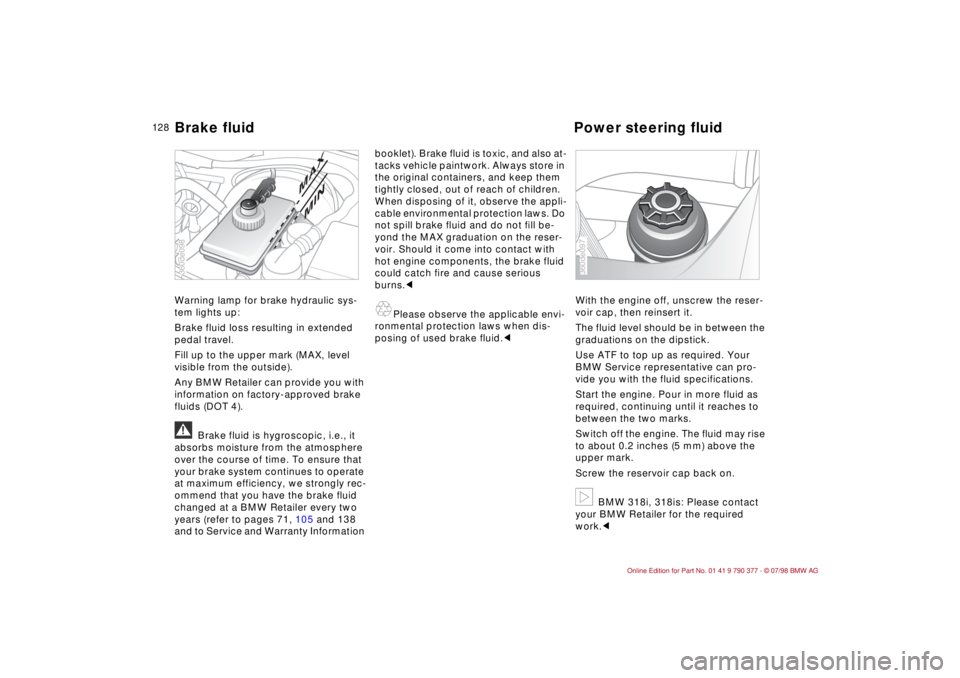
Warning lamp for brake hydraulic sys-
tem lights up:
Brake fluid loss resulting in extended
pedal travel.
Fill up to the upper mark (MAX, level
visible from the outside).
Any BMW Retailer can provide you with
information on factory-approved brake
fluids (DOT 4).
a
Brake fluid is hygroscopic, i.e., it
absorbs moisture from the atmosphere
over the course of time. To ensure that
your brake system continues to operate
at maximum efficiency, we strongly rec-
ommend that you have the brake fluid
changed at a BMW Retailer every two
years (refer to pages 71, 105 and 138
and to Service and Warranty Information booklet). Brake fluid is toxic, and also at-
tacks vehicle paintwork. Always store in
the original containers, and keep them
tightly closed, out of reach of children.
When disposing of it, observe the appli-
cable environmental protection laws. Do
not spill brake fluid and do not fill be-
yond the MAX graduation on the reser-
voir. Should it come into contact with
hot engine components, the brake fluid
could catch fire and cause serious
burns.c
A
Please observe the applicable envi-
ronmental protection laws when dis-
posing of used brake fluid.cWith the engine off, unscrew the reser-
voir cap, then reinsert it.
The fluid level should be in between the
graduations on the dipstick.
Use ATF to top up as required. Your
BMW Service representative can pro-
vide you with the fluid specifications.
Start the engine. Pour in more fluid as
required, continuing until it reaches to
between the two marks.
Switch off the engine. The fluid may rise
to about 0.2 inches (5 mm) above the
upper mark.
Screw the reservoir cap back on.
b
BMW 318i, 318is: Please contact
your BMW Retailer for the required
work.c
MAXMIN
360de098
360de097
Brake fluid Power steering fluid
Page 132 of 179

13 1
At a glanceControlsCar careRepairsTechnicalDataIndex
Washing your carRight from the start, you can wash your
new BMW either by hand or in an auto-
matic car wash. BMW Convertible: For
instructions on cleaning and care of the
convertible top, refer to page 136 ff.
To prevent spots, avoid washing when
the hood is still warm, or immediately
after and during exposure to strong
sunlight.
When using an automatic car wash,
ensure that
dno damage occurs to vehicles with
add-on body elements (e.g., spoilers,
telephone aerials). Consult the car
wash operator if necessary
dthe vehicle is cleaned with minimum
brush pressure, and that ample water
is available for washing and rinsing.
Loosen and remove stubborn dirt and
dead insects before washing the car.
a
Always maintain an adequate dis-
tance between the spray source and the
vehicle's surface when using spray
wands and high-pressure washers. In-
adequate distance and excessive pres-
sure can damage or weaken the finish,
making it more susceptible to subse-
quent attack. In addition, moisture could
penetrate to vehicle components, lead-
ing to long-term damage.c
Parts of the car which are inaccessible
to the automatic washer - such as door
sills, door and hood edges, etc. -
should be cleaned by hand.
b
Please observe the following
when cleaning the headlamp covers:
dDo not clean by wiping with a dry
cloth (scratches). Never use abra-
sives or strong solvents to clean the
covers.
dRemove dirt and contamination (such
as insects) by soaking with BMW Car
Shampoo and then rinsing with
plenty of water.
dAlways use a de-icer spray to remove
accumulated ice and snow Ð Never
use a scraper!cIn the winter months, it is especially
important to ensure that the car is
washed on a regular basis. Large quan-
tities of dirt and road salt are difficult to
remove, and they also cause damage to
the vehicle.
a
After washing, the brakes may be
wet and thus less effective! Apply the
brakes briefly to dry them.c
Caring for your car
Page 133 of 179

13 2
Exterior finishTo provide effective corrosion protec-
tion, multilayer paintwork is applied at
the factory. Cataphoretic immersion
priming techniques are supplemented
using special body-cavity protectants,
with the application of specially-devel-
oped and extensively tested materials.
The entire underbody is sprayed with a
flexible PVC layer before final compre-
hensive application of a wax-based
protectant.
Regular maintenance makes an impor-
tant contribution to maintaining the
safety and value of your vehicle.
Increasing awareness of the effects of
harmful environmental factors on vehi-
cle finishes have led paint and vehicle
manufacturers to initiate ongoing pro-
grams designed to further improve the
durability of their finishes. Despite the
high quality of the resulting products,
local and regional factors can still have
a negative effect on your car's paint-
work. These should guide you in deter-
mining the frequency and extent of your
efforts to maintain the vehicle finish.
Depending upon material and type of
impact (perforation of paint layer), phys-
ical stresses from sand, road salt,
gravel, etc. can cause corrosion to start extending beneath the finish, starting at
the point of impact.
Road dirt, tar spots, dead insects, ani-
mal droppings (strong alkali effect) and
tree excretions (resins and pollen) all
contain substances capable of causing
damage when allowed to remain on
your car's finish for any period of time
(spots, etching, flaking, separation in
the top coat).
In industrial areas, deposits from ßy ash,
lime, oily soot, sulphur dioxide in pre-
cipitation (acid rain) and other environ-
mental pollutants will damage the car's
surface (usually limited to the external
horizontal surfaces) unless adequate
protection is provided.
In coastal regions, high levels of atmo-
spheric salt and humidity promote cor-
rosion.
In tropical zones, temperatures of over
100 5F (approx. 406) in the shade pre-
vail, in addition to heavy ultraviolet radi-
ation and high humidity. Under those
circumstances, light-colored paints
reach temperatures of up to 175 5F
(approx. 806) and dark paints up to
250 5F (approx. 1206).
Caring for the vehicle finishAs a precaution against damage result-
ing from exposure to aggressive sub-
stances, we recommend that you wash
the car weekly when it is used in an
area with high levels of air pollution or
aggressive natural substances (tree
resin, pollen).
Remove particularly aggressive sub-
stances immediately in order to prevent
changes to, and discoloration of, the
paint. Such substances are e.g., gaso-
line spilled during refueling, oil, grease,
brake fluid and bird droppings.
Any contamination remaining on the
surface of the vehicle will be especially
conspicuous after washing. Use clean-
ing fluid or alcohol with a clean cloth or
cotton pad to remove. You can use tar
remover to remove any spots on the fin-
ish of the vehicle, but should never
apply it or any other aggressive
cleanser to lenses or headlamp covers.
These areas should then be waxed to
maintain protection.b
A full range of car-care products is
available from your BMW Retailer.c
Caring for your car
Page 147 of 179
14 6
a
Change tires only on a flat, hard
surface affording good traction. Avoid
jacking the car on a soft or slippery sup-
port surface (snow, ice, loose gravel,
etc.), as it could slide sideways.
Take extra care to ensure that the base
of the jack is positioned on a solid sup-
port surface.
Never use wooden blocks or similar
objects to support the base of the jack,
as the weight of the car could exceed
their support capacity.
Never lie beneath the vehicle or start
the engine while the car is supported by
the jack - risk of fatal injury.
Additional precautions to observe when
changing flat tires:
When pulling over on the roadside to
change a tire, always try to park the car
as far as possible from passing traffic.
Switch on the hazard flashers.
All passengers should be outside the
car and well away from your immediate
working area (e.g., behind the guard-
rail).Turn the steering wheel to the straight-
ahead position, remove the key and
engage the steering lock. Shift into 1st
or reverse (selector lever in Park with
automatic) and engage the parking
brake.
If a warning triangle or portable hazard
warning lamp is available, set it up on
the roadside at an appropriate distance
from the rear of the vehicle. Observe all
safety guidelines and regulations.c
b
To avoid rattling noises, note the
positions of the tools and return them to
their original positions.c
To change the tire you will need
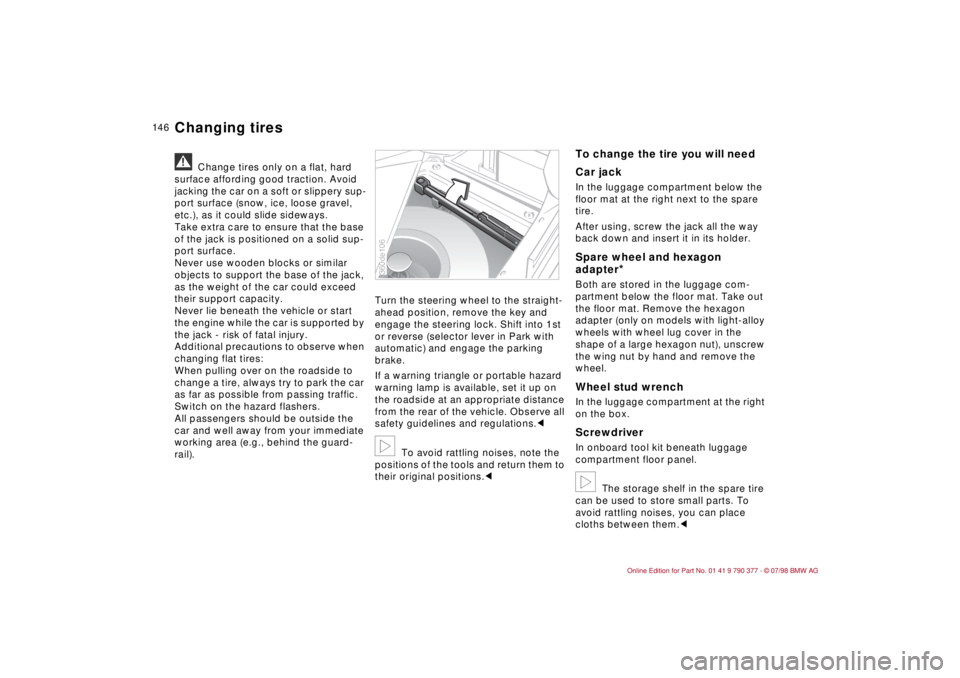
Car jackIn the luggage compartment below the
floor mat at the right next to the spare
tire.
After using, screw the jack all the way
back down and insert it in its holder.Spare wheel and hexagon
adapter
*
Both are stored in the luggage com-
partment below the floor mat. Take out
the floor mat. Remove the hexagon
adapter (only on models with light-alloy
wheels with wheel lug cover in the
shape of a large hexagon nut), unscrew
the wing nut by hand and remove the
wheel.Wheel stud wrench In the luggage compartment at the right
on the box. ScrewdriverIn onboard tool kit beneath luggage
compartment floor panel.b
The storage shelf in the spare tire
can be used to store small parts. To
avoid rattling noises, you can place
cloths between them.c
360de106
Changing tires
Page 171 of 179

170
Note: This index does not correspond to the original manual in all details
AABS (Antilock Brake
System)
103
Acceleration values
163
Activated charcoal filter
92
Adjusting steering wheel 45
Air conditioner
91
Air distribution 90
Air pressure
111
Air supply
92
Airbag
50
Aluminum wheel
115
Antifreeze
105
, 127
Antifreeze,
Radiator
105
, 127
Antifreeze,
radiator
127, 105
Anti-lock braking system
ABS
103
Aquaplaning
100
, 111
ASC+T Automatic stability
control plus
Traction
Traktion
10
, 84
Ashtray
94
AUC Automatic
recirculated-air control
91
Automatic car washes
131
Automatic recirculated-air
control AUC
91
Automatic stability control
plus traction
ASC+T
10
, 84Automatic transmission
58
Capacity
166
Filling capacity
166
Autoradio
108
Average fuel
consumption
79
Average speed 78
Axle load, permissible
163
BBackrest unlock
45
Backup lights
57
, 143
Battery
149
, 167
Removal and
installation 150
Symbols
149
Battery capacity
167
Battery change
Key
145
Battery charge current
20
Battery electrolyte
149
Battery, discharged 153
Belts
47
blower 92
BMW Convertible
Car wash
136
Care
136
Electrical
Convertible top
actuation
39
Emergency closure
41
Fully automatic
Convertible top
actuation
39Hardtop
109
Manual convertible top
Actuation 41
Manual convertible top
actuation 37
Rear window
Ventilation 91
, 105
Rollover protection
system
52
Ski bag 97
Storage compartment
95
Vehicle
decommissioning
137
BMW Convrtible
Electrical windows
Lifters
36
BMW Hi-Fi System
93
BMW Sport seat
44
Brake fluid
128
Brake lights,
Replace bulbs
143
Brake pads
20
Brake system hydraulic
circuits
21
Brake-in procedure
100
Brakes
104
Defects 128
Interference
105
Braking system 105
Breaking in vehicle
100
Bulb replacement 141
CCar battery
149
Car wash
131
CARB OBD II interface
24
Care of upholstery
134
Care of wool velour 134
Care, exterior
132
Care, interior 133
Care, vehicle exterior
132
Catalytic converter
102
Cellular phone
108
Center armrest 95
Central brake light
143
Central locking system
31
Central locking system
button
32
Central locking unit
31
Changes,
technical
6
Charge-current indicator
light
20
Charging the battery
150
Check air pressure
25
Check control
71
Check Control with outside
temperature gauge and
digital clock 74
Check engine oil level
124
CHECK key
71
Check oil level 124
Childproof door locks
52
Child-restraint system 48
Cigarette lighter
94
Everything from A to Z