1998 BMW CONVERTIBLE automatic transmission
[x] Cancel search: automatic transmissionPage 60 of 179

59
At a glanceControls Car careRepairsTechnicalDataIndex
D - Drive (automatic shift program)This position is designed for driving
under all normal operating conditions.
All forward gears are selected by the
transmission as necessary. 3 - Sport Program, direct controlThis position is designed for perfor-
mance-oriented driving, and features
delayed upshifts for optimal utilization
of the vehicle's power reserves.
When D is engaged, the transmission
may respond to certain conditions by
repeatedly shifting between 3rd and 4th
gears. You can select this position to
suppress upshifts into 4th gear and pre-
vent the transmission from "hunting" in
this way.
2 and 1 - Mountain ascents and
engine brakingSelect these positions to prevent un-
desired shifts on mountain roads or
extended uphill and downhill stretches.
These ranges let you use the engine's
braking effect to maximum advantage.
The transmission upshifts only as far as
the selected gear (1st or 2nd).
Do not move the selector lever to either
of these positions when traveling at
speeds of 108 mph (170 km/h) or
above. The transmission downshifts
only at correspondingly low speeds."Kickdown" (automatic downshift)To obtain maximum acceleration, the
accelerator pedal can be depressed
beyond the normal to the full-throttle
position, at which a pressure point must
be overcome.
Shift programsA - Automatic program
For economical driving. This is the initial
position each time the engine is started.
M - Manual program
This program is for driving conditions
under which the selected gear is to be
retained. The transmission then remains
in this gear both when starting off and
during acceleration. With this program
you drive only in 3rd gear in position D.
It is advantageous, e.g., on slopes or
when towing a trailer, to drive in selec-
tor lever position 1 or 2, or in winter on
slippery roads in selector lever position
3, which enables gentle starts and pre-
vents undesirable shifting.
Automatic transmission*
Page 61 of 179

60
Indicator lamp for shift
electronicsdIf the lamp fails to go out or
dif it lights up during driving, there is a
malfunction in the shifting electronics
or in the transmission.
Bring the vehicle to a stop, select trans-
mission position "P", set the parking
brake and turn the engine off (ignition
key to position 0).
Wait a few seconds, then start the
engine.
If the indicator lamp goes out after a
few seconds, normal transmission per-
formance has been restored. Drive off
normally.
If the indicator lamp does not go out, all
selector lever positions can still be
selected, however in the forward posi-
tions the vehicle has limited perfor-
mances as it drives only in the 3rd or
4th gear.
If this happens, avoid extreme engine
loads and consult the nearest autho-
rized BMW Retailer.
a
Never carry out any work in the
engine compartment without first
ensuring that the transmission is in Park
or Neutral. Never leave children in the
vehicle unattended.c
For information on tow-starting, towing
and jump starting refer to pages 153
and 154.
1 High beam (blue indicator lamp)
2 Headlamp ßasher
3 Turn signal indicator (green indicator
lamp and rhythmic ticking of the
blinker relay).
Flashing of the indicator lamp and tick-
ing faster than normal: a turn-indicator
lamp is defective.
To signal brieflyPress the lever up to but not beyond the
lock.
O
Goes out after the engine has
started.
1
2
3
3
360de039
Automatic transmission*Turn signals/high beam
Page 63 of 179
62
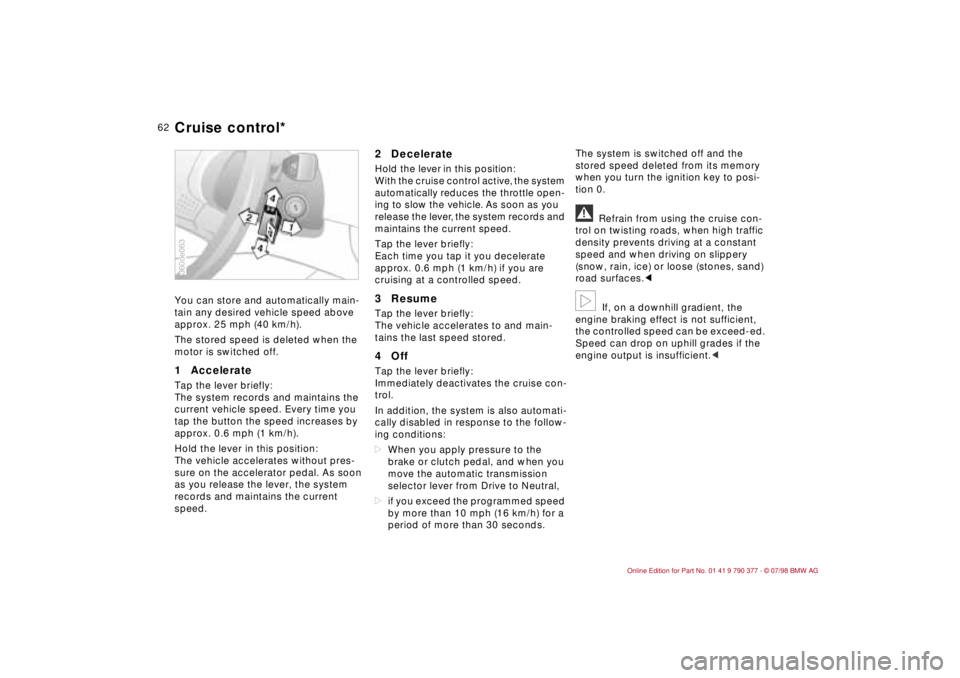
You can store and automatically main-
tain any desired vehicle speed above
approx. 25 mph (40 km/h).
The stored speed is deleted when the
motor is switched off.
1 Accelerate Tap the lever briefly:
The system records and maintains the
current vehicle speed. Every time you
tap the button the speed increases by
approx. 0.6 mph (1 km/h).
Hold the lever in this position:
The vehicle accelerates without pres-
sure on the accelerator pedal. As soon
as you release the lever, the system
records and maintains the current
speed.
2 DecelerateHold the lever in this position:
With the cruise control active, the system
automatically reduces the throttle open-
ing to slow the vehicle. As soon as you
release the lever, the system records and
maintains the current speed.
Tap the lever briefly:
Each time you tap it you decelerate
approx. 0.6 mph (1 km/h) if you are
cruising at a controlled speed.3 ResumeTap the lever briefly:
The vehicle accelerates to and main-
tains the last speed stored.4 OffTap the lever briefly:
Immediately deactivates the cruise con-
trol.
In addition, the system is also automati-
cally disabled in response to the follow-
ing conditions:
dWhen you apply pressure to the
brake or clutch pedal, and when you
move the automatic transmission
selector lever from Drive to Neutral,
dif you exceed the programmed speed
by more than 10 mph (16 km/h) for a
period of more than 30 seconds.The system is switched off and the
stored speed deleted from its memory
when you turn the ignition key to posi-
tion 0.
a
Refrain from using the cruise con-
trol on twisting roads, when high traffic
density prevents driving at a constant
speed and when driving on slippery
(snow, rain, ice) or loose (stones, sand)
road surfaces.c
b
If, on a downhill gradient, the
engine braking effect is not sufficient,
the controlled speed can be exceed-ed.
Speed can drop on uphill grades if the
engine output is insufficient.c
360de063Cruise control*
Page 105 of 179

10 4
Disc brakes furnish optimum decelera-
tion and braking control as well as
greater fade resistance under heavy
use.
Limited vehicle use, extended periods
with the car parked or in storage and
light loading will increase the tendency
for corrosion to form on the rotors, and
dirt to accumulate on the pads. This
happens because the minimum pres-
sure between the pad and the disc
required for the self-cleaning function
of the disc brakes is not achieved.
If the brake rotors are corroded, they
will tend to respond to braking with a
pulsating effect which even extended
application will fail to cure.
a
Use only original BMW-approved
brake pads, as otherwise vehicle autho-
rization is no longer valid.c
Driving notes While driving in wet conditions and in
heavy rain, it is a good idea to apply
light pressure to the brake pedal every
few miles - Watch traffic conditions to
ensure that this maneuver does not
endanger other road users. The heat
generated in this braking process helps
dry the brake pads and rotors.
Maximum braking force is obtained
while the wheels continue to rotate,
peaking when the wheels remain on the
verge of locking without actually doing
so. ABS maintains this state automati-
cally. If the ABS fails, you should revert
to the staggered braking technique
described above (refer to page 106).
Extended or steep mountain descents
do not necessarily have to lead to
reduced braking efficiency; downshift
to a gear in which only minimal periodic
brake applications are required (you
can move the selector lever to the
appropriate lower range if your car is
equipped with an automatic transmis-
sion).
You can further increase the engine's
braking effect by selecting a lower gear,
downshifting as far as first gear or plac-
ing the selector lever in position 1 (2).Should engine braking prove inade-
quate, you should still avoid extended,
continuous braking. Instead of main-
taining low to moderate pressure over
an extended period of time, you should
decelerate the vehicle by applying more
substantial force at the pedal (watch for
following traffic!) and then pausing
before repeating the application. This
staggered braking technique allows the
brakes to cool in the intervals between
active braking phases, preventing over-
heating and ensuring that full braking
capacity remains available at all times.
a
Do not allow the vehicle to coast by
pressing down the clutch pedal or shift-
ing into neutral while underway. Never
drive with the engine switched
off (!). The engine provides no braking
effect when the clutch is disengaged or
the transmission is in neutral, and there
is no power-assist for brakes and steer-
ing when the engine is not running.
Never allow floor mats, carpets or other
objects to protrude into the area around
the accelerator, clutch and brake pedals
and obstruct their movement.c
Disc brakes
Page 107 of 179

10 6
BrakesWinter road conditions substantially
reduce the amount of traction available
between the tires and the road surface;
the resulting - considerable - increases
in braking distance should be continu-
ally borne in mind.
ABS is intended to prevent the wheels
from locking under braking; to help the
vehicle to remain stable and sensitive to
steering. Should the ABS fail, with lock-
ing wheels as a result: Reduce the
pressure on the brake pedal until the
wheels just start to roll again while still
maintaining enough force to continue
braking. Then increase the pressure,
release the pressure when the wheels
lock, reapply pressure, etc.
This staggered braking procedure will
reduce stopping distances while help-
ing you maintain steering control.
It can allow you to steer around hazards
once you have reduced the pressure on
the brake pedal.
a
Never downshift to exploit engine
braking when driving on slippery road
surfaces; it could lead to loss of rear-
wheel traction and endanger vehicle
control. ABS and ASC+T can not protect
against such loss of traction, since they
have no effect on this kind of decelera-
tion.c
b
Disengage the clutch during hard
braking on road surfaces affording only
poor or uneven traction.c
Loss of lateral traction (sliding)Release the accelerator pedal and
depress the clutch pedal or push the
selector lever to position N with auto-
matic transmission. Countersteer care-
fully and attempt to regain control of the
vehicle.
ParkingSelect 1st or reverse gear. If your car is
equipped with an automatic transmis-
sion, select Park. Engage the parking
brake when parking on hills and
inclined surfaces. To prevent frost and
corrosion from locking the parking
brake liners at the drum, you can dry
them by gently pulling up the lever
while stopping (ensure that you do not
endanger following traffic).a
The brake lamps do not light up
when the parking brake is applied.c
Winter driving
Page 126 of 179

12 5
At a glanceControlsCar careRepairsTechnicalDataIndex
Measure the oil level:
1 Pull out dipstick and wipe off with a
lint-free cloth, paper tissue, etc.
2 Push the dipstick all the way into the
guide tube and pull it out again.
3 The oil level should be between the
two marks on the dipstick.
Add oil Wait until the level has dropped to just
above the lower graduation before add-
ing oil. Never wait until the oil drops
below the lower mark.
The space between the two marks on
the dipstick corresponds to approxi-
mately 1.1 US quarts (1 liter). Do not fill
to beyond the upper mark on the dip-
stick. Excess oil harms the engine.
Because it would be consumed within a
short period, it would also result in an
abnormally high rate of oil consump-
tion.a
BMW engines are designed to op-
erate without oil additives; the use of ad-
ditives could lead to damage in some
cases. This also applies to the manual
and automatic transmissions, the differ-
ential and the power steering system.c
Engine oil specificationsAlways refer to the API specifications
when selecting oil.
Required quality:
API SH
API-SH/CD
API-SH/CEViscosity ratingsViscosity = Oil flow rating according to
SAE class.
Select the SAE viscosity rating accord-
ing to the average seasonal air temper-
ature.
Consult the table on the following page
to determine the correct SAE viscosity.
You can continue to operate the vehicle
for short periods of time at tempera-
tures beyond the range for the SAE rat-
ing of the oil being used.A
Always observe all environmental
protection guidelines and regulations
when disposing of used oil.c
Recommendation: have the oil changed
by your BMW Retailer.
360de096
Engine oil
Page 155 of 179
15 4
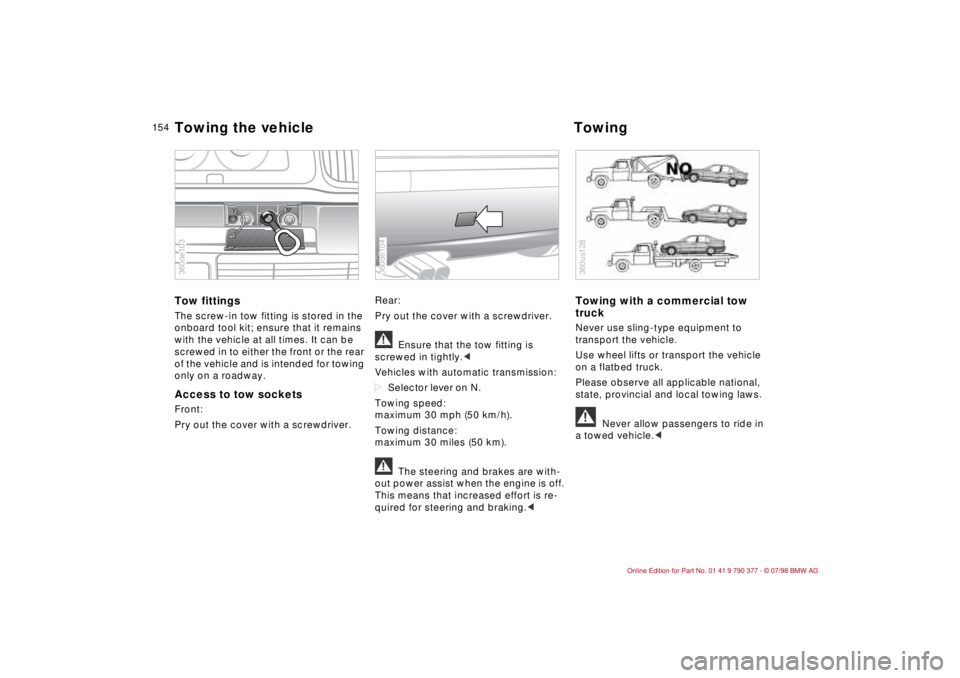
Tow fittingsThe screw-in tow fitting is stored in the
onboard tool kit; ensure that it remains
with the vehicle at all times. It can be
screwed in to either the front or the rear
of the vehicle and is intended for towing
only on a roadway. Access to tow socketsFront:
Pry out the cover with a screwdriver.Rear:
Pry out the cover with a screwdriver.
a
Ensure that the tow fitting is
screwed in tightly.c
Vehicles with automatic transmission:
dSelector lever on N.
Towing speed:
maximum 30 mph (50 km/h).
Towing distance:
maximum 30 miles (50 km).
a
The steering and brakes are with-
out power assist when the engine is off.
This means that increased effort is re-
quired for steering and braking.c
Towing with a commercial tow
truckNever use sling-type equipment to
transport the vehicle.
Use wheel lifts or transport the vehicle
on a flatbed truck.
Please observe all applicable national,
state, provincial and local towing laws.a
Never allow passengers to ride in
a towed vehicle.c
360de103
360de104
360us128
Towing the vehicle Towing
Page 164 of 179

At a glanceControls Car careRepairsTechnicalDataIndex
16 3
BMW 318i
SedanBMW 318is
CoupeBMW 318i
Convertible
Vehicle weight empty
(including driver, ready for operation, with full tank of fuel,
options not included)
with manual transmission
with automatic transmissionlbs (kg)
lbs (kg)2,954 (1,340)
3,042 (1,380)2,987 (1,355)
3,075 (1,395)3,153 (1,430)
3,230 (1,465)
Approved gross vehicle weight
with manual transmission
with automatic transmissionlbs (kg)
lbs (kg)3,924 (1,780)
4,012 (1,820)3,957 (1,795)
4,045 (1,835)3,990 (1,810)
4,068 (1,845)
Approved front axle load lbs (kg) 1,830 (830)
1,830 (830) 1,830 (830)
Approved rear axle load lbs (kg) 2,304 (1,045) 2,337 (1,060) 2,348 (1,065)
Maximum payload lbs (kg) 970 (440) 970 (440) 838 (380)
Approved roof load capacity lbs (kg) 165 (75) 165 (75) 88 (40)
Never exceed either the approved axle weights or the gross vehicle weight.
Luggage compartment capacity cu. ft. (liter) 15.4 (435) 14.3 (405) 8.1 (230)
Weights