1998 BMW 740I oil level
[x] Cancel search: oil levelPage 144 of 211
143n
RepairsIndexOverview Controls Car care Technology Data
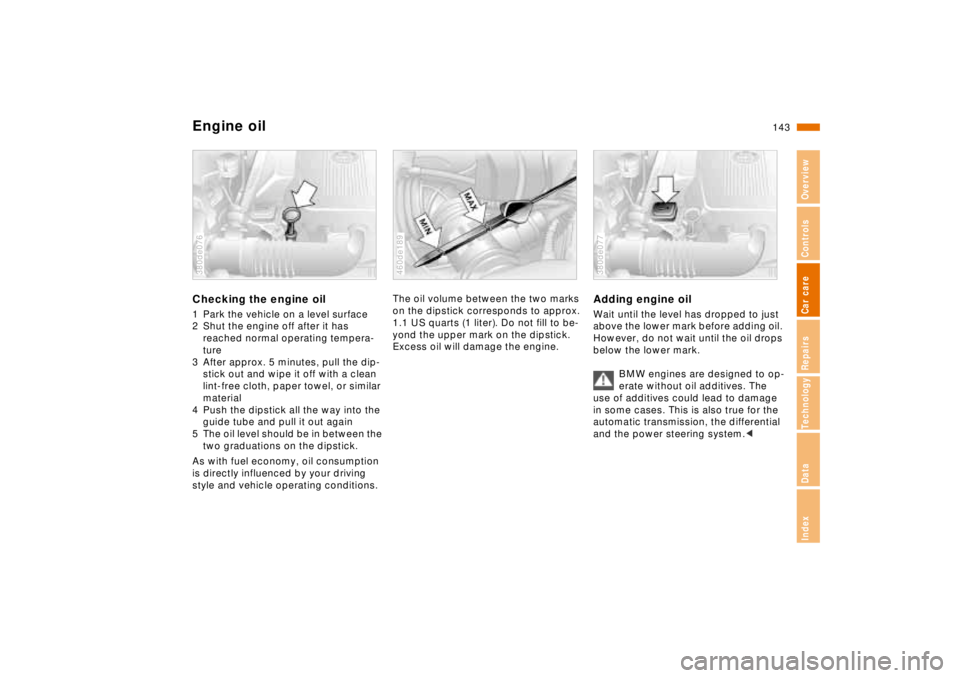
Engine oilChecking the engine oil1 Park the vehicle on a level surface
2 Shut the engine off after it has
reached normal operating tempera-
ture
3 After approx. 5 minutes, pull the dip-
stick out and wipe it off with a clean
lint-free cloth, paper towel, or similar
material
4 Push the dipstick all the way into the
guide tube and pull it out again
5 The oil level should be in between the
two graduations on the dipstick.
As with fuel economy, oil consumption
is directly influenced by your driving
style and vehicle operating conditions.380de076
The oil volume between the two marks
on the dipstick corresponds to approx.
1.1 US quarts (1 liter). Do not fill to be-
yond the upper mark on the dipstick.
Excess oil will damage the engine.460de189
Adding engine oilWait until the level has dropped to just
above the lower mark before adding oil.
However, do not wait until the oil drops
below the lower mark.
BMW engines are designed to op-
erate without oil additives. The
use of additives could lead to damage
in some cases. This is also true for the
automatic transmission, the differential
and the power steering system.< 380de077
Page 149 of 211
148n
Oil for power steering/Level control system
*
Vehicle Identification Number
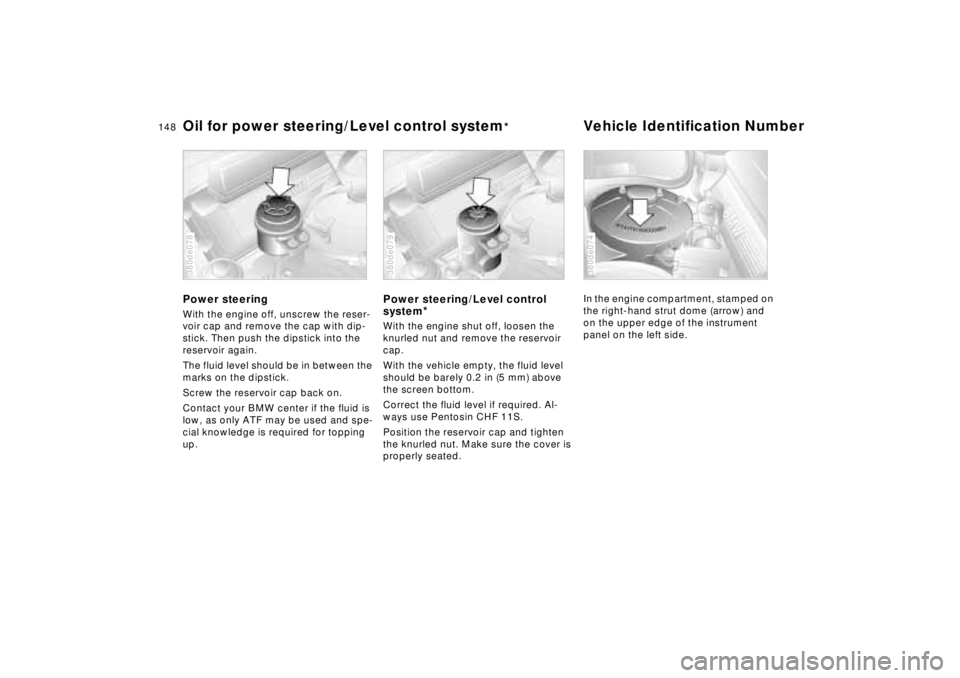
Power steeringWith the engine off, unscrew the reser-
voir cap and remove the cap with dip-
stick. Then push the dipstick into the
reservoir again.
The fluid level should be in between the
marks on the dipstick.
Screw the reservoir cap back on.
Contact your BMW center if the fluid is
low, as only ATF may be used and spe-
cial knowledge is required for topping
up.380de078
Power steering/Level control
system
*
With the engine shut off, loosen the
knurled nut and remove the reservoir
cap.
With the vehicle empty, the fluid level
should be barely 0.2 in (5 mm) above
the screen bottom.
Correct the fluid level if required. Al-
ways use Pentosin CHF 11S.
Position the reservoir cap and tighten
the knurled nut. Make sure the cover is
properly seated.380de079
In the engine compartment, stamped on
the right-hand strut dome (arrow) and
on the upper edge of the instrument
panel on the left side.380de074
Page 152 of 211

151n
RepairsIndexOverview Controls Car care Technology Data
Caring for your carExterior finishTo provide effective corrosion protec-
tion, multilayer paintwork is applied at
the factory. Cataphoretic immersion
priming techniques are supplemented
using special body-cavity protectants,
with the application of specially-devel-
oped and extensively tested materials.
A layer of flexible PVC is first applied to
the undercarriage. Following this, a
comprehensive undercoating treatment
with a wax-based protectant is applied.
Regular maintenance makes an impor-
tant contribution to maintaining the
safety and value of your vehicle.
Increasing awareness of the effects of
harmful environmental factors on a ve-
hicle's exterior finish have led paint and
vehicle manufacturers to initiate pro-
grams designed to further improve the
durability of their finishes. Despite this,
environmental factors that occur locally
or regionally can have negative effects
on the finish of your vehicle. These
should guide you in determining the fre-
quency and extent of your efforts to
maintain the vehicle finish.Depending upon material and type of
impact (perforation of paint layer), phys-
ical stresses from sand, road salt,
gravel, etc., can cause corrosion to
start extending beneath the finish, start-
ing at the point of impact.
Road dirt, tar spots, dead insects, ani-
mal droppings (strong alkali effect) and
tree excretions (resins and pollen) all
contain substances capable of causing
damage when allowed to remain on the
finish of your car for any period of time
(spots, etching, flaking, separation in
the top coat).
In industrial areas, deposits of flue dust,
lime, oily soot, precipitation containing
sulfur-dioxide (acid rain) and other envi-
ronmental pollutants will damage the
car's finish unless adequate care is pro-
vided – even though this is generally
limited to the outside horizontal sur-
faces.In coastal regions, high levels of atmo-
spheric salt and humidity promote cor-
rosion.
In tropical zones, temperatures of over
1057 (406) in the shade prevail, in
addition to heavy ultraviolet radiation
and high humidity. Under those circum-
stances, light exterior finishes reach
temperatures of up to 1757 (806) and
dark finishes up to 2507 (1206).
Page 153 of 211

152n
Caring for your carCaring for the vehicle finishRegular washing is a preventive mea-
sure against long-term effects from
substances that are harmful to the vehi-
cle's finish, especially if you drive your
vehicle in areas with high levels of air
pollution or aggressive natural sub-
stances (tree resins, pollen).
Nevertheless, you should immediately
remove especially aggressive sub-
stances. Failure to do so can lead to
changes in the paint's chemical struc-
ture or to discoloration. Gasoline spilled
during refueling, oil, grease and brake
fluid should always be cleaned away
immediately, as should bird droppings.
All of these substances cause damage
to the finish.
Any contamination remaining on the
surface of the vehicle will be especially
conspicuous after washing. Use clean-
ing fluid or alcohol with a clean cloth or
cotton pad to remove. Remove tar
spots with tar remover. After cleaning,
the affected areas should be waxed to
ensure continued protection.
A full range of car-care products is
available from your BMW center.<
Waxing your carProtect the finish using carnauba or
synthetic-based waxes only.
The best way to determine when the
finish needs to be waxed is by noting
when water stops beading on the sur-
face.
You can use a glass cleaner to remove
any wax or silicone that may have been
left on the windows during waxing.
A full range of car-care products is
available from your BMW center.<
Paint damageYou can touch up small areas of dam-
age with BMW spray paint or a BMW
touch-up stick.
The color code of your vehicle is lo-
cated on a tag near the vehicle's data
plate and on the first page of the Ser-
vice and Warranty Information Booklet
(US models) or of the Warranty and Ser-
vice Guide Booklet (Canadian models).
Damage caused by flying stones,
scratches, etc., must be touched up
without delay to prevent rust from form-
ing.
If corrosion has started to form in an
area with paint damage, remove all rust
and clean the area. Then prime the area
with a BMW Primer Stick. Finally, apply
the finish coat. Wait a few days, then
polish the repaired area. Finish by ap-
plying a wax preservative.
More extensive paint damage should be
repaired professionally in accordance
with the manufacturer's instructions.
Your BMW center uses original BMW
finish materials in accordance with ap-
proved repair procedures.
Page 205 of 211

Everything from A to ZHeadlamp flasher68
Headlamp washer
system142
Headlamp washers69
Heated seats106
Heated steering wheel106
Heating and ventilation100
Heating during a stop104
Height195
HiFi system187
High beam headlamps,
bulb replacement164
High beams68
Hood release137
Horn23IIce warning72
Ignition key30
Ignition switch59
Independent ventilation
system107
Indicator lamps20
Inflation pressures26,132
INSPECTION74
Instrument cluster18
Instrument lighting96
Integrated Universal Remote
Control108
Interior door handles,
lighted36,96
Interior lamps32,97Interior lamps, bulb
replacement167
Interior lamps,
radio remote control34
Interior motion sensor40
Interior rearview mirror,
automatic dimming50
Intermittent wipe switch68
JJump starting179KKey Memory53
Keys30
Kickdown63,66LLashing eyes39,118
Leather care154
Length195
Level control system148
License plate lamps, bulb
replacement166
Light switch96
Lighted exterior door handles
32,33
Lighted interior door handles
36,96
LIGHTS ON warning96
Limit87
Loading118Load-securing devices118
Locking and unlocking the
doors32
Locks, care128
Low beam headlamps, bulb
replacement164
Low beams96
Low-fuel warning lamp73
Lug bolts171
Luggage compartment 37, 39
Nets39
Luggage compartment
lamps, bulb
replacement167
Luggage compartment lid 37
Luggage compartment lid,
Automatic Soft-Close38
Luggage compartment lid,
manual operation37
Luggage compartment
nets39
Luggage compartment,
emergency release37
Luggage compartment,
locking separately37
Luggage compartment, radio
remote control34
Luggage rack118
Luggage straps39
Lumbar support47
MMaintenance74,149
Malfunction displays75
Manually controlled
recirculated-air103
Master key30
Memory51,53
MFL (Multi-function steering
wheel)23
Microfilter105
MID (Multi-Information
Display)78
Mirror defrosting50
Mirror memory51
Mirrors50
Modifications,
technical6,157
Multi-function armrest112
Multi-function steering wheel
(MFL)23
Multi-Information Display
(MID)78NNew transmitter, radio
remote control168
Nozzles100OOBD connector158
Odometer72
Oil additives143
Page 206 of 211

RepairsIndexOverview Controls Car care Technology Data
Everything from A to Z
205n
Oil consumption143
Oil level check143
Oil pressure,
indicator lamp20
Oil specifications144
Oil, Engine oil
Capacities197
OILSERVICE74
Onboard computer84
Onboard tool kit162
Opening the luggage
compartment from the
inside38
Outside mirrors50
Outside temperature
display72
PPaint blemishes,
exterior dirt152
Park Distance Control
(PDC)90
Parking aid90
Parking brake61
Parking in winter130
PDC (Park Distance
Control)90
Playing cassettes
Refer to the
Radio Owner's ManuelPlaying CDs
Refer to the
Radio Owner's Manuel
Pocket light111
Power seat adjustment46
Power steering130
Power steering fluid148
Power windows42
Pressure, tires26,132
Pushbutton for central
locking system36
RRadio
Car radio
Refer to the separate
Owner's Manuel
Radio reception131,186
Radio remote control33
Radio remote control,
battery change168
Radio remote control,
new transmitter168
Rain sensor68,150
RDC (Tire Pressure
Control)94
Reading lamps98
Rear passenger-area air
conditioning105
Rear seat adjustment,
electric48
Rear seat heating106Rear window blind107
Rear window defroster70
Rear-seat control
Front passenger's seat 112
Onboard computer112
Radio112
Rear window blind112
Telephone112
Rearview mirrors50
Refueling25
Remote control for onboard
computer89
Removing condensation,
windows102
Replacement keys30
Replacing tires133
Residual heat104
Roof luggage rack118
Roof weight rating196
Rubber seals and
components154
SSafety belt tensioner187
Safety belts54
Safety lock buttons36
Screw-on valve stem
caps134
Seat adjustment46
Seat heating106
Seat memory51
Seat, power46Securing cargo118
Selector lever, automatic
transmission62,65
Service and Warranty
Information Booklet149
Service Interval Display
74,149
Servotronic130
Shoulder support47
Shutting off the engine60
Ski bag116
Skid control130
Sliding/Tilt sunroof44
Sliding/Tilt sunroof with glass
moonroof45
Sliding/Tilt sunroof, closing
after electrical fault178
Sliding/Tilt sunroof,
convenience operating
mode32
Sliding/Tilt sunroof, radio
remote control33
Slippery roads129
Snow chains129,135
Socket115
Spare key30
Spare tire171
Spark plugs198
Speaker113
Special oils144
Speed limit warning87
Speedometer19
Page 208 of 211

Repairs
Index
Overview
Controls
Car care
Technology
Data
Owner service procedures from A to Z207 n
A
Adding brake fluid 147
Adding engine coolant 146
Adding engine oil 143
Adding fluid, power steering 148
Air pressure 26
B
Backup lamps, bulb
replacement 166
Battery change, radio remote control 168
Battery, checking charge condition 174
Battery, discharged 179
Brake lamps, bulb replacement 166
Brakes, brake faults 128
Bulb replacement 163
C
Changing a wheel 170
Charging the battery 174
Check Control 75
Checking the engine oil 143
Checking tire pressure 26
D
Defrosting, windows102
Difficult steering 130
Doors, manual operation 32
E
Electrical accessories,
failure 176
Electrical fault fuel filler door 178
Sliding/Tilt sunroof 178
Emergency release Doors 32
Fuel filler door 178
Luggage compartment
lid 37
Sliding/Tilt sunroof 178
Engine oil specifications 144
F
Failure messages75
Filling the windshield washer fluid reservoir 142
First-aid kit 24
Fittings, tow-starting and towing 180
Fog lamp,
replace the bulb 165
Footwell lamps, bulb replacement 167 Fuel filler door,
manual release after
electrical fault 178
Fuses, replacing 176
G
Glove compartment lamp,
bulb replacement 167
H
Hazard warning flashers 24
Hazard warning triangle 24
High beam headlamps, bulb replacement 164,165
Hood release 137
I
Indicator lamps 20
Interior lamps, bulb replacement 167
Interior motion sensor, deactivation 41
J
Jump starting 179
L
License plate lamps, bulb
replacement 166
Low beam headlamps, bulb
replacement 164 Luggage compartment
lamps, bulb
replacement 167
Luggage compartment lid, emergency release 37
M
Maintenance74,149
Malfunction displays 75
N
New transmitter, radio re-
mote control 168
O
Oil level check 143
Oil specifications 144
Onboard tool kit 162
P
Power steering,
adding fluid 148
Pressure, tires 26
R
Radio remote control,
battery change 168
Radio remote control, new transmitter 168
Rear lamp assembly 166
Removing condensation, windows 102