1998 BMW 540i body general
[x] Cancel search: body generalPage 803 of 1002

Downloaded from www.Manualslib.com manuals search engine
400-9
Body-General
Battery safety terminal
(BST)
4 Starting with 1999 models (9198 production and later), a py-
rotechnic (explosive charge) device automatically discon-
nects the battery positive terminal during impacts. Key
features,
like power windows and door locks, remain opera-
tional.
Security
Electronic immobilization (EWS)
Ignition key transponder signal All
E39 vehicles incorporate an electronic immobilization sys-
tem known as EWS. This svstem uses a wireless comrnuni-
cation link between a transponder chip in the ignition key and
the ring antenna surrounding the ignition switch. The EWS
control module blocks the starting of the vehicle unless the
correct coded ignition key is used.
NOTE-
Electronic immobilization is sometimes referred to as the
driveaway protection system.
Antitheft alarm (DWA)
This is adealer-installed option for which the E39 vehicles are
factory-wired. When armed, the system monitors door
loci(
contacts and trunk and engine hood locks and sounds a siren
if it detects tampering.
E39 interiors have a unique character, with a combination
of
sporty features and innovativedesign. All body versions were
made in a wide choice of interior and exterior colors. New col-
ors with matching leather or leatherette upholstery were intro-
duced for each model year.
Driving
comfort is enhanced by power steering, tilt steering
wheel, height-adjustable front seats, and electrically adjust-
able and heated rear-view mirrors. Inside the car there are
reading lights at four seating positions.
Page 804 of 1002

Downloaded from www.Manualslib.com manuals search engine
400-1 0
Body-General
Seats
4 Anatomically correct seats are constructed from polyure-
10 way seat adjustment thane foam
containing areas or "zones" of different firmness.
They offer good lateral support without constricting the occu-
pant.
The seats have a passive internal ventilation system: Cylin-
drical cavities within the cushions and backrests generate a
pumping effect as the ride motions cause occupant motion.
This
helps remove moisture and feeds fresh air into the seats.
Other features of the seating system:
The seat bases have steel springs for added support and
strength.
The seat control switches are along the outside edge of
the
seat.
Heated seats are an option in all models
In cars equipped with seat position memory, three different
seat confiaurations can be memorized by the seat control
module(s): Seat memory coordinates with outside mirror
memory. These functions are controlled by the seat mem-
ory
module(s).
* For security reasons, the release lever to fold the rear seat
backrest forward is installed in the trunk.
Sport Wagon models: Rear seat
baclts are split 60140, with
the center armrest on the left seat back.
The center armrest incorporates a non adjustable head-
rest. When folded down, the armrest opens out with
cup-
holders and a storage compartment. See 520 Seats for
more details.
instruments and controls
Everything in the interior passengercompartment essential to
the driver is logically grouped and easy to reach. All instru-
ments and controls have been arranged ergonomically and
are fully integrated into the overall design of the vehicle.
Tilt-telescopic steering wheel has
30 mm (1.2 in) of vertical
and longitudinal adjustment.
Multifunction steering wheel contains two
ltey pads con-
taining controls for the sound system, telephone and
cruise control.
Padded dashboard houses the instrument cluster and the
ventilation and heating system.
Page 805 of 1002

Downloaded from www.Manualslib.com manuals search engine
Instrument cluster
Instrument cluster uses large easy-to-read analog instru-
ments and is removable as a unit without removing the dash-
board. On-board computer and Check Control functions are
integrated into the instrument cluster displays.
Service Interval Display
Service Interval Display calculates vehicle service needs
based on current driving patterns, and indicates to the driver
when the car requires
service
On-board navigation
An integrated on-board navigation system, based on Global
Positioning System (GPS) technology, is optionally available
on
E39 cars. When installed, a multifunction monitor is includ-
ed in the center of the dash above the radio. in addition to dis-
playing navigation system information, this monitor accesses
On-Board Computerfunctions, audiosystem controls, mobile
phone dialling and memory, and automatic ventilation.
Park Distance Control (PDC)
Park Distance Control (PDC) is an optional system which
uses ultrasonic sensors in the rear bumper trim to warn the
driver of approaching too close to obstacles when parlting.
Central body electronics
E39 vehicles are equipped with an integrated complex of
electronic modules connected mostly via K-Bus. This system,
called central body electronics (ZKE
Ill), is primarily con-
trolled by the general module (GM
Ill). An overview of ZKE Ill
functions is found in 600 Electrical System-General. Details
of ZKE
Ill functioning is in the following repair groups:
- 512 Door Windows
* 515 Central Locking and Aniti-Theft
520 Seats
a 540 Sunroof
611 Wipers and Washers
620 Instruments
Page 806 of 1002

Downloaded from www.Manualslib.com manuals search engine
400-12
I Body-General
HEATING AND AIR ~ONDITIONING
(I H KA)
4 The integrated heating and air conditioning (IHKA) system
uses an extra large, infinitely variable radial blower motor for
good distribution of air. Fresh air enters through the grille
be.
low the engine hood and into the passenger compartment via
the dashboard and
footwell vents.
- Repair information for the heating and air conditioning
system is covered
in 640 Heating and Air Conditioning.
Page 851 of 1002

Downloaded from www.Manualslib.com manuals search engine
51 0 Exterior Trim. Bumpers
General ........................... .51 0.2 Exterior Trim ...................... 51 0-1 3
Outside Rear View Mirrors
Outside mirror glass. replacing
Outside mirror housing.
removing and installing
......
Outside mirror assemblv .
BMW emblem. removing and installing ... 510-13 .......... .51 0.2
Body side molding. replacing ........... 51 0-13 .......... .51 0.2
Radiator grill. removing and installing .... 51 0-1 4
Headlight housing trim panel.
.......... .51 0.3
removing and installing ............... 510-14 . .
removing and installing ................ .51 0.4
Bumpers ......................... .51 0.5
Front bumper assembly
............... .51 0.6
Front bumper, removing and installing
.... .51 0.7
Front bumper impact absorber. replacing
. .51 0.8
Rear bumper assembly ............... .51 0.9
Rear bumper. removing and installing
... .51 0.10
Rear bumper impact absorber. replacing
. .51 0.1 1
Front bumper height. adjusting
......... .51 0.12
Page 896 of 1002
Downloaded from www.Manualslib.com manuals search engine
51 5-2
/Central Locking and Anti-Theft
This section covers repair information for door, trunk and car-
go compartment locks, central locking, electronic
immob~liza-
tion (EWS) and anti-theft alarm (DWA).
€39 cars are equipped with sophisticated self-diagnostic elec-
trical systems. When experiencing malfunctions relating to
central locking. EWS or anti-theft systems, start the diagnosis
process using the
BMW service tester DIS, GT 1, MoDiC or
equivalent scan tool. An advanced diagnostic scan tool can
usually pinpoint electrical faults quickly and safely.
Additional electrical information can be found in:
610 Electrical Component Locations
ELE Electrical Wiring Diagrams
Central locking in E39 vehicles controls the door
locks, trunk
or tailgate lock and fuel filler flap lock. The control module for
the Central Body Electronics system (ZKE
Ill), lknown as the
General Module (GM
Ill), controls central locking.
ZKE
Ill manages the following central locking related func-
tions:
Central locking
* Keyless entry
Key memory
Power trunk release
Electric opening of tailgate
DWA alarm system
Diagnosis
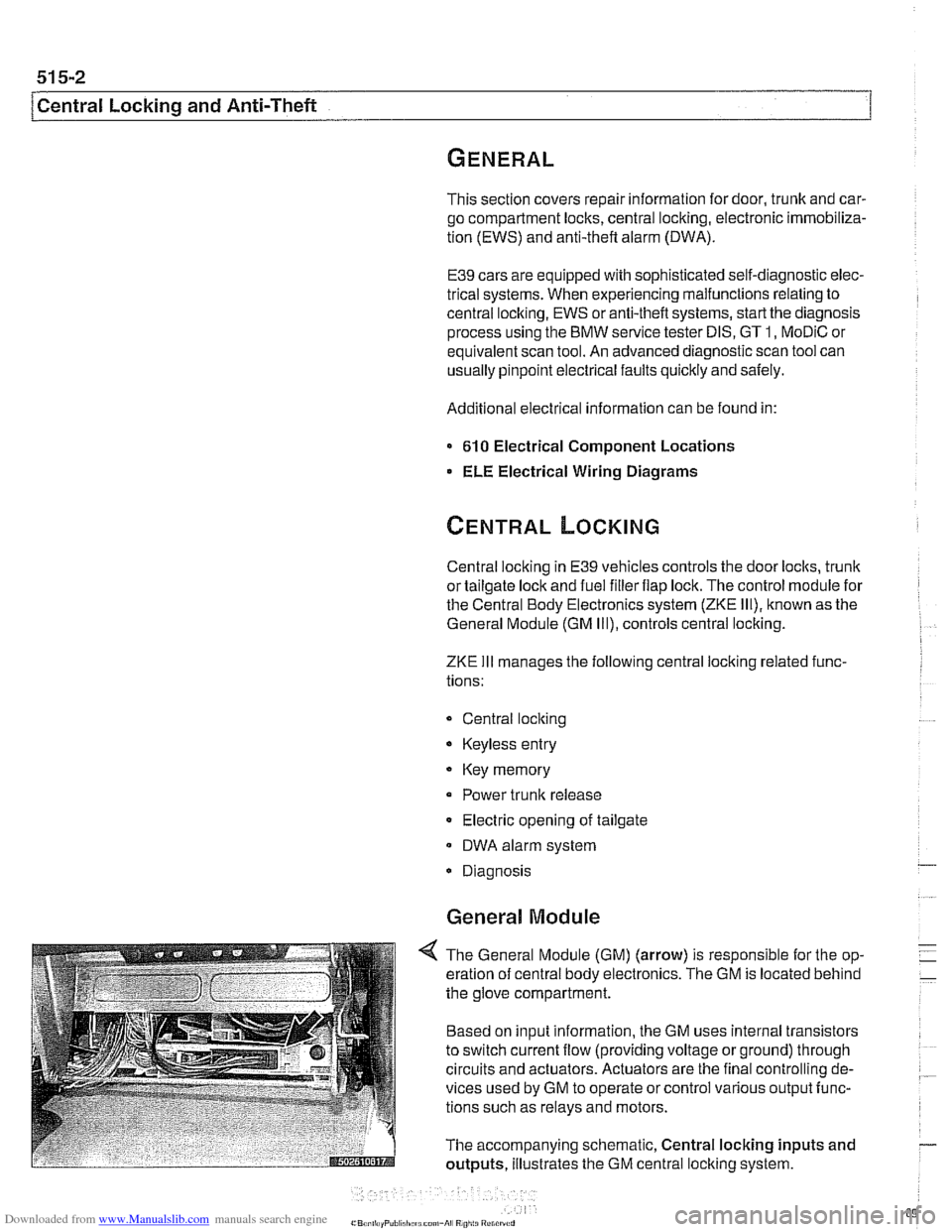
General Module
4 The General Module (GM) (arrow) is responsible for the op-
eration of central body electronics. The GM is located behind
the glove compartment.
Based on input information, the GM uses internal transistors
to switch current flow (providing voltage or ground) through
circuits and actuators. Actuators are the final controlling de-
vices used by GM to operate or control various output func-
tions such as relays and motors.
The accompanying schematic, Central locking inputs and
outputs, illustrates the GM central locking system.
Page 942 of 1002

Downloaded from www.Manualslib.com manuals search engine
- -
Seat Belts
Front seat belt tensioner, removing and
installing
- Disconnect battery negative (-) cable in trunk.
The
front seat belt loclts are equipped with pyrotechnic (ex-
plosive charge) automatic tensioners. These tensioners are
designed to automatically retract and tension the seat belt by
55 mm (approximately 2 inches) in the event of an accident.
CAUTION-
Prior to disconnecting the battery, read the battery discon-
nection cautions given in
001 General Warnings and Cau-
tions.
WARNING-
Pyrotechnic seat belt tensioners are powerful devices and
should be handled with extreme care. Incorrect handling
can trigger the tensioner and cause injury
BMW recommends that all repair or replacement work
on pyrotechnic devices must be carried out by a quali-
fied BMW technician.
Be sure to disconnect the battery and wait
5 seconds
before attempting to work on pyrotechnic devices.
Pyrotechnic devices cannot be repaired. Always re-
place them.
Never treat pyrotechnic components with cleaning
agents or grease.
- Do not expose pyrotechnic components to tempera-
tures above
75% (167°F).
Pyrotechnic components can only be tested electrically
when installedusing the
BMWService Tester (DISplus,
GTI, or MoDiC).
Do not fire a pyrotechnic gas generatorprior to dispos-
al. It must be fired by a special disposal company or
shipped
back to BMW in the packaging of the new com-
ponent.
During body straightening and welding with an electric
arc welder, always disconnect the battery and the con-
nection to the pyrotechnic gas generators.
- Remove front seat as described in 520 Seats.
-
Page 960 of 1002

Downloaded from www.Manualslib.com manuals search engine
721-12
Airbag System (SRS)
Head protection airbag (HPS)
4 Replacement of a head protection airbag (HPS) is an exten-
sive operation, including removal of the following:
Complete dashboard
Complete headliner
Windshield pillar (A-pillar) trim
Door pillar (B-pillar) trim
- Before starting work on the HPS airbag, disconnect negative
(-) cable from battery and cover negative terminal with insu-
lating material.
Prior to disconnecting the battery, read the battery discon-
nection cautionsgiven in001 General Warnings and Cau-
tions.
Tightening torque HPS
airbag to body 11 Nm (8 ft-lb)
HPS airbag mounting bracket
to A or B-pillar
HPS gas generator to
dashboard reinforcement
(M6
self-tapping screw) 2.5
Nm (22 in-lb)
4 Nm (35 in-lb)