1998 ACURA INTEGRA ecm
[x] Cancel search: ecmPage 1478 of 1680
A/C Gompressor Controls (conrd)
- How the Circuit Works
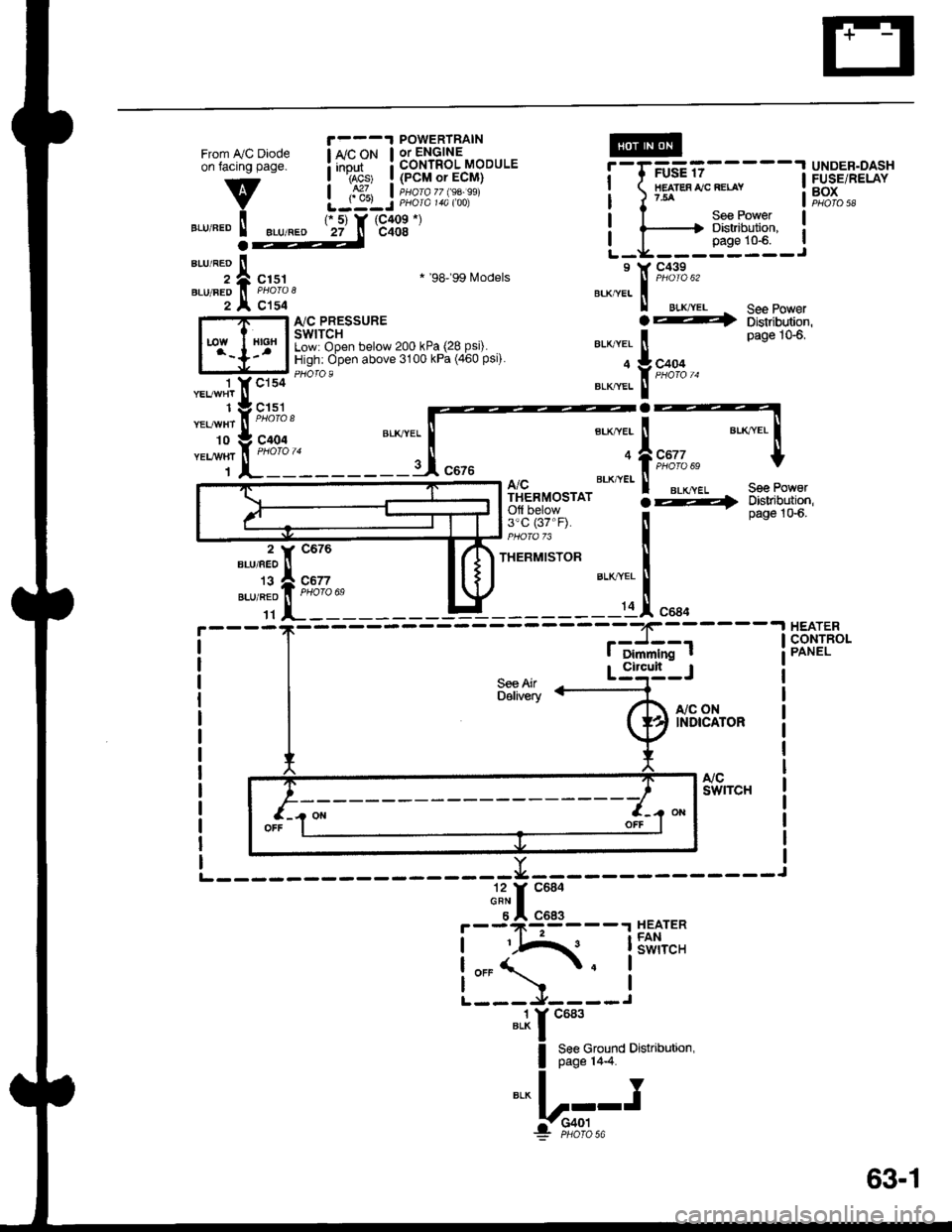
Battery voltage is supplied through fuse 56 to the
A,/C compressor clutch relay contacts at all times.
With the ignition switch in ON (ll), voltage is applied
to the coil of the A,/C compressor clutch relay
through fuse 17. When you push the A,/C switch
ON, and the heater fan switch is in posation 1, 2, 3,
or 4, a "ground" input is provided to the engine or
powertrain control module (ECM or PCM) through
the A,/C thermostat and the A,/C pressure switch.
The A,/C compressor clutch relay is grounded by the
engine or powertrain control module (ECM or PCM).
When energized, the A,/C compressor clutch relay
allows battery voltage to turn on the A,/C
comDressor clutch,
The A,/C ON indicator light comes on when the A"/C
system is requested.
A,/C Thermostat
The A,/C thermostat is located on the evaoorator
housing. The AJC thermostat turns off the A,/C
compressor clutch if the temperature at the
evaporator goes below 3'C (37'F). This prevents
condensation from freezing on the evaporator fins
and blocking the air delivery into the passenger
compartment. The blower motor will keep running
when the sensor lurns off the compressor.
A,/C Pressure Switch
The A,/C pressure switch is located in the condenser
outlet line where refrigerant is in a high
temperature/high pressure liquid state. The switch
will sense abnormally high or low pressure, and
open the circuit. This removes ground, and the
compressor will stop running.
Refer to the Service Manual (Section 22,
Air Conditioning) for specific tests or
troubleshooting procedures.
62-2
Page 1479 of 1680
Fans
- with
|------
See PowerDistribution,page 1G6.
;;;----13X3,5"
l,fP"[r s"" eo'""t
A/C -
E@
UNDER.HOODFUSE/RELAYBOXDistribution,
FUSE 56(coxoEr{sE8 faN}FUSE 57COOLING
204
FUSE/RELAY
2
(Not
I
I
I
I
IL
I Y C439sucrel ll PHoro"62rrr.
orl
*T'.I.
:-gg]gi Ji,'oio,,,
Seg PowerDistribution,page 10.6.c216y":':---______i
See PowerDbtribution,page lG1.
c2'16 1
BLKBEO
' POWERTRAIN ,
: or ENGINE, CONTROL ::,::A ,. ' MODULE ;(PCM or ECM) ,' PHOIA 77 (9A 99 |' PHofa 14a $q :!---- usA.----
COI{DENSERFANRELAYPHOTO 23
RADIATORFANRELAYHlofa 22
c215-----J
* '98199 [,4odels
cltl8LU/BLK
c9{t6
c206
c206
ffi-
".",".t"f
"oo' 6
i
v
To Splice onfacing page
c151
c155
BLU/BIK
BLU/ALK
CONDENSERFANMOTOR
RADIATORFANMOTOR
RADIATORFAN SWITCHClosed above93"C (200"F).
".:r
"'''
I see c,ornoarr< Distribution,
".,.f
','"i.
-lr:;--: PHafo 28
c155PHOTA 9
See GroundDistribution,page 14-2
Y
I
63
I. G151
Page 1480 of 1680
From IVC Diodeon facing page.
v
".r,".o ! ".u,".o
1 YCls4 '- --
"t"*1t ,I, ^..,
-t'I:::'
ri'fft_____:_
POWERTRAIN
! *'"P* ! 3b'nli?3'-"oou'.I rAcs' I {PCM or ECM}
| ,S1, I iuorozz $a.ssiLJ:LJ PHora 14a too)IIEATES IJC RELAY?54
UNDER.DASHFUSE/RELAYBOXPHO|O 58
r 5) Y (C409 *)
27 n c408
See PowerDistribution,page 10-6.a
";;;ic151
c154
* '98'99 Models
I'lC PRESSURESWITCHLow: Open below 200 kPa (28 Psi).High: Open above 3100 kPa (460 Psi).
.4
See Po' erDistribution,page 106,
See PoworDbtribution,page 1G6.
A/CTHERMOSTATOfl below3'c (37"F).
THERMISTOR
S€e AirDelivery
"a*a, i
*,*rfrs,*lt-
a
BTK,"VEI i
9:1L"" t
::;1".,.
I Dimmlng t
-.I HEATER,J--- I cONrR(CONTROL
Circult
r,/c oNINDICATOR
".1r "ur'
I 8:8ffiTo
o'"u''"''n'
*!r".-
F--9*l:93----r HEATER
!iIA{. lSiii,"'.
L:5-l--i
63-1
Page 1481 of 1680
Fans
- Without A/C
UNDER-HOODFUSE/RELAYBOX
r--------UNDER-DASHFUSE/RELAYBOXFUSE 57cooLrfic FAx2oa
a4 Distribution,
_ ' Cg(F
ll Pase 106'BLK,YEL I
. A """?t'3"---------JI Soe Powgri------{' Distribution,
I page 10-6./\-_--_--
'I
GBN
RADIATORFANRELAYP|1OTO 22
: l__
ru::
.i
-d*"^
ffil u
(Not Used)---?f;---------==:
I (Nor Used)BLUT'EL
f
"
f,r;.;
.l "oo, I
'[TliiF:,- il
"'*,'
-r-I I "-'" I
i*'Er t: 11,c402 i
*-
:lI' Btu'RED I er-uraeo I
i 3__J
:ilt; ".r,".o I
i ,, I "oo.: (. s) x (c4oe -)
l---rNTl:,oll,ffIE '"
: Used) I CoNTROL' I MODULE
: | (PcM or EcM). I PHA|O 77 (98 99):_----- PHOTO 140 taAl.,
)8 '99 Models
(Not Used)
?i-------=
,.'! rN(
. I .oo,PF.IA/c
Lf l"r,i"r,B%
ItlI .t. l
.:x
*::_,"."
24
t_
l'*
c301
PHOTO36
t9
GBN
See GroundDistribution,page 14-2.
I
I
_l
, r27) A C408
i r-;--, I iiiir o
; I FAN. I control;t, L----
I'irl RAOIATORI t I FANswtrcH
l{-cl 9J3?39,"-"e e3 c (2oo F)
1 Y c11r
"*l
Orr< See GroundI Distribution,BLK
L/-4
eaee 14.
1FJ::.,"
usA ---.
* '98
._____.-'.1!;;6i-
PHO|O 4
63-2
Page 1482 of 1680
Fans (cont'd)
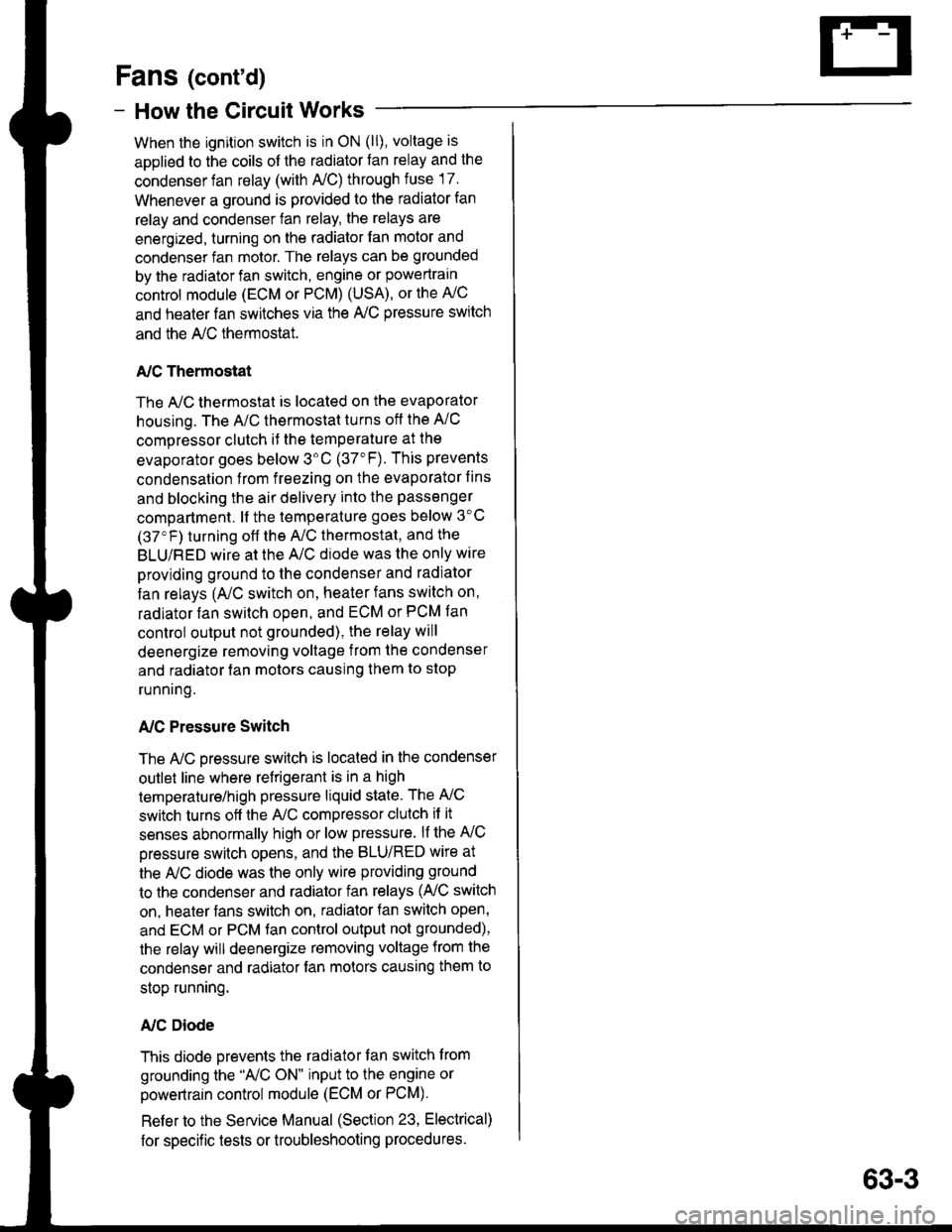
- How the Gircuit Works
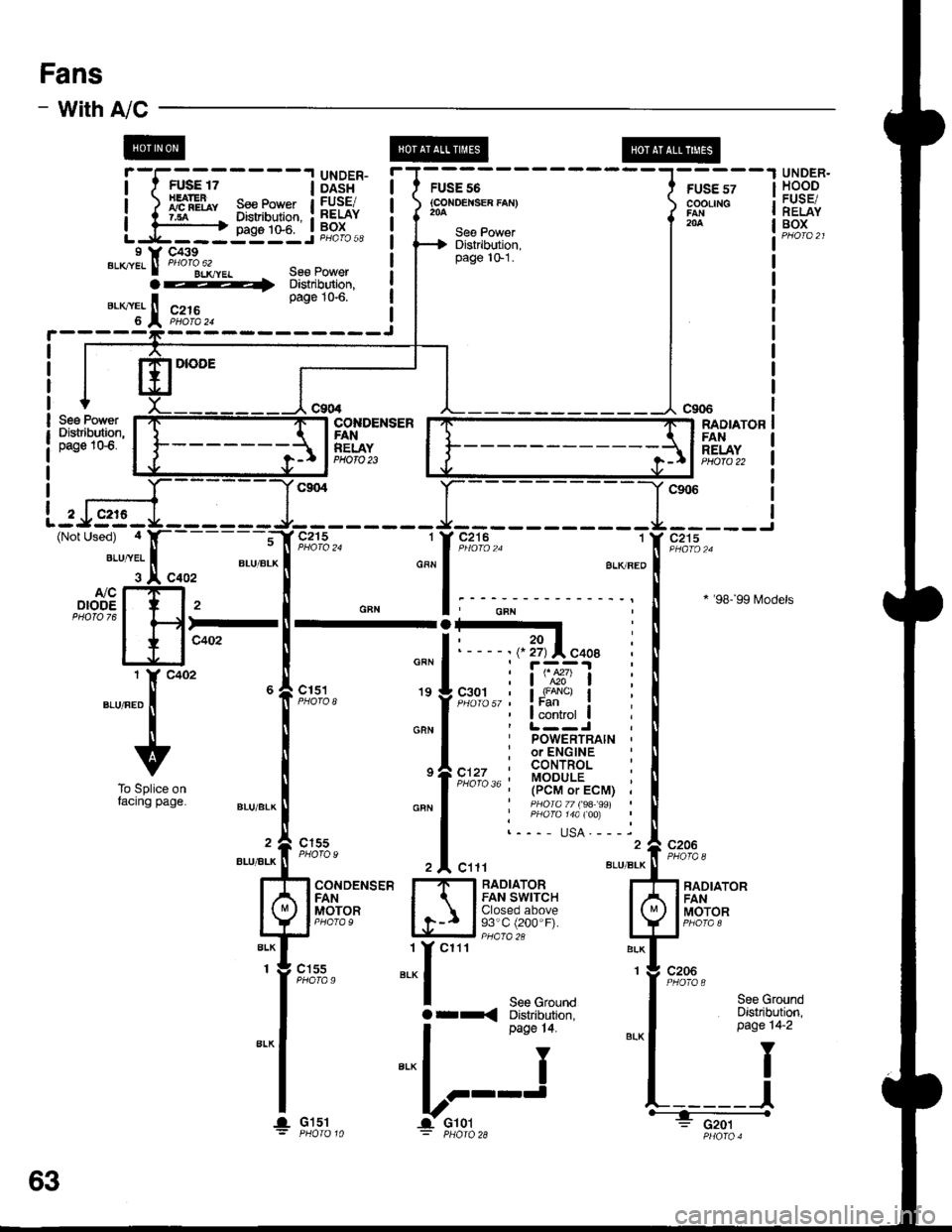
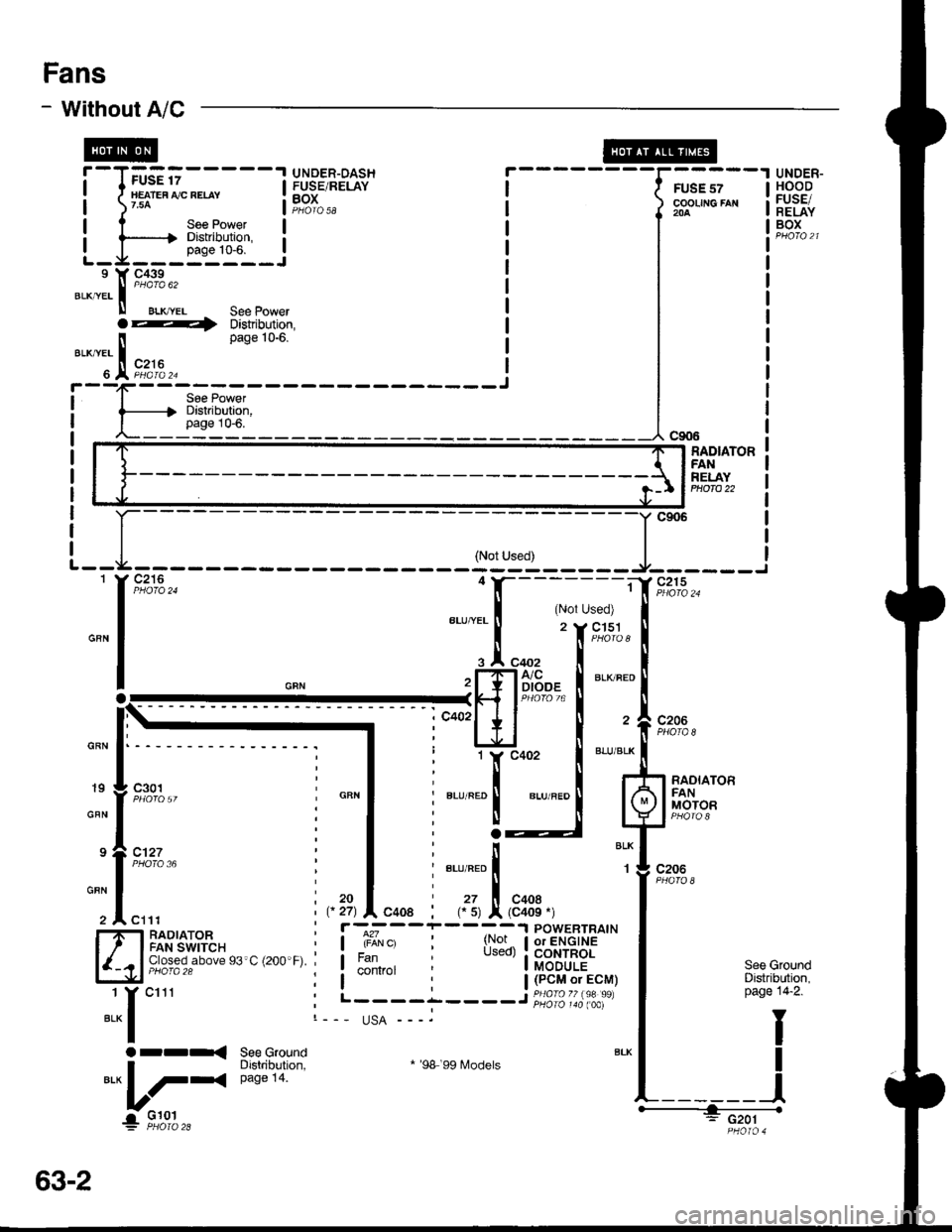
When the ignition switch is in ON (ll), voltage is
applied to the coils of the radiator fan relay and the
condenser fan relay (with A,/C) through fuse 17.
Whenever a ground is provided to the radiator fan
relay and condenser fan relay, the relays are
energized, turning on the radiator fan motor and
condenser fan motor. The relays can be grounded
by the radiator fan switch, engine or powertrain
control module (ECM or PCM) (USA), or the A,/C
and heater lan switches via the A'lC pressure switch
and the A,/C lhermostat.
A,/C Thermostat
The A,/C thermostat is located on the evaporator
housing. The A/C thermostat turns oft the A/C
compressor clutch it the temperature at the
evaporator goes below 3'C (37"F). This prevents
condensalion from freezing on the evaporator fins
and blocking the air delivery into the passenger
compartment. lt the temperature goes below 3'C
(37'F) turning off the A"/C thermostat, and the
BLU/RED wire at the A,/C diode was the only wire
providing ground to the condenser and radiator
fan relays (A,/C switch on, heater fans switch on,
radiator fan switch open, and ECM or PCM fan
controi output not grounded), the relay will
deenergize removing voltage from the condenser
and radiator fan motors causing them to stop
running.
A,/C Pressure Switch
The AJC oressure switch is located in the condenser
outlet line where refrigerant is in a high
temperature/high pressure liquid state. The A,/C
switch turns off the A,/C compressor clutch if it
senses abnormally high or low pressure. lf the A'lC
pressure switch opens, and the BLU/RED wire at
the A/C diode was the only wire providing ground
to the condenser and radiator fan relays (L/C switch
on, heater fans switch on, radiator lan switch open'
and ECM or PCM fan control output not grounded),
the relay will deenergize removing voltage from the
condenser and radiator fan motors causing them to
stop running.
A./C Diode
This diode orevents the radiator fan switch f rom
grounding the "A'lC ON" input to the engine or
powertrain control module (ECM or PCM).
Refer to the Service Manual (Section 23, Electrical)
for specific tests or troubleshooting procedures.
63-3
Page 1499 of 1680
Gauges (cont'd)
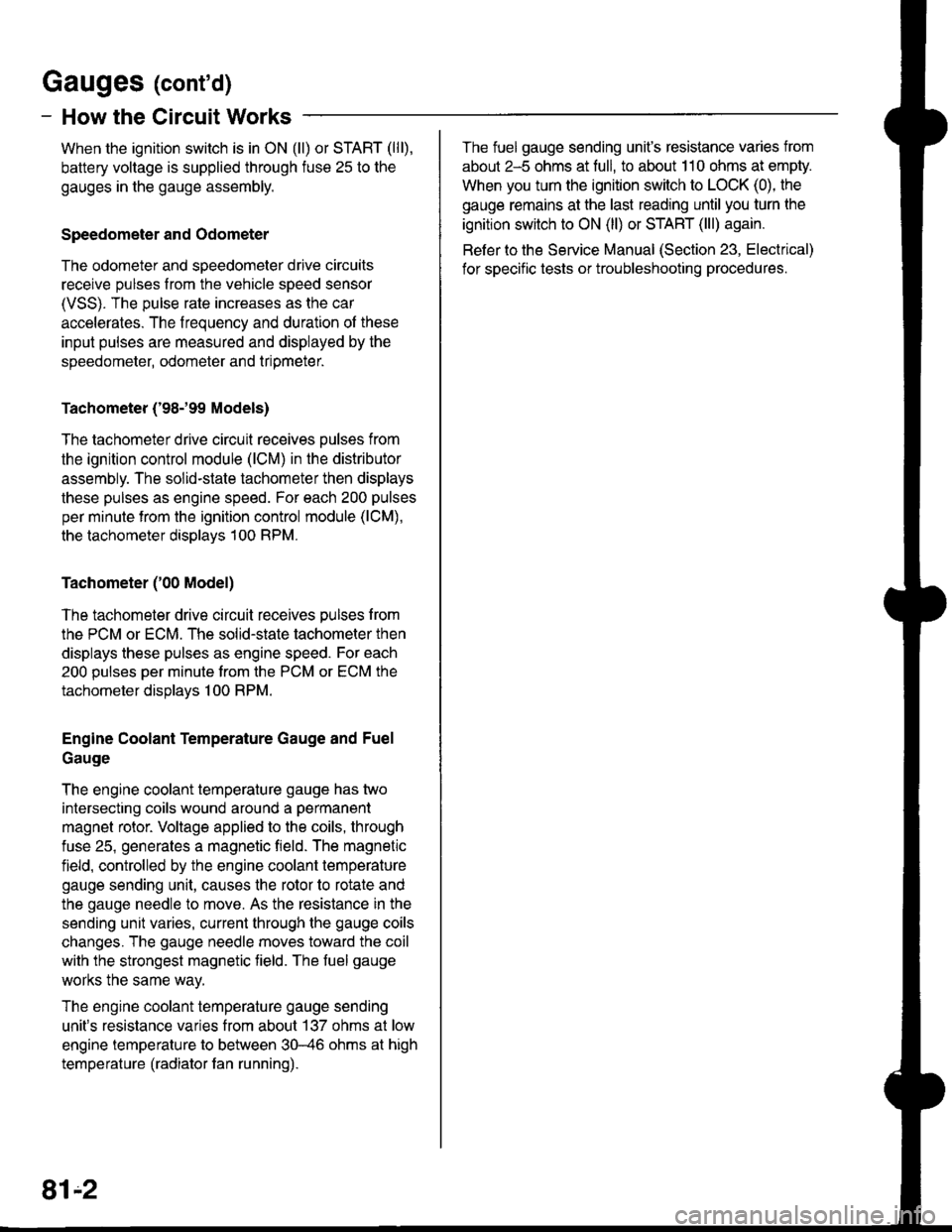
- How the Circuit Works
When the ignition switch is in ON (ll) or START (lll),
battery voltage is supplied through fuse 25 to the
gauges in the gauge assembly.
Speedometer and Odometer
The odometer and speedometer drive circuits
receive pulses lrom the vehicle speed sensor
(VSS). The pulse rate increases as the car
accelerates. The frequency and duration of these
input pulses are measured and displayed by the
speedometer, odometer and tripmeter.
Tachometer ('98-'99 Models)
The tachometer drive circuit receives oulses from
the ignition control module (lCM) in the distributor
assembly. The solid-state tachometer then displays
these pulses as engine speed. For each 200 pulses
per minute from the ignition control module (lCM),
the tachometer displays 100 RPM.
Tachometer ('00 Model)
The tachometer drive circuit receives pulses f rom
the PCM or ECM. The solid-state tachometer then
displays these pulses as engine speed. For each
200 oulses oer minute trom the PCM or ECM the
tachometer displays 1 00 RPM.
Engine Coolant Temperature Gauge and Fuel
Gauge
The engine coolant temperature gauge has two
intersecting coils wound around a permanent
magnet rotor. Voltage applied to the coils, through
fuse 25, generates a magnetic field. The magnetic
field, controlled by the engine coolant temperature
gauge sending unit, causes the rotor to rotate and
the gauge needle to move. As the resistance in the
sending unit varies, current through the gauge coils
changes. The gauge needle moves toward the coil
with the strongest magnetic tield. The fuel gauge
works the same way.
The engine coolant temperature gauge sending
unit's resistance varies from about 137 ohms at low
engine temperature to between 30-46 ohms at high
temperature (radiator fan running).
The fuel gauge sending unit's resistance varies from
about 2-5 ohms at full, to about 110 ohms at empty.
When you turn the ignition switch to LOCK (0), the
gauge remains at the last reading until you turn lhe
ignition switch to ON (ll) or START (lll) again.
Refer to the Service Manual (Section 23, Electrical)
for specific tests or troubleshooting procedures.
81'2
Page 1546 of 1680
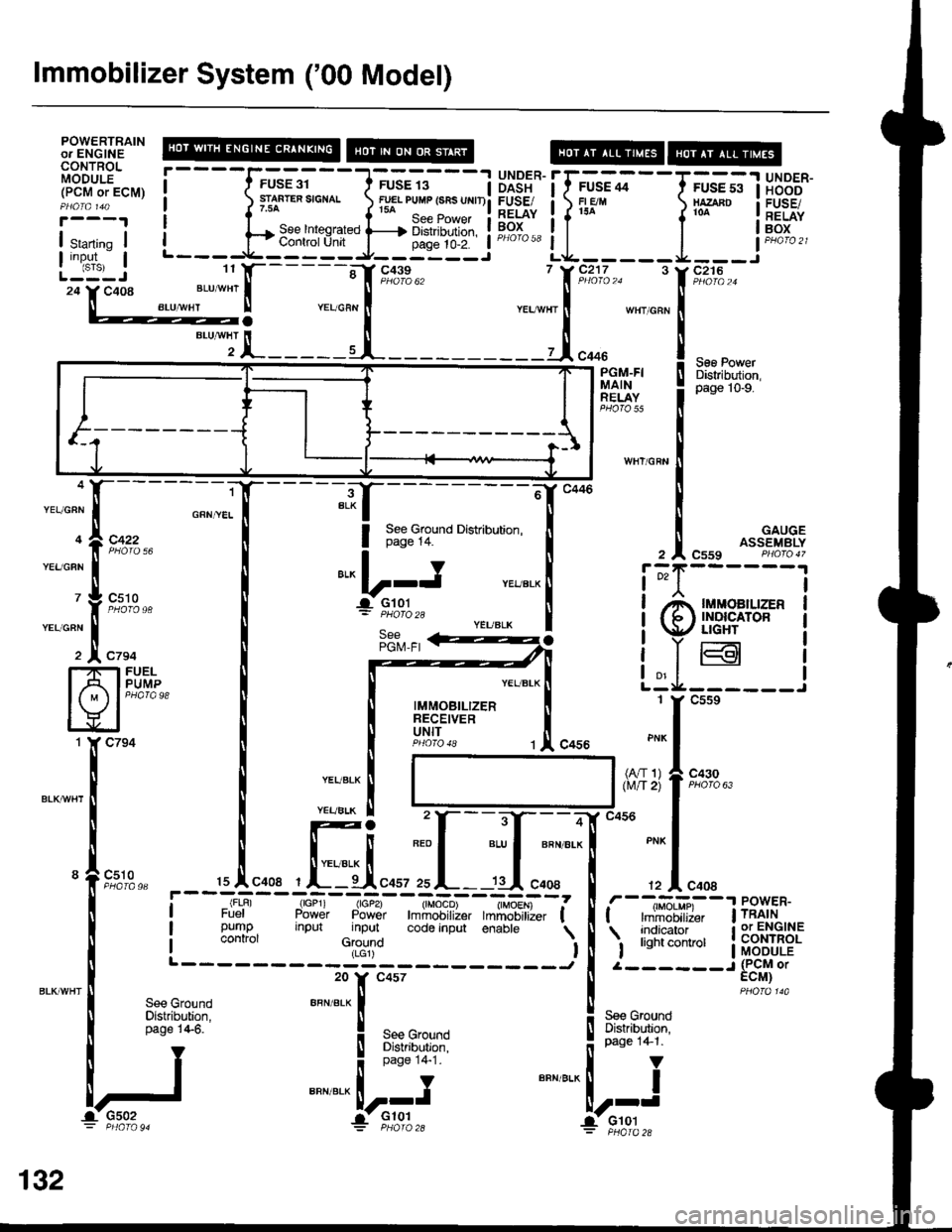
lmmobilizer System ('00 Model)
POWERTRAINol ENGINECONTROL;,6ri iriE' !- - - - -F^-E; -
I 1,'r._,..--:
-'j
!.i3!.* i f ;.-. *-
- -
F ;; ; I H 3BB"(Pclvl or EcM) I ( rri-*." ",ono. rua ruur lsns urrll Firser i o_e,n xrano I FUsEi
ig-r i fl^.ee,ntesra,ed fi;rl,u,:l i iEioi i f
"'-
l
'*"
iEEf'
! :"'ll,l' ! L---g-_'ry_+J-:_E.:gil
"u'*
il.^=---=I-= -i;;eo''
io"-r, I B:i,fffil
!4.1ry.. : pase lo-e.RELAY
WHI/GRN
;{---------61'c446 t
i ;;6;;;uno o'"u'u"'on l I GAuGE
""i;i ,.""..1
i*':,:""#'= PHoro2s
| ! (9 ilSi'"ito" I
yffi
i"Yffi i
| ,""o",.,r.*
-'-=--l t;ia;;----'
I "ffi;f:'- ,.!, "ouu ""- I
"..".* i I
I I l"#fl;llF#'*"
, ffi ".,, ILF"l'
"."
; I "..,
7;:F,
-;:*+
,-Tr,u-,"*"tilt, f I [-;*tn-
-l
isx,fi^'no"
ul.:ii'o codeinput enabre
I iilfli:lT*, itf$Egf(LGr)-J | 2------J (PCM or20
tr,
c4s7
| :,"#,.,enr erx | ! s." crouna
t g"-:,Bn'*,l l
guW
"""".-U:i' BFN""l--i
i:-f,:g:,, Yffi:
".,"":r------*-";T
^
| ,"!::.," !
-:":fr'*,,
I
[f,"i;. I
".--rr
l N
'lr**"" ,,tr*,
I
i--!r,
*.**il
iltlw
IJ: PHafag4
132
Page 1547 of 1680
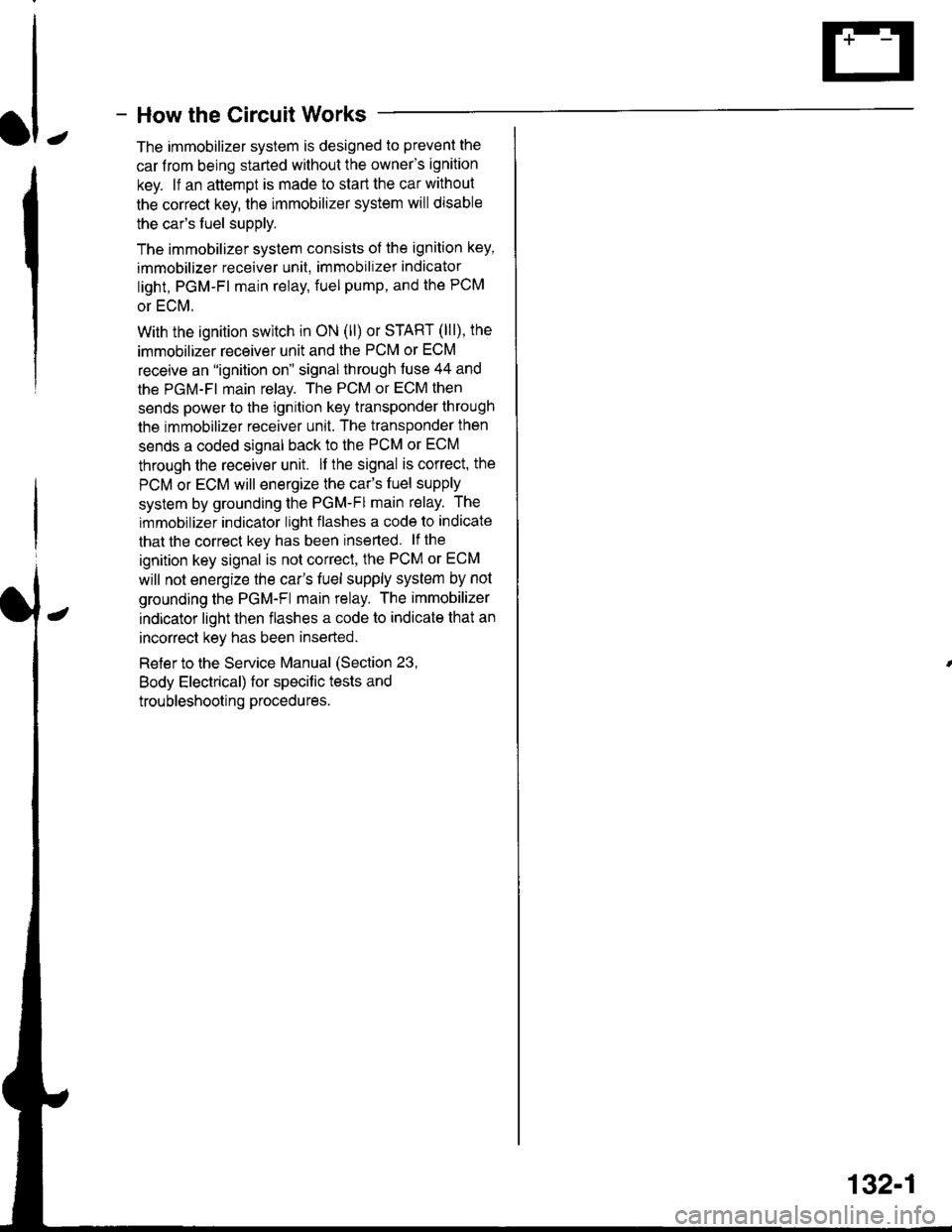
- How the Circuit Works
The immobilizer system is designed to prevent the
car f rom being started without the owner's ignition
key. lf an attempt is made to start the car without
the correct key, the immobilizer system will disable
the car's fuel supply.
The immobilizer system consists of the ignition key,
immobilizer receiver unit, immobilizer indicator
light, PGM-FI main relay, fuel pump, and the PCM
or ECM.
With the ignition switch in ON (ll) or START (lll), the
immobilizer receiver unit and the PCM or ECM
receive an "ignition on" signal through fuse 44 and
the PGM-FI main relay. The PCM or ECM then
sends power to the ignition key transponder through
the immobilizer receiver unit. The transponder then
sends a coded signal back to the PCM or ECM
through the receiver unit. lf the signal is correct, the
PCM or ECM will energize the car's fuel supply
system by grounding the PGM-FI main relay. The
immobilizer indicator light flashes a code to indicate
that the correct key has been inserted. lf the
ignition key signal is not correct, the PCM or ECM
will not energize the car's fuel supply system by not
grounding the PGM-Fl main relay. The immobilizer
indicator light then flashes a code to indicate that an
incorrect key has been inserted.
Refer to the Service Manual (Section 23,
Body Electrical) for specific tests and
troubleshooting procedures.
132-1