1997 TOYOTA TACOMA wheel size
[x] Cancel search: wheel sizePage 34 of 221

34
This SRS airbag system has a service re-
minder indicator to inform the driver of op-
erating problems. If either of the following
conditions occurs, this indicates a mal-
function of the airbags. Contact your To-
yota dealer as soon as possible to service
the vehicle. The light does not come on when the
ignition key is turned to the ACCº or
ONº position, or remains on.
The light comes on while driving.In the following cases, contact your Toyo-
ta dealer as soon as possible: The SRS airbag has been inflated.
The front part of the vehicle (shaded in the illustration) was involved in an ac-
cident not of the extent to cause the
SRS airbags to inflate
The pad section of the steering wheel
(shaded in the illustration)is scrat-
ched, cracked, or otherwise damaged. Toyota strongly urges the use of child
restraint systems for children small
enough to use them.
The laws of all fifty states in the U.S.A.
and Canada now require the use of a child
restraint system.
Your vehicle conforms to SAEJ1819.
If a child is too large for a child restraint
system,
the child should sit in the rear seat
and must be restrained using the vehicle's
seat belt. See Seat beltsº for details.CAUTION!
For effective protection in automo-
bile accidents and sudden stops,
children must be properly re-
strained using a seat belt or child
restraint system depending on the
age and size of the child. Holding
a child in your arms is not a substi-
tute for a child restraint system. In
an accident, the child can be
crushed against the windshield, or
between you and the vehicle's in-
terior.
Child restraintÐ ÐChild restraint precautions
Page 35 of 221

34
This SRS airbag system has a service re-
minder indicator to inform the driver of op-
erating problems. If either of the following
conditions occurs, this indicates a mal-
function of the airbags. Contact your To-
yota dealer as soon as possible to service
the vehicle. The light does not come on when the
ignition key is turned to the ACCº or
ONº position, or remains on.
The light comes on while driving.In the following cases, contact your Toyo-
ta dealer as soon as possible: The SRS airbag has been inflated.
The front part of the vehicle (shaded in the illustration) was involved in an ac-
cident not of the extent to cause the
SRS airbags to inflate
The pad section of the steering wheel
(shaded in the illustration)is scrat-
ched, cracked, or otherwise damaged. Toyota strongly urges the use of child
restraint systems for children small
enough to use them.
The laws of all fifty states in the U.S.A.
and Canada now require the use of a child
restraint system.
Your vehicle conforms to SAEJ1819.
If a child is too large for a child restraint
system,
the child should sit in the rear seat
and must be restrained using the vehicle's
seat belt. See Seat beltsº for details.CAUTION!
For effective protection in automo-
bile accidents and sudden stops,
children must be properly re-
strained using a seat belt or child
restraint system depending on the
age and size of the child. Holding
a child in your arms is not a substi-
tute for a child restraint system. In
an accident, the child can be
crushed against the windshield, or
between you and the vehicle's in-
terior.
Child restraintÐ ÐChild restraint precautions
Page 50 of 221
49
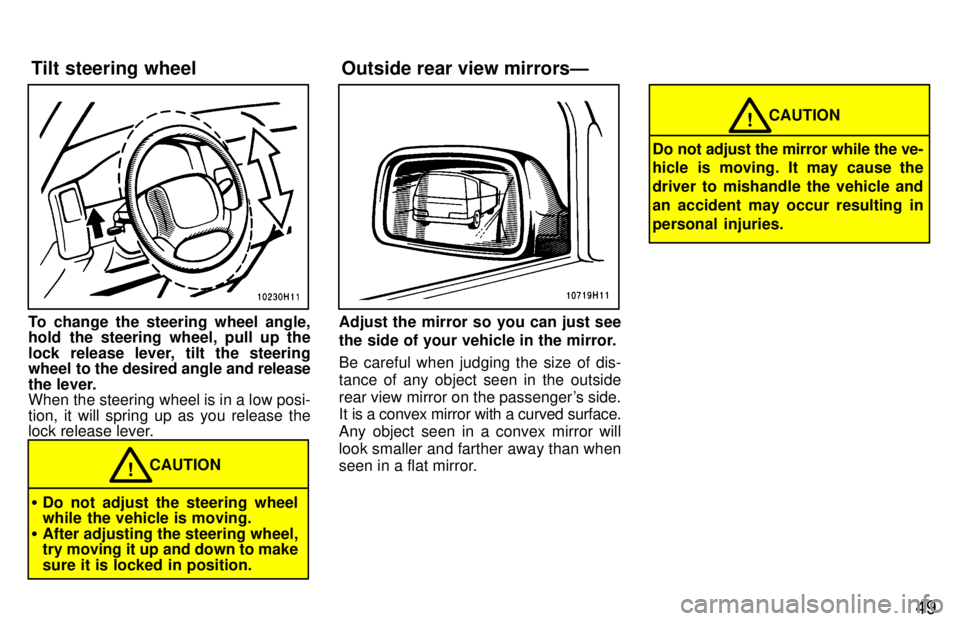
To change the steering wheel angle,
hold the steering wheel, pull up the
lock release lever, tilt the steering
wheel to the desired angle and release
the lever.
When the steering wheel is in a low posi-
tion, it will spring up as you release the
lock release lever.
Do not adjust the steering wheel
while the vehicle is moving.
After adjusting the steering wheel,try moving it up and down to make sure it is locked in position.
CAUTION!
Adjust the mirror so you can just see
the side of your vehicle in the mirror. Be careful when judging the size of dis- tance of any object seen in the outside
rear view mirror on the passenger's side.
It is a convex mirror with a curved surface.
Any object seen in a convex mirror will
look smaller and farther away than when
seen in a flat mirror.
CAUTION!
Do not adjust the mirror while the ve-
hicle is moving. It may cause the
driver to mishandle the vehicle and
an accident may occur resulting in
personal injuries.
Tilt steering wheel Outside rear view mirrorsÐ
Page 121 of 221
120
Effective way to press the ABSº brake
pedal: When the anti-lock brake system
function is in action, you may feel the brake pedal pulsating and hear a noise.
In this situation, to let the anti-lock brake
system work for you, just hold the brake
pedal down more firmly. Do not pumpthe brake. This will result in reduced
braking performance.
The brake pedal pulsation caused by the
anti-lock brake system may indicate haz- ardous road surface conditions. Althoughthe anti-lock brake system assists in pro-
viding vehicle control, it is still important to
drive with all due care, because the anti-
lock brake system cannot overcome the
laws of physics that act on your vehicle: Braking capab ility is dependent on tire
friction with the road surface.
Even though the anti-lock brake sys-
tem is operating, a driver cannot main- tain full control on certain slippery road
surfaces, when cornering at highspeeds, or in violent maneuvers.
Avoid high speeds on wet roads. The
anti-lock brake system cannot elimi-
nate the risk of hydroplaning and lossof tire friction. Always maintain a safe distance from the
vehicle in
front of you. Compared with ve-
hicles not fitted with an anti-lock brake
system, your vehicle may require a longer
stopping distance in the following cases: Driving on rough, gravel or snow-cov-
ered roads.
Driving with tire chains installed.
Driving on roads where the road sur-
face is pitted or has other differencesin surface height.
CAUTION!
Do not use tires other than the
manufacturer 's designated tires, and
do not mix tires or wheels of different
sizes. You may prevent the antilockbrake system from operating at fulleffictiveness.
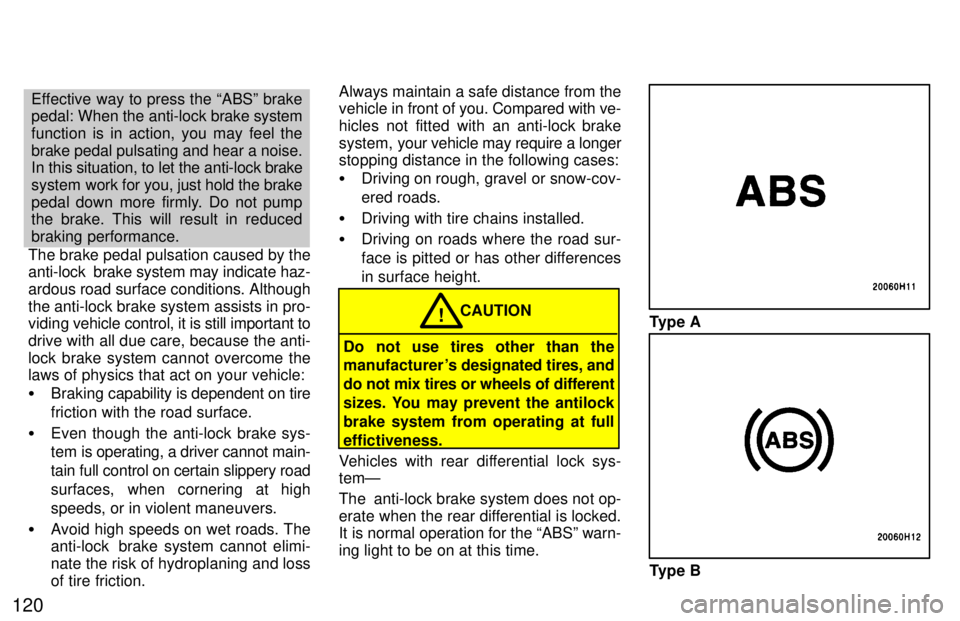
Vehicles with rear differential lock sys- temÐ
The anti-lock brake system does not op-
erate when the rear differential is locked.
It is normal operation for the ABSº warn-
ing light to be on at this time.Type A
Type B
Page 126 of 221
125
CAUTION!
Do not mix summer and all sea-
son tires on your vehicle as this
can cause dangerous handling
characteristics, resulting in loss
of control.
Do not use tires other than the
manufacturer 's designated tires,
and do not mix tires or wheels of
the sizes different from the originals.
Page 163 of 221

162
High pressure water or steam is effec-
tive for cleaning the vehicle's under-
side and wheel housings. Pay particu-
lar attention to these areas as it is
difficult to see all the mud and dirt. It
will do more harm than good to simply
wet the mud and debris without remov-
ing them. The lower edge of doors,
rocker panels and frame members
have drain holes which should not be
allowed to clog with dirt as trapped wa-
ter in these areas can cause corrosion.
Wash the underside of the vehicle
thoroughly when winter is over.
See Washing and waxing your Toyotaº
for more tips.
Check the condition of your vehicle's
paint and trim. If you find any chips or
scratches in the paint, touch them up im- mediately to prevent corrosion from start- ing. If the chips or scratches have gone
through the bare metal, have a qualified
body shop make the repair. Check the interior of your vehicle.
Wa-
ter and dirt can accumulate under the floor
mats and could cause corrosion. Occa-
sionally check under the mats to make sure the area is dry. Be particularly careful
when transporting chemicals, cleansers,
fertilizers, salt, etc.; these should be
transported in proper containers. If a spill
or leak should occur, immediately clean
and dry the area.
Use mud shields on your wheels. If you
drive on salted or gravel roads, mud
shields help protect your vehicle. Full- size shields, which come as near to the
ground as possible, are the best. We rec-
ommend that the fittings and the area
where the shields are installed be treated
to resist corrosion. Your Toyota dealer will
be happy to assist in supplying and instal-
ling the shields if they are recommended for your area.
Do not park your vehicle in a damp, poorly ventilated garage. If you wash
your vehicle in the garage, or if you drive
it in covered with water or snow, your ga- rage may be so damp it will cause corro-
sion. Even if your garage is heated, a wet
vehicle can corrode if the ventilation is
poor. Washing your Toyota by hand
Work in the shade and wait until the ve-
hicle body is not hot to the touch.
CAUTION
When cleaning under floor or chas-
sis, be careful not to injure your hands.!
1. Rinse off loose dirt with a hose. Re- move any mud or road salt from the
underside of the vehicle or in the wheel
wells.
2. Wash with a mild car-wash soap, mixed according to the manufacturer's
instructions. Use a soft cotton mitt and
keep it wet by dipping it frequently into
the wash water. Do not rub hard-let the soap and water remove the dirt.
Aluminum wheels: Use only a mild soap or
neutral detergent.
Road tar: Remove with turpentine or
cleaners that are marked safe for painted surfaces.
Do not use gasoline or strong
solvents, which may be toxic or
cause damage.
NOTICE
Washing and waxing your
Toyota
Page 186 of 221
185
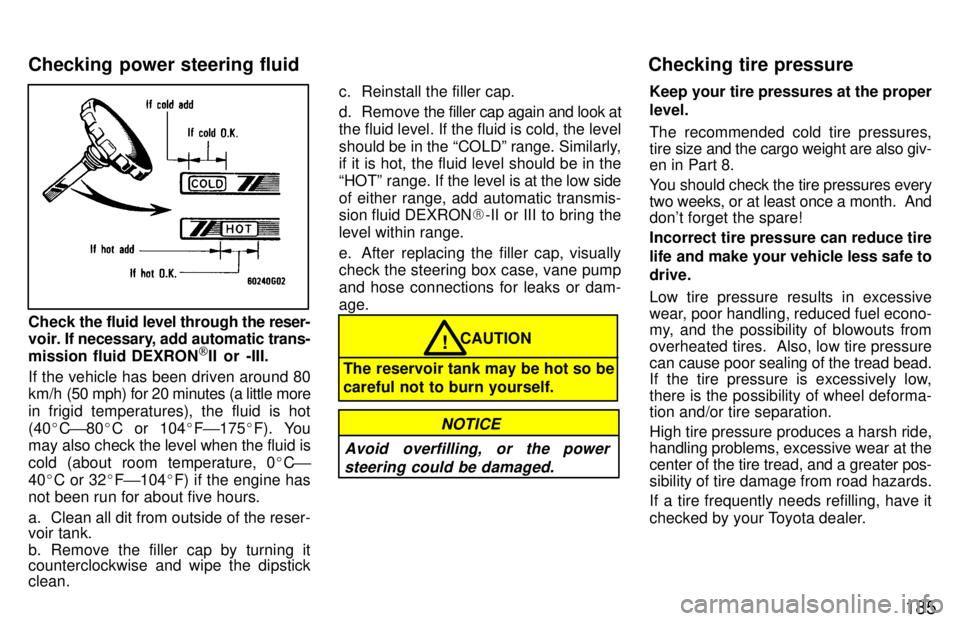
Check the fluid level through the reser-
voir. If necessary, add automatic trans-
mission fluid DEXRON [
II or -III.
If the vehicle has been driven around 80
km/h (50 mph) for 20 minutes (a little more
in frigid temperatures), the fluid is hot (40 C ' 80 C or 104 F ' 175 F). You
may also check the level when the fluid is
cold (about room temperature, 0 C '
40 C or 32 F ' 104 F) if the engine has
not been run for about five hours.
a. Clean all dit from outside of the reser- voir tank.
b. Remove the filler cap by turning it
counterclockwise and wipe the dipstick clean. c. Reinstall the filler cap.
d. Remove the filler cap again and look at the fluid level. If the fluid is cold, the level
should be in the COLDº range. Similarly, if it is hot, the fluid level should be in the
HOTº range. If the level is at
the low side
of either range, add automatic transmis-
sion fluid DEXRON -II or III to bring the
level within range.
e. After replacing the filler cap, visually check the steering box case, vane pump
and hose connections for leaks or dam-age.
CAUTION
The reservoir tank may be hot so be careful not to burn yourself.!
Avoid overfilling, or the power steering could be damaged.
NOTICE
Keep your tire pressures at the proper level.
The recommended cold tire pressures, tire size and the cargo weight are also giv-
en in Part 8.
You should check the tire pressures every two weeks, or at least once a month. And
don't forget the spare!
Incorrect tire pressure can reduce tire
life and make your vehicle less safe to drive.
Low tire pressure results in excessive
wear, poor handling, reduced fuel econo-
my, and the possibility of blowouts from
overheated tires. Also, low tire pressure
can cause poor sealing of the tread bead.
If the tire pressure is excessively low,
there is the possibility of wheel deforma- tion and/or tire separation.
High tire pressure produces a harsh ride,
handling problems, excessive wear at the center of the tire tread, and a greater pos-
sibility of tire damage from road hazards.
If a tire frequently needs refilling, have it
checked by your Toyota dealer.
Checking power steering fluid
Checking tire pressure
Page 188 of 221
187
CAUTION
Do not mix radial, bias belted, or
bias-ply tires on your vehicle. It
can cause dangerous handling
characteristics, resulting in loss of control.
Do not use tire or wheels other than
the manufacturer's recommended size.!
Toyota recommends all four tires, or at
least both of the front or rear tires be
replaced at a time as a set.
See If you have a flat tireº in Part 4 for tire
change procedure.
When a tire is replaced, the wheel
should always be balanced.
An unbalanced wheel may affect vehicle
handling and tire life. Wheels can get out
of balance with regular use and should
therefore be balanced occasionally.
When replacing a tubeless tire, the air
valve should also be replaced with a
new one.
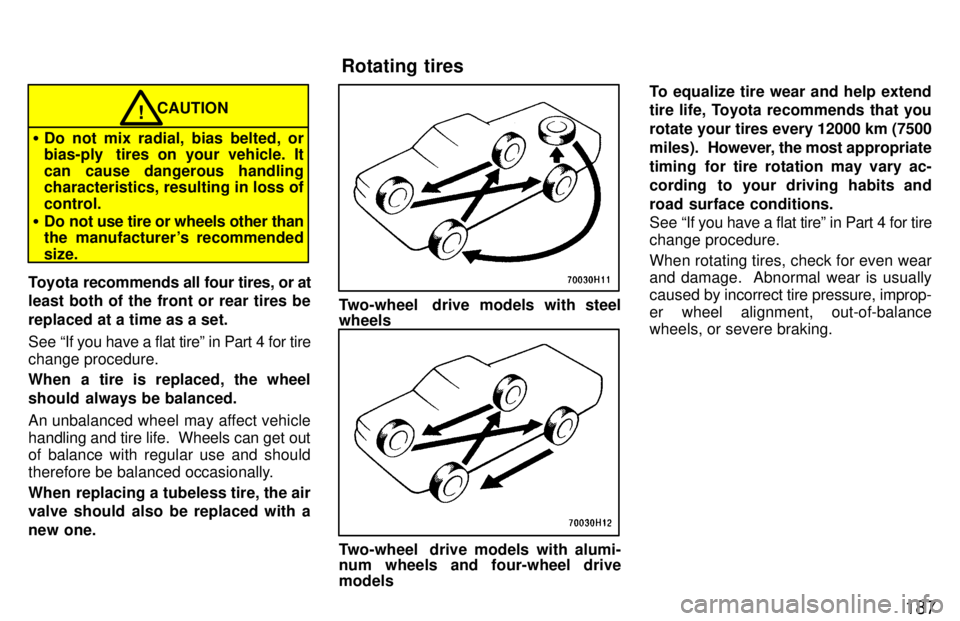
Two-wheel drive models with steel wheels
Two-wheel drive models with alumi-
num wheels and four-wheel drive models To equalize tire wear and help extend
tire life, Toyota recommends that you
rotate your tires every 12000 km (7500
miles).
However, the most appropriate
timing for tire rotation may vary ac-
cording to your driving habits and
road surface conditions.
See If you have a flat tireº in Part 4 for tire
change procedure. When rotating tires, check for even wear
and damage. Abnormal wear is usually
caused by incorrect tire pressure, improp-
er wheel alignment, out-of-balance
wheels, or severe braking.
Rotating tires