1997 TOYOTA TACOMA tires
[x] Cancel search: tiresPage 150 of 221
149
Xtra-cab modelsÐTo raise the vehicle,
insert the jack handle extension into the jack (it is a loose fit) and turn it clockwisewith the handle, making sure the handle remains firmly fitted into the jack handle
extension. As the j
ack touches the vehicle
and begins to lift, double-check that it is
properly positioned.
Never get under the vehicle when
the vehicle is supported by the jack alone. CAUTION
!
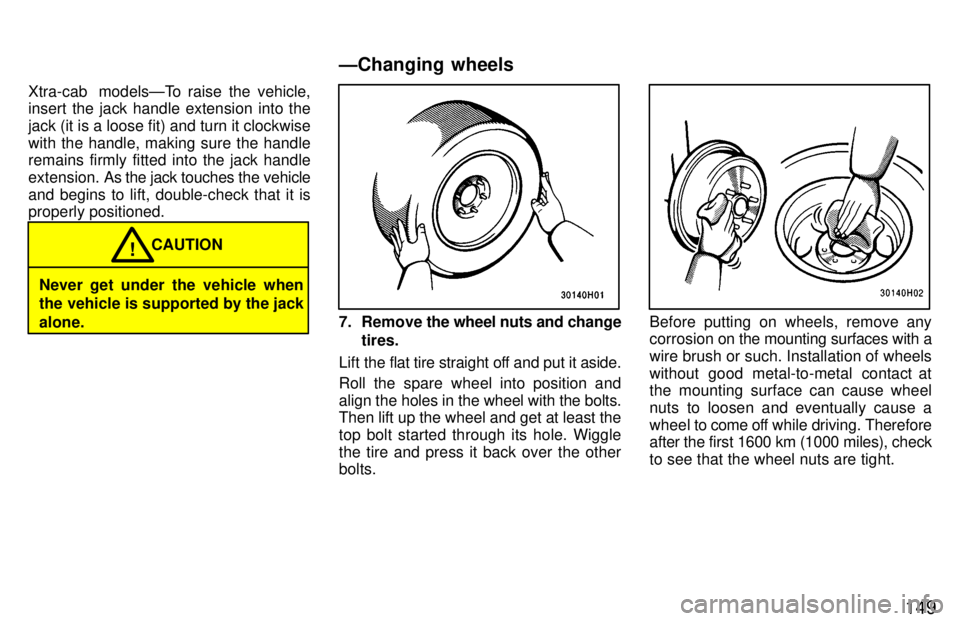
7. Remove the wheel nuts and change
tires.
Lift the flat tire straight off and put it aside.
Roll the spare wheel into position and
align the holes in the wheel with the bolts.
Then lift up the wheel and get at least thetop bolt started through its hole. Wigglethe tire and press it back over the other bolts.Before putting on wheels, remove any
corrosion on the mounting surfaces with a
wire brush or such. Installation of wheels
without good metal-to-metal contact at
the mounting surface can cause wheel
nuts to loosen and eventually cause a
wheel to come off while driving. Therefore
after the first 1600 km (1000 miles), check
to see that the wheel nuts are tight.
ÐChanging wheels
Page 158 of 221
157
If the emergency towing hook is
used to get out when your vehicle
becomes stuck in the mud, sand or
other condition from which the
vehicle can not be driven out under
its own power, make sure to observe
the precautions mentioned below.
Otherwise, excessive stress will be
put on the hook and the towing
bacle or chain may break, causing
serious injury or damage. If the towing vehicle can hardly
move, do not forcibly continue the
towing. Contact your Toyota deal-
er or a commercial tow truck ser- vice for assistance.
Tow the vehicle as straight ahead as possible.
Keep away from the vehicle during
towing. CAUTION
!
The following methods are effective to
use when your vehicle is stuck in the
mud, sand or other condition from
which
the vehicle cannot be driven out
under its own power. Use extreme cau-
tion when towing the vehicle. In addi-tion, keep away from the vehicles and towing cable or chain when towing. Remove the sand and soil in the front and the back of the tires.
Place stones or wood under the tires.
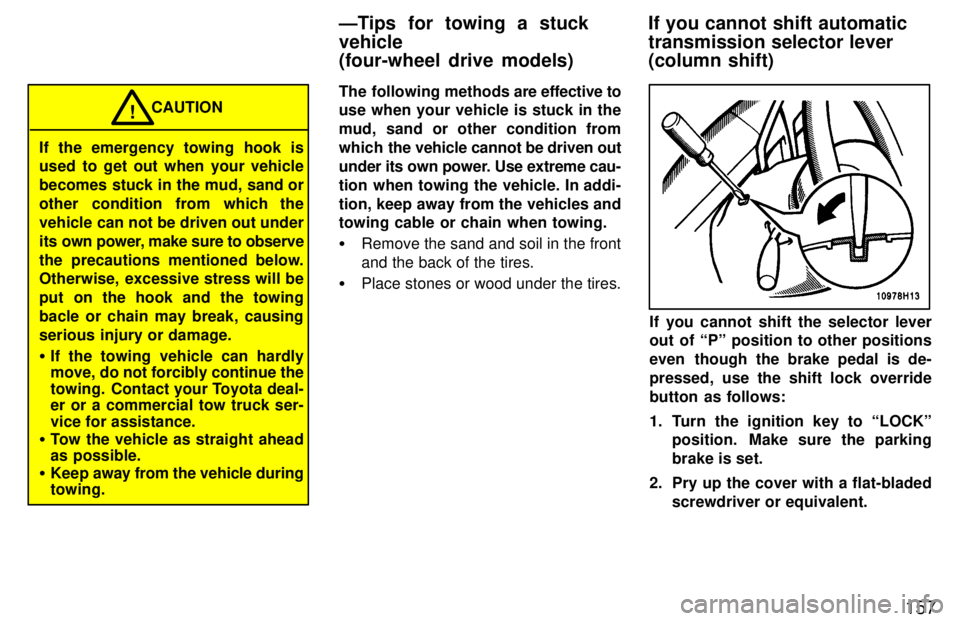
If you cannot shift the selector lever
out of Pº position to other positions
even though the brake pedal is de-pressed, use the shift lock override
button as follows:
1. Turn the ignition key to LOCKº
position. Make sure the parking brake is set.
2. Pry up the cover with a flat-bladed screwdriver or equivalent.
ÐTips for towing a stuck
vehicle (four-wheel drive models)
If you cannot shift automatic transmission selector lever (column shift)
Page 170 of 221

169
Tire surface and wheel nuts Check the tires carefully
for cuts, damage
or excessive wear. See Chapter 7-2 for
additional information. When checking the tires, make sure no nuts are missing,
and check the nuts for looseness. T ighten
them if necessary.
Tire rotation
Rotate the tires every 12000 km (7500
miles). See Chapter 7-2 for additional in- formation.
Fluid leaks Check underneath for leaking fuel, oil, wa-
ter or other fluid after the vehicle has been
parked for a while. If you smell fuel fumes
or notice any leak, have the cause found
and corrected immediately. Doors and engine hood Check that all doors including tailgate op- erate smoothly and all latches lock se-
curely. M ake sure the engine hood secon-
dary latch secures the hood from opening
when the primary latch is released. INSIDE THE VEHICLE Items listed below should be checked
regularly, e.g. while performing peri-
odic services, cleaning the vehicle,etc. Lights Make sure the headlights, stop lights, tail lights, turn signal lights, and other lights are all working. Check headlight aim. Service reminder indicators and
warn-
ing buzzers Check that all service reminder indicators
and warning buzzers function properly. Steering wheel
Be alert for changes in steering condition, such as hard steering or strange noise. Seats Check that all front seat controls such as
seat adjusters, seatback recliner, etc. op- erate smoothly and that all latches lock
securely in any position. Check that the
head restraints move up and down
smoothly and that the locks hold securely
in any latched position. For folding-down
seatback (bench seat), check that the
latches lock securely. Seat belts
Check that the seat belt system such as
buckles, retractors and anchors operate
properly
and smoothly. Make sure the belt
webbing is not cut, frayed, worn or dam-aged. Accelerator pedal Check the pedal for smooth operation and
uneven pedal effort or catching. Clutch pedal Check the pedal for smooth operation. Brake pedal Check the pedal for smooth operation and
that the pedal has the proper clearance. Check the brake booster function. Brakes
At a safe place, check that the brakes do not pull to one side when applied. Parking brake Check that the lever has the proper travel and that, on a safe incline, your vehicle is
held securely with only the parking brake applied.
Page 182 of 221
Part 7Checking the engine oil level
181
DO-IT-YOURSELF MAINTENANCEÐ
Chapter 7-2 Engine and Chassis
Checking the engine oil level
Checking the engine coolant level
Checking brake fluid
Checking power steering fluid
Checking tire pressure
Checking and replacing tires
Rotating tires
Installing snow tires and chains
Replacing wheels
Aluminum wheel precautions
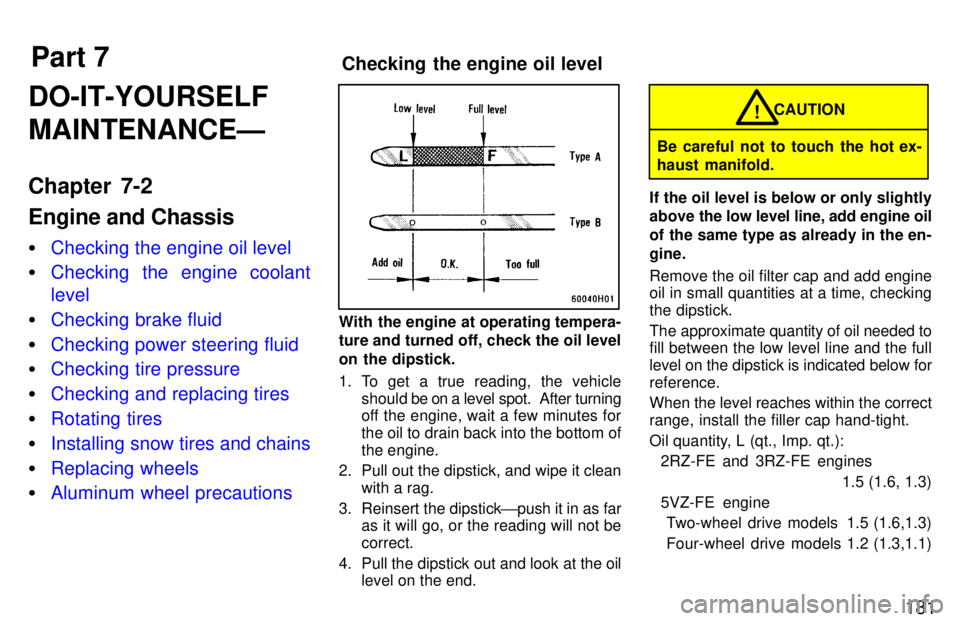
With the engine at operating tempera- ture and turned off, check the oil level
on the dipstick.
1. To get a true reading, the vehicle
should be on a level spot. After turning
off the engine, wait a few minutes for
the oil to drain back into the bottom ofthe engine.
2. Pull out the dipstick, and wipe it clean with a rag.
3. Reinsert the dipstick 'push it in as far
as it will go, or the reading will not becorrect.
4. Pull the dipstick out and look at the oil level on the end.
CAUTION
Be careful not to touch the hot ex-
haust manifold.!
If the oil level is below or only slightly
above the low level line, add engine oil
of the same type as already in the en- gine. Remove the oil filter cap and add engine oil in small quantities at a time, checking the dipstick.
The approximate quantity of oil needed to
fill between the low level line and the full
level on the dipstick is indicated below forreference. When the level reaches within the correct range, install the filler cap hand-tight.
Oil quantity, L (qt., Imp. qt.):
2RZ-FE and 3RZ-FE engines
1.5 (1.6, 1.3)
5VZ-FE engine Two-wheel drive models 1.5 (1.6,1.3)
Four-wheel drive models 1.2 (1.3,1.1)
Page 186 of 221
185
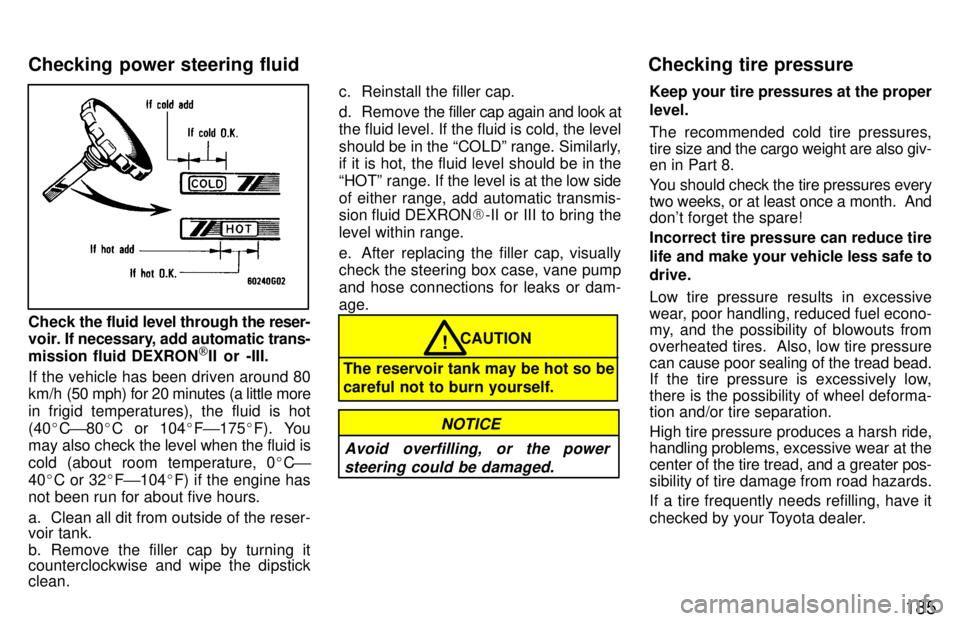
Check the fluid level through the reser-
voir. If necessary, add automatic trans-
mission fluid DEXRON [
II or -III.
If the vehicle has been driven around 80
km/h (50 mph) for 20 minutes (a little more
in frigid temperatures), the fluid is hot (40 C ' 80 C or 104 F ' 175 F). You
may also check the level when the fluid is
cold (about room temperature, 0 C '
40 C or 32 F ' 104 F) if the engine has
not been run for about five hours.
a. Clean all dit from outside of the reser- voir tank.
b. Remove the filler cap by turning it
counterclockwise and wipe the dipstick clean. c. Reinstall the filler cap.
d. Remove the filler cap again and look at the fluid level. If the fluid is cold, the level
should be in the COLDº range. Similarly, if it is hot, the fluid level should be in the
HOTº range. If the level is at
the low side
of either range, add automatic transmis-
sion fluid DEXRON -II or III to bring the
level within range.
e. After replacing the filler cap, visually check the steering box case, vane pump
and hose connections for leaks or dam-age.
CAUTION
The reservoir tank may be hot so be careful not to burn yourself.!
Avoid overfilling, or the power steering could be damaged.
NOTICE
Keep your tire pressures at the proper level.
The recommended cold tire pressures, tire size and the cargo weight are also giv-
en in Part 8.
You should check the tire pressures every two weeks, or at least once a month. And
don't forget the spare!
Incorrect tire pressure can reduce tire
life and make your vehicle less safe to drive.
Low tire pressure results in excessive
wear, poor handling, reduced fuel econo-
my, and the possibility of blowouts from
overheated tires. Also, low tire pressure
can cause poor sealing of the tread bead.
If the tire pressure is excessively low,
there is the possibility of wheel deforma- tion and/or tire separation.
High tire pressure produces a harsh ride,
handling problems, excessive wear at the center of the tire tread, and a greater pos-
sibility of tire damage from road hazards.
If a tire frequently needs refilling, have it
checked by your Toyota dealer.
Checking power steering fluid
Checking tire pressure
Page 187 of 221

186The following instructions for check-
ing tire pressure should be observed:
The pressure should be checked
only when the tires are cold. If your
vehicle has been parked for at least 3hours and has not been driven for
more than 1.5 km or 1 mile since, you
will get an accurate cold tire pressure reading.
Always use a tire pressure gauge.
The appearance of a tire can be mis-
leading. Besides, tire pressure that
are even just a few pounds off can de-
grade handling and ride.
Do not bleed or reduce tire pres-sure after driving. It is normal for the
tire pressure to be higher after driving.
Never exceed the cargo weight ra-tio. The luggage weight should bedis-
tributed evenly.
Be sure to reinstall the tire inflation
valve caps. Without the valve caps,
dirt or moisture could get into the valve
core and cause air leakage. If the caps
have been lost, have new ones put onas soon as possible.
CHECKING YOUR TIRES Check the tire tread for the tread wear
indicators. If the indicators show, re-place the tires.
The tires on your Toyota have built-in tread wear indicators to help you know
when the tires need replacement. When
the tread depth wears to 1.6 mm (0.06 in.)
or less, the indicators will appear. If you
can see the indicators in two or more adja-
cent grooves, the tire should be replaced.
The lower the tread, the higher the risk of skidding. The effectiveness of snow tires is lost
if the tread wears down below 4 mm (0.16 in.). Check the tires regularly for damage
such as cuts, splits and cracks. If any
damage is found, consult with a tech-
nician and have the tire repaired or re- placed. Even if the damage does not appear seri-
ous, a qualified technician should ex-
amine the damage. Objects which have penetrated the tire may have caused in-ternal damage.
Any tires which are over six years old
must be checked by a qualified techni-
cian even if damage is not obvious.
Tires deteriorate with age even if they
have never or seldom been used.
This
also applies to the spare tire and tires
stored for future use. REPLACING YOUR TIRES
When replacing a tire, use only the
same size and construction as origi-
nally installed and with the same or
greater load capacity.
Using any other size or type of tire may se-
riously affect handling, ride, speedomeet-
er/odometer calibration, ground clear-
ance, and clearance between the body
and tires or snow chains.
Checking and replacing tires
Page 188 of 221
187
CAUTION
Do not mix radial, bias belted, or
bias-ply tires on your vehicle. It
can cause dangerous handling
characteristics, resulting in loss of control.
Do not use tire or wheels other than
the manufacturer's recommended size.!
Toyota recommends all four tires, or at
least both of the front or rear tires be
replaced at a time as a set.
See If you have a flat tireº in Part 4 for tire
change procedure.
When a tire is replaced, the wheel
should always be balanced.
An unbalanced wheel may affect vehicle
handling and tire life. Wheels can get out
of balance with regular use and should
therefore be balanced occasionally.
When replacing a tubeless tire, the air
valve should also be replaced with a
new one.
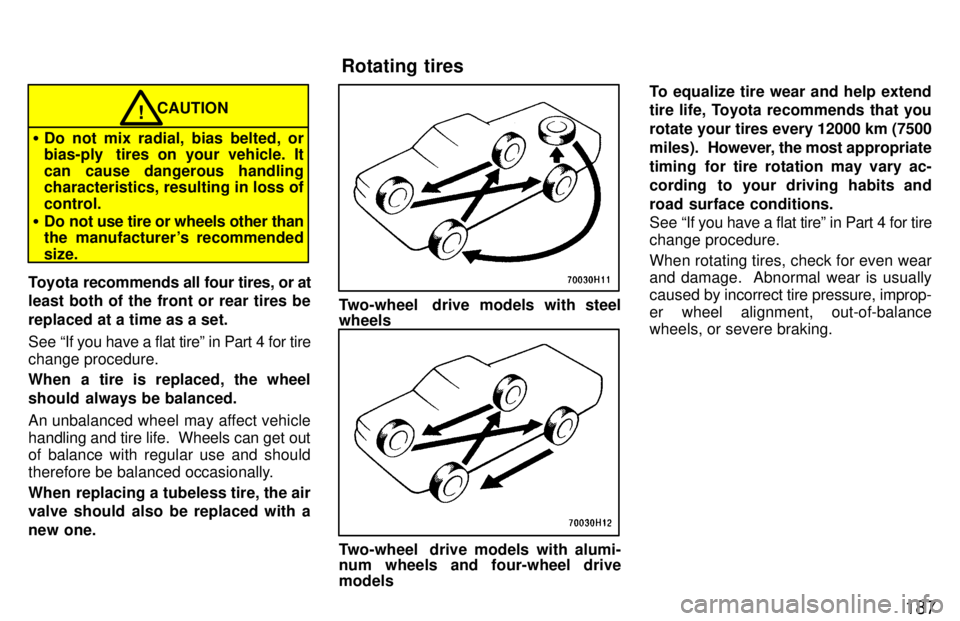
Two-wheel drive models with steel wheels
Two-wheel drive models with alumi-
num wheels and four-wheel drive models To equalize tire wear and help extend
tire life, Toyota recommends that you
rotate your tires every 12000 km (7500
miles).
However, the most appropriate
timing for tire rotation may vary ac-
cording to your driving habits and
road surface conditions.
See If you have a flat tireº in Part 4 for tire
change procedure. When rotating tires, check for even wear
and damage. Abnormal wear is usually
caused by incorrect tire pressure, improp-
er wheel alignment, out-of-balance
wheels, or severe braking.
Rotating tires
Page 189 of 221
188WHEN TO USE SNOW TIRES OR CHAINS
Snow tires or chains are recom-
mended when driving on snow or ice.
On wet or dry roads, conventional tires
provide better traction than snow tires. SNOW TIRE SELECTION
If you need snow tires, select tires of
the same size, construction and load capacity as the original tires on your
Toyota.
Do not use tires other than those men-
tioned above. Do not install studded tires
without first checking local regulations for
possible restrictions.
SNOW TIRE INSTALLATION
Snow tires should be installed on all wheels. Installing snow tires on the front wheels
only can lead to an excessive difference
in road grip capability between the front
and rear tires which would cause loss of
vehicle control.
When storing removed tires, you should
store them in a cool dry place.
Mark the direction of rotation and be sure to install them in the same direction when replacing.
CAUTION
Do not drive with the snow tires in- correctly inflated.
Never drive over 120 km/h (75 mph)
with any type of snow tires.!
TIRE CHAIN SELECTION
Use the tire chains of correct size and type.
Regulations regarding the use of tire
chains vary according to location or
type of road, so always check then be-
fore installing chains.
CHAIN INSTALLATIONInstall the chains on the front tires as
tightly as possible. Do not use tire
chains on the rear tires. Retighten
chains after driving 0.5 '1.0 km
(1/4 '1/2 mile).
When installing chains on your tires, care- fully follow the instructions of the chain
manufacturer.
If wheel covers are used, they will be
scratched by the chain band, so remove the covers before putting on the chains.
Do not exceed 50 km/h (30 mph) or
the chain manufacturer's recom-
mended speed limit, whichever is
lower.
Drive carefully avoiding bumps,
holes, and sharp turns, which may cause the vehicle to bounce.
Avoid sharp turns or locked-wheel
braking, as use of chains may ad- versely affect vehicle handling.
CAUTION!
Installing
snow tires and
chains