11 5
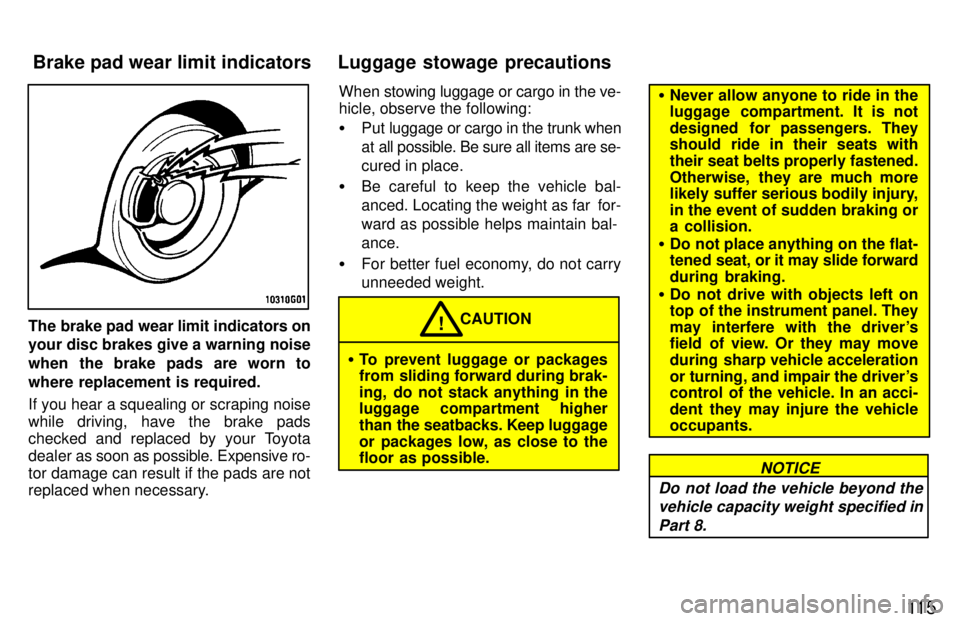
The brake pad wear limit indicators on your disc brakes give a warning noise
when the brake pads are worn to
where replacement is required.
If you hear a squealing or scraping noise
while driving, have the brake pads
checked and replaced by your Toyota
dealer as soon as possible. Expensive ro-
tor damage can result if the pads are not
replaced when necessary. When stowing luggage or cargo in the ve-
hicle, observe the following:
Put luggage or cargo in the trunk when
at all possible. Be sure all items are se-cured in place.
Be careful to keep the vehicle bal-
anced. Locating the weight as far for-
ward as possible helps maintain bal-ance.
For better fuel economy, do not carry unneeded weight.CAUTION!
To prevent luggage or packages
from sliding forward during brak-
ing, do not stack anything in the
luggage compartment higher
than the seatbacks. Keep luggage
or packages low, as close to the
floor as possible.
Never allow anyone to ride in the
luggage compartment. It is not
designed for passengers. They
should ride in their seats with
their seat belts properly fastened.
Otherwise, they are much more
likely suffer serious bodily injury, in the event of sudden braking or a collision.
Do not place anything on the flat-
tened seat, or it may slide forward
during braking.
Do not drive with objects left on
top of the instrument panel. They
may interfere with the driver's
field of view. Or they may move
during sharp vehicle acceleration
or turning, and impair the driver's
control of the vehicle. In an acci-
dent they may injure the vehicle occupants.
Do not load the vehicle beyond the
vehicle capacity weight specified in
Part 8.
NOTICE
Brake pad wear limit indicators Luggage stowage precautions
171
Look at the see-through coolant res-
ervoir when the engine is cold. The
coolant level is satisfactory if it is be-
tween the FULLº and LOWº lines on
the reservoir. If the level is low, add
ethylene-glycol type coolant.
The coolant level in the reservoir will vary
with engine temperature. However, if the
level is on or below the LOWº line, add
coolant. Bring the level up to the FULLº line. Use only ethylene-glycol type coolant. See information in the next column.
If the coolant level drops within a short
time after replenishing, there may be a
leak in the system. Visually check the ra-
diator, hoses, radiator cap and drain cock
and water pump.
If you can find no leak, have your Toyota
dealer
test the cap pressure and check for
leaks in the cooling system.
To prevent burning yourself, do not
remove the radiator cap when the en-
gine is hot.
CAUTION! Coolant type selection
Your coolant must contain ethylene-gly- col antifreeze. In addition to preventingfreezing and subsequent damage to the
engine, this will also prevent corrosion. Further supplemental inhibitors or addi-
tives are neither needed nor recom- mended.
Read
the antifreeze container for informa-
tion on freeze protection. Follow the
manufacturer 's directions for how much
to mix with water. The total capacity of the
cooling system is given in Part 8. We rec-
ommend 50% solution be used for your
Toyota, or a sufficient quantity to provideprotection to about -35 C (-31 C).
Do not use alcohol type antifreeze
or plain water alone.
NOTICE
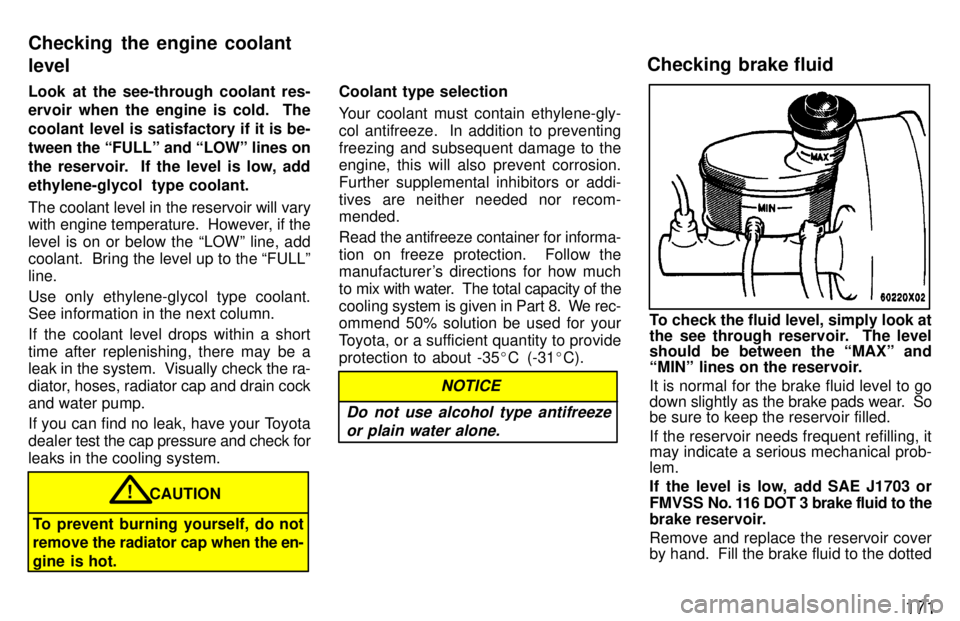
To check the fluid level, simply look at
the see through reservoir. The level
should be between the MAXº and
MINº lines on the reservoir. It is normal for the brake fluid level to go
down slightly as the brake pads wear. So
be sure to keep the reservoir filled. If the reservoir needs frequent refilling, it may indicate a serious mechanical prob- lem.
If the level is low, add SAE J1703 or
FMVSS No. 116 DOT 3 brake fluid to the
brake reservoir. Remove and replace the reservoir cover by hand. Fill the brake fluid to the dotted
Checking brake fluid
Checking the engine coolant level