1997 TOYOTA RAV4 ABS
[x] Cancel search: ABSPage 40 of 198
39
In a severe frontal impact, sensors detect
deceleration and the system triggers the
airbag inflators. Then a chemical reaction
in the inflators momentairly fills the
airbags with non-toxic nitrogen gas to
help restrain the forward motion of theoccupants. When the airbags inflate, they produce a fairly
loud noise and release some smoke
along with the nitrogen gas. This is notharmful and does not indicate a fire. Be
sure to wash off any residue as soon as
possible to prevent minor skin irritation.
Deployment of the airbags happen in a
fraction of a second, so the airbags must
inflate with considerable force. While the
system is designed to reduce serious inju-
ries, it may also cause minor burns or
abrasions and swellings.
Parts of the airbag module (steering
wheel hub, dashboard) may be hot forseveral minutes, but the airbags them-selves w ill not be hot. The airbags are de-
signed to inflate only once.
A crash severe enough to inflate the air-
bags may break the windshield as the ve-
hicle buckles. In vehicles with a passen-ger airbag the windshield may also be
damaged by absorbing some of the force
of the inflating airbag.
CAUTION!
The SRS airbag system is de-
signed only as a supplement to
the primary protection of the driv-
er side and front passenger side seat belt systems. The front seat
occupants are particularly sus-
ceptable to death or serious injury
if they do not wear their seat belts;
when sudden braking or a colli-
sion occurs, they may be thrown
forward into deployed SRS air-
bags. To obtain maximum protec-
tion in an accident, the driver and
all passengers in the vehicle
should always wear their seat
belts when driving because death
or serious injuries can result to
unrestrainted occupants. For in-
structions and precautions con-
cering the seat belt systems, see
Seat beltsº in this chapter.
A baby or small child who is too
small to use a seat belt should be
properly secured in a rear seat
using a child restraint system.
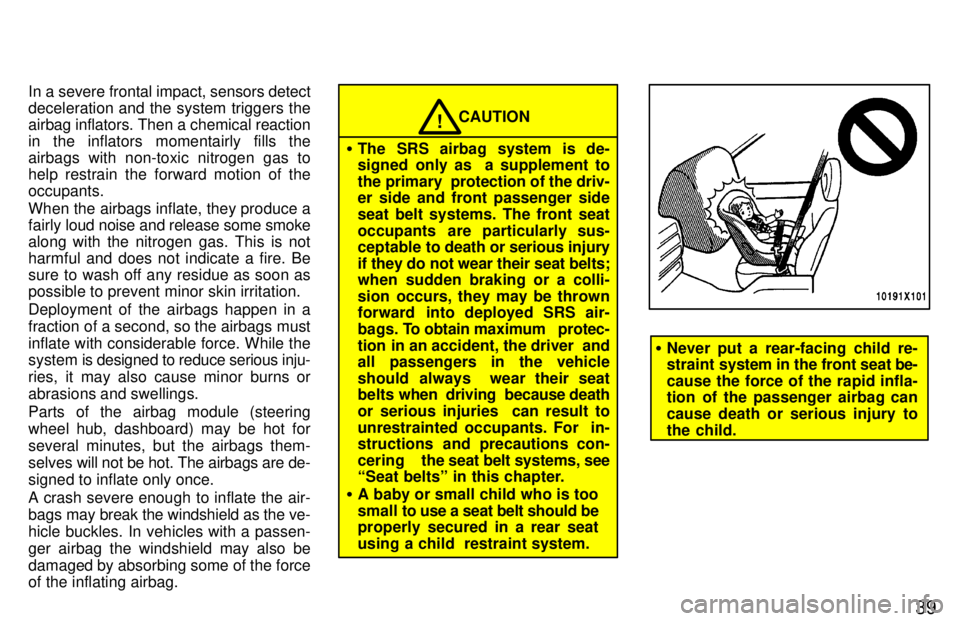
Never put a rear-facing child re-
straint system in the front seat be-
cause the force of the rapid infla-
tion of the passenger airbag can cause death or serious injury to
the child.
Page 75 of 198

73
NOTICE
Do not continue driving if the engine drive belt is broken or loose.
(d) Low Oil Pressure Warning Light
This light warns that the engine oil pres-
sure is too low.
If it flickers or stays on while you are driv-
ing, pull off the road to a safe place and
stop the engine immediately. Call a Toyo-
ta dealer or qualified repair shop for assis-tance.
The light may occasionally flicker when
the engine is idling or it may come on brief-
ly after a hard stop. There is no cause for concern if it then goes out when the en-
gine is accelerated slightly.
The light may come on when the oil level
is extremely low. It is not designed to indi- cate low oil level, and the oil level must bechecked using the level dipstick.
Do not drive the vehicle with the
warning light onÐeven for one
block. It may ruin the engine. CAUTION
! (e) Malfunction Indicator Lamp
This lamp comes on in the following cases.
a. The fuel tank is completely empty. (See Fuel gaugeº in Chapter 1-5 for in- structions.)
b. The fuel tank cap is not tightened se-
curely. (See Fuel tank capº in Chapter
1-2 for instructions.)
c. There is a problem somewhere in your
engine or automatic transmission electri- cal system.
If it comes on while you are driving in case
c, have your vehicle checked/repaired by
your Toyota dealer as soon as possible.
(f) Low Fuel Level Warning Light
This light comes on when the fuel level in
the tank becomes nearly empty. Fill up the tank as soon as possible.
On inclines or curves, due to the move-
ment of fuel in the tank, the low fuel level
warning light may come on earlier than usual.
(g) ABSº Warning Light
This light warns that there is a problem
somewhere in your anti-lock brake sys- tem. If the light comes on while you are driving,
have your vehicle checked by your T
oyota
dealer as soon as possible.
The light will come on when the ignition
key is turned to the ONº position. After
about 3 seconds, the light will go off. When the ABSº warning light is on (and
the brake system warning light is off), the brake system operates conventionally but
anti-lock brake system is not assisting brake performance so that the wheels can
lock-up during sudden braking or braking
on slippery road surfaces.
(h) Open Door Warning Light
This light remains on until all the doors
and back door are completely closed.
(i) Automatic Transmission Fluid Tem-
perature Warning Light (four-
wheel drive models)
This light warns that the automatic trans- mission fluid temperature is too high.
Page 76 of 198

74If this light comes on while you are driving,
slow
down and pull off the road. Stop the
vehicle at a safe place and put the selector
lever in pº. With the engine idling, wait
until the light goes off If the light goes off,
you can start the vehicle again. If the light
does not go off, call a Toyota dealer or
qualified repair shop for assistance.
NOTICE
Continued driving with the warning light on may damage the automatic
transmission.
(j) SRS Airbag Warning Light This light will come on when the igni-
tion key is turned to the ACCº or ONº
position. After about 6 seconds, the
light w ill go off. This means the airbag
system is operating properly.
The warning light system monitors the
front airbag sensors, center airbag sensor
assembly, inflators, warning light, inter-
connecting wiring and power sources.
If either of the following conditions occurs, this indicates a malfunction somewhere in the parts monitored by the warning light
system. Contact your Toyota dealer as
soon as possible to service the vehicle.
The light does not come on when the
ignition key is turned to the ACCº or
ONº position or remains on.
The light comes on while driving.
(k) Light Reminder Buzzer
This buzzer will sound if the driver's door is opened with the key removed from the
ignition switch and the headlight switch
left on. (l) Key Reminder Buzzer
This buzzer reminds you to remove the
key when you open the driver's door with the ignition key in the ACCº or LOCKº position.
CHECKING SERVICE REMINDER INDI-
CATORS (except the low fuel level
warning light)
1. Apply the parking brake.
2. Open one of the doors. The open door warning light should come on.
3. Close the door. The open door warning light should go
off.
4. Turn the ignition key to ACCº. The SRS airbag warning light should
come on. It goes off after about 6 sec-onds. 5. Turn the ignition key to ONº, but do
not start the engine.
All the service reminder indicators ex-
cept the open door warning light, SRS
airbag warning light and automatictransmission fluid temperature warn-
ing light should come on. The ABSº
warning light goes off after about 3 seconds.
6. Turn the ignition key to STARTº. The automatic transmission fluid tempera-
ture warning light should come on.
If any service reminder indicator or warn-
ing buzzer does not function as described above, either the bulb is burned out or the
circuit is in need of repair. Have it checked
by your Toyota dealer as soon as pos-sible.
Page 114 of 198

11 3
TANDEM MASTER CYLINDER BRAKE SYSTEM
The tandem master cylinder brake sys-
tem is a hydraulic system with two sepa-
rate sub-systems. If either sub-system
should fa
il, the other will still work. Howev-
er, the pedal will be harder to press, and
your stopping distance will be longer.
Also, the brake system warning light may come on.
CAUTION!
Do not drive your vehicle with only a single brake system. Have your
brakes fixed immediately.
BRAKE BOOSTER
The brake booster uses engine vacuum to
power-assist the brakes. If the engine
should quit while you are driving, you can
bring the vehicle to a stop with normal
pedal pressure. There is enough reserve vacuum for one or two stopsÐbut nomore!
CAUTION!
Do not pump the brake pedal if the
engine stalls. Each push on the
pedal uses up your vacuum re- serve.
Even if the power assist is com-
pletely lost, the brakes will still
work. But you will have to push
the pedal hardÐmuch harder
than normal. And your braking
distance will be longer.
ANTI-LOCK BRAKE SYSTEM (with ABSº warning light)
The anti-lock brake system is designed to
automatically help prevent lock-up of the
wheels during sudden braking or braking on slippery road surfaces. This assists in
providing directional stability and steeringperformance of the vehicle under these circumstances.
The anti-lock brake system becomes op- erative after the vehicle has accelerated
to a speed in excess of approximately 10
km/h (6 mph). It stops operating when the
vehicle decelerates to a speed below
approximately 5 km/h (3 mph). You may hear a sound in the engine
compartment for a
few seconds when the
engine is started or just after the vehicle is started. This means that the anti-lock
brake system is in the self check mode,
and does not indicate a malfunction.
Effective way to press the ABSº brake
pedal: When the anti-lock brake system
function is in action, you may feel the brake pedal pulsating and hear a noise.
In this situation, to let the anti-lock brake
system work for you, just hold the brake
pedal down more firmly. Do not pumpthe brake. This will result in reduced
braking performance.
The brake pedal pulsation caused by the
anti-lock brake system may indicate haz- ardous road surface conditions. Althoughthe anti-lock brake system assists in pro-
viding vehicle control, it is still important to
drive with all due care, because the anti-
lock brake system cannot overcome the
laws of physics that act on your vehicle: Braking capab ility is dependent on tire
friction with the road surface.
Brake system
Page 115 of 198
11 4
Even though the anti-lock brake sys-
tem is operating, a driver cannot main- tain full control on certain slippery road
surfaces, when cornering at high speeds, or in violent maneuvers.
Avoid high speeds on wet roads. The
anti-lock brake system cannot elimi-
nate the risk of hydroplaning and loss of tire friction.
Always maintain a safe distance from the
vehicle in front of you. Compared with ve-
hicles not fitted with an anti-lock brake
system, your vehicle may require a longer
stopping distance in the following cases: Driving on rough, gravel or snow-cov-
ered roads.
Driving with tire chains installed.
Driving on roads where the road sur-
face is pitted or has other differences in surface height.
CAUTION!
Do not use tires other than the
manufacturer 's designated tires,
and do not mix tires or wheels of
different si zes. You may prevent the
anti-lock brake system from oper-
ating at full effectiveness.
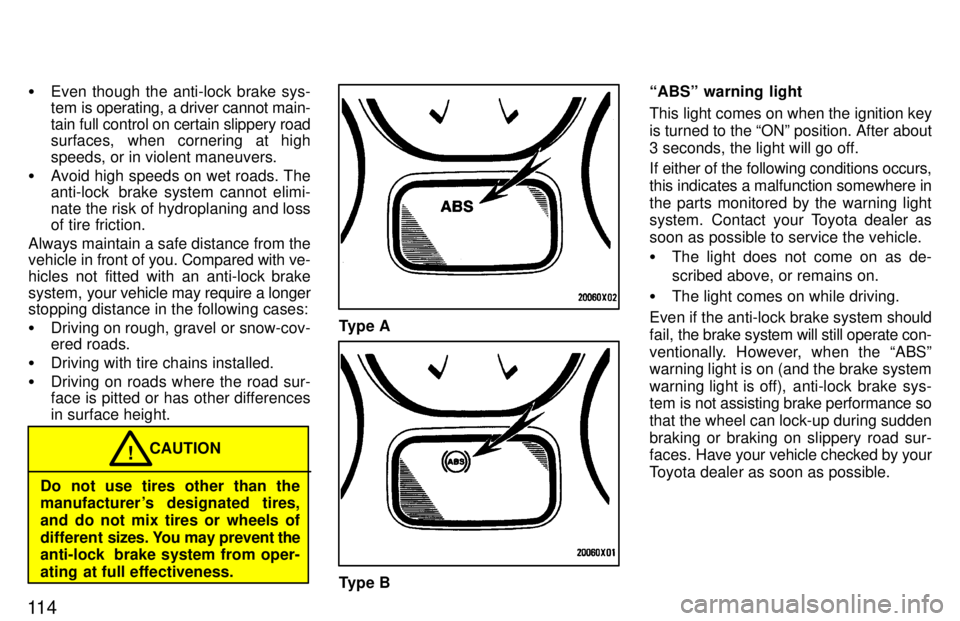
Type A
Type B ABSº warning light
This light comes on when the ignition key is turned to the ONº position. After about
3 seconds, the light will go off.
If either of the following conditions occurs, this indicates a malfunction somewhere inthe parts monitored by the warning light
system. Contact your Toyota dealer as
soon as possible to service the vehicle.
The light does not come on as de-
scribed above, or remains on.
The light comes on while driving.
Even if the anti-lock brake system should
fail, the brake system will still operate con-
ventionally. However, when the ABSº
warning light is on (and the brake system
warning light is off), anti-lock brake sys-
tem is not assisting brake performance so that the wheel can lock-up during sudden
braking or braking on slippery road sur-
faces. Have your vehicle checked by your
Toyota dealer as soon as possible.
Page 128 of 198

127
Avoid jerky starts or sudden accelera- tion. If your vehicle has manual trans-
mission, prevent excessive clutch slip-
page by keeping engine rpm low and
not racing the engine. Always start out
in first gear.
Avoid jerky steering and sharp turns.
The trailer could hit your vehicle in a
tight turn. Slow down before making a
turn to avoid the necessity of sudden braking.
Backing w ith a trailer is difficult and re-
quires practice. Grip the bottom of thesteering wheel and move your hand to
the left to move the trailer to the left. Move your hand to the right to move
the trailer to the right. (This procedure is generally opposite to that when
backing without a trailer). Also, just
turn the steering wheel a little at a time,
avoiding sharp or prolonged turning. Have someone guide you when back-
ing to reduce the risk of an accident.
Remember that when making a turn, the trailer wheels will be closer than the vehicle wheels to the inside of the
turn. Therefore, compensate for this
by making a larger than normal turning
radius with your vehicle.
Crosswinds and rough roads will ad-
versely affect handling of your vehicle
and trailer, causing sway. Pay atten-
tion to the rear from time to time to pre-
pare yourself for being passed by largetrucks or buses, which may cause your
vehicle and trailer to sway. If swaying
happens, firmly grip the steering wheel
and reduce speed immediately but
gradually. Never increase speed.
Steer straight ahead. If you make no
extreme correction with the steering or
brakes, the vehicle and trailer will sta- bilize.
Be careful when passing other ve- hicles. Passing requires considerable
distance. After passing a vehicle, do
not forget the length of your trailer and
be sure you have plenty of room be-
fore changing lanes.
In order to maintain engine braking ef-
ficiency, do not use fifth gear (manual
transmission or overdrive (automatic transmission).
Because of the added load of the trail-
er, your vehicle's engine may overheat
on hot days (at temperatures over30 5C [85 5F]) when going up a long or steep
grade with a trailer. If the engine
coolant termperatue gauge indicates
overheating, immediately turn off the
air conditioning (if in use), pull off the
road and stop in a safe spot. Refer to
If your vehicle overheatsº in Part 4 ofthis manual.
Always place wheel blocks under both
the vehicle and trailer wheels whenparking. Apply the parking brake firm-
ly. Put the transmission in Pº (auto-
matic) or in first or reverse (manual).
Avoid parking on a slope with a trailer, but if it cannot be avoided, do so onlyafter performing the following:
1. Apply the brakes and hold.
2. Have someone place wheel blocks un-
der both the vehicle and trailer wheels.
3. When the wheel blocks are in place, release your brakes slowly until the blocks absorb the load.
4. Apply the parking brake frimly.
5. Shift into first or reverse (manual) or Pº (automatic) and turn off the engine.
Page 168 of 198

172line. This brings the fluid to the correct
level when you put the cover back on.
Use only newly opened brake fluid. Once
opened, brake fluid absorbs moisture
from the air, and excess moisture can cause a dangerous loss of braking.
CAUTION!
Take care when filling the reservoir
because brake fluid can harm your
eyes and damage painted surfaces.
If fluid gets in your eyes, flush your
eyes with clean water.
If you spill the fluid, be sure to wash it off with water to prevent it from
damaging the parts or paint.
NOTICE
Check the fluid level through the reser-
voir. If necessary, add automatic trans-
mission fluid DEXRON [
-II or III.
If the vehicle has been driven around
80 km/h (50 mph) for 20 minutes (a little more in frigid temperatures), the fluid is
hot (60 C ' 80 C or 140 F ' 175 F). You
may also check the level when the fluid is cold (about room temperature, 10 C
' 30 C or 50 F ' 85 F) if the engine has
not been run for about five hours. Clean all dirt from outside of the reservoirtank and look at the fluid level. If the fluid is cold, the level should be in the COLDº
range. Similarly, if it is hot, the fluid level
should be in the HOTº range. If the level
is at the low side of either range, add auto-
matic transmission fluid DEXRON
[
-II or
III to bring the level within range.
To remove the filler cap, turn it counter-
clockwise and lift up. To reinstall it, turn it
clockwise. After replacing the filler cap,
visually check the steering box case, vane
pump and hose connections for leaks or damage.
CAUTION!
The reservoir tank may be hot so be
careful not to burn yourself.
Avoid overfilling, or the power steering could be damaged.
NOTICE
Checking power steering fluid
Page 183 of 198

187
1. Open the hood. Unplug the con-nector. Turn the plastic cover coun-
terclockwise and remove it.
If the connector is tight, wiggle it.2. Remove the rubber cover.3. Release the bulb retaining spring and remove the bulb. Install a new
bulb and the bulb retaining spring.
To install a bulb, align the tabs of the bulb with the cutout of the mounting hole.
ÐHeadlights