1997 TOYOTA PASEO light
[x] Cancel search: lightPage 123 of 182

121
JUMP STARTING PROCEDURE
1. If the booster battery is installed in
another vehicle, make sure the ve-
hicles are not touching. T urn off all un-
necessary lights and accessories.
2. If required, remove all the vent plugs from the booster and discharged bat-
teries. Lay a cloth over the open vents
on the batteries. (This helps reduce
the explosion hazard, personal injuries
and burns.)
3. If the engine in the vehicle with the booster battery is not running, start it
and let it run for a few minutes. During
jump starting, run the engine at about
2000 rpm with the accelerator pedal
lightly depressed.
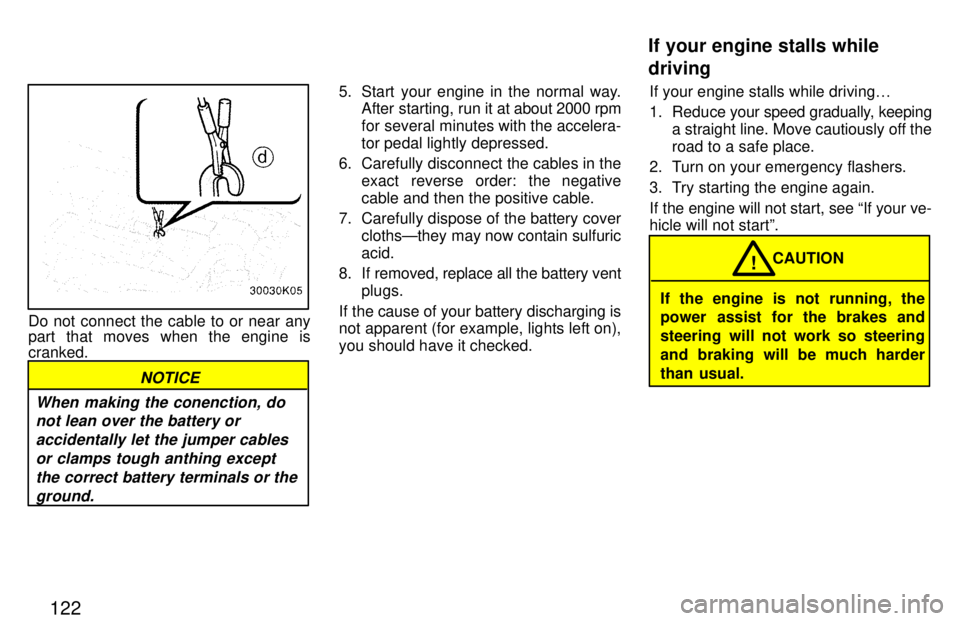
4. Make the cable connection in the ordera, b, c, d.
a. Connect the clamp of the positive (red) jumper cable to the positive (+)
terminal on the discharged battery.
b. Connect the clamp at the other end
of the positive (red) jumper cable to the
positive (+) terminal on the booster
battery.c. Connect the clamp of the negative
(black) jumper cable to the negative
(-) terminal on the booster battery.
d. Connect the clamp at the other end
of the negative (black) jumper cable to
a solid, stationary, unpainted, metallic
point of the ve hicle with the discharged
battery.
The recommended connecting points are shown in the following illustration:
Page 124 of 182
122
Do not connect the cable to or near any
part that moves when the engine is cranked.
NOTICE
When making the conenction, do not lean over the battery or
accidentally let the jumper cablesor clamps tough anthing except the correct battery terminals or theground.
5. Start your engine in the normal way. After starting, run it at about 2000 rpm
for several minutes with the accelera- tor pedal lightly depressed.
6. Carefully disconnect the cables in the exact reverse order: the negative
cable and then the positive cable.
7. Carefully dispose of the battery cover clothsÐthey may now contain sulfuricacid.
8. If removed, replace all the battery vent plugs.
If the cause of your battery discharging is
not apparent (for example, lights left on), you should have it checked. If your engine stalls while driving
0
1. Reduce your speed gradually, keeping
a straight line. Move cautiously off the
road to a safe place.
2. Turn on your emergency flashers.
3. Try starting the engine again.
If the engine will not start, see If your ve-
hicle will not startº.
If the engine is not running, the
power assist for the brakes and
steering will not work so steering
and braking will be much harder
than usual. CAUTION
!
If your engine stalls while driving
Page 127 of 182
125
The compact spare tire saves space in your trunk, and its lighter weight helps to improve fuel economy and permits easier
installation in case of a flat tire.
The compact spare
tire can be used many
times, if necessary. It has tread life of up
to 4800km (3000 miles) depending on
road conditions and your driving habits.
When tread wear indicators appear on the
tire, replace the tire.
See also the tire section in chapter 7-2 for
details on the tread wear indicators andother service information.
The compact spare tire was de-
signed especially for your Toyota.
Do not use it on any other vehicle.
Do not exceed 80 km/h (50 mph)
when driving with the compactspare tire.
Avoid sudden acceleration, sud-
den deceleration, and sharp turns
with the compact spare tire. CAUTION
!
NOTICE
Your ground clearance is reduced when the compact spare tire is
installed so avoid driving overobstacles and drive slowly on rough, unpaved roads and speedbumps. Also, do not attempt to go through an automatic car wash asthe vehicle may get caught,
resulting in damage.
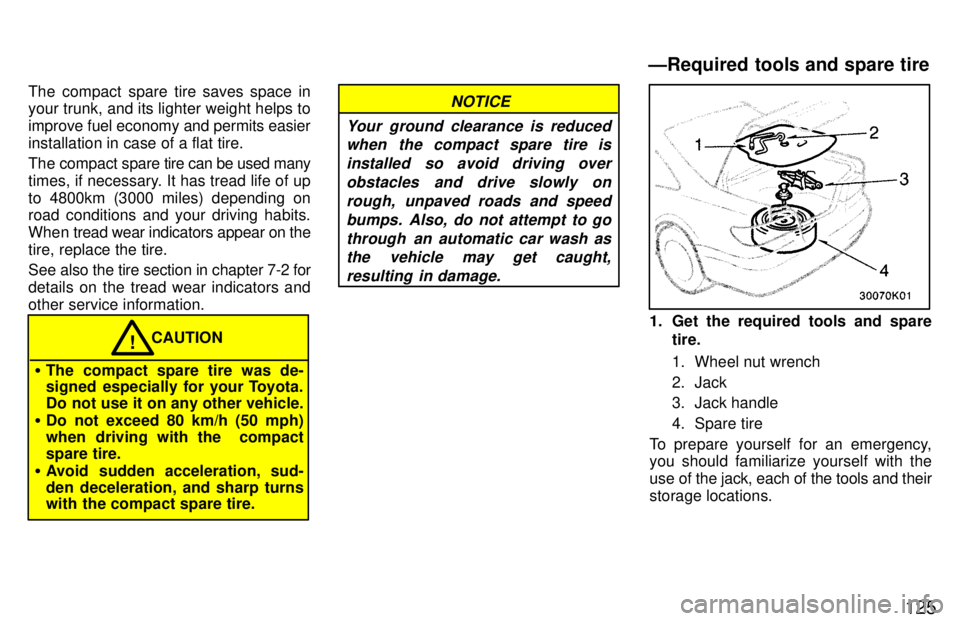
1. Get the required tools and spare tire.
1. Wheel nut wrench
2. Jack
3. Jack handle
4. Spare tire
To prepare yourself for an emergency, you should familiarize yourself with the
use of the jack, each of the tools and theirstorage locations.
ÐRequired tools and spare tire
Page 141 of 182
139
Do not use solvent, thinner, gas-oline or window cleaner on the in-
terior.
NOTICE
Carpets
Use a good foam-type shampoo to
clean the carpets.
Begin by vacuuming thoroughly to re-
move as much dirt as possible. Several
types of foam cleaners are available' some are in aerosol cans and others are
powders or liquids which you mix with wa-
ter to produce a foam. To shampoo the
carpets, use a sponge or brush to apply the foam. Rub in overlapping circles.
Do not apply water ± the best results are obtained by keeping the carpet as dry as possible. Read the shampoo instructions
and follow them closely. Seat belts
The seat belts may be cleaned with
mild soap and water or with lukewarm
water.
Use a cloth or sponge. As you are clean-
ing, check the belts for excessive wear,
fraying, or cuts.
Do not use dye or bleach on the
belts-it may weaken them.
NOTICE
Windows
The windows may be cleaned with any
household window cleaner.
When cleaning the inside of the
windows, be careful not to scratch
or damage the heater wires on therear window.
NOTICE
Air conditioning control panel, car au-
dio, instrument panel, console panel,
and switches Use a soft damp cloth for cleaning.
Soak a clean soft cloth in water or luke-
warm water then lightly wipe off any dirt.
Do not use organic substances
(solvents, kerosene, alcohol, gas-
oline, etc.) or alkaline or acidic
solutions. These chemicals cancause discoloring, staining or
peeling of the surface.
If you use cleaners or polishingagents, make sure their ingredi-
ents do not include the sub-
stances mentioned above.
If you use a liquid car freshener,do not spill the liquid onto the ve-
hicle's interior surfaces. It maycontain the ingredients men-
tioned above. Immediately clean
any spill using the method men-tioned above.
NOTICE
If you have any questions about the
cleaning of your Toyota, your local To-
yota dealer will be pleased to answer them.
Page 145 of 182

143
Tire surface and wheel nuts Check the tires carefully
for cuts, damage
or excessive wear. See Chapter 7-2 for
additional information. When checking the tires, make sure no nuts are missing,
and check the nuts for looseness. T ighten
them if necessary.
Tire rotation
Rotate the tires every 12000 km (7500
miles). See Chapter 7-2 for additional in- formation.
Fluid leaks Check underneath for leaking fuel, oil, wa-
ter or other fluid after the vehicle has been
parked for a while. If you smell fuel fumes
or notice any leak, have the cause found
and corrected immediately. Doors and engine hood Check that all doors including trunk lid op-
erate smoothly and all latches lock se-
curely. M ake sure the engine hood secon-
dary latch secures the hood from opening
when the primary latch is released. INSIDE THE VEHICLE Items listed below should be checked
regularly, e.g. while performing peri-
odic services, cleaning the vehicle,etc. Lights Make sure the headlights, stop lights, tail lights, turn signal lights, and other lights are all working. Check headlight aim. Service reminder indicators and
warn-
ing buzzers Check that all service reminder indicators
and warning buzzers function properly. Steering wheel
Check that it has the specified freeplay.
Be alert for changes in steering condition, such as hard steering or strange noise. Seats Check that all front seat controls such as
seat adjusters, seatback recliner, etc. op- erate smoothly and that all latches lock
securely in any position. For folding-down
rear seat backs, check that the latches
lock securely. Seat belts
Check that the seat belt system such as
buckles, retractors and anchors operate
properly and smoothly. Make sure the belt
webbing is not cut, frayed, worn or dam- aged. Accelerator pedal Check
the pedal for smooth operation and
uneven pedal effort or catching. Clutch pedal Check the pedal for smooth operation. Brake pedal Check the pedal for smooth operation and
that the pedal has the proper clearance. Check the brake booster function. Brakes
At a safe place, check that the brakes do not pull to one side when applied. Parking brake Check that the lever has the proper travel and that, on a safe incline, your vehicle is
held securely with only the parking brake applied.
Automatic transmission Parkº mech-
anism
Check the lock release button of the se-
lector lever for proper and smooth opera-
tion. On a safe incline, check that your ve-
hicle is held securely with the selector lever in Pº position and all brakes re- leased.
Page 154 of 182

152Here is a list of parts and tools you will
need on performing do-it-yourself main-
tenance. Remember all Toyota parts are
designed in metric sizes, so your tools
must be metric. Checking the engine oil level Parts (if level is low):
Engine oil API SH, Energy-Conserv-
ing IIº multigrade or ILSAC multigrade
having viscosity proper for your cli- mate
Tools: Rag or paper towel
Funnel (only for adding oil)
Checking the engine coolant level Parts (if level is low): Ethylene-glycol antifreeze
Demineralized or distilled water
Tools: Funnel (only for adding coolant)
Checking brake fluid Parts (if level is low): SAE J1703 or FMVSS No. 116 DOT 3 brake fluid
Tools: Rag or paper towel
Funnel (only for adding fluid) Checking power steering fluid Parts (if level is low):
Automatic transmission fluid DEXRON [
-II or III
Tools: Rag or paper towel
Funnel (only for adding fluid)
Checking battery condition Non-maintenance batteriesÐ
Tools: Warm water
Baking soda
Grease
Conventional wrench (for terminal clamp bolts)
Maintenance type batteriesÐ Parts (if level is low): Distilled water
Tools: Warm water
Baking soda
Grease
Conventional wrench (for terminal clamp bolts)
Coin (for vent plugs)
Funnel (only for adding distilled water) Checking and replacing fuses Parts (if replacement is necessary):
Fuse with same amperage rating as original
Tools: Conventional wrench (for instrument
lower panel nut)
Adding washer fluid Parts: Water
Washer fluid containing antifreeze (for winter use)
Tools: Funnel
Replacing light bulbs Parts: Bulb with same number and wattage rating as original (See charts in Re-
placing light bulbsº in Chapter 7-3.)
Tools: Screwdriver
Parts and tools
Page 155 of 182
Part 7Checking the engine oil level
153
DO-IT-YOURSELF MAINTENANCEÐ
Chapter 7-2 Engine and Chassis
Checking the engine oil level
Checking the engine coolant level
Checking brake fluid
Checking power steering fluid
Checking tire pressure
Checking and replacing tires
Rotating tires
Installing snow tires and chains
Replacing wheels
Aluminum wheel precautions
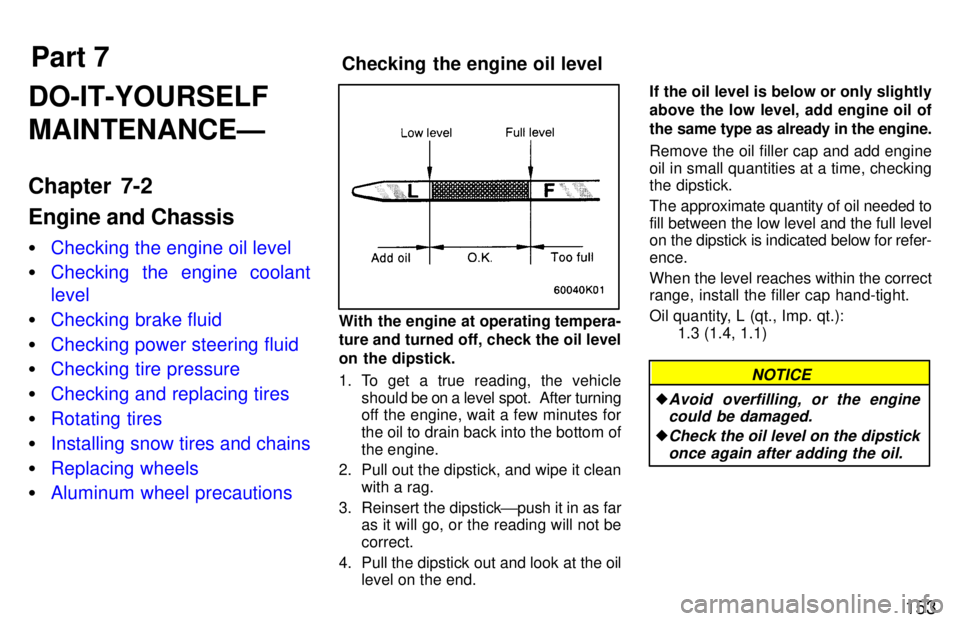
With the engine at operating tempera- ture and turned off, check the oil level
on the dipstick.
1. To get a true reading, the vehicle
should be on a level spot. After turning
off the engine, wait a few minutes for
the oil to drain back into the bottom ofthe engine.
2. Pull out the dipstick, and wipe it clean with a rag.
3. Reinsert the dipstick 'push it in as far
as it will go, or the reading will not becorrect.
4. Pull the dipstick out and look at the oil level on the end. If the oil level is below or only slightly
above the low level, add engine oil of
the same type as already in the engine. Remove the oil filler cap and add engine
oil in small quantities at a time, checking the dipstick.
The approximate quantity of oil needed to fill between the low level and the full level
on the dipstick is indicated below for refer- ence.
When the level reaches within the correct range, install the filler cap hand-tight.
Oil quantity, L (qt., Imp. qt.):
1.3 (1.4, 1.1)
Avoid overfilling, or the engine could be damaged.
Check the oil level on the dipstick
once again after adding the oil.
NOTICE
Page 158 of 182
156To check the fluid level, simply look at
the see-through reservoir. The level
should be between the MAXº and
MINº lines on the reservoir. It is normal for the brake fluid level to go
down slightly as the
brake pads wear. So
be sure to keep the reservoir filled. If the reservoir needs frequent refilling, it may indicate a serious mechanical prob- lem.
If the level is low, add SAE J1703 or
FMVSS No. 116 DOT 3 brake fluid to the
brake reservoir. Remove and replace the reservoir cover by hand. Fill the brake fluid to the dotted
line. This brings the fluid to the correct
level when you put the cover back on.
Use only newly opened brake fluid. Once
opened, brake fluid absorbs moisture
from the air, and excess moisture can cause a dangerous loss of braking.
CAUTION
Take care when filling the reservoir
because brake fluid can harm your
eyes and damage painted surfaces. If
fluid gets in your eyes, flush your
eyes with clean water.!
If you spill the fluid, be sure to wash
it off with water to prevent it from
damaging the parts or paint.
NOTICE
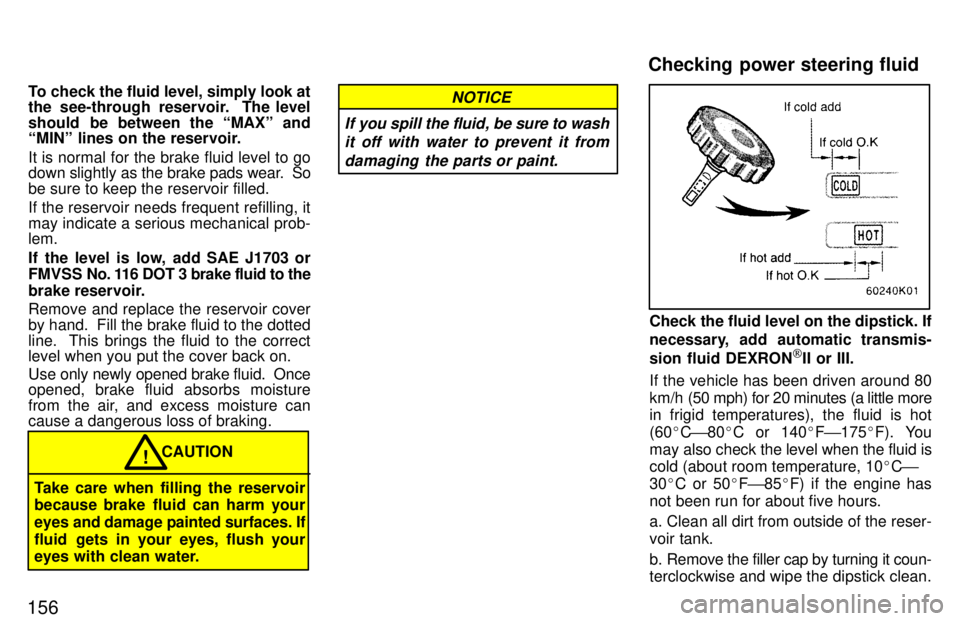
Check the fluid level on the dipstick. If
necessary, add automatic transmis-
sion fluid DEXRON [
II or III.
If the vehicle has been driven around 80
km/h (50 mph) for 20 minutes (a little more
in frigid temperatures), the fluid is hot (60 C ' 80 C or 140 F ' 175 F). You
may also check the level when the fluid is
cold (about room temperature, 10 C '
30 C or 50 F ' 85 F) if the engine has
not been run for about five hours.
a. Clean all dirt from outside of the reser- voir tank.
b. Remove the filler cap by turning it coun- terclockwise and wipe the dipstick clean.
Checking power steering fluid