Page 158 of 182
156To check the fluid level, simply look at
the see-through reservoir. The level
should be between the MAXº and
MINº lines on the reservoir. It is normal for the brake fluid level to go
down slightly as the
brake pads wear. So
be sure to keep the reservoir filled. If the reservoir needs frequent refilling, it may indicate a serious mechanical prob- lem.
If the level is low, add SAE J1703 or
FMVSS No. 116 DOT 3 brake fluid to the
brake reservoir. Remove and replace the reservoir cover by hand. Fill the brake fluid to the dotted
line. This brings the fluid to the correct
level when you put the cover back on.
Use only newly opened brake fluid. Once
opened, brake fluid absorbs moisture
from the air, and excess moisture can cause a dangerous loss of braking.
CAUTION
Take care when filling the reservoir
because brake fluid can harm your
eyes and damage painted surfaces. If
fluid gets in your eyes, flush your
eyes with clean water.!
If you spill the fluid, be sure to wash
it off with water to prevent it from
damaging the parts or paint.
NOTICE
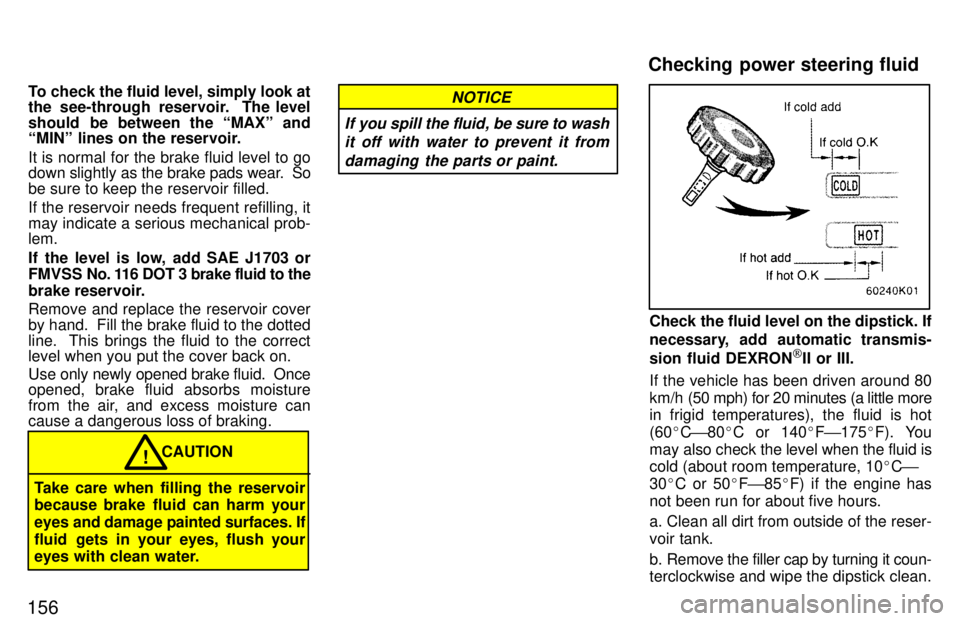
Check the fluid level on the dipstick. If
necessary, add automatic transmis-
sion fluid DEXRON [
II or III.
If the vehicle has been driven around 80
km/h (50 mph) for 20 minutes (a little more
in frigid temperatures), the fluid is hot (60 C ' 80 C or 140 F ' 175 F). You
may also check the level when the fluid is
cold (about room temperature, 10 C '
30 C or 50 F ' 85 F) if the engine has
not been run for about five hours.
a. Clean all dirt from outside of the reser- voir tank.
b. Remove the filler cap by turning it coun- terclockwise and wipe the dipstick clean.
Checking power steering fluid
Page 166 of 182
164
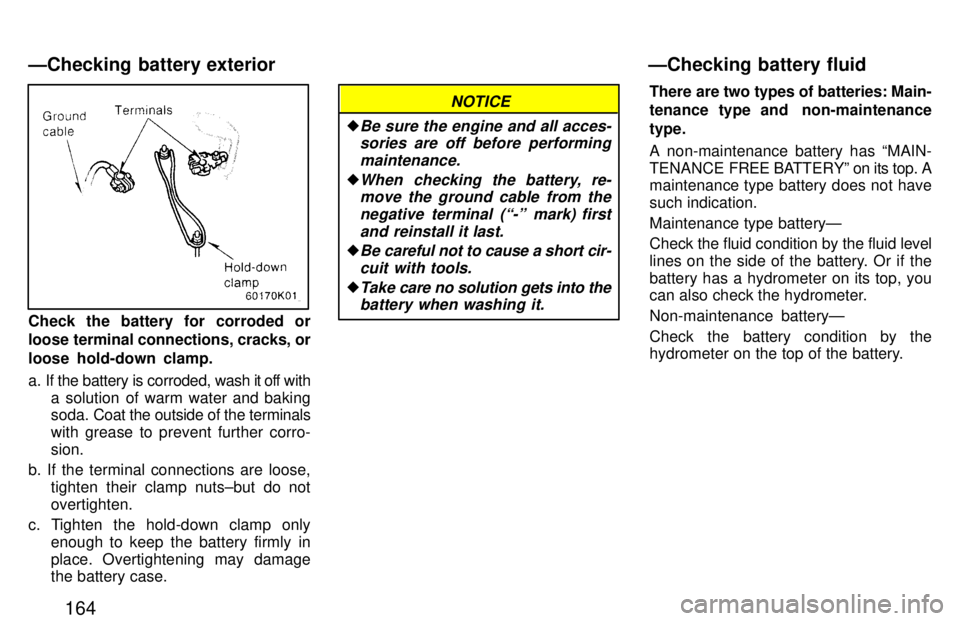
Check the battery for corroded or
loose terminal connections, cracks, or
loose hold-down clamp.
a. If the battery is corroded, wash it off witha solution of warm water and baking soda. Coat the outside of the terminals
with grease to prevent further corro- sion.
b. If the terminal connections are loose, tighten their clamp nuts±but do notovertighten.
c. Tighten the hold-down clamp only enough to keep the battery firmly inplace. Overtightening may damage the battery case.
NOTICE
Be sure the engine and all acces-
sories are off before performing
maintenance.
When checking the battery, re-move the ground cable from the
negative terminal (-º mark) first
and reinstall it last.
Be careful not to cause a short cir-cuit with tools.
Take care no solution gets into thebattery when washing it.
There are two types of batteries: Main-
tenance type and non-maintenance type. A non-maintenance battery has MAIN-
TENANCE FREE BATTERYº on its top. A
maintenance type battery does not havesuch indication. Maintenance type batteryÐ Check the fluid condition by the fluid level
lines on the side of the battery. Or if the
battery has a hydrometer on its top, you
can also check the hydrometer. Non-maintenance batteryÐ
Check the battery condition by the
hydrometer on the top of the battery.
ÐChecking battery exterior
ÐChecking battery fluid
Page 168 of 182
166
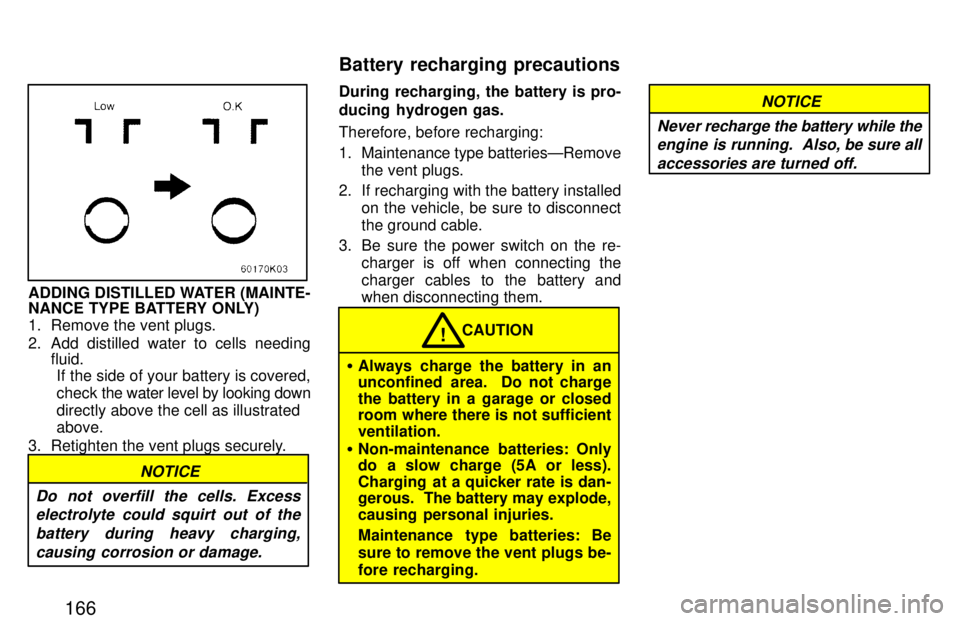
ADDING DISTILLED WATER (MAINTE-
NANCE TYPE BATTERY ONLY)
1. Remove the vent plugs.
2. Add distilled water to cells needingfluid.
If the side of your battery is covered, check the water level by looking down
directly above the cell as illustrated above.
3. Retighten the vent plugs securely.
NOTICE
Do not overfill the cells. Excess electrolyte could squirt out of the
battery during heavy charging,causing corrosion or damage.
During recharging, the battery is pro-
ducing hydrogen gas. Therefore, before recharging:
1. Maintenance type batteriesÐRemove the vent plugs.
2. If recharging with the battery installed on the vehicle, be sure to disconnect the ground cable.
3. Be sure the power switch on the re- charger is off when connecting the
charger cables to the battery and
when disconnecting them.
Always charge the battery in an
unconfined area. Do not charge
the battery in a garage or closed
room where there is not sufficient ventilation.
Non-maintenance batteries: Only
do a slow charge (5A or less).
Charging at a quicker rate is dan-
gerous. The battery may explode,
causing personal injuries.
Maintenance type batteries: Be sure to remove the vent plugs be-fore recharging. CAUTION
!
NOTICE
Never recharge the battery while the
engine is running. Also, be sure all
accessories are turned off.
Battery recharging precautions
Page 177 of 182

175
BATTERY
Open voltage* at 20 5C (68 5F):
12.7 V Fully charged
12.3 V Half charged
11.9 V Discharged
*: Voltage that is checked 20 minutes af-
ter the key is removed with all the lights
turned off
Charging rates: 5 A max
CLUTCH
Pedal freeplay, mm (in.): 5' 15 (0.2 '0.6)
Fluid type:
SAE J1703 or FMVSS No. 116 DOT 3
MANUAL TRANSAXLE
Oil capacity, L (qt., Imp. qt.): 1.9 (2.0, 1.6)
Oil type:
Multipurpose gear oil API GL- 4
or GL- 5
Recommended oil viscosity: SAE 75W-90
AUTOMATIC TRANSAXLE Fluid capacity (drain and refill), L (qt., Imp. qt.): Up to 3.1 (3.3, 2.7) Fluid type:
Automatic transmission fluid D-II or DEXRON [
III (DEXRON [
II)
BRAKESMinimum pedal clearance when de- pressed with the pressure of 490 N (50
kgf, 110 lbf) with the engine running, mm (in.):
With anti-lock brake system55 (2.2)
Without anti-lock brake system 60 (2.4)
Pedal freeplay, mm (in.): 1Ð6 (0.04Ð0.24)
Pad wear limit, in. (mm): 1.0 (0.04)
Lining wear limit, in. (mm): 1.0 (0.04)
Parking brake adjustment when pulledwith the force of 196 N (20 kgf, 44 lbf): 5Ð8 clicks
Fluid type:
SAE J1703 or FMVSS No. 116 DOT 3
STEERINGWheel freeplay: Less than 30 mm (1.2 in.)
Power steering fluid type:
Automatic transmission fluid DEXRON [
II or III Tire size:
Spare tire
T115/70D14
Except spare tire
P185/60R14 82H
Tire pressure, kPa (kgf/cm 2
or bar,
psi): Spare tire
420 (4.2, 60)
Except spare tire
183 (1.83, 26)
Wheel size:
Spare tire 14 x 4T Except spare tire
Aluminum wheels 14 x 5.5JJ
Except aluminum wheels 14 x 5.5J
Wheel nut torque, N Vm (kg Vm, ft Vlbf):
103 (10.5, 76)
Tires