Page 130 of 182
128
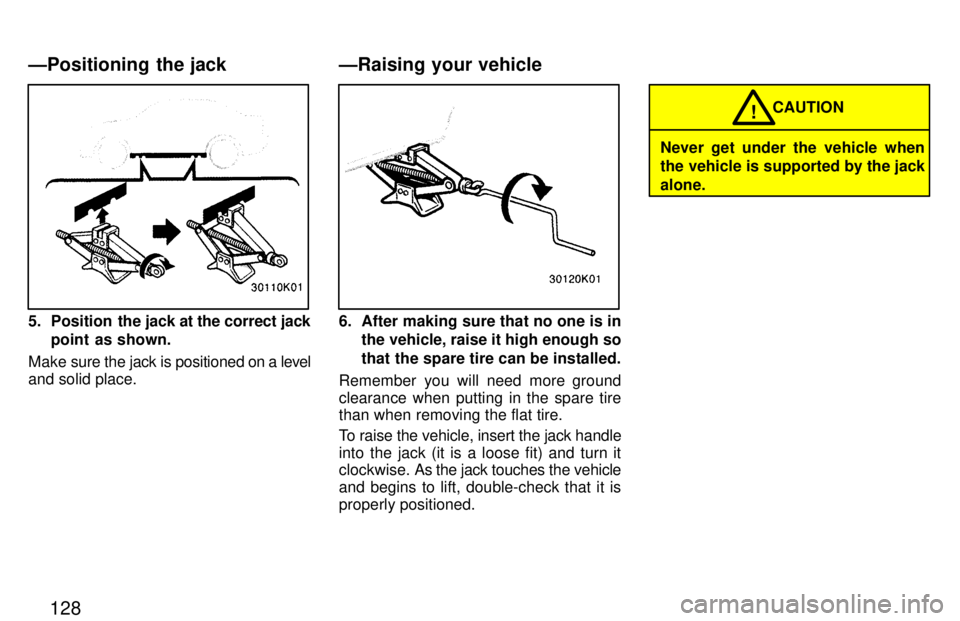
5. Position the jack at the correct jack
point as shown.
Make sure the jack is positioned on a level
and solid place.6. After making sure that no one is in
the vehicle, raise it high enough so
that the spare tire can be installed.
Remember you will need more ground
clearance when putting in the spare tire than when removing the flat tire.
To raise the vehicle, insert the jack handle
into the jack (it is a loose fit) and turn it
clockwise. As the j ack touches the vehicle
and begins to lift, double-check that it is
properly positioned.
Never get under the vehicle when
the vehicle is supported by the jack alone. CAUTION
!
ÐPositioning the jack ÐRaising your vehicle
Page 132 of 182
130
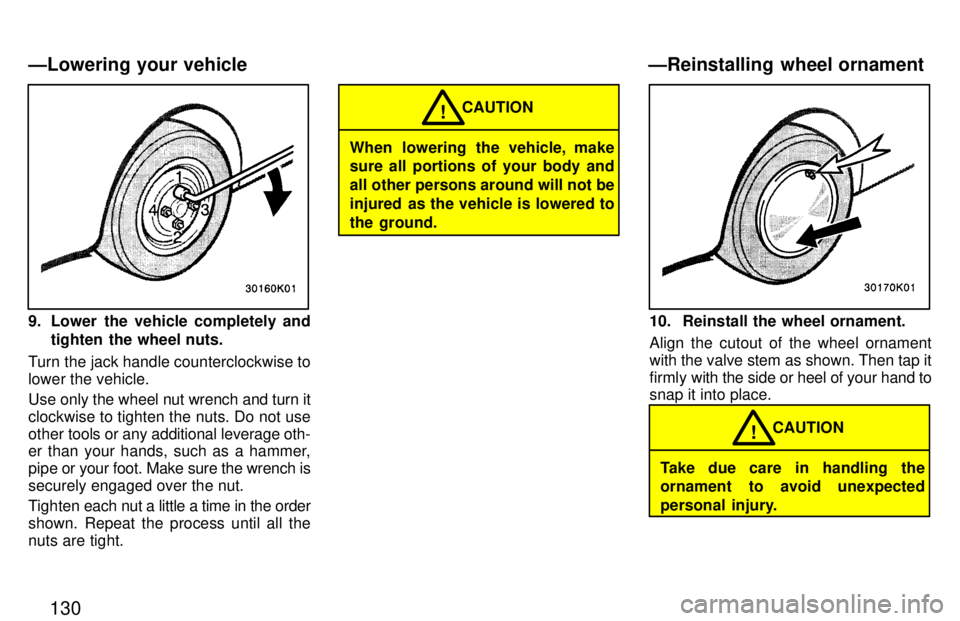
9. Lower the vehicle completely andtighten the wheel nuts.
Turn the jack handle counterclockwise to lower the vehicle.
Use only the wheel nut wrench and turn it
clockwise to tighten the nuts. Do not useother tools or any additional leverage oth-
er than your hands, such as a hammer,
pipe or your foot. Make sure the wrench is
securely engaged over the nut.
Tighten each nut a little a time in the order
shown. Repeat the process until all the
nuts are tight.
When lowering the vehicle, make sure all portions of your body and
all other persons around will not be
injured as the vehicle is lowered tothe ground. CAUTION
!
10. Reinstall the wheel ornament.
Align the cutout of the wheel ornament with the valve stem as shown. Then tap it
firmly
with the side or heel of your hand to
snap it into place.
Take due care in handling the
ornament to avoid unexpected
personal injury. CAUTION
!
ÐReinstalling wheel ornament
ÐLowering your vehicle
Page 158 of 182
156To check the fluid level, simply look at
the see-through reservoir. The level
should be between the MAXº and
MINº lines on the reservoir. It is normal for the brake fluid level to go
down slightly as the
brake pads wear. So
be sure to keep the reservoir filled. If the reservoir needs frequent refilling, it may indicate a serious mechanical prob- lem.
If the level is low, add SAE J1703 or
FMVSS No. 116 DOT 3 brake fluid to the
brake reservoir. Remove and replace the reservoir cover by hand. Fill the brake fluid to the dotted
line. This brings the fluid to the correct
level when you put the cover back on.
Use only newly opened brake fluid. Once
opened, brake fluid absorbs moisture
from the air, and excess moisture can cause a dangerous loss of braking.
CAUTION
Take care when filling the reservoir
because brake fluid can harm your
eyes and damage painted surfaces. If
fluid gets in your eyes, flush your
eyes with clean water.!
If you spill the fluid, be sure to wash
it off with water to prevent it from
damaging the parts or paint.
NOTICE
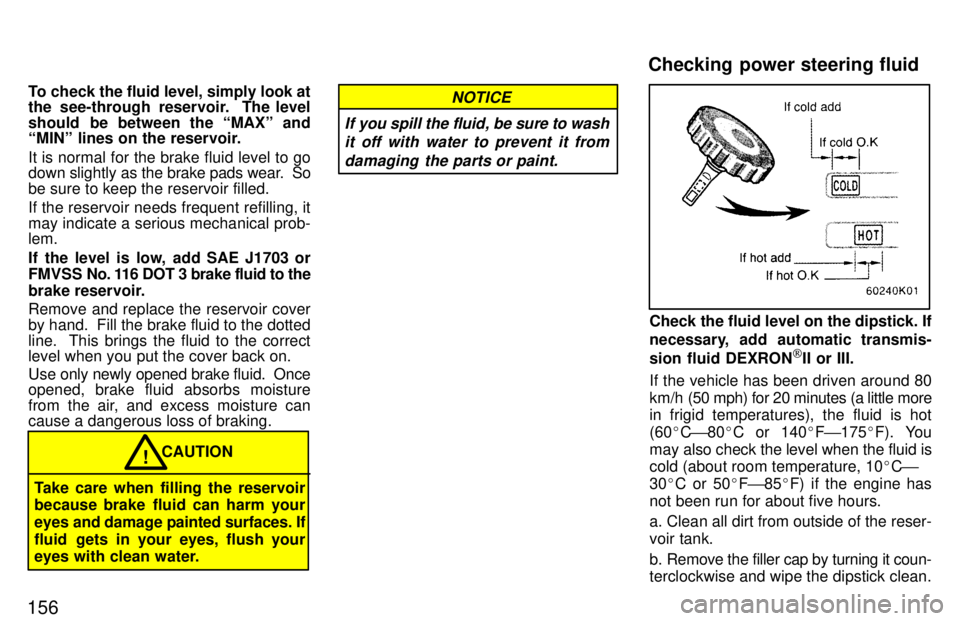
Check the fluid level on the dipstick. If
necessary, add automatic transmis-
sion fluid DEXRON [
II or III.
If the vehicle has been driven around 80
km/h (50 mph) for 20 minutes (a little more
in frigid temperatures), the fluid is hot (60 C ' 80 C or 140 F ' 175 F). You
may also check the level when the fluid is
cold (about room temperature, 10 C '
30 C or 50 F ' 85 F) if the engine has
not been run for about five hours.
a. Clean all dirt from outside of the reser- voir tank.
b. Remove the filler cap by turning it coun- terclockwise and wipe the dipstick clean.
Checking power steering fluid
Page 178 of 182

176
Engine compartment (U.S.A.) Fuses (type A)
1. HEAD (LH) 10 A: Left-hand head-
light
2. HEAD (RH) 10 A: Right-hand head-
light
3. AM2 15 A: Ignition system, charging
system, multiport fuel injection system/
sequential multiport fuel injection system,
SRS airbag system, starter system
4. HAZ-HORN 15 A: Horns, turn signal
lights, em ergency flashers, theft deterrent
system
5. EFI 15 A: Multiport fuel injection sys-
tem/sequential multiport fuel injection
system, air conditioning systemEngine compartment (Canada)
6. DOME 10 A: Interior lights, open
door warning light, clock, car audio sys-
tem, anti-lock brake system, theft deter- rent system
7. OBD-II 7.5 A: On-board diagnosis
system
8. ALT-S 5 A: Charging system
9. DRL 5 A: Daytime running light sys-
tem
10. HEAD (RH-LWR) 10 A: Right-hand
headlight (low beam)
11. HEAD (LH-LWR) 10 A: Left-hand
headlight (low beam)
12. HEAD (RH-UPR) 10 A: Right-hand
headlight (high beam)Engine compartment (Canada only)
13. HEAD (LH-UPR) 10 A: Left-hand
headlight (high beam)
14. STOP 10 A: Stop lights, high
mounted stoplight, anti-lock brake sys-
tem, shift lock control system
15. A/C 10 A: Air conditioning system
16. TAIL 15 A: Tail lights, parking lights,
license plate lights, instrument panel
lights, emergency flashers, air condition-
ing system, rear window defogger, car au-
dio system, cigarette lighter, clock
Fuses
Page 179 of 182

177
Instrument panel
17. GAUGE 10 A: Gauge and meters,
service reminder indicator and warning
buzzers (except discharge and open door
warning lights), back-up lights, rear win-
dow defogger
18. TURN 7.5 A: Turn signal lights,
emergency flashers
19. WIPER 20 A: Windshield wipers and
washers
20. ECU-IG 5 A: Anti-lock brake sys-
tem, air conditioning system
21. CIG&RADIO 15 A: Cigarette lighter,
car audio system, clock, anti-lock brake
system, theft deterrent system, shift lock control systemInstrument panel
22. IGN 5 A: Charging system, dis-
charge warning light, multiport fuel injec- tion system/sequential multiport fuel in-
jection system, SRS airbag system
23. SRS 5 A: SRS airbag warning light
Fuses (type B)
24. CDS FAN 30 A: Electric cooling fans
25. RAD FAN 30 A: Electric cooling fans
26. HEATER 40 A: Air conditioning sys-
tem, A/Cº fuses
27. DIMMER 30 A: HEAD RH (Lo)º,
HEAD LH (Lo)º, HEAD RH (Hi)º and
HEAD LH (Hi)º fuses
28. MAIN 30 A: Starter system 29. DEF 30 A:
Rear window defogger
30. PWR 30 A: Power windows, power
door lock system Fuses (type C)
31. ABS 60 A: Anti-lock brake system
32. AM1 50 A: DEFº, WIPERº,
GAUGEº, ECU-IGº, TURNº, IGNº and
PWRº fuses
33. ALT 100 A: ABSº, STOPº, TAILº,
SRSº, DEFº, AM1º, WIPERº,
GAUGEº, ECU-IGº, TURNº, IGNº and
PWRº fuses