Page 146 of 218
140
Do not connect it to or near any part that
moves when the engine is cranked.
NOTICE
When making the connections, to avoid serious injury, do not lean
over the battery or accidentally letthe jumper cables or clamps touchanything except the correct batteryterminals or the ground.
5. Start your engine in the normal way. Af-
ter starting, run it at about 2000 rpm for
several minutes with the accelerator ped-
al lightly depressed.
6. Carefully disconnect the cables in the
exact reverse order: the negative cable
and then the positive cable.
7. Carefully dispose of the battery cover
clothsÐthey may now contain sulfuric
acid.
8. If removed, replace all the battery vent
plugs.
If the cause of your battery discharging is
not apparent (for example, lights left on),
you should have it checked. If your engine stalls while driving
0
1. Reduce your speed gradually, keep-
ing a straight line. Move cautiously off the
road to a safe place.
2. Turn on your emergency flashers.
3. Try starting the engine again.
If the engine will not start, see If your ve-
hicle will not startº.
If the engine is not running, the
power assist for the brakes and
steering will not work so steering
and braking will be much harder
than usual. CAUTION
!
If your engine coolant temperature
gauge indicates overheating, if you
experience a loss of power, or if you
hear a loud knocking or pinging noise,
the engine has probably overheated.
You should follow this procedure
0
1. Pull safely off the road, stop the ve-
hicle and turn on your emergency flash-
ers. Put the transmission in Pº (automat-
ic) or neutral (manual) and apply the
parking brake. Turn off the air conditioning
if it is being used.
2. If coolant or steam is boiling out of the
radiator or reservoir, stop the engine. Wait
until the steam subsides before opening
the hood. If there is no coolant boiling over
or steam, leave the engine running and
make sure the electric cooling fan is oper-
ating. If it is not, turn the ignition off.
To help avoid personal injury, keep
the hood closed until there is no
steam. Escaping steam or coolant is
a sign of very high pressure. CAUTION
!
3. Visually check to see if the engine drive
belt (water pump belt) is broken or loose.
Look for obvious coolant leaks from the ra-
diator, hoses, and under the vehicle. How-
ever, note that water draining from the air
conditioning is normal if it has been used.
If your engine stalls while
driving
If your vehicle overheats
(7A-FE engine)
ProCarManuals.com
Page 171 of 218

165
Tire surface and wheel nuts
Check the tires carefully for cuts, damage
or excessive wear. See Chapter 7-2 for
additional information. When checking
the tires, make sure no nuts are missing,
and check the nuts for looseness. T ighten
them if necessary.
Tire rotation
Rotate the tires every 12000 km (7500
miles). See Chapter 7-2 for additional in-
formation.
Fluid leaks
Check underneath for leaking fuel, oil, wa-
ter or other fluid after the vehicle has been
parked for a while. If you smell fuel fumes
or notice any leak, have the cause found
and corrected immediately.
Doors and engine hood
Check that all doors and back door oper-
ate smoothly and all latches lock securely.
Make sure the engine hood secondary
latch secures the hood from opening
when the primary latch is released.
INSIDE THE VEHICLE
Items listed below should be checked
regularly, e.g. while performing peri-
odic services, cleaning the vehicle,
etc. Lights
Make sure the headlights, stop lights, tail
lights, turn signal lights, and other lights
are all working. Check headlight aim.
Service reminder indicators and
warn-
ing buzzers
Check that all service reminder indicators
and warning buzzers function properly.
Steering wheel
Be alert for changes in steering condition,
such as hard steering or strange noise.
Seats
Check that all front seat controls such as
seat adjusters, seatback recliner, etc. op-
erate smoothly and that all latches lock
securely in any position. Check that the
head restraints move up and down
smoothly and that the locks hold securely
in any latched postiion. For folding-down
rear seatbacks, check that the latches
lock securely.
Seat belts
Check that the seat belt system such as
buckles, retractors and anchors operate
properly and smoothly. Make sure the belt
webbing is not cut, frayed, worn or dam-
aged. Accelerator pedal
Check
the pedal for smooth operation and
uneven pedal effort or catching.
Clutch pedal
Check the pedal for smooth operation.
Brake pedal
Check the pedal for smooth operation and
that the pedal has the proper clearance.
Check the brake booster function.
Brakes
At a safe place, check that the brakes do
not pull to one side when applied.
Parking brake
Check that the lever has the proper travel
and that, on a safe incline, your vehicle is
held securely with only the parking brake
applied.
Automatic transmission Parkº mech-
anism
Check the lock release button of the se-
lector lever for proper and smooth opera-
tion. On a safe incline, check that your ve-
hicle is held securely with the selector
lever in Pº position and all brakes re-
leased.
IN THE ENGINE COMPARTMENT
Items listed below should be checked
from time to time , e.g. each time when
refueling.
ProCarManuals.com
Page 197 of 218

191
If the headlights or other electrical
components do not work, check the
fuses. If any of the fuses are blown,
they must be replaced.
See Fuse locationsº in Chapter 7-1 for
locations of the fuses.
Turn the ignition switch and inopera-
tive component off. Pull a suspected
fuse straight out and check it.
Determine which fuse may be causing the
problem. The lid of the fuse box shows the
name of the circuit for each fuse. See Part
8 of this manual for the functions con-
trolled by each circuit.
Type A fuses can be pulled out by using
the pull-out tool. The location of the pull-
out tool is shown in the illustration. If you are not sure whether the fuse has
blown, try replacing the suspected fuse
with one that you know is good.
If the fuse has blown, push a new fuse
into the clip.
Only install a fuse with the amperage rat-
ing designated on the fuse box lid.
If you do not have a spare fuse, in an
emergency you can pull out the CIG &
RADº, DOMEº or HTRº fuse, which may
be dispensable for normal driving, and
use it if its amperage rating is the same.
If you cannot use one of the same amper-
age, use one that is lower, but as close as
possible to the rating. If the amperage is
lower than that specified, the fuse might
blow out again but this does not indicate
anything
wrong. Be sure to get the correct
fuse as soon as possible and return the
substitute to its original clip.
It is a good idea to purchase a set of spare
fuses and keep them in your vehicle for
emergencies.
If the new fuse immediately blows out,
there is a problem with the electrical sys-
tem. Have your Toyota dealer correct it as
soon as possible.
Checking and replacing fuses
ProCarManuals.com
Page 198 of 218
192
Never use a fuse with a higher am-
perage rating, or any other object,
in place of a fuse. This may cause
extensive damage and possibly a
fire.CAUTION
!
If any washer does not work, the wash-
er tank may be empty. Add washer
fluid.
You may use plain water as washer fluid.
However, in cold areas where tempera-
tures range below freezing point, use
washer fluid containing antifreeze. This
product is available at your Toyota dealer
and most auto parts stores. Follow the
manufacturer 's directions for how much
to mix with water.
NOTICE
Do not use engine antifreeze or any other substitute because it may
damage your vehicle's paint.
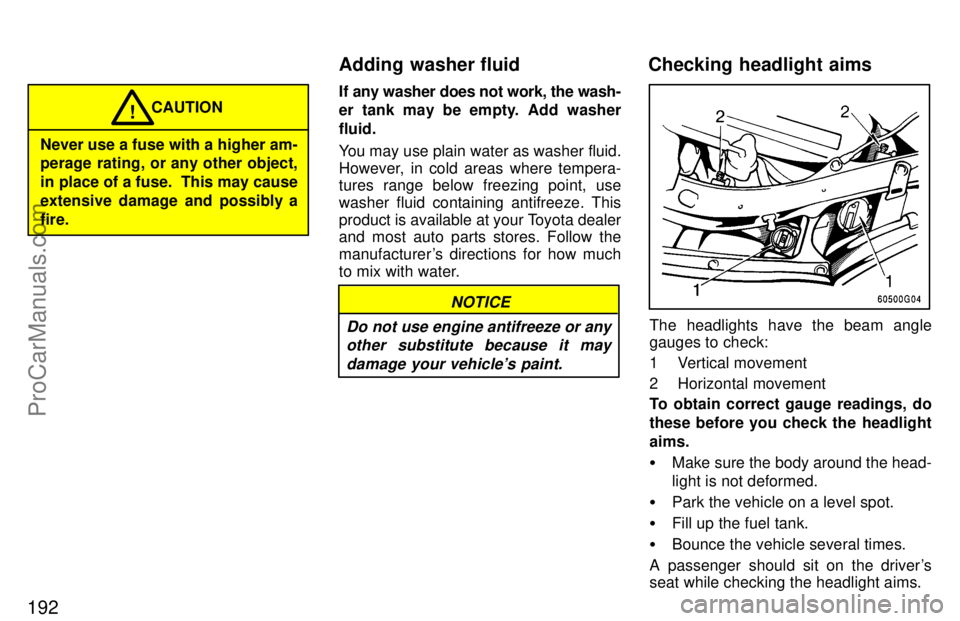
The headlights have the beam angle
gauges to check:
1 Vertical movement
2 Horizontal movement
To obtain correct gauge readings, do
these before you check the headlight
aims.
� Make sure the body around the head-
light is not deformed.
� Park the vehicle on a level spot.
� Fill up the fuel tank.
� Bounce the vehicle several times.
A passenger should sit on the driver's
seat while checking the headlight aims.
Adding washer fluid Checking headlight aims
ProCarManuals.com
Page 199 of 218

193
Vertical movement gauges: The bubble
on the gauge should be within two marks
from center on both sides.Horizontal movement gauges: The
triangle mark on the gauge should be
within one mark from the Oº position.
If a gauge reading is not within the accept-
able range, have the aiming adjusted by
your Toyota dealer.The following illustrations show how to
gain access to the bulbs. When replacing
a bulb, make sure the ignition switch and
light switch are off. Use bulbs with the
wattage ratings given in the table.
Halogen bulbs have pressurized
gas inside and require special
handling. They can burst or shatter
if scratched or dropped. Hold a bulb
only by its plastic or metal case. Do
not touch the glass part of a bulb
with bare hands.
CAUTION
!
NOTICE
Only use a bulb of the listed type.
Light bulbsBulb
No.WType
Headlights
(low beam)900655A
Headlights
(high beam)900565B
Front fog light-55C
Parking and front turn sig-
nal lights115727/8C
Front side marker lights1943.8D
Replacing light bulbsÐ
ProCarManuals.com
Page 200 of 218
194
Light bulbsBulb
No.WType
Rear side marker, stop
and tail lights (coupe)115727/8C
Rear side marker lights
(liftback)1944.9D
Rear turn signal lights115627C
Stop and tail lights115727/8C
Back-up lights115627C
License plate lights1685D
High mounted stoplight92118C
Interior lights
(without moon roof)Ð10C
Interior lights
(without moon roof)Ð8C
Personal lightsÐ5E
Glovebox lightÐ1.2D
Door courtesy lightsÐ3.8D
Luggage compartment
lightÐ5E
Trunk lightÐ3.8D
A: HB4 halogen bulbs
B: HB3 halogen bulbs
C: Single end bulbs
D: Wedge base bulbs
E: Double end bulbs
1. Unplug the connector while de-
pressing the lock release.
If the connector is tight, wiggle it.2. Turn the bulb and remove it.
ÐHeadlights
ProCarManuals.com
Page 201 of 218
195
3. Install a new bulb and the connec-
tor into the mounting hole.
Aiming is not necessary after replacing
the bulb. When aiming adjustment is nec-
essary, contact your Toyota dealer.1. Loosen the retainer screw and take
out the beam unit.2. Turn the cover counterclockwise
and remove it.
ÐFront fog lights
ProCarManuals.com
Page 203 of 218
197
Use a Phillips-head screwdriver.Use a Phillips-head screwdriver.
ÐParking and front turn
signal lights ÐFront side marker lights
ProCarManuals.com