Page 146 of 215
146
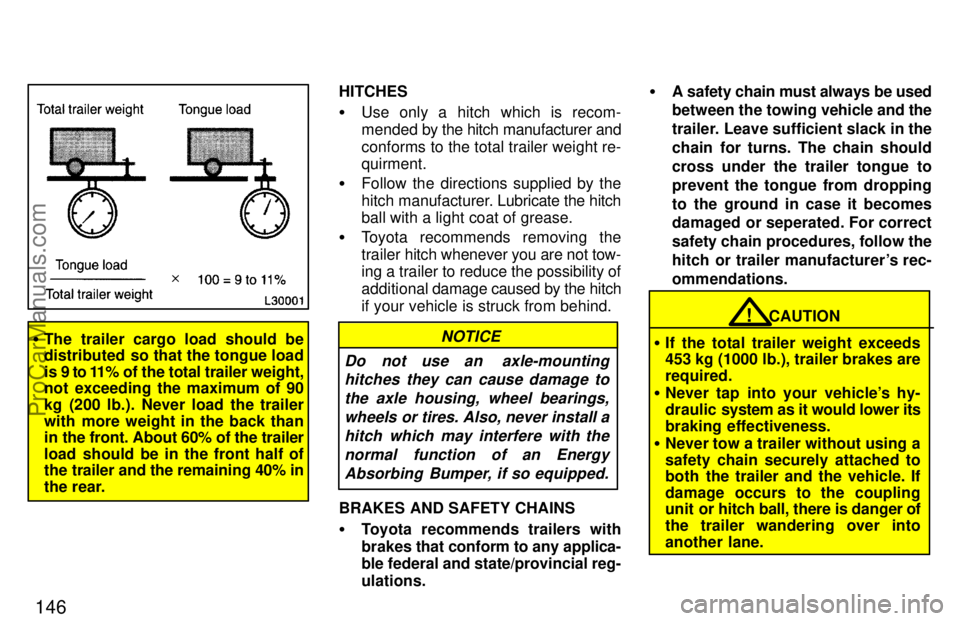
�The trailer cargo load should be
distributed so that the tongue load
is 9 to 11% of the total trailer weight,
not exceeding the maximum of 90
kg (200 lb.). Never load the trailer
with more weight in the back than
in the front. About 60% of the trailer
load should be in the front half of
the trailer and the remaining 40% in
the rear.HITCHES
�Use only a hitch which is recom-
mended by the hitch manufacturer and
conforms to the total trailer weight re-
quirment.
�Follow the directions supplied by the
hitch manufacturer. Lubricate the hitch
ball with a light coat of grease.
�Toyota recommends removing the
trailer hitch whenever you are not tow-
ing a trailer to reduce the possibility of
additional damage caused by the hitch
if your vehicle is struck from behind.
Do not use an axle-mounting
hitches they can cause damage to
the axle housing, wheel bearings,
wheels or tires. Also, never install a
hitch which may interfere with the
normal function of an Energy
Absorbing Bumper, if so equipped.
NOTICE
BRAKES AND SAFETY CHAINS
�Toyota recommends trailers with
brakes that conform to any applica-
ble federal and state/provincial reg-
ulations.�A safety chain must always be used
between the towing vehicle and the
trailer. Leave sufficient slack in the
chain for turns. The chain should
cross under the trailer tongue to
prevent the tongue from dropping
to the ground in case it becomes
damaged or seperated. For correct
safety chain procedures, follow the
hitch or trailer manufacturer's rec-
ommendations.
CAUTION!
�If the total trailer weight exceeds
453 kg (1000 lb.), trailer brakes are
required.
�Never tap into your vehicle's hy-
draulic system as it would lower its
braking effectiveness.
�Never tow a trailer without using a
safety chain securely attached to
both the trailer and the vehicle. If
damage occurs to the coupling
unit or hitch ball, there is danger of
the trailer wandering over into
another lane.
ProCarManuals.com
Page 149 of 215

149
1. Apply the brakes and hold.
2. Have someone place wheel blocks un-
der both the vehicle and trailer wheels.
3. When the wheel blocks are in place,
release your brakes slowly until the
blocks absorb the load.
4. Apply the parking brake frimly.
5. Shift into first or reverse (manual) or
Pº (automatic) and turn off the engine.
When restarting out after parking on a
slope:
1. With the transmission in Pº position
(automatic) or the clutch pedal de-
pressed (manual), start the engine.
(With an automatic transmission, be
sure to keep the brake pedal de-
pressed.)
2. Shift into gear.
3. Release the parking brake (also foot
brake on automatic transmission ve-
hicles) and slowly pull or back away
from the wheels blocks. Stop and ap-
ply your brakes.
4. Have someone retrieve the blocks.
�Do not exceed 72 km/h (45 mph) or
the posted towing speed limit,
whichever is lower. Because insta-
bility (swaying) of a towing vehicle
trailer combination usually in-
creases as the speed increases,
exceeding 72 km/h (45 mph) may
cause loss of control.
�Slow down and downshift before
descending steep or long downhill
grades. Do not make sudden
downshifts
�Avoid holding the pedal down too
long or too frequently. This could
cause the brakes to overheat and
result in reduced braking efficien-
cy.
CAUTION!
Getting more kilometers/mileage from a li-
ter/gallon of fuel is easy-just take it easy.
It will help make your vehicle last longer,
too. Here are some specific tips on how to
save money on both fuel and repairs:
�Keep your tires inflated at the cor-
rect pressure. Underinflation causes
tire wear and wastes fuel. See Chapter
7-2 for instructions.
�Do not carry unneeded weight in
your vehicle. Excess weight puts a
heavier load on the engine, causing
greater fuel consumption.
�Avoid lenghty warm-up idling.
Once the engine is running smoothly,
begin drivingÐbut gently. Remember,
however, that on cold winter days this
may take a little longer.
�Accelerate slowly and smoothly.
Avoid jackrabbit starts. Get into high
gear as quickly as possible.
�Avoid long engine idling. If you have
a long wait and you are not in traffic, it
is better to turn off the engine and start
again later.
�Avoid engine lug or overrevving.
Use a gear position suitable for the
road on which you are travelling.
How to save fuel and make
your vehicle last longer, too
ProCarManuals.com
Page 187 of 215

190
Use only newly opened brake fluid. Once
opened, brake fluid absorbs moisture
from the air, and excess moisture can
cause a dangerous loss of braking.
CAUTION!
Take care when filling the reservoir
because brake fluid can harm your
eyes and damage painted surfaces. If
fluid gets in your eyes, flush your
eyes with clean water.
If you spill the fluid, be sure to wash
it off with water to prevent it from
damaging the parts or paint.
NOTICECheck the fluid level through the reser-
voir. If necessary, add automatic trans-
mission fluid DEXRON
[II or III.
If the vehicle has been driven around 80
km/h (50 mph) for 20 minutes (a little more
in frigid temperatures), the fluid is hot
(60�C'80�C or 140�F'175�F). You
may also check the level when the fluid is
cold (about room temperature, 10�C'
30�C or 50�F'85�F) if the engine has
not been run for about five hours.Clean all dirt from outside of the reservoir
tank and look at the fluid level. If the fluid
is cold, the level should be in the COLDº
range. Similarly, if it is hot, the fluid level
should be in the HOTº range. If the level
is at the low side of either range, add auto-
matic transmission fluid DEXRON
[-II or
III to bring the level within range.
To remove the filler cap, turn it counter-
clockwise and lift up. To reinstall it, turn it
clockwise. After replacing the filler cap,
visually check the steering box case, vane
pump and hose connections for leaks or
damage.
CAUTION!
The reservoir tank may be hot so be
careful not to burn yourself.
Avoid overfilling, or the power
steering could be damaged.
NOTICE
Checking power steering fluid
ProCarManuals.com
Page 200 of 215
204
2. Release the bulb retaining spring
and remove the bulb. Install a new
bulb and the bulb retaining spring.
To install a bulb, align the tabs of the bulb
with the cutouts of the mounting hole.3. Install the rubber cover with the
TOPº mark upward, and snuggle
on the boss. Insert the connector.
Then install the plastic cover.
Make sure the rubber cover fits snugly on
the connector and the headlight body.
Aiming is not necessary after replacing
the bulb. When aiming adjustment is nec-
essary, contact your Toyota dealer.Use a flat-bladed screwdriver.
ÐParking, front side marker
and front turn signal lights
ProCarManuals.com
Page 213 of 215

218
33. PANEL 7.5 A: Gauge and meter, au-
dio system, cigarette lighter, glove box
light, clock, instrument panel light con-
trol, service reminder indicators, air
conditioning control panel lights, ash-
tray light, emergency flasher, seat
heater control system, daytime run-
ning light system, rear window defog-
ger, electronically controlled automat-
ic transmission system
34. TURN 7.5 A: Emergency flasher
35. RAD-NO. 7 7.5 A: Audio system,
power
36. CIG 15 A: Cigarette lighter, shift lock
control system, power rear view mirror
controls, theft deterrent system, pow-
er door lock system, SRS airbag sys-
tem, outside rear view mirror defogger,
air conditioning system
Fuses (type B)
37. CDS 30 A: Electric cooling fans
38.RADI FAN 30 A: Electric cooling fans
39. MAIN 40 A: HEAD (RH-HI)º, ºhead
(rh-lo)º FUSES
40. HTR 50 A: AM1º, A/Cº fuses
41. DEF 40 A: Rear window defogger42. PWR 30 A: Power window control sys-
tem, power seat, electric moon roof
43. AM1 40 A: Head lamp cleaner
Fuses (type C)
44. ALT 100 A: RDI FANº, CDSº fuses
45. ABS 60 A: Anti-lock brake system
ProCarManuals.com
