1997 TOYOTA 4RUNNER Ect
[x] Cancel search: EctPage 75 of 223
78Vehicles with cruise control-When the
cruise control is being used, even if you
downshift the transmission by turning offthe overdrive switch, engine braking will
not be applied because the cruise control is not cancelled. For ways to decrease the vehicle speed,
see Cruise controlº in this chapter.
Be careful when downshifting on a
slippery surface. Abrupt shifting
could cause the vehicle to spin or skid.
CAUTION
!
(c) Using 2º and Lº positions The 2º and Lº positions are used for
strong engine braking as described pre-
viously. With the selector lever in 2º or Lº, you
can start the vehicle in motion as with the
lever in Dº. With the selector lever in 2º, the vehicle
will start in the first gear and automatically
shift to the second gear.
With the selector lever in Lº, the trans-
mission is engaged in the first gear.
NOTICE
Be careful not to overrev the en- gine. Watch the tachometer to
keep engine rpm from going intothe red zone. The approximate
maximum allowable speed foreach position is given below for
your reference:
Front drive control lever in H2º or
H4º
3RZ-FE engine
2º 111 km/h (88 mph) . . . . . .
Lº 60 km/h (37 mph) . . . . .
5VZ-FE engine2º 118 km/h (73 mph). . . . . .
Lº 64 km/h (40 mph)
. . . . .
Front drive control lever in L4º 3RZ-FE engine
2º 43 km/h (26 mph) . . . . . .
Lº 23 km/h (14 mph) . . . . .
5VZ-FE engine
2º 46 km/h (28 mph). . . . . .
Lº 25 km/h (15 mph) . . . . .
Do not continue hill climbing or
hard towing for a long time in the 2º
or Lº position. This may cause se- vere automatic transmission dam- age from overheating. To preventsuch damage, use Dº position for hill climbing or hard towing.
(d) Backing up
1. Bring the vehicle to a complete stop.
2. With the brake pedal held down with your foot, shift the selector lever to the
Rº position.
NOTICE
Never shift into reverse while the vehicle is moving.
(e) Parking
1. Bring the vehicle to a complete stop.
2. Pull the pa rking brake lever fully to se-
curely apply the parking brake.
3. With the brake pedal pressed down, shift the selector lever to the P posi- tion.
Page 76 of 223
79
While the vehicle is moving, never
attempt to move the selector lever
into Pº position under any
circumstances. Serious mechanical
damage and loss of vehicle control may result.CAUTION
!
(f) Good driving practice If the transmission is repeatedly up-
shifted and downshifted between third
gear and overdrive when climbing a
gentle slope, the overdrive switch
should be turned off. Be sure to turn the switch on immediately afterward.
When towing a trailer, in order to main-
tain engine braking efficiency, do notuse overdrive.
Always keep your foot on the brake
pedal while stopped with the engine
running. This prevents the vehicle
from creeping. CAUTION
!
NOTICE
Do not hold the vehicle on an upgrade with the accelerator pedal.
It can cause the transmission tooverheat. Always use the brake pedal or parking brake.
(g) Rocking your vehicle in stuck
If you rock your vehicle to make it
out when it becomes stuck in snow,
mud, sand, etc., first check that there are no objects or people
around the vehicle. During
operation, the vehicle may suddenly move forward or
backward as it becomes unstuck,
causing injury or damage to nearby
people or objects. CAUTION
!
NOTICE
If you rock your vehicle, observe the following precautions to prevent
damage to the transmission andother parts.
Do not depress the acceleratorpedal while shifting the selector
lever or before the transmission is
completely shifted to forward or reverse gear.
Do not race the engine and avoid
spinning the wheels.
If your vehicle remains stuck afterrocking the vehicle several times,consider other ways such as tow-ing.
(h) Driving in POWERº mode In the POWERº mode, the transmission
is shifted up and down at a higher vehicle
speed than in the NORMALº mode and a
more powerful acceleration is achieved.
To set the POWERº mode, push in the
driving pattern selector button. The
POWERº mode indicator light comes on.
For ordinary driving, Toyota recommends
using the NORMALº mode to improve
fuel economy.
Page 77 of 223

80(i) If you cannot shift the selector lever
out of Pº position
If you cannot shift the selector lever from the Pº position even though the brake
pedal is depressed, use the shift lock
override button. For instructions, see Ifyou cannot shift automatic transmission selector leverº in Part 4.
The shift pattern is as shown above.
Press the clutch pedal down fully while
shifting, and then release it slowly. Do not
rest your foot on the pedal while driving, because it will cause clutch trouble. And do not use the clutch to hold the vehicle
when stopped on an uphill grade-use the
parking brake. Recommended shifting speeds
The transmission is fully synchronized
and upshifting or downshifting is easy.
For the best compromise between fuel
economy and vehicle performance, you
should upshift or downshift at the follow-
ing speeds:
gear km/h (mph)
1 to 2 or 2 to 1 24 (15)
2 to 3 or 3 to 2 40 (25)
3 to 4 or 4 to 3 64 (40)
4 to 5 or 5 to 4 72 (45)
Downshift to the appropriate gear if accel-
eration is needed when you are cruising
below the above downshifting speeds.
Upshifting too soon or downshifting too
late will cause lugging, and possibly,
pinging. Regularly revving the engine to
maximum speed in each gear will cause
excessive engine wear and high fuel consumption.
Manual transmission
Page 78 of 223

81
Maximum allowable speeds
To get on a highway or to pass slower traf- fic, maximum acceleration may be neces-
sary.
Make sure you observe the following
maximum allowable speeds in each gear:
Two-wheel drive models gear km/h (mph)
1 48 (29)
2 90 (55)
3 139 (86)
4 165 (102)
Four-wheel drive models
3RZ-FE engine gear km/h (mph) H2º and H4º L4º
1 45 (28) 17 (11)
2 84 (52) 32 (20)
3 130 (81) 50 (31)
4 165 (102) 64 (39)
5VZ-FE engine
gear km/h (mph) H2º and H4º L4º
1 48 (29) 18 (11)
2 89 (55) 34 (21)
3 127 (79) 49 (31)
4 165 (102) 64 (39)
NOTICE
Do not downshift if you are going faster than the maximum allowable
speed for the next lower gear.
Good driving practice If it is difficult to shift into reverse, put
the transmission in neutral, release
the clutch pedal momentarily, and then
try again.
When towing a trailer, in order to main-
tain engine braking efficiency, do not
use the fifth gear.
Be careful when downshifting on a
slippery surface. Abrupt shifting
could cause the vehicle to spin or skid. CAUTION
!
NOTICE
Make sure the vehicle is completely stopped before shifting into
reverse.
Use the front drive control lever to se-
lect the following transfer modes. H2º (high speed position, two-wheel
drive): Lever at H2º
Use this for normal driving on dry hardsur- faced roads. This position gives greater
economy, quietest ride and least wear.
H4º (high speed position, four-wheel drive): Lever at H4º
Use this for normal driving on wet, icy or
snow-covered roads. This position pro-
vides greater traction than two-wheel drive.
Four-wheel drive systemÐ (a) Front drive control (lever type)
Page 79 of 223

82Nº (neutral position):
Lever at Nº
No power is delivered to the wheels. The vehicle must be stopped.
L4º (low speed position, four-wheel
drive): Lever at L4º
Use the for maximum power and traction.
Use L4º for climbing or descending steep
hills, off-road driving, and hard pulling in
sand, mud or deep snow.
The four-wheel drive indicator light
comes on when the H4º, Nº or L4º mode is selected. See (c) Shifting procedure (lever type)º
for further instructions.
Use the front drive control lever and
4WDº button to select the following transfer modes. H2º (high speed position, two-wheel
drive): Lever at Hº, 4WDº button left out
Use this for normal driving on dry hardsur- faced roads. This position gives greater
economy, quietest ride and least wear.
H4º (high speed position, four-wheel
drive): Lever at Hº, 4WDº button pushed
in.
Use this for normal driving on wet, icy or
snow-covered roads. This position pro-
vides greater traction than two-wheel drive. Nº (neutral position):
Lever at Nº
No power is delivered to the wheels. Thevehicle must be stopped.
L4º (low speed position, four-wheel
drive): Lever at L4º
Use this for maximum power and traction. Use L4º for climbing or descending steep
hills, off-road driving, and hard pulling in
sand, mud or deep snow.
The four-wheel drive indicator light
comes on when the H4º, Nº or L4º mode
is selected.
See (c) Shifting procedure (lever/button
type)º for further instructions.
(a) Front drive control (lever/button type)
Page 80 of 223

83
Steel wheels
Aluminum wheelsThe A.D.D. can be engaged or disen-
gaged by the shifting operations de-
scribed in (c) Shifting procedureº.
You should drive in four-wheel drive for at least 16 km (10 miles) each month. This
will assure that the front drive compo- nents are lubricated.
SHIFTING BETWEEN H2º AND H4º With free-wheeling hubs
To shift from H2º to H4º
, move the
front drive control lever. Also, engage both the free-wheeling hubs.
This can be done when the vehicle is stopped, or moving straight ahead at
speeds of 40 km/h (25 mph) or less. You need not depress the clutch pedal. If you
have trouble shifting, depress or releasethe accelerator pedal momentarily while
pushing the front drive control lever.
Never move the front drive control
lever if wheels are slipping. Stop the slipping or spinning before shifting. CAUTION
!
To shift from H4º to H2º , simply move
the front drive control lever.
This can be done at any vehicle speed.
You need not depress the clutch pedal.
If the indicator light does not go off when you shift the transfer into H2º, drive
straight ahead while accelerating or de- celerating, or drive in reverse.
(b) A.D.D. (automatic discon- necting differential)
(c) Shifting procedure (levertype with automatic transmis- sion)
Page 83 of 223
86
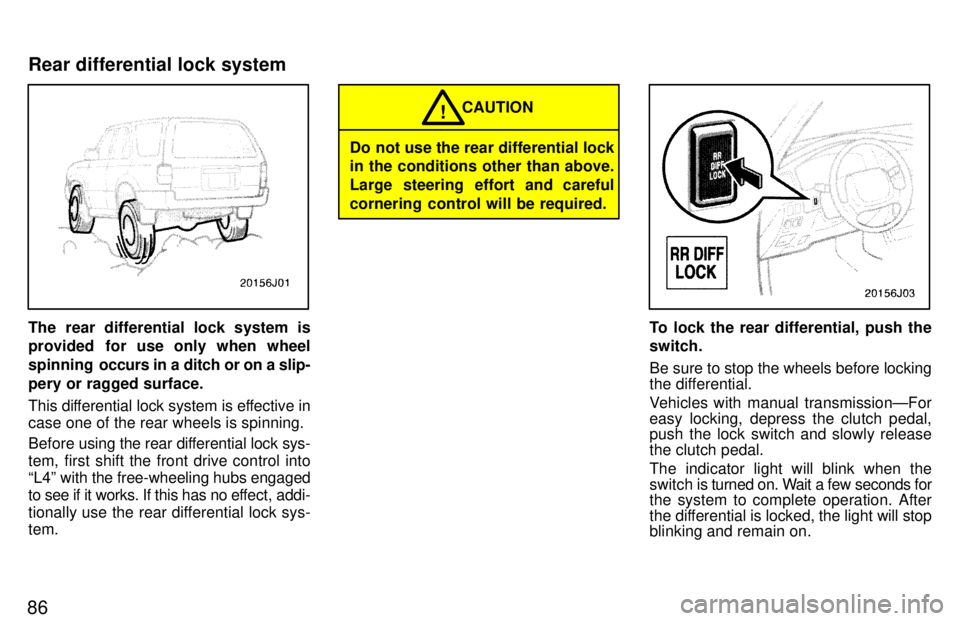
The rear differential lock system is
provided for use only when wheel
spinning occurs in a ditch or on a slip-
pery or ragged surface.
This differential lock system is effective in case one of the rear wheels is spinning.
Before using the rear differential lock sys-
tem, first shift the front drive control into L4º with the free-wheeling hubs engaged
to see if it works. If this has no ef fect, addi-
tionally use the rear differential lock sys-tem.
Do not use the rear differential lock
in the conditions other than above.
Large steering effort and careful
cornering control will be required. CAUTION
!
To lock the rear differential, push the switch.
Be sure to stop the wheels before locking
the differential.
Vehicles with manual transmissionÐFor
easy locking, depress the clutch pedal,
push the lock switch and slowly release the clutch pedal.
The indicator light will blink when the
switch is
turned on. Wait a few seconds for
the system to complete operation. After
the differential is locked, the light will stop
blinking and remain on.
Rear differential lock system
Page 84 of 223
87
The anti-lock brake system does not op-
erate when the rear differential is locked.
It is normal operation for the ABSº warn-
ing light to be on at this time.
Do not lock the differential until
the wheels have stopped spin-
ning. Otherwise, the vehicle may
move in an unexpected direction
when the differential lock is en-
gaged, resulting in an accident.
This may also lead to possible
damage to differential lock com-
ponent parts.
Do not drive over 8 km/h (5 mph)
when the differential is locked. CAUTION
!
To unlock the differential, push the
switch once again.
Unlock the differential as soon as the ve- hicle moves out.
For easy unlocking, slightly turn the steer-
ing wheel in either direction while the ve- hicle is in motion.
When the differential lock is disengaged, the indicator light will go out. The differential will also unlock if you shift
the front drive control lever out of L4º. Never f
orget to turn off the switch after us-
ing this feature.
To check the indicator bulb, turn the igni-
tion key to the ONº position, but do not
start the engine.
Do not keep driving with the
differential lock switch on. CAUTION
!
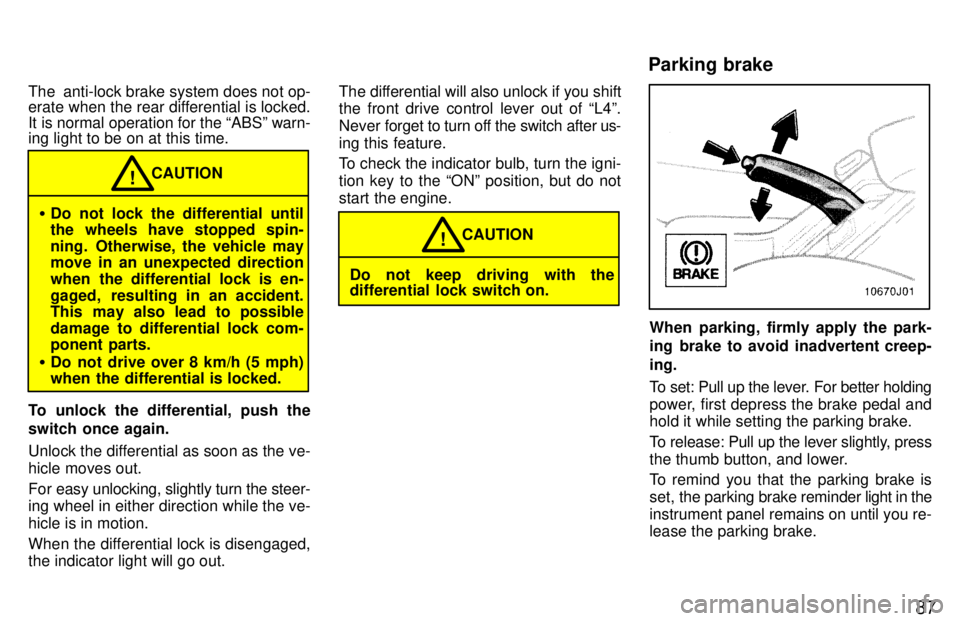
When parking, firmly apply the park-
ing brake to avoid inadvertent creep- ing.
To set: Pull up the lever. For better holding
power, first depress the brake pedal and
hold it while setting the parking brake.
To release: Pull up the lever slightly, press
the thumb button, and lower.
To remind you that the parking brake is
set,
the parking brake reminder light in the
instrument panel remains on until you re- lease the parking brake.
Parking brake