1997 TOYOTA 4RUNNER steering wheel
[x] Cancel search: steering wheelPage 170 of 223
173
TOWING PRECAUTIONS: Use a safety chain system for all towing,
and abide by the state/provincial and local
laws. The wheels and axle on the ground
must be in good condition. If they are
damaged, use a towing dolly.
Two-wheel drive modelsÐ
(a) Towing with wheel lift type truck From frontÐ
Manual transmission
We recommend using a towing dolly un-
der the rear wheels. If you do not use a
towing dolly, release the parking brake
and put the transmission in neutral. Automatic transmission:
Use a towing dolly under the rear wheels.
NOTICE
Never tow a vehicle with an automatic transmission from the
front with the rear wheels on theground, as this may cause serious damage to the transmission.
From rearÐ Place the ignition key in the
ACCº position.
NOTICE
When lifting wheels, take care to
ensure adequate ground clear-
ance for towing at the oppositeend of the raised vehicle. Other-wise, the bumper and/or under-
body of the towed vehicle will be damaged during towing.
Do not tow with the key removedor in the LOCKº position, as thesteering lock mechanism is notstrong enough to hold the front
wheels straight while towing.
(b) Using flat bed truck
(c) Towing with sling type truck from front
Follow the instructions for twoing from
front in (b) Towing with wheel lift type truckº. Four-wheel drive modelsÐ
(a) Towing with wheel lift type truck From frontÐ
Manual transmission:
We recommend using a towing dolly un-
der the rear wheels. If you do not use a
towing dolly, release the parking brake,
put the transmission in neutral and set the
transfer in H2º mode. Automatic transmission:
Use a towing dolly under the rear wheels.
NOTICE
Never tow a vehicle with an automatic transmission from the
rear with the front wheels on theground, as this may cause serious damage to the transmission.
From rearÐWe recommend using a tow-
ing dolly under the front wheels. If you do
not use a towing dolly, place the ignition key in the ACCº position, put the trans- mission in neutral and set the transfer inH2º.
Page 171 of 223
174
NOTICE
Do not tow with the key removed or in the LOCKº position when
towing from the rear without atowing dolly. The steering lock mechanism is not strong enough tohold the front wheels straight.
(b) Using flat bed truck
(c) Towing with sling type truck from front
Follow the instructions for towing from
front in (b) Towing with wheel lift type truckº.
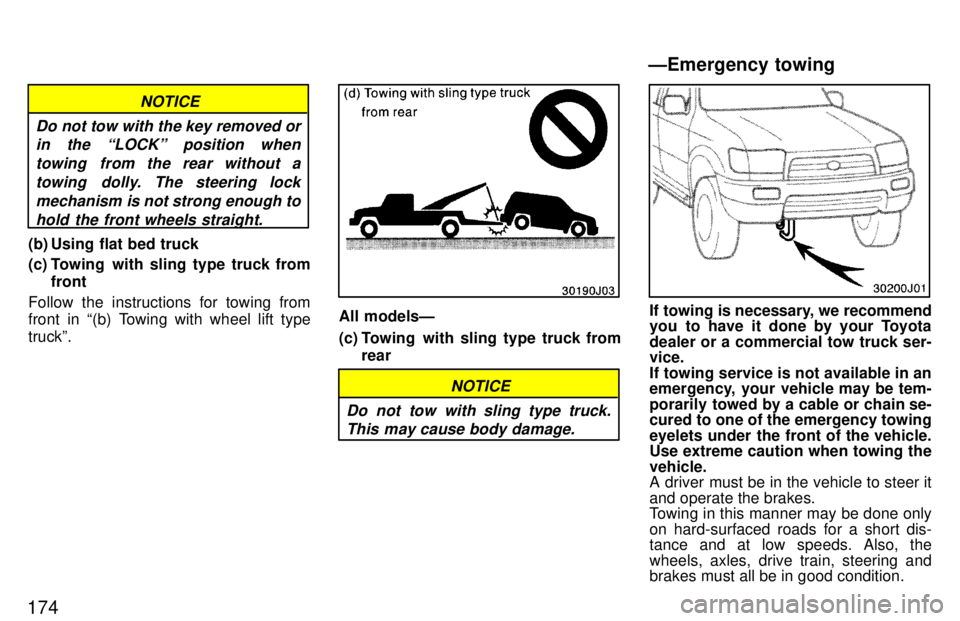
All modelsÐ
(c) Towing with sling type truck from rear
NOTICE
Do not tow with sling type truck. This may cause body damage.
If towing is necessary, we recommend
you to have it done by your Toyota
dealer or a commercial tow truck ser- vice.
If towing service is not available in an
emergency, your vehicle may be tem-
porarily towed by a cable or chain se-
cured to one of the emergency towing
eyelets under the front of the vehicle.
Use extreme caution when towing the vehicle.
A driver must be in the vehicle to steer it and operate the brakes.
Towing in this manner may be done only
on hard-surfaced roads for a short dis-
tance and at low speeds. Also, the
wheels, axles, drive train, steering and brakes must all be in good condition.
ÐEmergency towing
Page 172 of 223
175
CAUTION!
Use extreme caution when towing
vehicles. Avoid sudden starts or
erratic driving maneuvers which
would place excessive stress on the
emergency towing hook and towing
cable or chain. The hook and towing
cable or chain may break and cause
serious injury or damage.
NOTICE
Use only a cable or chain specific- ally intended for use in towing
vehicles. Securely fasten the cableor chain to the towing eyelet provided.
Before towing, release the parking brake
and put the transmission in neutral
(manual) or Nº (automatic)And transfer in
H2º (four-wheel drive models). The key
must be in ACCº (engine off) or ONº (en-
gine running).
CAUTION!
If the engine is not running, the
power assist for the brakes and
steering will not work so steering
and braking will be much harder
than usual.
Before emergency towing, check that
the hook is not broken or damaged and
that the installation bolts are not loose.
Fasten the towing cable or chain se-curely to the hook.
Do not jerk the hook. Apply steady and
even force.
To avoid damaging the hook, do not
pull from the side or at a vertical angle.
Always pull straight ahead.
ÐEmergency towing hook precautions
Page 184 of 223

187
Tire surface and wheel nuts Check the tires carefully
for cuts, damage
or excessive wear. See Chapter 7-2 for
additional information. When checking the tires, make sure no nuts are missing,
and check the nuts for looseness. T ighten
them if necessary.
Tire rotation
Rotate the tires every 12000 km (7500
miles). See Chapter 7-2 for additional in- formation.
Fluid leaks Check underneath for leaking fuel, oil, wa-
ter or other fluid after the vehicle has been
parked for a while. If you smell fuel fumes
or notice any leak, have the cause found
and corrected immediately. Doors and engine hood
Check that all doors including back door
operate smoothly and all latches lock se-
curely. M ake sure the engine hood secon-
dary latch secures the hood from opening
when the primary latch is released. INSIDE THE VEHICLE Items listed below should be checked
regularly, e.g. while performing peri-
odic services, cleaning the vehicle, etc. Lights Make sure the headlights, stop lights, tail lights, turn signal lights, and other lights are all working. Check headlight aim. Service reminder indicators and
warn-
ing buzzers Check that all service reminder indicators
and warning buzzers function properly. Steering wheel
Check that it has the specified freeplay.
Be alert for changes in steering condition, such as hard steering or strange noise. Seats Check that all seat controls such as seat
adjusters, seatback recliner, etc. operate
smoothly and that all latches lock securely
in any position. Check that the head re-
straints move up and down smoothly and
that the locks hold securely in any latched
position. For folding-down rear seat-
backs, swing-up rear seat cushions and
detachable temporary third seat, check
that the latches lock securely. Seat belts
Check that the seat belt system such as
buckles, retractors and anchors operate
properly
and smoothly. Make sure the belt
webbing is not cut, frayed, worn or dam-aged. Accelerator pedal Check the pedal for smooth operation and
uneven pedal effort or catching. Clutch pedal Check the pedal for smooth operation. Brake pedal Check the pedal for smooth operation and
that the pedal has the proper clearance. Check the brake booster function. Brakes
At a safe place, check that the brakes do not pull to one side when applied. Parking brake Check that the lever has the proper travel and that, on a safe incline, your vehicle is
held securely with only the parking brake applied.
Page 196 of 223
Part 7Checking the engine oil level
199
DO-IT-YOURSELF MAINTENANCEÐ
Chapter 7-2 Engine and Chassis
Checking the engine oil level
Checking the engine coolant level
Checking brake fluid
Checking power steering fluid
Checking tire pressure
Checking and replacing tires
Rotating tires
Installing snow tires and chains
Replacing wheels
Aluminum wheel precautions
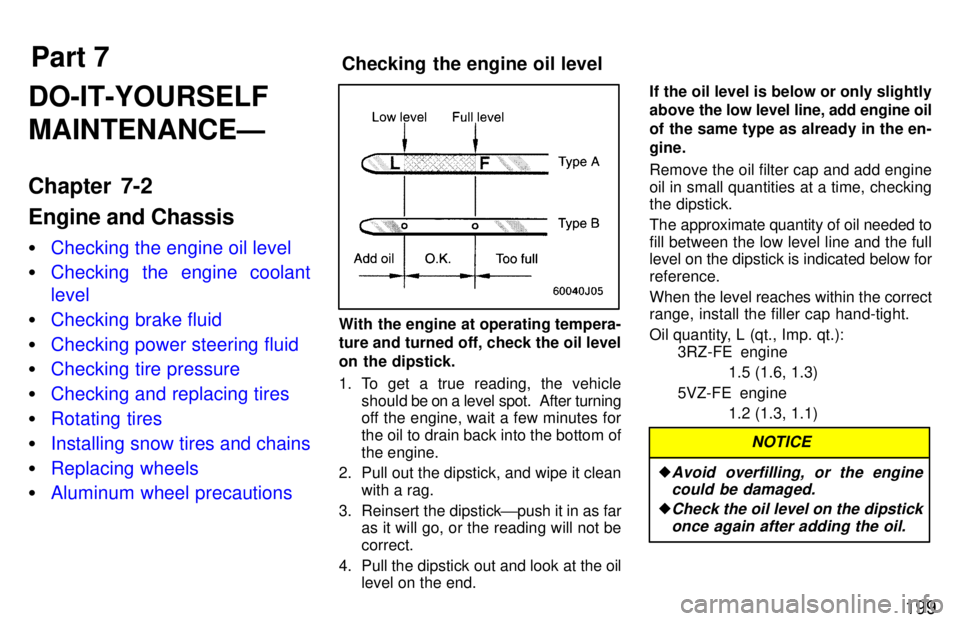
With the engine at operating tempera- ture and turned off, check the oil level
on the dipstick.
1. To get a true reading, the vehicle
should be on a level spot. After turning
off the engine, wait a few minutes for
the oil to drain back into the bottom ofthe engine.
2. Pull out the dipstick, and wipe it clean with a rag.
3. Reinsert the dipstick 'push it in as far
as it will go, or the reading will not becorrect.
4. Pull the dipstick out and look at the oil level on the end. If the oil level is below or only slightly
above
the low level line, add engine oil
of the same type as already in the en- gine. Remove the oil filter cap and add engine oil in small quantities at a time, checking the dipstick.
The approximate quantity of oil needed to
fill between the low level line and the full
level on the dipstick is indicated below for reference. When the level reaches within the correct range, install the filler cap hand-tight.
Oil quantity, L (qt., Imp. qt.): 3RZ-FE engine
1.5 (1.6, 1.3)
5VZ-FE engine 1.2 (1.3, 1.1)
Avoid overfilling, or the engine could be damaged.
Check the oil level on the dipstick
once again after adding the oil.
NOTICE
Page 218 of 223

P265/70R16 200 (2.2, 32) 220 (2.2, 32) 7J x 16J*1
7JJX16 *2
P225/75R15 200 (2.0, 29) 200 (2.0, 29) 7J x 15 *1
7JJ x 15 *2
Tire size
Tire pressure
kPa (kgf/cm 2
or bar, psi)
Front Rear Wheel size
Wheel nut torque, N
m (kg fm, ft lbf):
110 (11.5, 83)
* 1:
Vehicles with steel wheels
* 2:
Vehicles with aluminum wheel
221
BRAKES Minimum pedal clearance when de-pressed with the pressure of 490 N (50
kgf, 110 lbf) with the engine running, mm (in.):
72 (2.9)
Pedal freeplay, mm (in.):
3' 6 (0.12 '0.24)
Pad wear limit, mm (in.):
1.0 (0.04)
Lining wear limit, mm (in.):
1.0 (0.04)
Parking brake adjustment when pulled with the force of 196 N (20 kgf, 44 lbf): 7' 9 clicks
Fluid type: SAE J1703 or FMVSS No. 116 DOT 3
STEERING Wheel freeplay:
Less than 30 mm (1.2 in.)
Power steering fluid type:
Automatic transmission fluid DEXRON [
II or III Tires