1997 TOYOTA 4RUNNER Tire
[x] Cancel search: TirePage 164 of 223

167
Turn the jack joint by hand.
To remove: Turn the joint in direction 1 un- til the jack is free.
To store: Turn the joint in direction 2 until the jack is firmly secured to prevent it fly-
ing forward during a collision or suddenbraking.To remove the spare tire:
1. Insert the end of the jack handle intothe lowering screw and turn it counter- clockwise.
2. After the tire is lowered completely to the ground, remove the holding brack-et.
When storing the spare tire, put it in placewith the outer side of the wheel facing up.Then secure the tire taking care that the
tire goes straight up without catching on
any other part, to prevent it from flying for-ward during a collision or sudden braking.2. Block the wheel diagnoally oppo- site the flat tire to keep the vehicle from rolling when it is jacked up.
When blocking the wheel, place a wheel
block from the front for the front wheels or
from the rear for the rear wheels.
ÐBlocking the wheel
Page 166 of 223

169
5. Position the jack at the correct jack
points as shown
Make sure the jack is positioned on a level
and solid place.6. After making sure that no one is in
the vehicle, raise it high enough so
that the spare tire can be installed.
Remember you will need more ground
clearance when putting in the spare tire than when removing the flat tire.
To raise the vehicle, insert the jack handle
extension in to the jack (it is a loose fit) and
turn it clockwise with the handle, makingsure the handle remains firmly fitted onto
the jack handle extension. As the jack touches the vehicle and begins to lift,
double-check that it is properly posi-tioned.
Never get under the vehicle when it is supported by the jack alone. CAUTION
!
ÐPositioning the jack ÐRaising your vehicle
Page 167 of 223

170
7. Remove the wheel nuts and changetires.
Lift the flat tire straight off and put it aside.
Roll the spare wheel into position and
align the holes in the wheel with the bolts.
Then lift up the wheel and get at least thetop bolt started through its hole. Wigglethe tire and press it back over the other bolts.Before putting on wheels, remove any
corrosion on the mounting surfaces with a
wire brush or such. Installation of wheels
without good metal-to-metal contact at
the mounting surface can cause wheel
nuts to loosen and eventually cause a
wheel to come off while driving. Therefore
after the first 1600 km (1000 miles), check
to see that the wheel nuts are tight.8. Reinstall all the wheel nuts finger
tight.
Reinstall the wheel nuts (tapered end in-
ward) and tighten them as much as youcan by hand. Press back on the tire back and see if you can tighten them more.
ÐChanging wheels
ÐReinstalling wheel nuts
Page 168 of 223
171
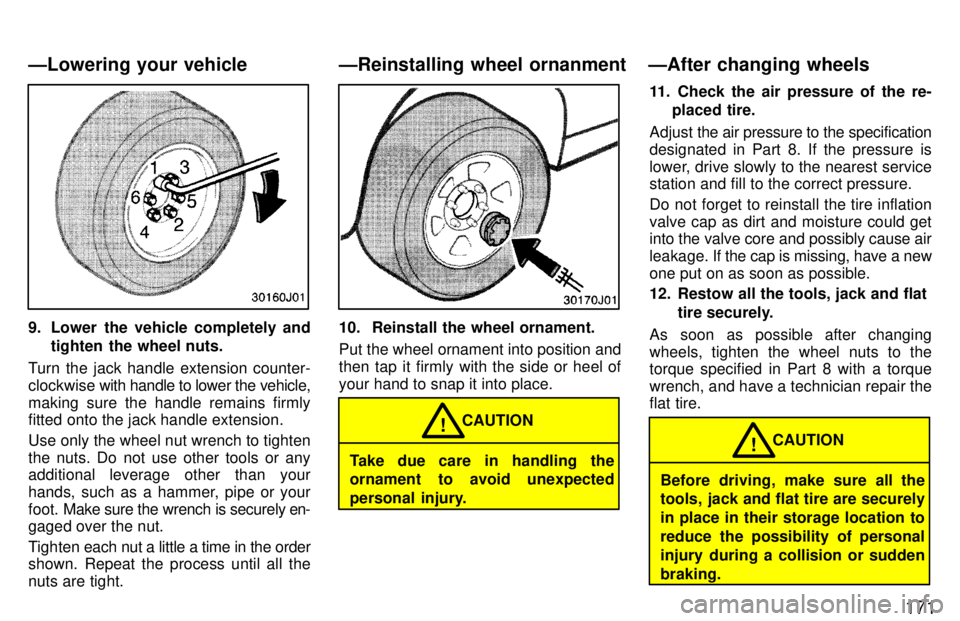
9. Lower the vehicle completely andtighten the wheel nuts.
Turn the jack handle extension counter-
clockwise with handle to lower the vehicle,
making sure the handle remains firmly
fitted onto the jack handle extension. Use only the wheel nut wrench to tighten the nuts. Do not use other tools or any
additional leverage other than your
hands, such as a hammer, pipe or your
foot. Make sure the wrench is securely en-
gaged over the nut.
Tighten each nut a little a time in the order
shown. Repeat the process until all the
nuts are tight.10. Reinstall the wheel ornament.
Put the wheel ornament into position and
then tap it firmly with the side or heel ofyour hand to snap it into place.
Take due care in handling the
ornament to avoid unexpected
personal injury. CAUTION
! 11. Check the air pressure of the re-
placed tire.
Adjust the air pressure to the specification
designated in Part 8. If the pressure is
lower, drive slowly to the nearest service station and fill to the correct pressure.
Do not forget to reinstall the tire inflation valve cap as dirt and moisture could get into the valve core and possibly cause air
leakage. If the cap is missing, have a new
one put on as soon as possible.
12. Restow all the tools, jack and flat
tire securely.
As soon as possible after changing
wheels, tighten the wheel nuts to the torque specified in Part 8 with a torque wrench, and have a technician repair the flat tire.
Before driving, make sure all the
tools, jack and flat tire are securely in place in their storage location to
reduce the possibility of personal
injury during a collision or suddenbraking. CAUTION
!
ÐLowering your vehicle ÐReinstalling wheel ornanment ÐAfter changing wheels
Page 173 of 223
176
If the emergency towing hook is
used to get out when your vehicle
becomes stuck in the mud, sand or
other condition from which the
vehicle can not be driven out under
its own power, make sure to observe
the precautions mentioned below.
Otherwise, excessive stress will be
put on the hook and the towing
cable or chain may break, causing
serious injury or damage. If the towing vehicle can hardly
move, do not forcibly continue the
towing. Contact your Toyota deal-
er or a commercial tow truck ser- vice for assistance.
Tow the vehicle as straight ahead as possible.
Keep away from the vehicle during
towing. CAUTION
!
The following methods are effective to
use when your vehicle is stuck in the mud, sand or other condition from which the ve-
hicle cannot be driven out under its own
power. Use extreme caution when
towing
the vehicle. In addition, keep away from
the vehicles and towing cable or chain
when towing. Remove the soil and sand in the front and the back of the tires.
Place stones or wood under the tires.
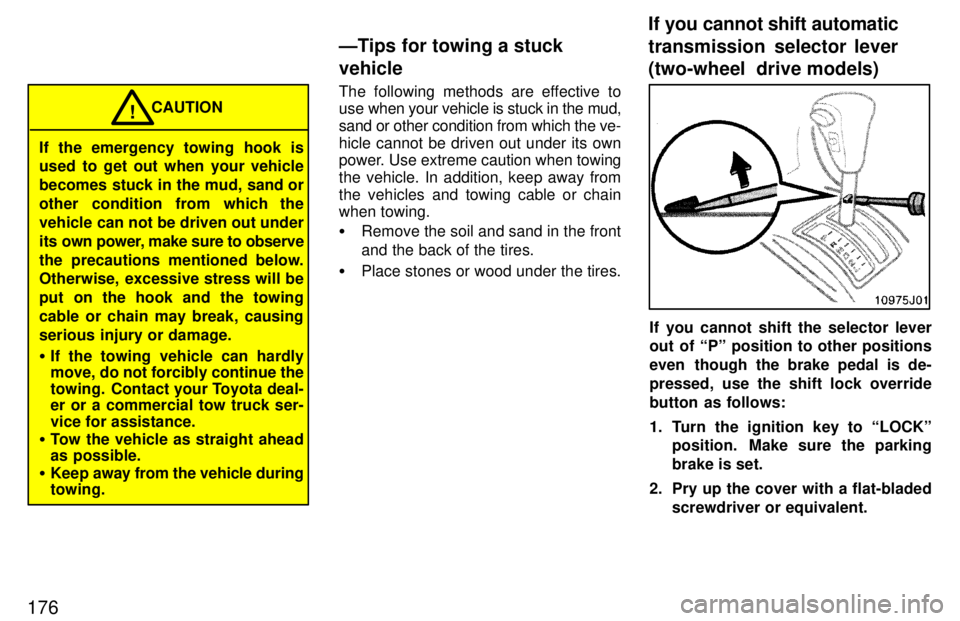
If you cannot shift the selector lever
out of Pº position to other positions
even though the brake pedal is de-pressed, use the shift lock override
button as follows:
1. Turn the ignition key to LOCKº
position. Make sure the parking brake is set.
2. Pry up the cover with a flat-bladed screwdriver or equivalent.
ÐTips for towing a stuck vehicle
If you cannot shift automatic
transmission selector lever
(two-wheel drive models)
Page 183 of 223

186Where to go for service?
Toyota technicians are well-trained spe- cialists
and are kept up to date with the lat-
est service information through technical
bulletins, service tips, and in-dealership
training programs. They learn to work on
Toyotas before they work on your vehicle,
rather than while they are working on it.
You can be confident that your Toyota
dealer's service department performs the
best job to meet the maintenance require-
ments on your vehicleÐreliably and eco-
nomically.
Your copy of the repair order is proof that
all required maintenance has been per-
formed for warranty coverage. And if any
problems should arise with your vehicle
while under warranty, your Toyota dealer
will promptly take care of it. Again, be sure
to keep a copy of the repair order for any
service performed on your Toyota.
What about do-it-yourself mainte- nance?
Many of the maintenance items are easy
to do yourself if you have a little mechani-
cal ability and a few basic automotive
tools. Simple instructions for how to per-
form them are presented in Part 7. If you are a skilled do-it-yourself me-
chanic, the Toyota service manuals are recommended. Please be aware that do-
it-yourself maintenance can affect your
warranty coverage. See Owner's Guide,
Owner 's
Manual Supplement or W arranty
Booklet for the details. Listed
below are the general maintenance
items that should be performed as fre-quently as specified. In addition to check-
ing the items listed, if you notice any un-
usual noise, smell or vibration, you should
investigate the cause or take your vehicle
to your T oyota dealer or a qualified service
shop immediately. It is recommended
that any problem you notice be brought to
the attention of your dealer or the qualified service shop for their advice.
Make these checks only where
adequate ventilation can be obtain-
ed if you run the engine. CAUTION
!
OUTSIDE THE VEHICLE
Items listed below should be per-
formed from time to time, unless
otherwise specified.
Tire pressure Check the pressure with a gauge every
two weeks, or at least once a month. See Chapter 7-2 for additional information.
General maintenance
Page 184 of 223

187
Tire surface and wheel nuts Check the tires carefully
for cuts, damage
or excessive wear. See Chapter 7-2 for
additional information. When checking the tires, make sure no nuts are missing,
and check the nuts for looseness. T ighten
them if necessary.
Tire rotation
Rotate the tires every 12000 km (7500
miles). See Chapter 7-2 for additional in- formation.
Fluid leaks Check underneath for leaking fuel, oil, wa-
ter or other fluid after the vehicle has been
parked for a while. If you smell fuel fumes
or notice any leak, have the cause found
and corrected immediately. Doors and engine hood
Check that all doors including back door
operate smoothly and all latches lock se-
curely. M ake sure the engine hood secon-
dary latch secures the hood from opening
when the primary latch is released. INSIDE THE VEHICLE Items listed below should be checked
regularly, e.g. while performing peri-
odic services, cleaning the vehicle, etc. Lights Make sure the headlights, stop lights, tail lights, turn signal lights, and other lights are all working. Check headlight aim. Service reminder indicators and
warn-
ing buzzers Check that all service reminder indicators
and warning buzzers function properly. Steering wheel
Check that it has the specified freeplay.
Be alert for changes in steering condition, such as hard steering or strange noise. Seats Check that all seat controls such as seat
adjusters, seatback recliner, etc. operate
smoothly and that all latches lock securely
in any position. Check that the head re-
straints move up and down smoothly and
that the locks hold securely in any latched
position. For folding-down rear seat-
backs, swing-up rear seat cushions and
detachable temporary third seat, check
that the latches lock securely. Seat belts
Check that the seat belt system such as
buckles, retractors and anchors operate
properly
and smoothly. Make sure the belt
webbing is not cut, frayed, worn or dam-aged. Accelerator pedal Check the pedal for smooth operation and
uneven pedal effort or catching. Clutch pedal Check the pedal for smooth operation. Brake pedal Check the pedal for smooth operation and
that the pedal has the proper clearance. Check the brake booster function. Brakes
At a safe place, check that the brakes do not pull to one side when applied. Parking brake Check that the lever has the proper travel and that, on a safe incline, your vehicle is
held securely with only the parking brake applied.
Page 185 of 223

188Automatic transmission Parkº
mech-
anism
Check the lock release button of the se-
lector lever for proper and smooth opera-
tion. On a safe incline, check that your ve-
hicle is held securely with the selector lever in ºPº position and all brakes re- leased.
IN THE ENGINE COMPARTMENT Items listed below should be checked
from time to time , e.g. each time when
refueling.
Washer fluid
Make sure there is sufficient fluid in the
tank. See Chapter 7-3 for additional infor-
mation.
Engine coolant level Make sure the coolant level is between
the FULLº and LOWº lines on the see-
through reservoir when the engine is cold.
See Chapter 7-2 for additional informa-tion.
Battery electrolyte level Make sure the electrolyte level of all bat-
tery cells is between upper and lower level
lines on the case. Add only distilled water
when replenishing. See Chapter 7-3 for
additional information. Brake fluid level
Make sure the brake fluid level is correct. See Chapter 7-2 for additional informa- tion.
Engine oil level
Check the l
evel on the dipstick with the en-
gine turned off and the vehicle parked on
a level spot. See Chapter 7-2 for addition-
al information. Power steering fluid level Check the level through the reservoir. The
level should be in the HOTº or COLDº
range depending on the fluid t emperature.
See Chapter 7-2 for additional informa- tion.
Exhaust system
If you notice any change in the sound of
the exhaust or smell exhaust fumes, have the cause located and corrected immedi-
ately. (See engine exhaust cautions in
Part 2.) Be on the alert for changes in perfor-
mance, sounds, and visual tip-offs
that in-
dicate service is needed. Some important
clues are as follows: Engine missing, stumbling, or pinging
Appreciable loss of power
Strange engine noises
A leak under the vehicle (however, wa-
ter dripping from the air conditioning
after use is normal.)
Change in exhaust sound (This may
indicate a dangerous carbon monox-
ide leak. Drive with the windows open
and have the exhaust system checked
immediately.)
Flat-looking tire; excessive tire squeal
when cornering; uneven tire wear
Vehicle pulls to one side when drivingstraight on a level road
Strange noises related to suspensionmovement
Loss of brake effectiveness; spongy
feeling brake or clutch pedal; pedal al-
most touches floor; vehicle pulls to one
side when braking
Engine coolant temperature continual-
ly higher than normal
Does your vehicle need repairing?