Page 12 of 223
11
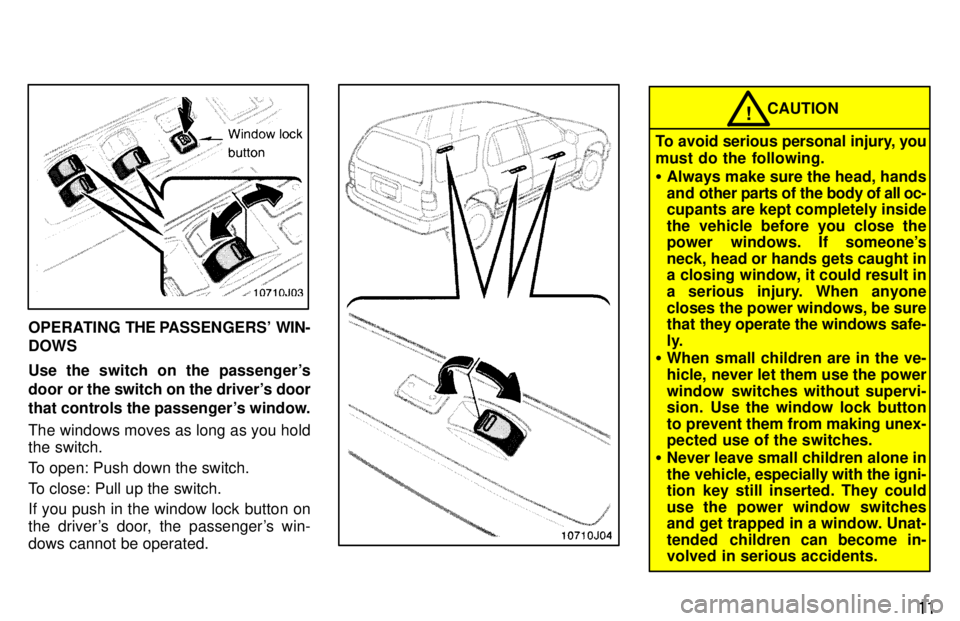
OPERATING THE PASSENGERS' WIN-
DOWS
Use the switch on the passenger's
door or the switch on the driver's door
that controls the passenger's window.
The windows moves as long as you hold the switch.
To open: Push down the switch.
To close: Pull up the switch.
If you push in the window lock button on
the driver's door, the passenger's win-
dows cannot be operated.
CAUTION!
To avoid serious personal injury, you
must do the following. Always make sure the head, hands
and other parts of the body of all oc-
cupants are kept completely inside
the vehicle before you close the
power windows. If someone's
neck, head or hands gets caught in
a closing window, it could result in
a serious injury. When anyone
closes the power windows, be sure
that they operate the windows safe-
ly.
When small children are in the ve-
hicle, never let them use the power
window switches without supervi-
sion. Use the window lock button
to prevent them from making unex-
pected use of the switches.
Never leave small children alone in
the vehicle, especially with the igni-
tion key still inserted. They could
use the power window switches
and get trapped in a window. Unat-
tended children can become in-
volved in serious accidents.
Page 13 of 223
12
The back window can be operated with
the inner switch on the center console
or outer switch on the back door.
OPERATING FROM INSIDE
The ignition key must be in the ONº posi- tion.
The back window moves as long as you
hold the inner switch.
To open: Push the switch on the DOWNº side.
To close: Push the switch on the UPº side.You can also open the back window when
the back window wiper is working. At that
time, the wi
per stops working until the win-
dow is closed again.
If you push in the window lock button on
the driver's door (with power window) or
on the instrument panel (without power
window), the back window cannot be op- erated.With power window (driver's door)
Without power window (instrument panel)
Power back window
Page 14 of 223
13
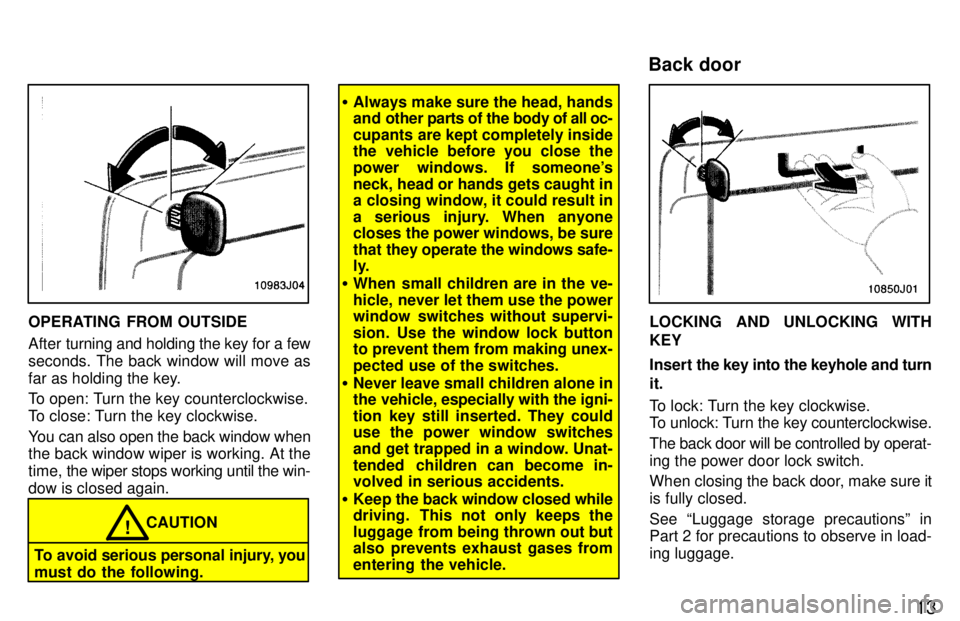
OPERATING FROM OUTSIDE
After turning and holding the key for a few
seconds. The back window will move as
far as holding the key.
To open: Turn the key counterclockwise.
To close: Turn the key clockwise.
You can also open the back window when the back window wiper is working. At the
time, the wiper st ops working until the win-
dow is closed again.
CAUTION!
To avoid serious personal injury, you
must do the following.
Always make sure the head, hands
and other parts of the body of all oc-
cupants are kept completely inside
the vehicle before you close the
power windows. If someone's
neck, head or hands gets caught in
a closing window, it could result in
a serious injury. When anyone
closes the power windows, be sure
that they operate the windows safe-
ly.
When small children are in the ve-
hicle, never let them use the power
window switches without supervi-
sion. Use the window lock button
to prevent them from making unex-
pected use of the switches.
Never leave small children alone in
the vehicle, especially with the igni-
tion key still inserted. They could
use the power window switches
and get trapped in a window. Unat-
tended children can become in-
volved in serious accidents.
Keep the back window closed while
driving. This not only keeps the
luggage from being thrown out but
also prevents exhaust gases from
entering the vehicle.
LOCKING AND UNLOCKING WITH KEY
Insert the key into the keyhole and turn
it.
To lock: Turn the key clockwise.
To unlock: Turn the key counterclockwise. The back door will be controlled by operat-
ing the power door lock switch.
When closing the back door, make sure it is fully closed. See Luggage storage precautionsº in
Part 2 for precautions to observe in load- ing luggage.
Back door
Page 16 of 223
15
LOCKING AND UNLOCKING WITH
POWER BACK DOOR LOCK SWITCH Push the switch.
To lock: Push the switch on the LOCKº side.
To unlock: Push the switch on the UN-
LOCKº side.
Vehicles with a power door lock sys-
temÐOperating the power door lock
switch simultaneously locks or unlocksthe back door (see Side doorsº).To open the hood, do the following.
1. Pull the hood lock release lever.The hood will spring up slightly.2. In front of the vehicle, pull up on theauxiliary catch lever and lift the hood.
Hood
Page 17 of 223
16
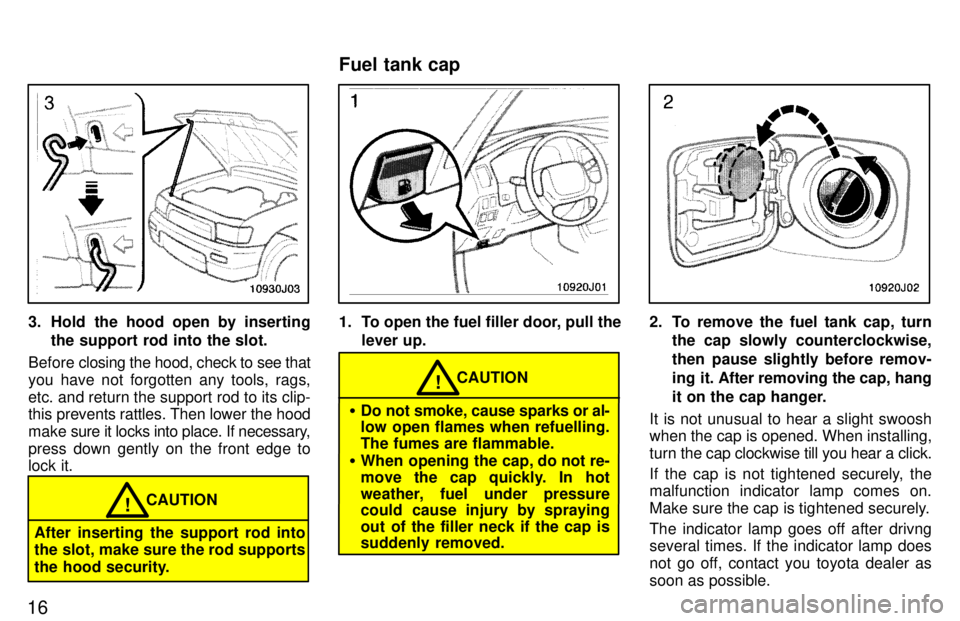
3. Hold the hood open by insertingthe support rod into the slot.
Before closing the hood, check to see that
you have not forgotten any tools, rags,
etc. and return the support rod to its clip-
this prevents rattles. Then lower the hood
make sure it locks into place. If necessary,
press down gently on the front edge to lock it.
CAUTION!
After inserting the support rod into
the slot, make sure the rod supports
the hood security.
1. To open the fuel filler door, pull the lever up.
CAUTION!
Do not smoke, cause sparks or al-
low open flames when refuelling. The fumes are flammable.
When opening the cap, do not re-
move the cap quickly. In hot
weather, fuel under pressure
could cause injury by spraying
out of the filler neck if the cap is
suddenly removed.
2. To remove the fuel tank cap, turn
the cap slowly counterclockwise,
then pause slightly before remov-
ing it. After removing the cap, hang
it on the cap hanger.
It is not unusual to hear a slight swoosh
when the cap is opened. When installing,
turn the cap clockwise till you hear a click.
If the cap is not tightened securely, the malfunction indicator lamp comes on.
Make sure the cap is tightened securely.
The indicator lamp goes off after drivng
several times. If the indicator lamp does
not go off, contact you toyota dealer as
soon as possible.
Fuel tank cap
Page 20 of 223
24
Front
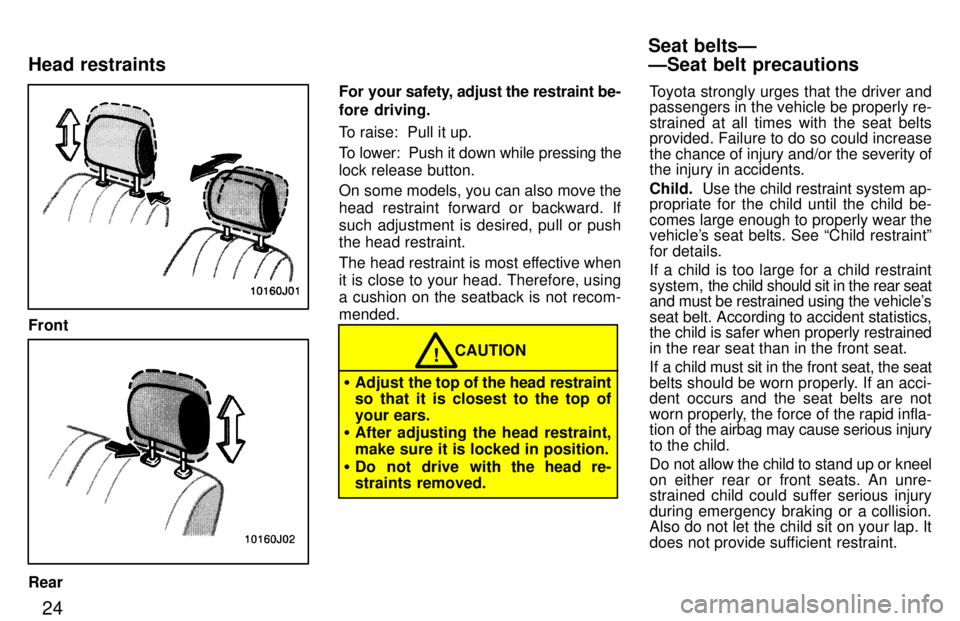
RearFor your s
afety, adjust the restraint be-
fore driving.
To raise: Pull it up.
To lower: Push it down while pressing the lock release button.
On some models, you can also move the
head restraint forward or backward. If
such adjustment is desired, pull or push the head restraint.
The head restraint is most effective when
it is close to your head. Therefore, using a cushion on the seatback is not recom- mended.
CAUTION!
Adjust the top of the head restraint
so that it is closest to the top of
your ears.
After adjusting the head restraint,
make sure it is locked in position.
Do not drive with the head re-
straints removed. Toyota strongly urges that the driver and passengers in the vehicle be properly re- strained at all times with the seat belts
provided. Failure to do so could increase
the chance of injury and/or the severity of the injury in accidents. Child.
Use the child restraint system ap-
propriate for the child until the child be-
comes large enough to properly wear the
vehicle's seat belts. See Child restraintº
for details.
If a child is too large for a child restraint
system, the child should sit in the rear seat
and must be restrained using the vehicle's
seat belt. According to accident statistics, the child is safer when properly restrained
in the rear seat than in the front seat.
If a child must sit in the front seat, the seat
belts should be worn properly. If an acci- dent occurs and the seat belts are not
worn properly, the force of the rapid infla-
tion of the airbag may cause serious injury
to the child.
Do not allow the child to stand up or kneel
on either rear or front seats. An unre-
strained child could suffer serious injury
during emergency braking or a collision.
Also do not let the child sit on your lap. It
does not provide sufficient restraint.
Seat beltsÐ ÐSeat belt precautions
Head restraints
Page 22 of 223
26
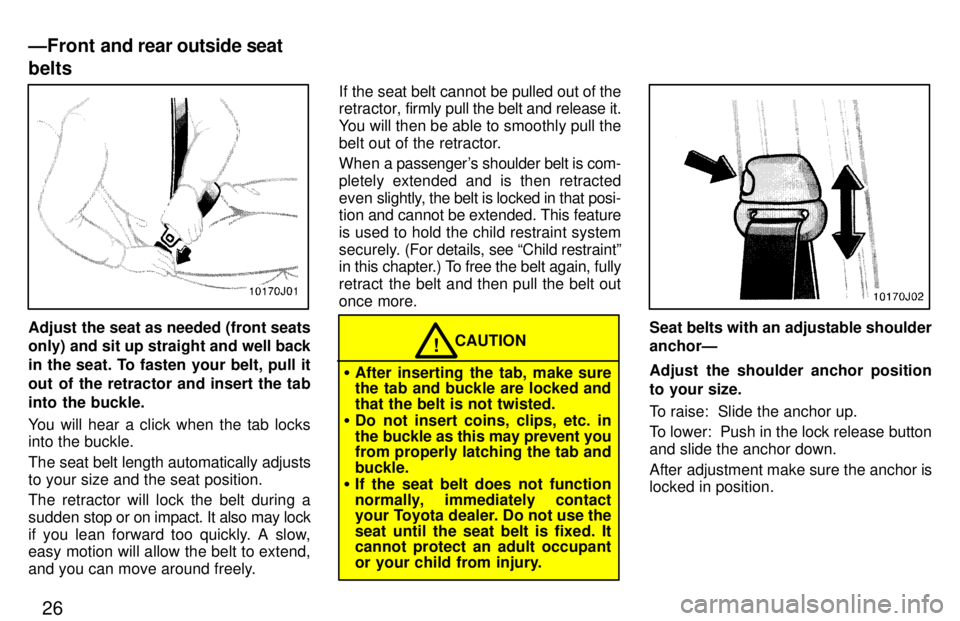
Adjust the seat as needed (front seats only) and sit up straight and well back
in the seat. To fasten your belt, pull it
out of the retractor and insert the tab
into the buckle.
You will hear a click when the tab locks into the buckle.
The seat belt length automatically adjusts
to your size and the seat position.
The retractor will lock the belt during a
sudden stop or on impact. It also may lock
if you lean forward too quickly. A slow, easy motion will allow the belt to extend,
and you can move around freely. If the seat belt cannot be pulled out of the
retractor,
firmly pull the belt and release it.
You will then be able to smoothly pull the
belt out of the retractor.
When a passenger's shoulder belt is com-
pletely extended and is then retracted
even slightly, the belt is locked in that posi-
tion and cannot be extended. This feature
is used to hold the child restraint system
securely. (For details, see Child restraintº
in this chapter.) To free the belt again, fully
retract the belt and then pull the belt out
once more.CAUTION!
After inserting the tab, make sure
the tab and buckle are locked and that the belt is not twisted.
Do not insert coins, clips, etc. in
the buckle as this may prevent you
from properly latching the tab and buckle.
If the seat belt does not function
normally, immediately contact
your Toyota dealer. Do not use the
seat until the seat belt is fixed. It cannot protect an adult occupant
or your child from injury.
Seat belts with an adjustable shoulder anchorÐ
Adjust the shoulder anchor position
to your size.
To raise: Slide the anchor up.
To lower: Push in the lock release button
and slide the anchor down.
After adjustment make sure the anchor is
locked in position.
ÐFront
and rear outside seat
belts
Page 24 of 223
28
To release the belt, press the buckle-
release button and allow the belt to re- tract.
If the belt does not retract smoothly, pull
it out and check for kinks or twists. Then make sure it remains untwisted as it re- tracts.Sit up straight and well back in the
seat. To fasten your belt, insert the tab
into the buckle.
You will hear a click when the tab locks into the buckle.
If the belt is not long enough for you, hold the tab at a right angle to the belt and pull
on the tab.
CAUTION!
After inserting the tab, make sure
the tab and buckle are locked and that the belt is not twisted.
Do not insert coins, clips, etc. in
the buckle as this may prevent you
from properly latching the tab and buckle.
If the seat belt does not function
normally, immediately contact
your Toyota dealer. Do not use the
seat until the seat belt is fixed. It cannot protect an adult occupant
or your child from injury.
ÐRear center seat belt