1997 TOYOTA 4RUNNER fuel
[x] Cancel search: fuelPage 61 of 223

64
The gauge indicates the engine cool-
ant temperature when the ignition
switch is on. The engine operating
temperature will vary with changes inweather and engine load.
If the needle moves into the red zone, your engine is too hot. If your vehicle
overheats, stop your vehicle and allow the
engine to cool.
Your vehicle may overheat during severe operating conditions, such as: Driving up a long hill on a hot day.
Reducing speed or stopping after high
speed driving.
Idling for a long period with the air con-
ditioning on in stop-and-go traffic.
Towing a trailer
NOTICE
Do not remove the thermostat in
the engine cooling system as this
may cause the engine to overheat. The thermostat is designed tocontrol the flow of coolant to keep
the temperature of the engine within the specified operatingrange.
Do not continue driving with an
overheated engine. See If yourvehicle overheatsº in Part 4.The tachometer indicates engine
speed in thousands of rpm (revolu-
tions per minute). Use it while driving
to select correct shift points and to
prevent engine lugging and overrev- ving.
Driving with the engine running too fast
causes excessive engine wear and poor
fuel economy. Remember, in most cases
the slower the engine speed, the greater
the fuel economy.
NOTICE
Do not let the indicator needle get into the red zone. This may cause
severe engine damage.
Tachometer
Engine coolant temperature gauge
Page 64 of 223

67
NOTICE
Do not continue driving if the engine drive belt is broken or loose.
(d) Low Oil Pressure Warning Light
This light warns that the engine oil pres-
sure is too low.
If it flickers or stays on while you are driv-
ing, pull off the road to a safe place and
stop the engine immediately. Call a Toyo-
ta dealer or qualified repair shop for assis- tance.
The light may occasionally flicker when
the engine is idling or it may come on brief-
ly after a hard stop. There is no cause for concern if it then goes out when the en-
gine is accelerated slightly.
The light may come on when the oil level
is extremely low. It is not designed to indi-cate low oil level, and the oil level must be checked using the level dipstick.
NOTICE
Do not drive the vehicle with the warning light onÐeven for one
block. It may ruin the engine.
(e) Malfunction Indicator Lamp
This lamp comes on in the following cases.
a. The fuel tank is completely empty. (See Fuel gaugeº in Chapter 1-5 for in- structions.)
b. The fuel tank cap is not tightened se-
curely. (See Fuel tank capº in Chapter
1-2 for instructions.)
c. There is a problem somewhere in your engine or automatic transmission
electrical system.
If it comes on while you are driving in case
c, have your vehicle checked/repaired by
your Toyota dealer as soon as possible.
(f) Low Fuel Level Warning Light
This light comes on when the fuel level in
the tank becomes nearly empty. Fill up the tank as soon as possible.
(g) ABSº Warning Light
This light warns that there is a problem
somewhere in your anti-lock brake sys-tem.
If the light comes on while you are driving,
have your vehicle checked by your T oyota
dealer as soon as possible. The light will come on when the ignition
key is turned to the ONº position. After
about 3 seconds, the light will go off. When the ABSº warning light is on (and
the brake system warning light is off), the brake system
operates conventionally but
anti-lock brake system is not assisting brake performance so that the wheels can
lock-up during sudden braking or braking
on slippery road surfaces.
(h) Open Door Warning Light
This light remains on until all the doors
and back door are completely closed.
(i) SRS Airbag Warning Light
This light will come on when the igni-
tion key is turned to the ACCº or ONº
position. After about 6 seconds, the
light w ill go off. This means the airbag
system is operating properly.
The warning light system monitors the air-
bag sensor assembly, inflators, warning
light, interconnecting wiring and power sources.
Page 70 of 223

73
Your automatic transmission has a shift
lock system to minimize the possibility of
incorrect operation. This means you can
only shift out of Pº position when the brake
pedal is depressed (with the ignition
switch in ONº position and the selector le-ver pulled toward you).
(a) Normal Driving
1. Start the engine as instructed in How
to start the engineº in Part 3. The trans- mission must be in Pº or Nº.
2. With your foot holding down the brake pedal, shift the selector lever to Dº.
In Dº position, the automatic transmis-
sion system will select the most suitable
gear for running conditions such as nor-
mal cruising, hill climbing, hard towing, etc.
Always turn the overdrive switch on for
better fuel economy and quieter driving. If
the engine coolant temperature is low, thetransmission will not shift into overdrive
gear even with the overdrive switch on.
Never put your foot on the accelera-
tor pedal while shifting. CAUTION
! 3. Release the parking brake and brake
pedal. Depress the accelerator pedal
slowly for smooth starting.
(b) Using engine braking
To use engine braking, you can downshift the transmission as follows: Turn off the overdrive switch. The O/D
OFFº indicator light will come on and the transmission will downshift to the
third gear.
Shift into the 2º position). The trans-
mission will downshift to the second
gear when the vehicle speed drops down to or lower than the followingspeed, and more powerful engine
braking will be obtained.
3RZ-FE engine 112 km/h (69 mph) . .
5VZ-FE engine 119 km/h (73 mph) . .
Shift into the Lº position. The trans-
mission will downshift to the first gear.
When the vehicle speed drops down to
or lower than the following speed, and
maximum engine braking will be ap- plied.
3RZ-FE engine 54 km/h (33 mph) . . .
5VZ-FE engine 58 km/h (36 mph) . . . Vehicles with cruise controlÐWhen the
cruise control is being used, even if you
downshift the transmission by turning off
the overdrive switch, engine braking is not
applied because the cruise control is not cancelled.
For ways to decrease the vehicle speed,
see Cruise controlº in this chapter.
Be careful when downshifting on a
slippery surface. Abrupt shifting
could cause the vehicle to spin orskid.
CAUTION
!
(c) Using the 2º and Lº positions
The 2º and Lº positions are used for
strong engine braking as described pre-
viously. With the selector lever in 2º or Lº, you
can start the vehicle in motion as with the
lever in Dº. With the selector lever in 2º, the vehicle
will start in the first gear and automatically
shift to the second gear.
With the selector lever in Lº, the trans-
mission is engaged in the first gear.
Page 72 of 223
75
(g) Rocking your vehicle if stuck
If you rock your vehicle to make it
out when it becomes stuck in snow,
mud, sand, etc., first check that there are no objects or people
around the vehicle. During
operation, the vehicle may suddenly move forward or
backward as it becomes unstuck,
causing injury or damage to nearby
people or objects.
CAUTION
!
NOTICE
If you rock your vehicle, observe the following precautions to prevent
damage to the transmission andother parts.
Do not depress the acceleratorpedal while shifting the selectorlever or before the transmission is
completely shifted to forward or
reverse gear.
Do not race the engine and avoidspinning the wheels.
If your vehicle remains stuck afterrocking the vehicle several times,
consider other ways such as tow-ing.
(h) Driving in pwrº (power) mode
In the PWRº mode, the transmission is shifted up and down at a higher vehicle
speed than in the NORMº (Normal) mode and a more powerful acceleration is
achieved. To set the PWRº mode, push
in the driving pattern selector button. The
PWRº mode indicator light comes on.
For ordinary driving, Toyota recommends
using the NORMº mode to improve fuel
economy.
(i) If you cannot shift the selector lever out of Pº position
If you cannot shift the selector lever from Pº position even though the brake pedal
is depressed, use the shift lock override
button. For instructions, see If you can- not shift automatic transmission selectorleverº in Part 4.
Page 74 of 223

77
Your automatic transmission has a shift
lock system to minimize the possibility of
incorrect operation. This means you can
only shift out of Pº position when the brake
pedal is depressed (with the ignition
switch in ONº position and the selector le- ver pulled toward you).
(a) Normal driving
1. Start the engine as instructed in How to start the engineº in Part 3. The trans- mission must be in Pº or Nº.
When the front drive control lever is in L4º
(low-speed position, four-wheel drive),
the driving pattern selector setting has no
effect on gear shift timing. (See Four-
wheel drive systemº in this chapter for in-
formation of the front drive control lever.)
2. With your foot holding down the brake pedal, shift the selector lever to Dº.
In Dº position, the automatic transmis-
sion system will select the most suitable
gear for running conditions such as nor-
mal cruising, hill climbing, hard towing, etc. Always turn the overdrive switch on for
better
fuel economy and quieter driving. If
the engine coolant temperature is low or
when the front drive control lever is in l4º
(low-speed position, four-wheel drive)
the transmission will not shift into the
overdrive gear even with the overdrive
switch on. ( See Fourwheel drive systemº
in this chapter for information of the front
drive control lever.)
Never put your foot on the accelera- tor pedal while shifting. CAUTION
!
3. Release the parking brake and brake pedal. Depress the accelerator pedal
slowly for smooth starting.
(b) Using engine braking
To use engine braking, you can downshift the transmission as follows: Turn off the overdrive switch. The O/D
OFFº indicator light will come on andthe transmission will downshift to the
third gear.
Shift into the 2º position. The trans-
mission will downshift to the second
gear when the vehicle speed drops
down to or lower than following speed,
and more powerful engine braking will
be obtained.
Front drive control lever in H2º or H4º
3RZ-FE engine 105 km/h (65 mph) . .
5VZ-FE engine 114 km/h (70 mph) . . .
Front drive control lever in L4º 3RZ-FE engine 38 km/h (23 mph) . . . .
5VZ-FE engine 41 km/h (25 mph) . . . .
Shift into the Lº position. The trans- mission will downshift to the first gear
when the vehicle speed drops down to
or lower than the following speed, and
maximum engine braking will be ap- plied.
Front drive control lever in H2º or H4º
3RZ-FE engine 51 km/h (31 mph) . . . .
5VZ-FE engine 55 km/h (34 mph) . . . .
Front drive control lever in L4º 3RZ-FE engine 11 km/h (6 mph) . . . . .
5VZ-FE engine 12 km/h (7 mph) . . . . .
Page 76 of 223
79
While the vehicle is moving, never
attempt to move the selector lever
into Pº position under any
circumstances. Serious mechanical
damage and loss of vehicle control may result.CAUTION
!
(f) Good driving practice If the transmission is repeatedly up-
shifted and downshifted between third
gear and overdrive when climbing a
gentle slope, the overdrive switch
should be turned off. Be sure to turn the switch on immediately afterward.
When towing a trailer, in order to main-
tain engine braking efficiency, do notuse overdrive.
Always keep your foot on the brake
pedal while stopped with the engine
running. This prevents the vehicle
from creeping. CAUTION
!
NOTICE
Do not hold the vehicle on an upgrade with the accelerator pedal.
It can cause the transmission tooverheat. Always use the brake pedal or parking brake.
(g) Rocking your vehicle in stuck
If you rock your vehicle to make it
out when it becomes stuck in snow,
mud, sand, etc., first check that there are no objects or people
around the vehicle. During
operation, the vehicle may suddenly move forward or
backward as it becomes unstuck,
causing injury or damage to nearby
people or objects. CAUTION
!
NOTICE
If you rock your vehicle, observe the following precautions to prevent
damage to the transmission andother parts.
Do not depress the acceleratorpedal while shifting the selector
lever or before the transmission is
completely shifted to forward or reverse gear.
Do not race the engine and avoid
spinning the wheels.
If your vehicle remains stuck afterrocking the vehicle several times,consider other ways such as tow-ing.
(h) Driving in POWERº mode In the POWERº mode, the transmission
is shifted up and down at a higher vehicle
speed than in the NORMALº mode and a
more powerful acceleration is achieved.
To set the POWERº mode, push in the
driving pattern selector button. The
POWERº mode indicator light comes on.
For ordinary driving, Toyota recommends
using the NORMALº mode to improve
fuel economy.
Page 77 of 223

80(i) If you cannot shift the selector lever
out of Pº position
If you cannot shift the selector lever from the Pº position even though the brake
pedal is depressed, use the shift lock
override button. For instructions, see Ifyou cannot shift automatic transmission selector leverº in Part 4.
The shift pattern is as shown above.
Press the clutch pedal down fully while
shifting, and then release it slowly. Do not
rest your foot on the pedal while driving, because it will cause clutch trouble. And do not use the clutch to hold the vehicle
when stopped on an uphill grade-use the
parking brake. Recommended shifting speeds
The transmission is fully synchronized
and upshifting or downshifting is easy.
For the best compromise between fuel
economy and vehicle performance, you
should upshift or downshift at the follow-
ing speeds:
gear km/h (mph)
1 to 2 or 2 to 1 24 (15)
2 to 3 or 3 to 2 40 (25)
3 to 4 or 4 to 3 64 (40)
4 to 5 or 5 to 4 72 (45)
Downshift to the appropriate gear if accel-
eration is needed when you are cruising
below the above downshifting speeds.
Upshifting too soon or downshifting too
late will cause lugging, and possibly,
pinging. Regularly revving the engine to
maximum speed in each gear will cause
excessive engine wear and high fuel consumption.
Manual transmission
Page 132 of 223
Part 2Off-road vehicle precautions
135
INFORMATION
BEFORE DRIVING
YOUR TOYOTA
Off-road vehicle precautions
Break-in period
Fuel
Operation in foreign countries
Three-way catalytic converter
Engine exhaust cautions
Facts about engine oil consumption
Twin ground electrode spark plugs
Brake system
Brake pad wear limit indicators
Luggage stowage precautions
Your Toyota's idenitification
Theft prevention labels
Suspension and chassis
Types of tires
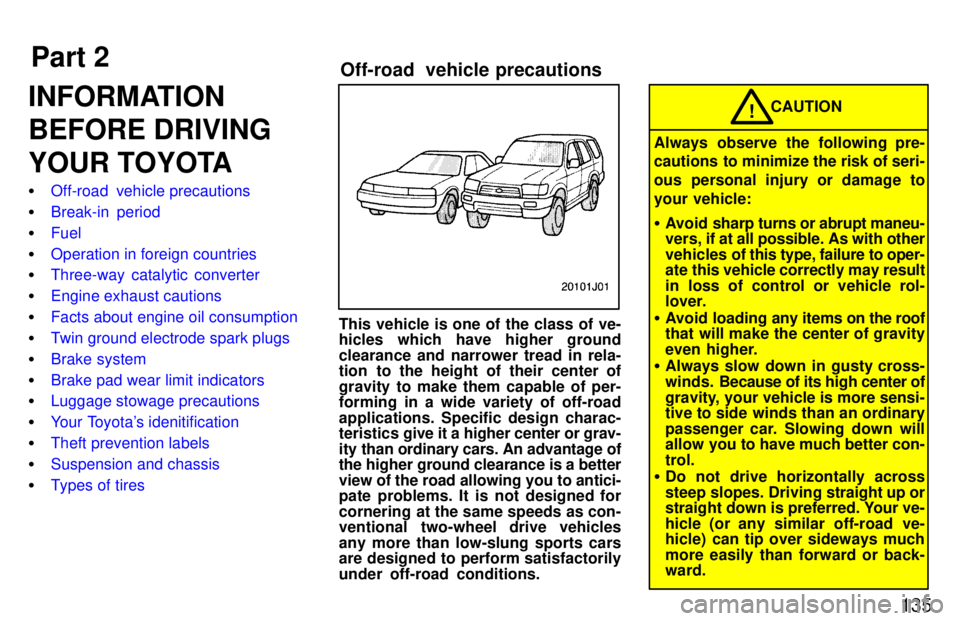
This vehicle is one of the class of ve-
hicles which have higher ground
clearance and narrower tread in rela-
tion to the height of their center of
gravity to make them capable of per- forming in a wide variety of off-road applications. Specific design charac-
teristics give it a hi
gher center or grav-
ity than ordinary cars. An advantage ofthe higher ground clearance is a better view of the road allowing you to antici-
pate problems. It is not designed for
cornering at the same speeds as con-
ventional two-wheel drive vehicles
any more than low-slung sports cars
are designed to perform satisfactorily under off-road conditions.
CAUTION!
Always observe the following pre-
cautions to minimize the risk of seri-
ous personal injury or damage to
your vehicle: Avoid sharp turns or abrupt maneu-
vers, if at all possible. As with other
vehicles of this type, failure to oper-
ate this vehicle correctly may result
in loss of control or vehicle rol-
lover.
Avoid l oading any items on the roof
that will make the center of gravity
even higher.
Always slow down in gusty cross-
winds. Because of its high center of
gravity, your vehicle is more sensi-
tive to side winds than an ordinary
passenger car. Slowing down will
allow you to have much better con- trol.
Do not drive horizontally across
steep slopes. Driving straight up or
straight down is preferred. Your ve-
hicle (or any similar off-road ve-
hicle) can tip over sideways much
more easily than forward or back- ward.