1997 TOYOTA 4RUNNER door lock
[x] Cancel search: door lockPage 14 of 223
13
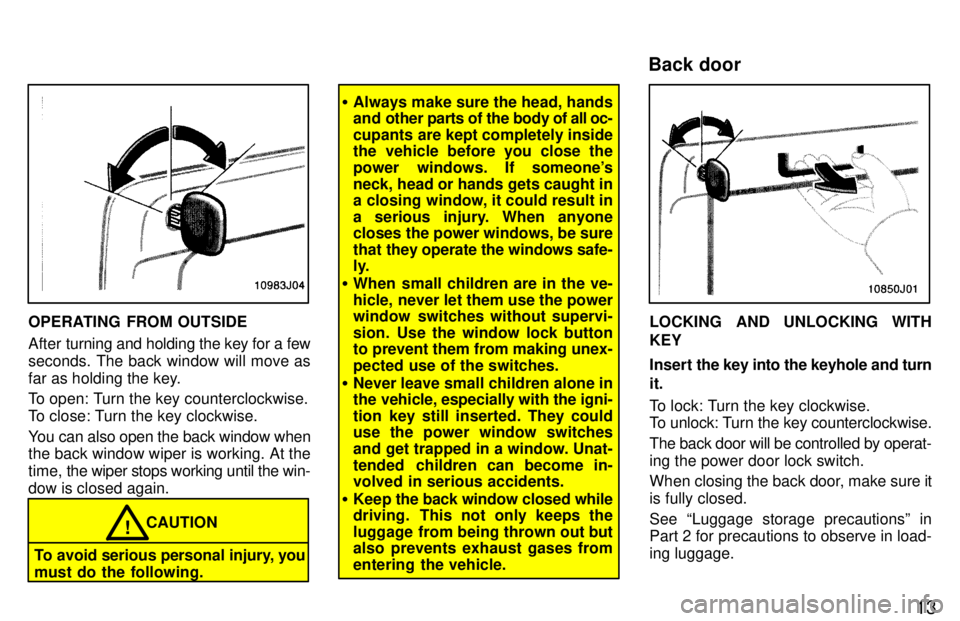
OPERATING FROM OUTSIDE
After turning and holding the key for a few
seconds. The back window will move as
far as holding the key.
To open: Turn the key counterclockwise.
To close: Turn the key clockwise.
You can also open the back window when the back window wiper is working. At the
time, the wiper st ops working until the win-
dow is closed again.
CAUTION!
To avoid serious personal injury, you
must do the following.
Always make sure the head, hands
and other parts of the body of all oc-
cupants are kept completely inside
the vehicle before you close the
power windows. If someone's
neck, head or hands gets caught in
a closing window, it could result in
a serious injury. When anyone
closes the power windows, be sure
that they operate the windows safe-
ly.
When small children are in the ve-
hicle, never let them use the power
window switches without supervi-
sion. Use the window lock button
to prevent them from making unex-
pected use of the switches.
Never leave small children alone in
the vehicle, especially with the igni-
tion key still inserted. They could
use the power window switches
and get trapped in a window. Unat-
tended children can become in-
volved in serious accidents.
Keep the back window closed while
driving. This not only keeps the
luggage from being thrown out but
also prevents exhaust gases from
entering the vehicle.
LOCKING AND UNLOCKING WITH KEY
Insert the key into the keyhole and turn
it.
To lock: Turn the key clockwise.
To unlock: Turn the key counterclockwise. The back door will be controlled by operat-
ing the power door lock switch.
When closing the back door, make sure it is fully closed. See Luggage storage precautionsº in
Part 2 for precautions to observe in load- ing luggage.
Back door
Page 16 of 223

15
LOCKING AND UNLOCKING WITH
POWER BACK DOOR LOCK SWITCH Push the switch.
To lock: Push the switch on the LOCKº side.
To unlock: Push the switch on the UN-
LOCKº side.
Vehicles with a power door lock sys-
temÐOperating the power door lock
switch simultaneously locks or unlocksthe back door (see Side doorsº).To open the hood, do the following.
1. Pull the hood lock release lever.The hood will spring up slightly.2. In front of the vehicle, pull up on theauxiliary catch lever and lift the hood.
Hood
Page 17 of 223
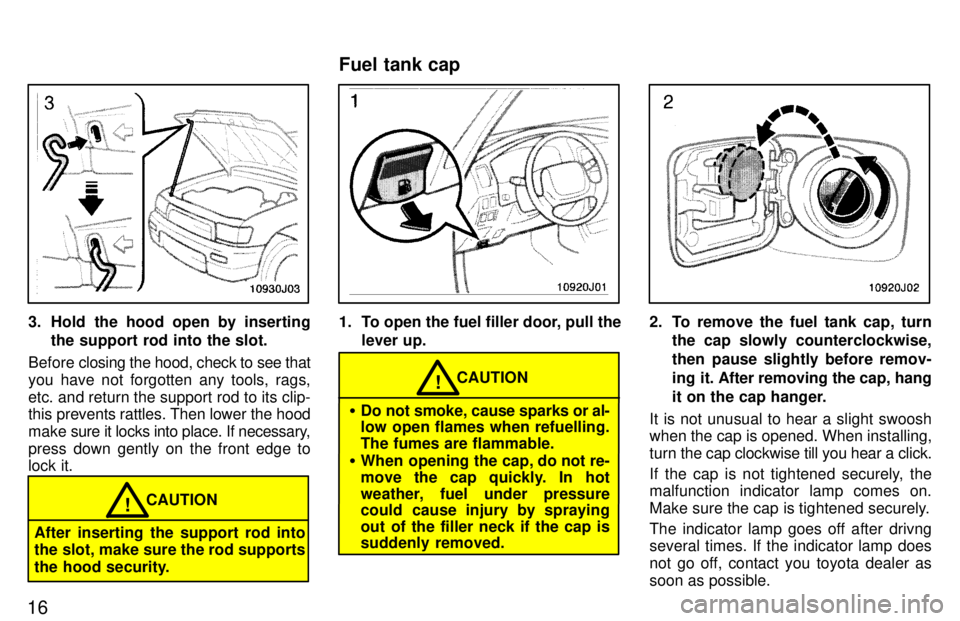
16
3. Hold the hood open by insertingthe support rod into the slot.
Before closing the hood, check to see that
you have not forgotten any tools, rags,
etc. and return the support rod to its clip-
this prevents rattles. Then lower the hood
make sure it locks into place. If necessary,
press down gently on the front edge to lock it.
CAUTION!
After inserting the support rod into
the slot, make sure the rod supports
the hood security.
1. To open the fuel filler door, pull the lever up.
CAUTION!
Do not smoke, cause sparks or al-
low open flames when refuelling. The fumes are flammable.
When opening the cap, do not re-
move the cap quickly. In hot
weather, fuel under pressure
could cause injury by spraying
out of the filler neck if the cap is
suddenly removed.
2. To remove the fuel tank cap, turn
the cap slowly counterclockwise,
then pause slightly before remov-
ing it. After removing the cap, hang
it on the cap hanger.
It is not unusual to hear a slight swoosh
when the cap is opened. When installing,
turn the cap clockwise till you hear a click.
If the cap is not tightened securely, the malfunction indicator lamp comes on.
Make sure the cap is tightened securely.
The indicator lamp goes off after drivng
several times. If the indicator lamp does
not go off, contact you toyota dealer as
soon as possible.
Fuel tank cap
Page 50 of 223

53
To change the steering wheel angle,
hold the steering wheel, pull up the
lock release lever, tilt the steering
wheel to the desired angle and release
the lever.
When the steering wheel is in a low posi-
tion, it will spring up as you release the
lock release lever.
Do not adjust the steering wheel
while the vehicle is moving.
After adjusting the steering wheel,try moving it up and down to make sure it is locked in position.
CAUTION!
Adjust the mirror so you can just see
the side of your vehicle in the mirror. Be careful when judging the size of dis- tance of any object seen in the outside
rear view mirror on the passenger's side.
It is a convex mirror with a curved surface.
Any object seen in a convex mirror will
look smaller and farther away than when
seen in a flat mirror.With power window (door armrest)
Without power window (instrument panel)
Tilt steering wheel Outside rear view mirrorsÐ
ÐPower Rear view mirror control
Page 52 of 223

Part 1Headlights and turn signals
55
OPERATION OF INSTRUMENTS ANDCONTROLSÐ
Chapter 1-4
Lights, Wipers and Defogger
Headlights and turn signals
Emergency flashers
Instrument panel light control
Interior lights
Personal lights
Luggage compartment light
Ignition switch light
Windshield wipers and washer
Back window wiper and washer
Back window defogger
HEADLIGHTS
To turn on the following lights: Twist
the headlight/turn signal lever knob. Position 1ÐParking, tail, license plate,
side marker and instrument panel lights Position 2ÐHeadlights and all of the above
If you turn the ignition switch to the lockº
position with the headlights left on, a
buzzer reminds you to turn the lights off
when you open the driver's door.
NOTICE
To prevent the battery from being discharged, do not leave the lights
on for a long period when theengine is not running.
Daytime running light system (Canada only)
The headlights turn on when the parking brake is released with the engine started,
even with the light switch in the OFFº position. They will not go off until the igni-
tion switch is turned off.
To turn on the other exterior lights and in-
strument panel lights, twist the knob to the
position 1.
Under the daytime running light system,
the headlights turn on at reduced intensi-
ty. Twist the knob to the position 2 to turn
to full intensity for driving at night.
Page 64 of 223

67
NOTICE
Do not continue driving if the engine drive belt is broken or loose.
(d) Low Oil Pressure Warning Light
This light warns that the engine oil pres-
sure is too low.
If it flickers or stays on while you are driv-
ing, pull off the road to a safe place and
stop the engine immediately. Call a Toyo-
ta dealer or qualified repair shop for assis- tance.
The light may occasionally flicker when
the engine is idling or it may come on brief-
ly after a hard stop. There is no cause for concern if it then goes out when the en-
gine is accelerated slightly.
The light may come on when the oil level
is extremely low. It is not designed to indi-cate low oil level, and the oil level must be checked using the level dipstick.
NOTICE
Do not drive the vehicle with the warning light onÐeven for one
block. It may ruin the engine.
(e) Malfunction Indicator Lamp
This lamp comes on in the following cases.
a. The fuel tank is completely empty. (See Fuel gaugeº in Chapter 1-5 for in- structions.)
b. The fuel tank cap is not tightened se-
curely. (See Fuel tank capº in Chapter
1-2 for instructions.)
c. There is a problem somewhere in your engine or automatic transmission
electrical system.
If it comes on while you are driving in case
c, have your vehicle checked/repaired by
your Toyota dealer as soon as possible.
(f) Low Fuel Level Warning Light
This light comes on when the fuel level in
the tank becomes nearly empty. Fill up the tank as soon as possible.
(g) ABSº Warning Light
This light warns that there is a problem
somewhere in your anti-lock brake sys-tem.
If the light comes on while you are driving,
have your vehicle checked by your T oyota
dealer as soon as possible. The light will come on when the ignition
key is turned to the ONº position. After
about 3 seconds, the light will go off. When the ABSº warning light is on (and
the brake system warning light is off), the brake system
operates conventionally but
anti-lock brake system is not assisting brake performance so that the wheels can
lock-up during sudden braking or braking
on slippery road surfaces.
(h) Open Door Warning Light
This light remains on until all the doors
and back door are completely closed.
(i) SRS Airbag Warning Light
This light will come on when the igni-
tion key is turned to the ACCº or ONº
position. After about 6 seconds, the
light w ill go off. This means the airbag
system is operating properly.
The warning light system monitors the air-
bag sensor assembly, inflators, warning
light, interconnecting wiring and power sources.
Page 65 of 223
68If either of the following conditions occurs, this indicates a malfunction somewhere in the parts monitored by the warning light
system. Contact your Toyota dealer as
soon as possible to service the vehicle.
The light does not come on when the
ignition key is turned to the ACCº or
ONº position or remains on.
The light comes on while driving.
(j) Light Reminder Buzzer
This buzzer will sound if the driver's door is opened while the ignition switch is turned to the LOCKº position with the
headlight switch on. Removing the key will
not stop the buzzer as long as the head-light switch is on.
(k) Key Reminder Buzzer
This buzzer reminds you to remove the
key when you open the driver's door with the ignition key in the ACCº or LOCKº position.
(l) Unengaged Parkº Warning Light
(vehicles with automatic transmis-sion)
This light warns that the transmission
Parkº mechanism is not engaged. If the
front drive control lever is in the Nº posi-
tion while the selector lever is in the Pº
position, the transmission will disengage
and the wheels will not lock.
To restore the park function, shift
the front drive control lever out of
Nº, or the vehicle can move. CAUTION
!
(m) Automatic Transmission Fluid
Temperature Warning Light
This light warns that the automatic trans- mission fluid temperature is too high.
If this light comes on while you are driving,
slow down and pull off the road. Stop the
vehicle at a safe place and put the selector
lever in Pº. With the engine idling, wait
until the light goes off. If the light goes off,
you may start the vehicle again. If the light
does not go off, call a Toyota dealer or
qualified repair shop for assistance.
NOTICE
Continued driving with the warning light on may damage the automatic
transmission.
(n)Low Windshield Washer Fluid Level
Warning Light (Canada)
The light warns that the windshield wash-
er fluid level is too low. Add washer fluid at
your earliest opportunity. (For instruc-
tions, see Adding washer fluidº in Chap-ter 7-3.)
CHECKING SERVICE REMINDER INDI-
CATORS
1. Apply the parking brake.
2. Open one of the side doors or the back
door.
The open door warning light should come on.
3. Close the door. The open door warning light should go
off.
4. Turn ignition key to ACCº. The SRS airbag warning light should
come on. It goes off after about 6 sec-onds.
5. Turn the ignition key to ONº, but do not start the engine.
All the service reminder indicators ex-
cept the open door warning light and
SRS airbag warning light should come
on. The ABSº warning light goes off
after about 3 seconds.
Page 68 of 223
Part 1Ignition switch with steering lock
71
OPERATION OF INSTRUMENTSAND CONTROLSÐ
Chapter 1-6 Ignition switch,
Transmission and Parking brake
Ignition swi
tch with steering lock
Automatic transmission
Manual transmission
Four-wheel drive system
Rear differential lock system
Parking brake
Cruise control
Clutch start cancel switch
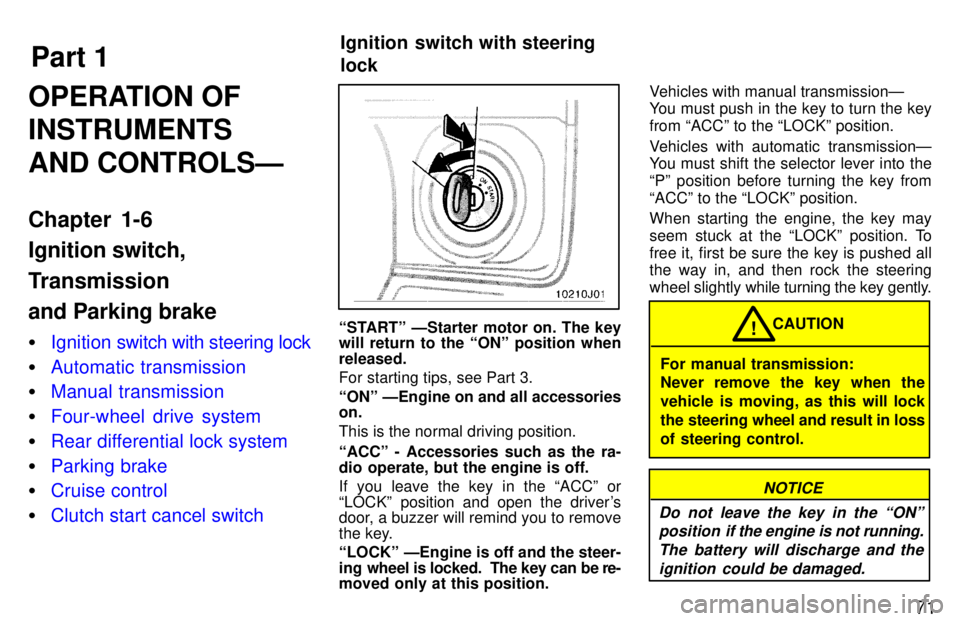
STARTº ÐStarter motor on. The key will return to the ONº position when released.
For starting tips, see Part 3.
ONº ÐEngine on and all accessories on.
This is the normal driving position. ACCº - Accessories such as the ra-
dio operate, but the engine is off.
If you leave the key in the ACCº or
LOCKº position and open the driver's
door, a buzzer will remind you to remove
the key.
LOCKº ÐEngine is off and the steer-
ing wheel is locked. The key can be re-
moved only at this position. Vehicles with manual transmissionÐ
You must push in the key to turn the key from ACCº to the LOCKº position.
Vehicles with automatic transmissionÐ
You must shift the selector lever into the
Pº position before turning the key from
ACCº to the LOCKº position. When starting the engine, the key may
seem stuck at the LOCKº position. To
free it, first be sure the key is pushed all
the way in, and then rock the steering
wheel slightly
while turning the key gently.
For manual transmission:
Never remove the key when the
vehicle is moving, as this will lock
the steering wheel and result in loss
of steering control. CAUTION
!
NOTICE
Do not leave the key in the ONº position if the engine is not running.
The battery will discharge and the ignition could be damaged.