Page 159 of 223
162If the engine will not start, your engine
may be flooded because of repeated cranking.
If this happens, turn the key to STARTº with the accelerator pedal held down.
Keep
the key and accelerator pedal so for
15 seconds and release them. Then try
starting the engine with your foot off the accelerator pedal.
If the engine does not start after 15 sec-
onds of cranking, release the key, wait a few minutes and try again.
If the engine still will not start, it needs ad-
justment or repair. Call a Toyota dealer or
qualified repair shop for assistance.
NOTICE
Do not crank for more than 30 sec- onds at a time. This may overheat
the starter and wiring systems.
To avoid serious personal injury and
damage to your vehicle which might
result from battery explosion, acid
burns, electrical burns, or damaged
electronic components, these instruc-
tions must be followed precisely.
If you are unsure about how to follow this procedure, we strongly recommend that you seek the help of a competent me-
chanic or towing service.
Batteries contain sulfuric acid
which is poisonous and corrosive.
Wear protective safety glasses
when jump starting, and avoid
spilling acid on your skin, cloth-
ing, or vehicle.
If you should accidentally get acid
on yourself or in you eyes, remove
any contaminated clothing and
flush the affected area with water
immediately. Then get immediate
medical attention. If possible, con-
tinue to apply water with a sponge
or cloth while en route to the medi- cal office. CAUTION
!
The gas normally produced by a battery will explode if a flame or
spark is brought near. Use only
standardized jumper cables and
do not smoke or light a match
while jump starting.
NOTICE
The battery used for boosting must be 12 V. Do not jump start unless
you are sure that the booster batteryis correct.
(b) Starting a flooded engine (c) Jump starting
Page 160 of 223

163
JUMP STARTING PROCEDURE
1. If the booster battery is installed in
another vehicle, make sure the ve-
hicles are not touching. T urn off all un-
necessary lights and accessories.
2. If required, remove all the vent plugs from the booster and discharged bat-
teries. Lay a cloth over the open vents
on the batteries. (This helps reduce
the explosion hazard, personal injuries
and burns.)
3. If the engine in the vehicle with the booster battery is not running, start it
and let it run for a few minutes. During
jump starting, run the engine at about
2000 rpm with the accelerator pedal
lightly depressed.
4. Make the cable connection in the ordera, b, c, d.
a. Connect the clamp of the positive (red) jumper cable to the positive (+)
terminal on the discharged battery.
b. Connect the clamp at the other
end of the positive (red) jumper cable
to the positive (+) terminal on the
booster battery.c. Connect the clamp of the negative
(black) cable to the negative (-) termi-
nal on the booster battery.
d. Connect the clamp at the other
end of the negative (black) jumper
cable to a solid, stationary,
un-painted, metallic point of the ve-
hicle with the discharged battery.
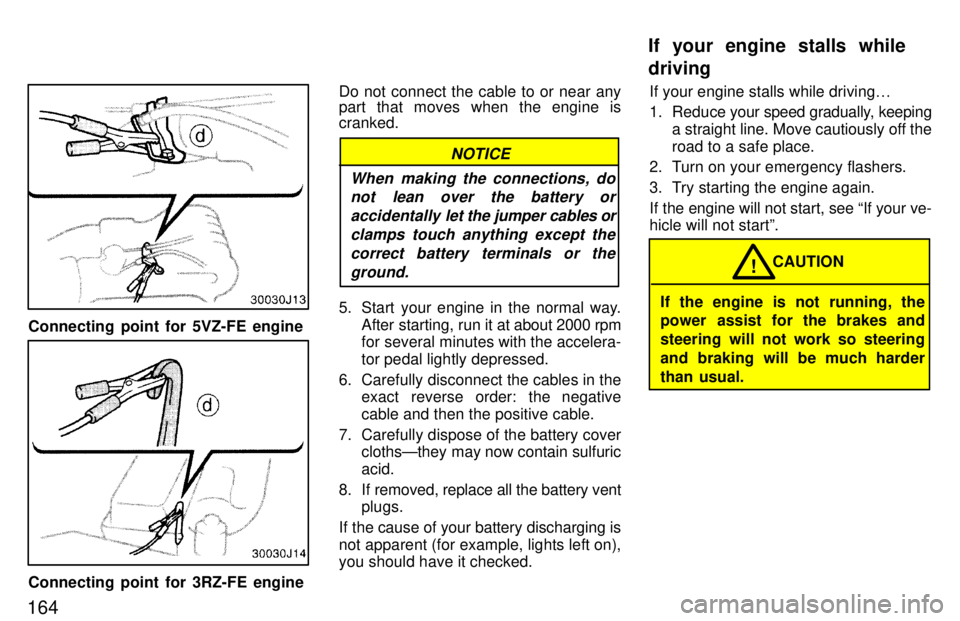
The recommended connecting points are
shown in the following illustration:
Page 161 of 223
164
Connecting point for 5VZ-FE engine
Connecting point for 3RZ-FE engineDo not connect the cable to or near any
part that moves when the engine is cranked.
NOTICE
When making the connections, do not lean over the battery or
accidentally let the jumper cables or
clamps touch anything except the correct battery terminals or the ground.
5. Start your engine in the normal way. After starting, run it at about 2000 rpm
for several minutes with the accelera- tor pedal lightly depressed.
6. Carefully disconnect the cables in the exact reverse order: the negative
cable and then the positive cable.
7. Carefully dispose of the battery cover clothsÐthey may now contain sulfuricacid.
8. If removed, replace all the battery vent plugs.
If the cause of your battery discharging is
not apparent (for example, lights left on), you should have it checked. If your engine stalls while driving
0
1. Reduce your speed gradually, keeping
a straight line. Move cautiously off the
road to a safe place.
2. Turn on your emergency flashers.
3. Try starting the engine again.
If the engine will not start, see If your ve-
hicle will not startº.If the engine is not running, the
power assist for the brakes and
steering will not work so steering
and braking will be much harder
than usual. CAUTION
!
If your engine stalls while driving
Page 164 of 223
167
Turn the jack joint by hand.
To remove: Turn the joint in direction 1 un- til the jack is free.
To store: Turn the joint in direction 2 until the jack is firmly secured to prevent it fly-
ing forward during a collision or suddenbraking.To remove the spare tire:
1. Insert the end of the jack handle intothe lowering screw and turn it counter- clockwise.
2. After the tire is lowered completely to the ground, remove the holding brack-et.
When storing the spare tire, put it in placewith the outer side of the wheel facing up.Then secure the tire taking care that the
tire goes straight up without catching on
any other part, to prevent it from flying for-ward during a collision or sudden braking.2. Block the wheel diagnoally oppo- site the flat tire to keep the vehicle from rolling when it is jacked up.
When blocking the wheel, place a wheel
block from the front for the front wheels or
from the rear for the rear wheels.
ÐBlocking the wheel
Page 165 of 223
168
Steel wheels
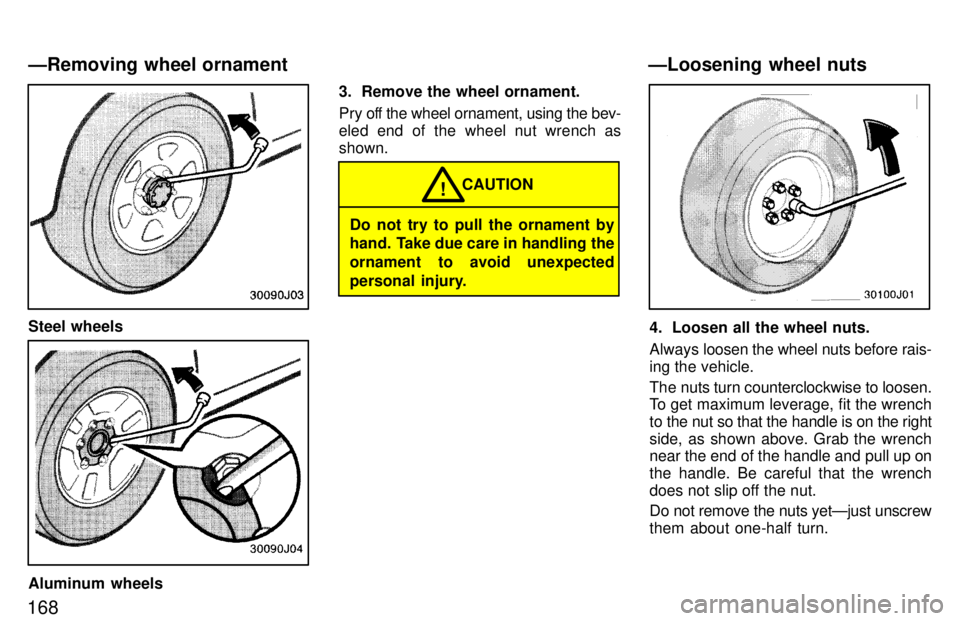
Aluminum wheels3. Remove the wheel ornament.
Pry off the wheel ornament, using the bev-
eled end of the wheel nut wrench asshown.
Do not try to pull the ornament by
hand. Take due care in handling the
ornament to avoid unexpected
personal injury.
CAUTION
!
4. Loosen all the wheel nuts. Always l
oosen the wheel nuts before rais-
ing the vehicle.
The nuts turn counterclockwise to loosen.
To get maximum leverage, fit the wrench
to the nut so that the handle is on the right
side, as shown above. Grab the wrench
near the end of the handle and pull up on
the handle. Be careful that the wrench
does not slip off the nut.
Do not remove the nuts yetÐjust unscrew
them about one-half turn.
ÐRemoving wheel ornament
ÐLoosening wheel nuts
Page 166 of 223
169
5. Position the jack at the correct jack
points as shown
Make sure the jack is positioned on a level
and solid place.6. After making sure that no one is in
the vehicle, raise it high enough so
that the spare tire can be installed.
Remember you will need more ground
clearance when putting in the spare tire than when removing the flat tire.
To raise the vehicle, insert the jack handle
extension in to the jack (it is a loose fit) and
turn it clockwise with the handle, makingsure the handle remains firmly fitted onto
the jack handle extension. As the jack touches the vehicle and begins to lift,
double-check that it is properly posi-tioned.
Never get under the vehicle when it is supported by the jack alone. CAUTION
!
ÐPositioning the jack ÐRaising your vehicle
Page 168 of 223
171
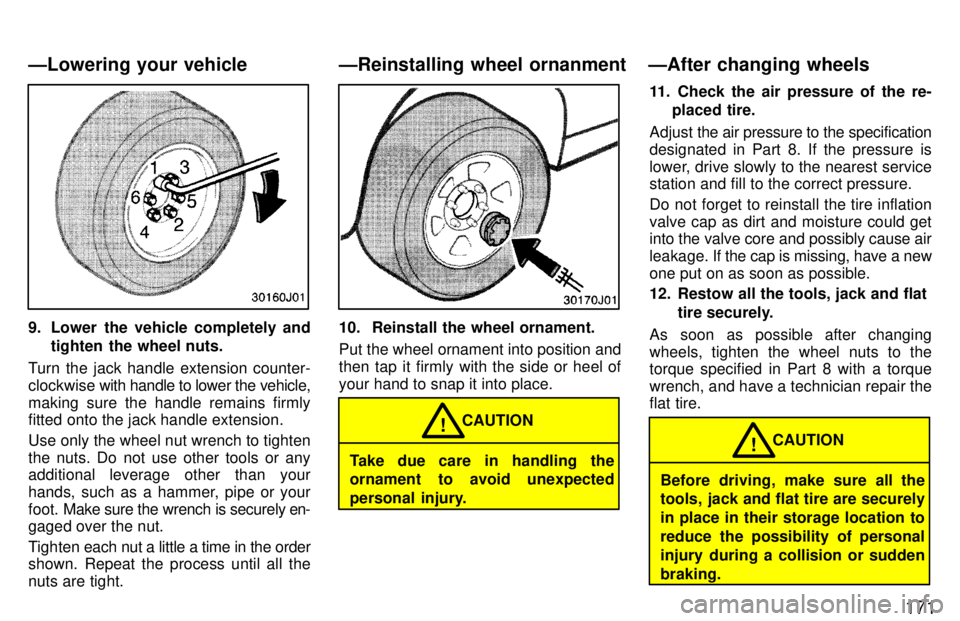
9. Lower the vehicle completely andtighten the wheel nuts.
Turn the jack handle extension counter-
clockwise with handle to lower the vehicle,
making sure the handle remains firmly
fitted onto the jack handle extension. Use only the wheel nut wrench to tighten the nuts. Do not use other tools or any
additional leverage other than your
hands, such as a hammer, pipe or your
foot. Make sure the wrench is securely en-
gaged over the nut.
Tighten each nut a little a time in the order
shown. Repeat the process until all the
nuts are tight.10. Reinstall the wheel ornament.
Put the wheel ornament into position and
then tap it firmly with the side or heel ofyour hand to snap it into place.
Take due care in handling the
ornament to avoid unexpected
personal injury. CAUTION
! 11. Check the air pressure of the re-
placed tire.
Adjust the air pressure to the specification
designated in Part 8. If the pressure is
lower, drive slowly to the nearest service station and fill to the correct pressure.
Do not forget to reinstall the tire inflation valve cap as dirt and moisture could get into the valve core and possibly cause air
leakage. If the cap is missing, have a new
one put on as soon as possible.
12. Restow all the tools, jack and flat
tire securely.
As soon as possible after changing
wheels, tighten the wheel nuts to the torque specified in Part 8 with a torque wrench, and have a technician repair the flat tire.
Before driving, make sure all the
tools, jack and flat tire are securely in place in their storage location to
reduce the possibility of personal
injury during a collision or suddenbraking. CAUTION
!
ÐLowering your vehicle ÐReinstalling wheel ornanment ÐAfter changing wheels
Page 169 of 223
172
Two-wheel drive modelsFour-wheel drive modelsIf towing is necessary, we recommend
you to have it done by your Toyota
dealer or a commercial tow truck ser-
vice. In consultation with them, have
your vehicle towed using either (a) or(b).
Only when you cannot receive a tow-
ing service from a Toyota dealer or
commercial tow truck service, tow
your vehicle carefully in accordance
with the instructions given in
ÐEmergency towingº in this part. Proper equipment will help ensure that your vehicle is not damaged while being
towed. Commercial operators are gener-
ally
aware of the state/provincial and local
laws pertaining to towing.
Your vehicle can be damaged if it is towed
incorrectly. Although most operators know the correct procedure, it is possible
to make a mistake. To avoid damage to your vehicle, make sure the following few
precautions are observed. If necessary,
show this page to the tow truck driver.
If your vehicle needs to be towedÐ