Page 259 of 371
What to Add
When you do need brake fluid, use only DOT-3 brake
fluid
-- such as Delco Supreme 11 @ (GM Part
No. 12377967). Use new brake fluid from a sealed
container only.
Always clean the brake fluid reservoir cap and the area around the cap before removing it. This will help keep
dirt from entering the reservoir.
/d CAUTION:
With the wrong kind of fluid in your brake
system, your brakes may not work well, or they
may not even work
at all. This could cause a
crash. Always use the proper brake fluid.
NOTICE:
Using the wrong fluid can badly damage
brake system parts. For example, just
a few
drops
of mineral-based oil, such as engine
oil, in your brake system can damage brake
system parts
so badly that they’ll have to be
replaced. Don’t let someone put in the
wrong kind of fluid.
If you spill brake fluid on your vehicle’s
painted surfaces, the paint finish can be
damaged. Be careful not to spill brake fluid
on your vehicle.
If you do, wash it off
immediately. See “Appearance Care’’ in
the Index.
6-32
Page 260 of 371
Brake Wear
Your Pontiac has front disc brakes and rear drum brakes.
Disc brake pads have built-in wear indicators that make a high-pitched warning sound when the brake pads are worn
and new pads are needed. The
sound may come and go or
be heard all the time your vehicle is moving (except when
you are pushing on the brake pedal
firmly).
The brake wear warning sound means that soon
your brakes won’t work well. That could lead to
an accident. When you hear the brake wear
warning sound, have your vehicle serviced.
I NOTICE:
Continuing to drive with worn-out brake pads
could result in costly brake repair.
Some driving conditions or climates may cause a brake
squeal when the brakes are first applied or lightly
applied. This does not mean something is wrong with
your brakes.
See “Caliper/Knuckle Maintenance Inspection” in
Section
7 of this manual under Part C “Periodic
Maintenance Inspections.”
Properly torqued wheel nuts are necessary to help
prevent brake pulsation. When tires
are rotated, inspect
brake pads for wear and evenly torque wheel nuts in the
proper sequence to
GM specifications.
Your rear drum brakes don’t have wear indicators, but if
you ever hear a rear brake rubbing noise, have the rear
brake linings inspected. Also, the rear brake drums
should be removed and inspected each time the tires are
removed for rotation or changing. When you have the
front brake pads replaced, have the rear brakes
inspected, too.
Brake linings should always be replaced as complete
axle sets.
See “Brake System Inspection” in Section
7 of this
manual under Part C “Periodic Maintenance
Inspections”.
6-33
Page 261 of 371
Brake Pedal Travel
See your dealer if the brake pedal does not return to
normal height, or if there is a rapid increase in pedal
travel. This could be a sign of brake trouble.
Brake Adjustment
Every time you make a moderate brake stop, your disc
brakes adjust for wear.
If you rarely make a moderate or
heavier stop, then your brakes might not adjust correctly.
If you drive in that way, then -- very carefully -- make a
few moderate brake stops about every
1,000 miles
(1 600 km), so your brakes will adjust properly.
If your brake pedal goes down farther than normal, your
rear drum brakes may need adjustment. Adjust them by
backing up and firmly applying the brakes a few times.
Replacing Brake System Parts
The braking system on a modern vehicle is complex. Its
many parts have to be of top quality and work well
together
if the vehicle is to have really good braking.
Your vehicle was designed and tested with top-quality
GM brake parts. When you replace parts of your braking
system
-- for example, when your brake linings wear
down and you have to have new ones put in
-- be sure
you get new approved
GM replacement parts. If you
don’t, your brakes may no longer work properly. For
example, if someone puts in brake linings that are
wrong for your vehicle, the balance between your front
and rear brakes can change
-- for the worse. The
braking performance you’ve come to expect can change
in many other ways if someone puts in the wrong
replacement brake parts.
Battery
Every new Pontiac has a Delco Freedom’ battery. You
never have to add water to one
of these. When it’s time
for a new battery, we recommend a Delco Freedom
battery. Get one that has the replacement number shown
on the original battery’s label.
Vehicle Storage
If you’re not going to drive your vehicle for 25 days or
more, take off the black, negative
(-) cable from the
battery. This will help keep your battery from
running down.
6-34
Page 288 of 371

Fuse
INT LPS
PWR ST
RDO IGN HTR-A/C
CRUISE
TAIL LPS
LTR WIPER
02
DR UNLK
Usage
Alarm Module (Illuminated Entry,
Warning Chimes, Overhead
Lamps, Map/Reading Lamps,
Glove Box Lamp, Trunk Lamp,
Radio, Power Mirrors), Anti-Lock
Brakes, Variable Effort Steering
Power Seat
Radio Heater/Air Conditioning Blower.
Daytime Running Lamps,
Automatic Light Control
Cruise Control
Parking Lamps, Taillamps
,
Sidemarker Lamps, License
Lamps, Instrument Panel Lights,
Headlamp Warning Alarm
Cigarette Lighter
Windshield Wipers/Washers Heated Oxygen Sensors
Automatic Door Unlock
Fuse
ALARM
FOG/FTP
PRNDL
DR LK
2
AIR BAG
HORN
INST STOP HAZ
PCM
DR LK
1
INST LPS
RR DEF HDLP
Usage
Automatic Transaxle, Automatic
Door Unlock, Alann Module
(Illuminated Entry, Warning
Chimes), Traction Telltale, Rear
Window Defogger, Remote
Keyless Entry
Fog Lamps
Instrument Cluster, Powertrain
Computer, Park-Lock Solenoid.
Electronic PRNDL
Door Locks
Air Bag-Power
Horn, Service Tool Power
Instrument Cluster Stoplamps, Hazard Lamps,
Anti-Lock Brakes
Powertrain Control Module
Door Locks, Remote Keyless Entry
Instrument Panel Lights,
Fog Lamps
Rear Window Defogger
Headlamps, Daytime Running
Lamps (Circuit Breaker)
6-61
Page 289 of 371
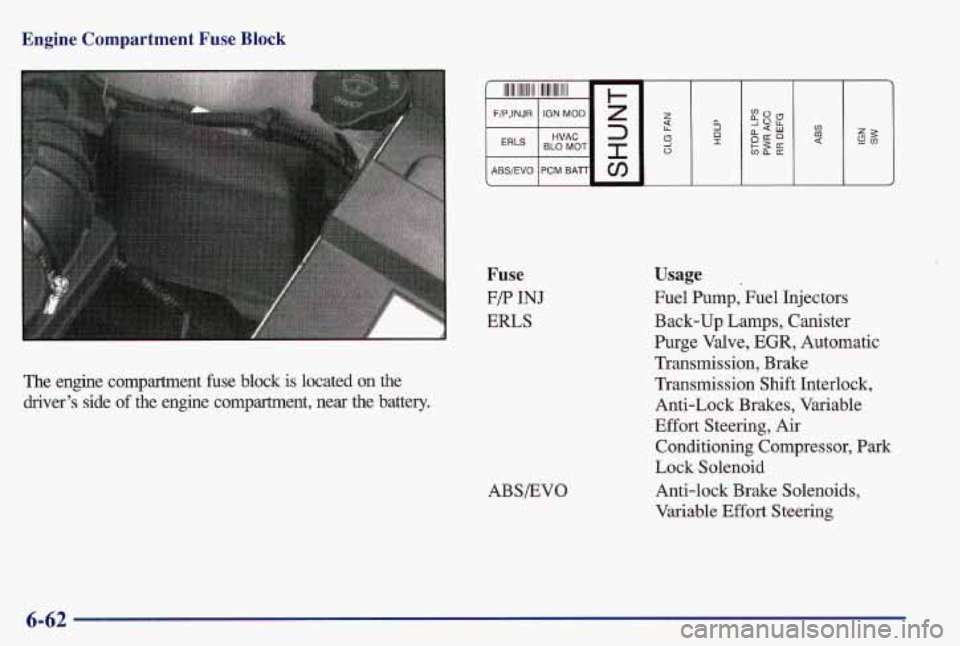
Engine Compartment Fuse Block
F/P,INJR I IGN MOD 1 L b1
ABSiEVO PCM BATT I
Fuse
F/P INJ
ERLS
The engine compartment fuse block
is located on the
driver’s side
of the engine compartment, near the battery.
ABSEVO
Usage
Fuel Pump, Fuel Injectors Back-up Lamps, Canister
Purge Valve, EGR, Automatic
Transmission, Brake
Transmission Shift Interlock,
Anti-Lock Brakes, Variable
Effort Steering, Air Conditioning Compressor, Park
Lock Solenoid
Anti-lock Brake Solenoids,
Variable Effort Steering
6-62
Page 290 of 371
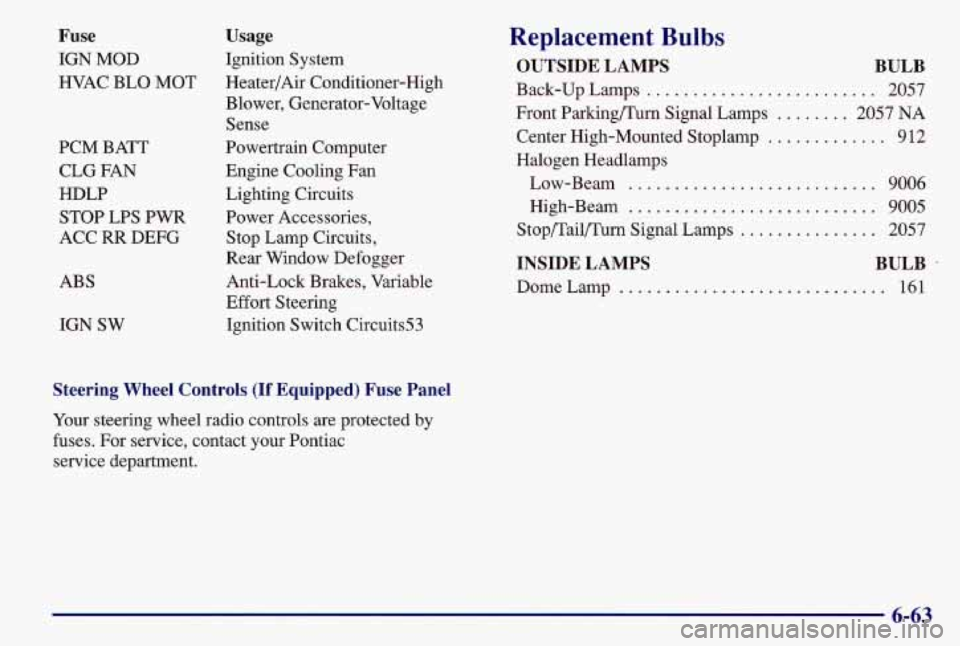
Fuse
IGN MOD
HVAC BLO
MOT
PCM BATT
CLG FAN
HDLP
STOP LPS PWR
ACC
RR DEFG
ABS
IGN
SW
Usage
Ignition System
Heater/Air Conditioner-High
Blower, Generator-Voltage Sense
Powertrain Computer
Engine Cooling Fan
Lighting Circuits
Power Accessories, Stop Lamp Circuits,
Rear Window Defogger
Anti-Lock Brakes, Variable
Effort Steering
Ignition Switch Circuits53
Steering Wheel Controls (If Equipped) Fuse Panel
Your steering wheel radio controls are protected by
fuses.
For service, contact your Pontiac
service department.
Replacement Bulbs
OUTSIDE LAMPS BULB
Back-up Lamps ......................... 2057
Front Parkingnurn Signal Lamps
........ 2057 NA
Center High-Mounted Stoplamp
... ... 912
Halogen Headlamps
Low-Beam
....... ,.. ........... 9006
High-Beam
........................... 9005
Stop/Tail/Turn Signal Lamps
............. 2057
INSIDE LAMPS
Dome Lamp .... .........
BULB
. 161
6-63
Page 300 of 371
Short TriplCity Maintenance Schedule
The services shown in this schedule up to 100,000 miles
(166 000 km) should be performed after 100,000 miles
(166 000 km) at the same intervals. The services shown
at
150,000 miles (240 000 krn) should be performed at
the same interval after
150,000 miles (240 000 km).
See “Owner’s Checks and Services” and “Periodic
Maintenance Inspections’’ following.
Footnotes
The U.S. Environmental Protection Agency or the
California
Air Resources Board has determined that the
failure to perform this maintenance item will not nullify
the emission warranty or limit recall liability prior to the
completion of the vehicle’s useful life. We, however,
urge that all recommended maintenance services be
performed at the indicated intervals and the maintenance
be recorded.
# Lubricate the suspension and steering linkage.
+ A good time to check your brakes is during tire
rotation. See “Brake System Inspection” under “Periodic Maintenance Inspection’’ in Part
C of
this schedule.
++ If you drive in a highly corrosive environment,
your brake calipers may require additional inspection
and service, at every other tire rotation. See
“Caliper/Knuckle Maintenance Inspection” under
“Periodic Maintenance Inspections” in
Part C of
this schedule.
7-7
Page 322 of 371
The services shown in this schedule up to 100,000 miles
(166
000 km) should be performed after 100,000 miles
(166
000 km) at the same intervals. The services shown
at 150,000 miles
(240 000 km) should be performed at
the same interval after
150,000 miles (240 000 km).
See “Owner’s Checks and Services” and “Periodic
Maintenance Inspections” following.
Footnotes
The U.S. Environmental Protection Agency or the
California Air Resources Board has determined that the
failure to perform this maintenance item will not nullify
the emission warranty or limit recall liability prior to the
completion of the vehicle’s useful life. We, however,
urge that all recommended maintenance services be
performed at the indicated intervals and the maintenance
be recorded.
# Lubricate the suspension and steering linkage.
+ A good time to check your brakes is during tire
rotation. See “Brake System Inspection” under “Periodic Maintenance Inspections” in
Part C of
this schedule.
++ If you drive in a highly corrosive environment,
your brake calipers may require additional
inspection and service, at every other tire rotation.
See “Caliper/Knuckle Maintenance Inspection”
under “Periodic Maintenance Inspections” in Part C
of this schedule.
7-29