1997 PONTIAC BONNEVILLE zone
[x] Cancel search: zonePage 119 of 405
Battery Light Voltmeter
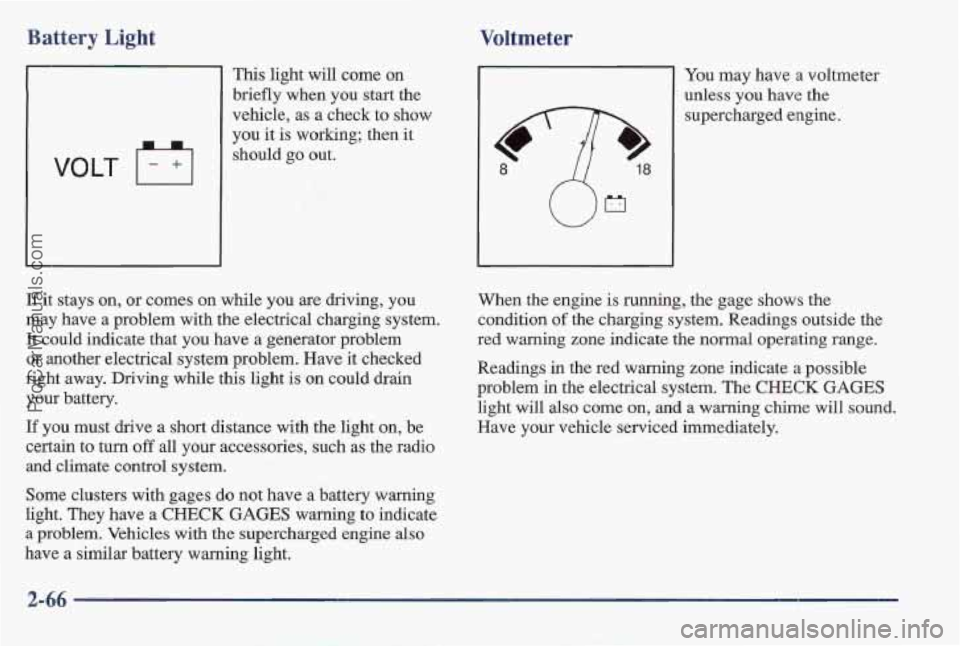
VOLT
This light will come on
briefly when you start the
vehicle, as a check to show
you it is working; then it
should go out.
You may have a voltmeter
unless you have the
supercharged engine.
If it stays on, OF comes on while you are driving, you
may have a problem with the electrical charging system.
It could indicate that you have a generator problem
or another electrical system problem. Have it checked
right away. Driving while this light is
on could drain
your battery.
If you must drive a short distance with the light on, be
certain to turn
off all your accessories, such as the radio
and climate control system.
Some clusters with gages do not have a battery warning
light. They have a
CHECK GAGES warning to indi'cate
a problem. Vehicles with th'e supercharged engine also
have
a simil'ar battery warning light. When the engine
is running, the
gage shows the
condition
of the charging system. Readings outside the
red warning zone indicate the normal operating range.
geadings
in the red warning zone Indicate a possible
problem
in the electrical system. The CHECK GAGES
light will also come on, and a warning chime will sound.
Have your vehicle serviced immediately.
2-66
ProCarManuals.com
Page 126 of 405
Oil Pressure Gage
0
h
120
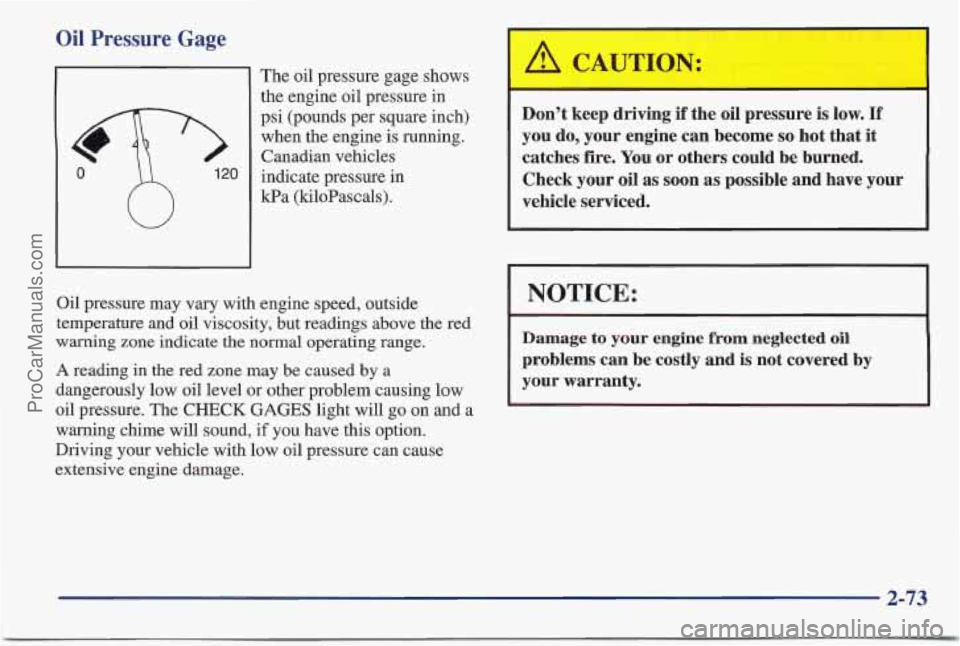
The oil pressure gage shows
the engine oil pressure in
psi (pounds per square inch)
when the engine is running.
Canadian vehicles
indicate pressure in
kPa (kiloPascals).
Oil pressure may vary with engine speed, outside
temperature and oil viscosity, but readings above the red
warning zone indicate
the normal operating range.
A reading in the red zone may be caused by a
dangerously low oil level or other problem causing low
oil pressure. The
CHECK GAGES light will go on and a
warning chime will sound, if you have this option.
Driving your vehicle with low oil pressure can cause
extensive engine damage.
A CAUTION:
Don’t keep driving if the oil pressure is low. If
you do, your engine can become so hot that it
catches fire. You
or others could be burned.
Check your oil as
soon ass possible and have your
vehicle serviced.
I NOTICE:
~~~ ~~ ~~
Damage to your engine from neglected oil
problems can be costly and is not covered by
your warranty.
1
2-73
ProCarManuals.com
Page 135 of 405
Electronic Compass (Option)
N‘
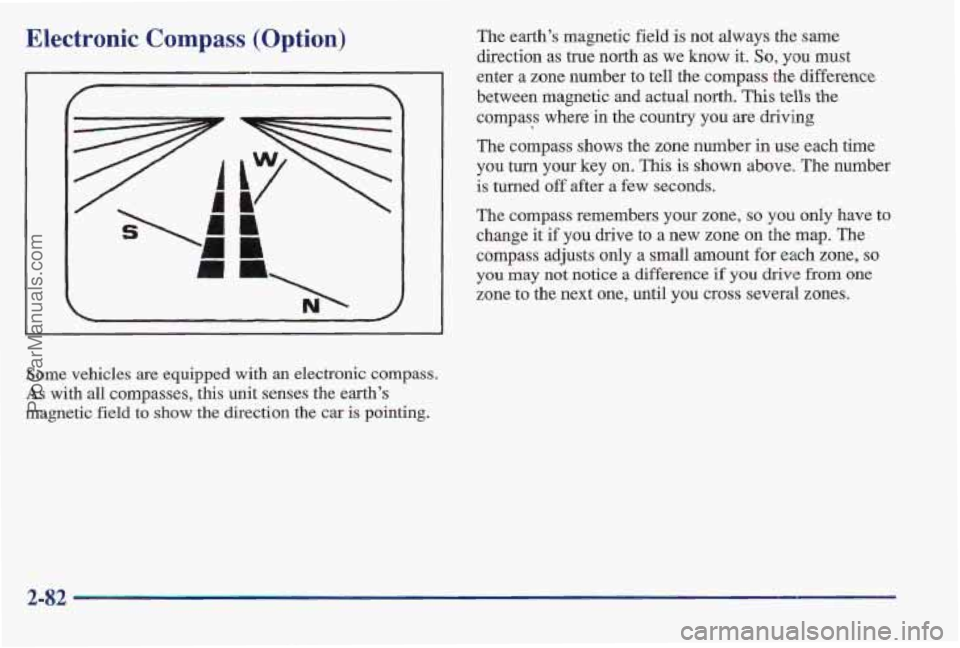
Some vehicles are equipped with an electronic compass.
As with all compasses, this unit senses the earth’s
magnetic
field to show the direction the car is pointing. The
earth’s magnetic field
is not always the same
direction as true north
as we know it. So, you must
enter
a zone number to tell the compass the difference
between magnetic and actual north.
This tells the
compass where in the country you are driving
The compass shows the zone number in use each time
you turn your key on. This is shown above. The number
is turned
off after a few seconds.
The compass remembers your zone,
so you only have to
change it if you drive to a new zone on the map. The
compass adjusts only a small amount for
each zone, so
you may not notice a difference if you drive from one
zone to the next one, until you cross several zones.
2-82
ProCarManuals.com
Page 136 of 405
Choosing Your Zone Number Changing
Your Zone Number
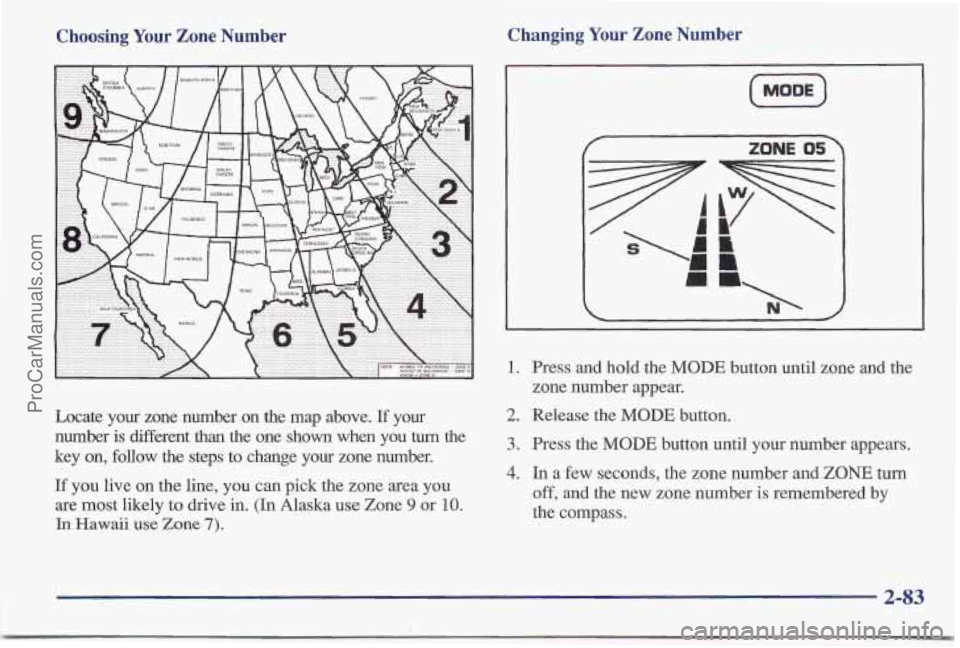
Locate your zone number on the map above. If your
number is different than the one shown when you
turn the
key on, follow
the steps to change your zone number.
If you live on the line, you can pick the zone area you
are most likely to drive in. (In Alaska use Zone
9 or 10.
In Hawaii use Zone 7).
r ZONE 05'
1.
2.
3.
4.
Press and hold the MODE button until zone and the
zone number appear.
Release the MODE button.
Press the MODE button until your number appears.
In a few seconds, the zone number and
ZONE turn
off, and the new zone number is remembered by
the compass.
2-83
ProCarManuals.com
Page 143 of 405
Comfort Controls
This section tells you how to make your air system
work for
you. Your comfort control system uses
ozone-friendly
R- 134a refrigerant.
With these systems, you can control the heating, cooling
and ventilation
in your Pontiac. Your vehicle also has a
flow-through ventilation system described later in
this section.
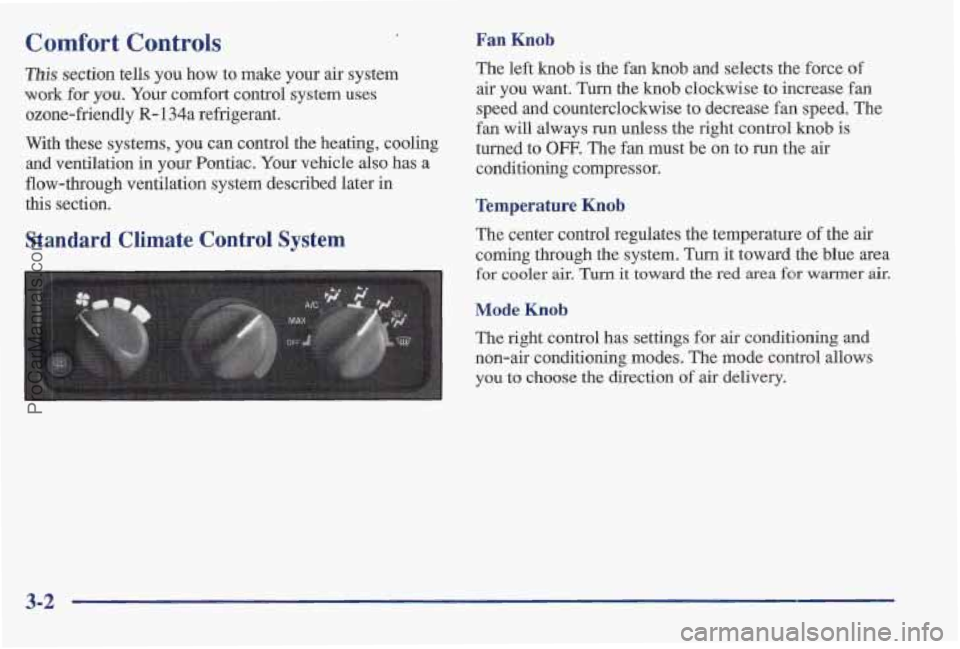
Standard Climate Control System
Fan Knob
The left knob is the fan knob and selects the force of
air you want. Turn the knob clockwise to increase fan
speed
and counterclockwise to decrease fan speed. The
fan will always
run unless the right control knob is
turned to
OFF. The fan must b'e on to run the air
conditioning compressor.
Temperature Knob
The center control regulates the temperature of the air
coming through the system. Turn it toward the blue area
for cooler air. Turn it toward the red area for warmer air.
Mode Knob
The right control has settings for air conditioning and
non-air conditioning modes. The mode control allows
you to choose
the direction of air delivery.
3-2
ProCarManuals.com
Page 145 of 405
Tempmerature Button
The TEMP button changes the temperature of the air
coming
through the system. Press the up arrow for
warmer air-and the down arrow for cooler air.
Mode Button
Press this button to deliver air through the floor, middle
or windshiel'd outlets. The system will stay in the
selected mode until the
MODE or AUTO button is
pushed. Press the up arrow to cycle through the
available modes.
Automatic Operation
When the system is set for AUTO, sensors will control
the air delivery mode. Air will come from the floor,
middle and windshield outlets. The fan speed will vary
as the system maintains the selected temperature setting.
To find your comfort zone, start with 75 O F (24" C)
temperature setting and allow about 20 minutes for the
system to regulate. Press the TEMP button up or down
to adjust the temperature setting if necessary. If you
choose the temperature setting of 60°F (15 O C), the
system
will remain at that maximum cooling setting
and will not regulate the fan speed.
If you choose the
temperature setting
of 90°F (33 "C), the system will remain at that maximum heating setting and will not
regulate the
fan speed. Choosing either maximum
setting will not cause the system to heat or cool
any faster.
Pressing the
AUTO button will display the requested
temperature, fan speed and
air delivery mode for five
seconds, then change to display the outside air
temperature. Be careful not
to put anything over the
sensor located in the middle of the instrument panel near
the windshield, or over the sensor in the grille above the
radio. These sensors are used by the automatic system to
regulate temperature.
The exterior temperature display sensor is in front
of the
car, near the radiator. This displayed temperature is most
accurate when the vehicle is moving. During
stops, or
while idling, the display shows the previous dsaving
temperature
for best system control.
To avoid blowing cold air in cold weather, the system
will delay turning on the fan until warm air
is available.
The length
of delay depends on outside air temperature,
engine coolant temperature,
and time since the engine
was last started. Pushing the fan button will override this
delay and change the fan to a selected single speed.
If you leave your vehicle, the system will remember the
control setting the next time you start your engine.
3-4
ProCarManuals.com
Page 198 of 405
If you drive regularly in steep country, or if you’re
planning to visit there, here are some tips that can make
your trips safer and more enjoyable.
Keep your vehicle in good shape. Check all fluid
levels and also the brakes, tires, cooling system
and transaxle. These parts can work hard on
mountain roads.
Know how to go down hills. The most important
thing to
know is this: let your engine do some of the
slowing down. Shift to a lower gear when you go
down a steep or long hill.
If you don’t shift down, your brakes could get so
hot that they wouldn’t work well. You would then
have poor braking or even none going down
a hill.
‘You could crash. Shift down to let your engine
assist your brakes on
a steep downhill slope. Coasting
downhill in NEUTRAL (N)
or with the
ignition
off is dangerous. Your brakes will have to
do all the
work of slowing down. They could get so
hot that they wouldn’t work well. You would then
have poor braking
or even none going down a hill.
You could crash. Always have your engine running
and your vehicle in gear when you go downhill.
Know how to go uphill. Drive in the highest
Stay in your own lane when driving on two-lane
gear possible.
roads in hills or mountains.
Don’t swing wide or cut
across the center
of the road. Drive at speeds that let
you stay in your own lane.
As you go over the top of a hill, be alert. There could be
something
in your lane, like a stalled car or an accident.
You may see highway signs on mountains that warn of
special problems. Examples are long grades, passing or
no-passing zones, a
falling rocks area or winding
roads. Be
alert to these and take appropriate action.
4-25
- ProCarManuals.com