Page 126 of 405
Oil Pressure Gage
0
h
120
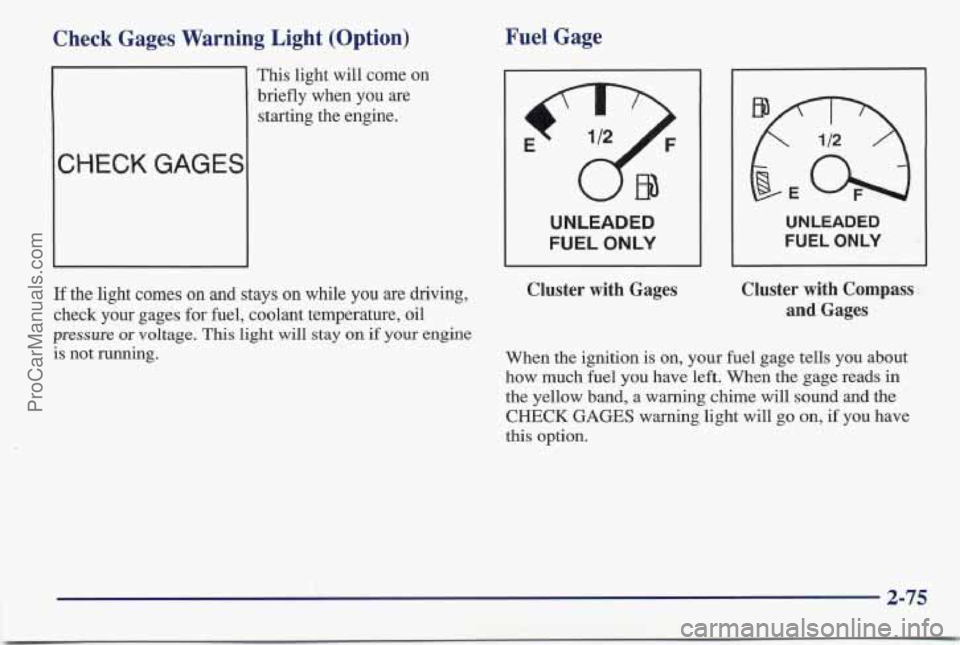
The oil pressure gage shows
the engine oil pressure in
psi (pounds per square inch)
when the engine is running.
Canadian vehicles
indicate pressure in
kPa (kiloPascals).
Oil pressure may vary with engine speed, outside
temperature and oil viscosity, but readings above the red
warning zone indicate
the normal operating range.
A reading in the red zone may be caused by a
dangerously low oil level or other problem causing low
oil pressure. The
CHECK GAGES light will go on and a
warning chime will sound, if you have this option.
Driving your vehicle with low oil pressure can cause
extensive engine damage.
A CAUTION:
Don’t keep driving if the oil pressure is low. If
you do, your engine can become so hot that it
catches fire. You
or others could be burned.
Check your oil as
soon ass possible and have your
vehicle serviced.
I NOTICE:
~~~ ~~ ~~
Damage to your engine from neglected oil
problems can be costly and is not covered by
your warranty.
1
2-73
ProCarManuals.com
Page 127 of 405
Check Oil Level Warning Light Low Washer Fluid Warning Light
CHECK OIL
LEVEL
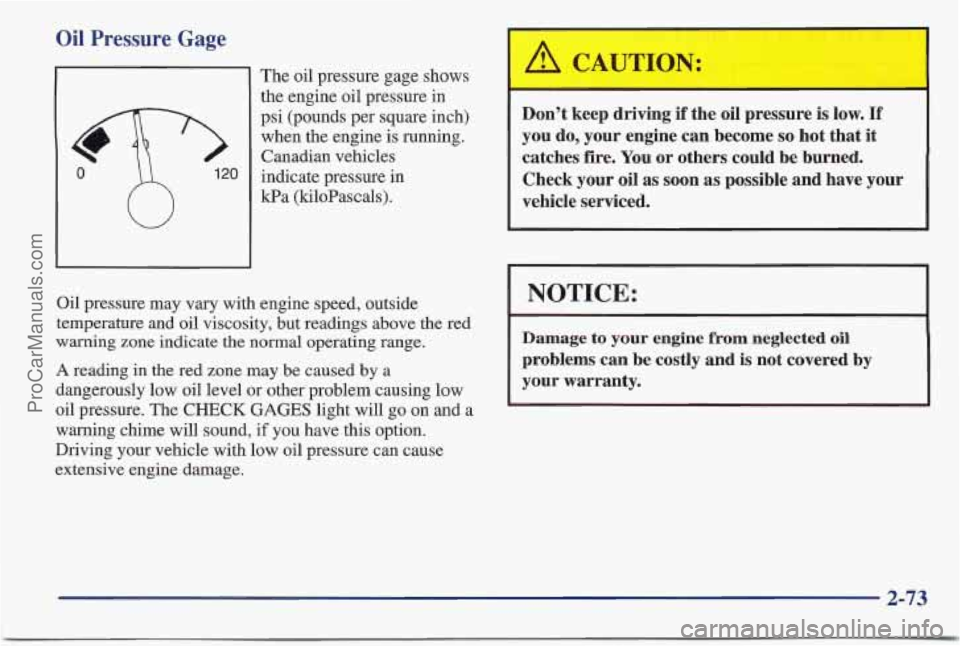
The CHECK OIL LEVEL
light
turns on for three
seconds as
a bulb check
each time the ignition key is
turned to the
RUN position.
If the light doesn’t turn on,
have your vehicle serviced.
If the engine oil is more than one quart (0.95 L) low and
the engine has been shut off for at least eight minutes,
the
CHECK OIL LEVEL light will turn on for about
one minute and will then remain
0: il the next time
you start the vehicle.
If the CHECK OIL LEVEL light turns on, the engine oil
level should be checked at the dipstick then brought up
to the proper level, if necessary. See “Engine Oil” in
the Index.
WASHER FLUID
This light will come on
when
your windshield
washers
are working and the
fluid container is less than
one-third full.
2-74 I-
ProCarManuals.com
Page 128 of 405
Check Gages Warning Light (Option)
1
This light will come on
briefly when you are
starting the engine.
CHECK GAGES
Fuel Gage
UNLEADED
FUEL
ONLY
UNLEADED
FUEL ONLY
If the light comes on and stays on while you are driving,
check your gages
for fuel, coolant temperature, oil
pressure or voltage. This light will stay on if your engine
is not running.
Cluster with Gages Cluster with Compass
and Gages
When
the ignition is on, your fuel gage tells you about
how much fuel you have
left. When the gage reads in
the yellow band, a warning chime will sound and the
CHECK
GAGES warning light will go on, if you have
this option.
2-75
ProCarManuals.com
Page 133 of 405
Driver Information Centerloption
CHECK OIL LEVEL
WASHER FLUID
Law COOLANT
CHECK PAOEB
HOOD DOOR
TRUNK AJAR
I
MONITOR
LAMP I HI BEAM HEAD
PARK LAMP
TURN SIQNAL
BACK UP TAIL
BRAKE LAMP
TRIP
8 8 8 8.8
3
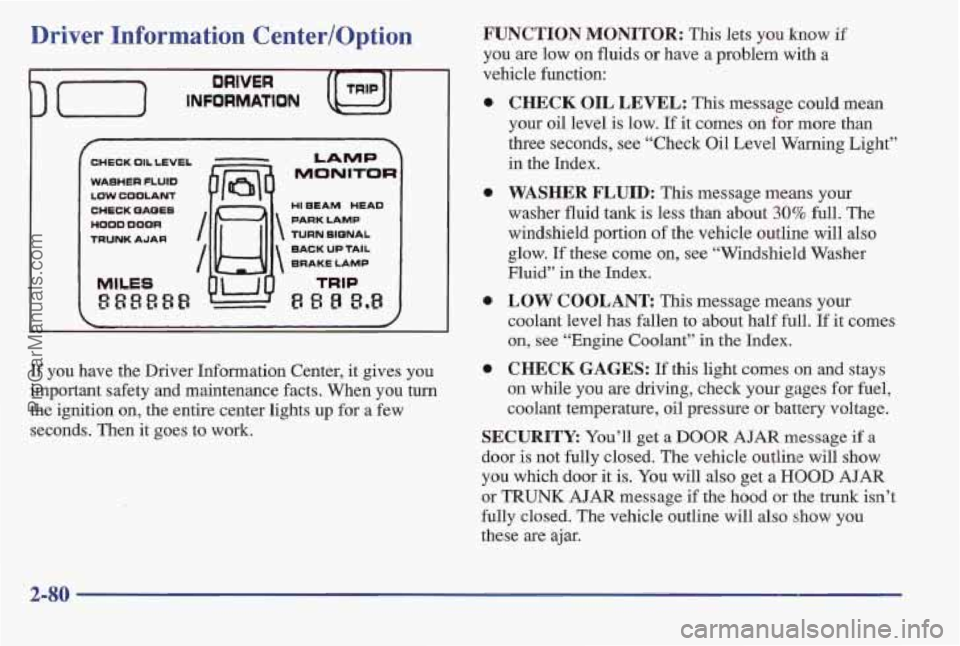
If you have the Driver Information Center, it gives you
important safety and maintenance facts. When you turn
the ignition on, the entire center lights up for a
few
seconds. Then it goes to work.
FUNCTION MONITOR: This lets you know if
you are low on fluids or have a problem with a
vehicle function:
a
a
CHECK OIL LEVEL: This message could mean
your oil level
is low. If it comes on for more than
three seconds, see “Check Oil Level Warning Light”
in the Index.
WASHER FLUID: This message means your
washer fluid tank is less than about 30% full. The
windshield portion
of the vehicle outline will also
glow. If these come on, see “Windshield Washer
Fluid”
in the Index.
LOW COOLANT This message means your
coolant level has fallen to about half full.
If it comes
on, see “Engine Coolant” in the Index.
CHECK GAGES: If this light comes on and stays
on while you are driving, check your gages for fuel,
coolant temperature, oil pressure or battery voltage.
SECURITY: You’ll get a DOOR AJAR message if a
door is not fully closled. The vehicle outline will show
you which door it is. You will also get a HOOD AJAR
or TRUNK AJAR message if the hood or the trunk isn’t
fully lclosed. The vehicle outline will also show you
these are ajar.
2-80
ProCarManuals.com
Page 169 of 405
Understanding Radio Reception
FM Stereo
FM stereo will give you the best sound. But mcl signals
will reach only about
10 to 40 miles (16 to 65 km). Tall
buildings
or hills can interfere with FM signals, causing
the sound
to come and go.
AM
The range for most AM stations is greater than for FM,
especially at night. The longer range, however, can
cause stations to interfere
with each other. AM can pick
up noise from things like storms and power lines. Try
reducing the treble to reduce this noise if
you ever get it.
Tips About Your Audio System
Hearing damage from loud noise is almost undetectable
until it is too late. Your hearing can adapt to higher
volumes of sound. Sound that
seems normal cin be loud
and harmful to your hearing. Take precautions by
adjusting the volume control on your radio to a safe
sound level before your hearing adapts to it.
To help avoid hearing loss or damage:
Adjust the volume control to the lowest setting.
Increase volume slowly until you hear comfortably
and clearly.
I NOTICE:
Before you add any sound equipment to your
vehicle
-- like a tape player, CB radio, mobile
telephone or two-way radio
-- be sure you can add
what you want. If you can, it’s very important to
do it properly. Added sound equipment may
interfere with the operation
of your vehicle’s
engine, Delco radio or other systems, and even
damage them. Your vehicle’s systems may
interfere with the operation
of sound equipment
that has been added improperly.
So, before adding sound equipment, check with
your dealer and be sure to check Federal rules
covering mobile radio and telephone unit,s.
3-28 J--
ProCarManuals.com
Page 180 of 405
Avoid needless heavy braking. Some people drive in
spurts
-- heavy acceleration followed by heavy
braking
-- rather than keeping pace with traffic. This is a
mistake. Your brakes may not have time to cool between
hard stops. Your brakes will wear out much faster
if you
do a lot of heavy braking.
If you keep pace with the
traffic and allow realistic following distances, you will
eliminate a lot of unnecessary braking. That means
better braking and longer brake life.
If your engine ever stops while you’re driving, brake
normally but don’t pump your brakes.
If you do, the
pedal may get harder to pus’h down.
If your engine
stops, you will still have some power brake assist. But
you will use
it when you brake. Once the power assist is
used up, it may take longer to stop and the brake pedal
will be harder to push.
Anti-Lock Brakes (ABS)
Your vehicle has anti-lock brakes (ABS). ABS is an
advanced electronic braking system that will help
prevent a braking skid.
When you start your engine, or when you begin to drive
away, your anti-lock brake system will check itself. You
may hear a momentary motor or clicking noise while
this test is going on, and you may even notice that
your
brake pedal moves a little. This is normal.
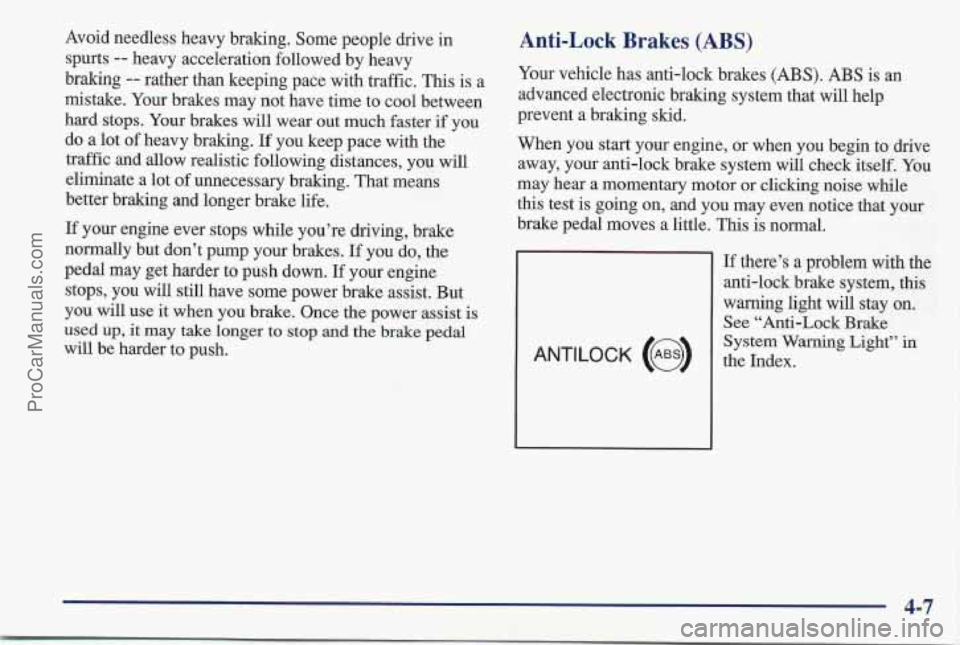
ANTILOCK (e)
If there’s a problem with the
anti-lock brake system, this
warning light will stay
on.
See “Anti-Lock Brake
System
Warning Light” in
the Index.
4-7
ProCarManuals.com
Page 196 of 405
The exit speed is usually posted.
Reduce your speed according to your speedometer, not
to your sense of motion. After driving for any distance
at higher speeds, you may tend to think you are going
slower than you actually are.
Before Leaving on a Long Trip
Make sure you’re ready. Try to be well rested. If you
must start when you’re not fresh
-- such as after a day’s
work
-- don’t plan to make too many miles that first part
of the journey. Wear comfortable clothing and shoes you
can easily drive in.
Is your vehicle ready for a long trip?
If you keep it
serviced and maintained, it’s ready to go.
If it needs
service, have
it done before starting out. Of course,
you’ll find experienced and able service experts
in
Pontiac dealerships all across North America. They’ll be
ready and willing
to help if you need it.
Here are some things you can check before a trip:
Windshield Washer Fluid: Is the reservoir full? Are
all windows clean inside and outside?
0 Wiper Blades: Are they in good shape?
Fuel, Engine Oil, Other Fluids: Have you checked
all levels?
Lamps: Are they all working? Are the lenses clean?
Tires: They are vitally important to a safe,
trouble-free trip.
Is the tread good enough for
long-distance driving? Are the tires all inflated to the
recommended pressure?
0 Weather Forecasts: What’s the weather outlook
along your route? Should you delay your trip a short
time to avoid a major storm system?
Maps: Do you have up-to-date maps?
4-23
ProCarManuals.com
Page 197 of 405

Highway Hypnosis
Is there actually such a condition as “highway hypnosis”?
Or is it just plain falling asleep at the wheel? Call it
highway hypnosis, lack
of awareness, or whatever.
There
is something about an easy stretch of road with
the same scenery, along with the hum
of the tires on the
road, the
drone of the engine, and the rush of the wind
against the vehicle that can make you sleepy. Don’t let it
happen
to you! If it does, your vehicle can leave the
road in less than a second, and you could crash and
be injured.
What
can you do about highway hypnosis? First, be
aware that it
can happen.
Then here are some tips:
Make sure your vehicle is well ventilated, with a
comfortably
cool interior.
rn Keep your eyes moving. Scan the road ahead and to
the sides. Check
your rearview mirrors and your
instruments frequently.
If you get sleepy, pull off the road into a rest, service
or parking area and take a nap, get some exercise, or
both, For safety, treat drowsiness on the highway as
an emergency.
Hill and Mountain Roads
Driving on steep hills or mountains is different from
driving in flat or rolling terrain.
4-24
ProCarManuals.com