1997 OLDSMOBILE SILHOUETTE change time
[x] Cancel search: change timePage 235 of 436

Remember: Anti-lock doesn’t change the time you need
to get your foot up to the brake pedal or always decrease
stopping distance.
If you get too close to the vehicle in
front of you, you won’t have time to apply your brakes
if that vehicle suddenly slows or stops. Always leave
enough room up ahead to stop, even though you have
anti-lock brakes.
Using Anti-Lock
Don’t pump the brakes. Just hold the brake pedal
down and let anti-lock work for you. You may feel the
system working, or you may notice some noise, but this
is normal.
LOW
TRACTION
If your vehicle has the
traction control system, this
light will come on when
your anti-lock system is
adjusting brake pressure to
help avoid a braking skid.
See “Low Traction Light”
in the Index.
Traction Control System (If Equipped)
Your vehicle may have a traction control system that
limits wheel spin. This is especially useful in slippery
road conditions. The system operates only if
it senses
that one or both of the front wheels are spinning or
beginning to lose traction. When this happens,
the
system works the front brakes and reduces engine power
to
limit wheel spin.
You may feel or hear the system worlung, but this
is normal.
If your vehicle is in cruise control when the traction
control system begins to limit wheel spin, the cruise
control will automatically disengage. When road
conditions allow you to safely use
it again, you may
re-engage the cruise control. (See “Cruise Control” in
the Index.)
4-9
ProCarManuals.com
Page 240 of 436

0
0
0
Do not get too close to the vehicle you want to
pass while you’re awaiting an opportunity. For one
thing, following too closely reduces your area
of
vision, especially if you’re following a larger
vehicle. Also, you won’t have adequate space
if
the vehicle ahead suddenly slows or stops. Keep
back a reasonable distance.
When it looks like a chance
to pass is coming up,
start to accelerate but stay in the right lane and don’t
get too close. Time your move
so you will be
increasing speed as the time comes to move into the
other lane. If the way is clear to pass, you will have a
“running start” that more than makes
up for the
distance you would lose by dropping back. And
if
something happens to cause you to cancel your pass,
you need only slow down and drop back again and
wait for another opportunity.
If other cars are lined up
to pass a slow vehicle, wait
your turn. But take care that someone isn’t trying to
pass
you as you pull out to pass the slow vehicle.
Remember to glance over your shoulder and check
the blind spot.
Check your mirrors, glance over your shoulder and
start your left lane change signal before moving out
of the right lane to pass. When you are far enough
ahead of the passed vehicle to see its front in your
inside mirror, activate your right lane change signal
and move back into the right lane. (Remember that
your right outside mirror
is convex. The vehicle you
just passed may seem to be farther away from you
than it really is.)
Try not to pass more than one vehicle at a time
on two-lane roads. Reconsider before passing the
next vehicle.
0 Don’t overtake a slowly moving vehicle too rapidly.
Even though the brake lamps are not flashing,
it may
be slowing down or starting to turn.
If you’re being passed, make it easy for the
following driver to get ahead of you. Perhaps you
can ease a little to the right.
4-14
ProCarManuals.com
Page 257 of 436

Towing a Trailer
/ CA, TKL 4:
If you don’t use the correct equipment and drive
properly, you can lose control when you pull a
trailer. For example, if the trailer is too heavy, the
brakes may not work well
-- or even at all. You
and your passengers could be seriously injured.
Pull a trailer only if you have followed all the
steps in this section. Ask your Oldsmobile retailer
for advice and information about towing
a trailer
with your vehicle.
NOTICE:
Pulling a trailer improperly can damage your
vehicle and result in costly repairs not covered by
your warranty.
To pull a trailer correctly, follow
the advice in this part, and see your Oldsmobile
retailer for important information about towing
a trailer with your vehicle.
Your vehicle can tow a trailer. To identify what the
vehicle trailering capacity is for your vehicle, you
should read the information
in “Weight of the Trailer”
that appears later in this section. But trailering
is
different than just driving your vehicle by itself.
Trailering means changes
in handling, durability and
fuel economy. Successful, safe trailering takes correct
equipment, and it has
to be used properly.
That’s the reason for this section. In
it are many
time-tested, important trailering tips and safety rules.
Many
of these are important for your safety and that of
your passengers.
So please read this section carefully
before you pull a trailer.
Load-pulling components such as the engine, transaxle,
wheel assemblies and tires are forced to work harder
against the drag of the added weight. The engine is
required to operate at relatively higher speeds and under
greater loads, generating extra heat. What’s more, the
trailer adds considerably to wind resistance, increasing
the pulling requirements.
ProCarManuals.com
Page 293 of 436

Rust or dirt on the wheel, or on the parts to
which it is fastened, can make the wheel nuts
become loose after a time. The wheel could come
off and cause an accident. When you change a
wheel, remove any rust or dirt from the places
where the wheel attaches to the vehicle. In an
emergency, you can use a cloth or
a paper towel
to do this; but be sure to use
a scraper or wire
brush later, if you need
to, to get all the rust or
dirt off.
A CAUTION: I
Never use oil or grease on studs or nuts. If you
do, the nuts might come loose. Your wheel could
fall off, causing
a serious accident.
8. Install spare tire and replace the wheel nuts with
the rounded end
of the nuts toward the wheel.
Tighten each
nut by hand until the wheel is held
against the hub.
5-29
ProCarManuals.com
Page 315 of 436

4.
5.
6.
Replace the filters by reversing Step 3. Make sure
the filters are inserted
so that the sealing foam is
angled
in the same direction on both filters. For the
type of filter to use,
see “Normal Replacement Parts”
in the Index.
Close the inner access door, while squeezing the tab,
to be sure
it is tightly closed.
Snap the outer access panel
into the back of the
glove box.
Automatic Transaxle Fluid
When to Check and Change
A good time to check your automatic transaxle fluid
level
is when the engine oil is changed.
Change both the fluid and filter every 50,000 miles
(83 000 km) if the vehicle is mainly driven under one
or more
of these conditions:
0 In heavy city traffic where the outside temperature
regularly reaches
90°F (32°C) or higher.
0 In hilly or mountainous terrain.
When doing frequent trailer towing.
Uses such as found in taxi, police or delivery service
If you do not use your vehicle under any of these
conditions, the fluid and filter do not require changing.
See “Scheduled Maintenance Services”
in the Index.
6-17
ProCarManuals.com
Page 328 of 436

Brake Pedal Travel
See your retailer if the brake pedal does not return to
normal height, or if there is a rapid increase
in pedal
travel. This could be
a sign of brake trouble.
Brake Adjustment
Every time you apply the brakes, with or without the
vehicle moving, your brakes adjust for wear.
Replacing Brake System Parts
The braking system on a modern vehicle is complex.
Its many parts have
to be of top quality and work well
together if the vehicle is to have really good braking.
Vehicles we design and test have top-quality
GM brake
parts in them, as your Oldsmobile does
when it is new.
When you replace parts of your braking system
-- for
example, when your brake linings wear down and you
have to have new ones put
in -- be sure you get new
genuine
GM replacement parts. If you don’t, your
brakes may no longer work properly. For example, if
someone puts
in brake linings that are wrong for your
vehicle, the balance between your front and rear brakes
can change
-- for the worse. The braking performance
you’ve come
to expect can change in many other ways if
someone puts in the wrong replacement brake parts.
Battery
Every new Oldsmobile has a Delco Freedom@ battery.
You never have to add water to one of these. When it’s
time for
a new battery, we recommend a Delco Freedom
battery. Get one that has the replacement number shown
on the original battery’s label.
Vehicle Storage
If you’re not going to drive your vehicle for 25 days or more,
take
off’ the black, negative (-) cable from the battery. This
will help keep your battery from running down.
Batteries have acid that can burn you and gas
that can explode.
You can be badly hurt if you
aren’t careful.
See “Jump Starting” in the Index
for tips on working around a battery without
getting hurt.
Contact your retailer to learn how to prepare your
vehicle for longer storage periods.
Also, for your audio system, see “Theft-Deterrent
Feature”
in the Index.
6-30
ProCarManuals.com
Page 339 of 436

Tire Inspection and Rotation
Tires should be rotated every 6,000 to 8,000 miles
(10 000 to 13 000 km). Any time you notice unusual
wear, rotate your tires
as soon as possible and check
wheel alignment. Also check for damaged tires or
wheels. See “When It’s Time for New Tires” and
“Wheel Replacement” later
in this section for
more information.
The purpose of regular rotation is
to achieve more
uniform wear for all tires on the vehicle. The first
rotation is the most important. See “Scheduled
Maintenance Services”
in the Index for scheduled
rotation intervals. When
rotating
your tires, always use the correct rotation
pattern shown here.
Don’t include the compact spare tire
in your tire rotation.
After the tires have been rotated, adjust the front and rear
inflation pressures
as shown on the Certificatioflire label.
Make certain that all wheel
nuts are properly tightened.
See “Wheel Nut Torque”
in the Index.
Rust or dirt on
a wheel, or on the parts to which
it is fastened, can make wheel nuts become loose
after
a time. The wheel could come off and cause
an accident. When you change a wheel, remove
any rust or dirt from places where the wheel
attaches to the vehicle. In an emergency, you can
use
a cloth or a paper towel to do this; but be
sure to use
a scraper or wire brush later, if you
need to, to get
all the rust or dirt off. (See
“Changing a Flat Tire” in the Index.)
6-41
ProCarManuals.com
Page 419 of 436
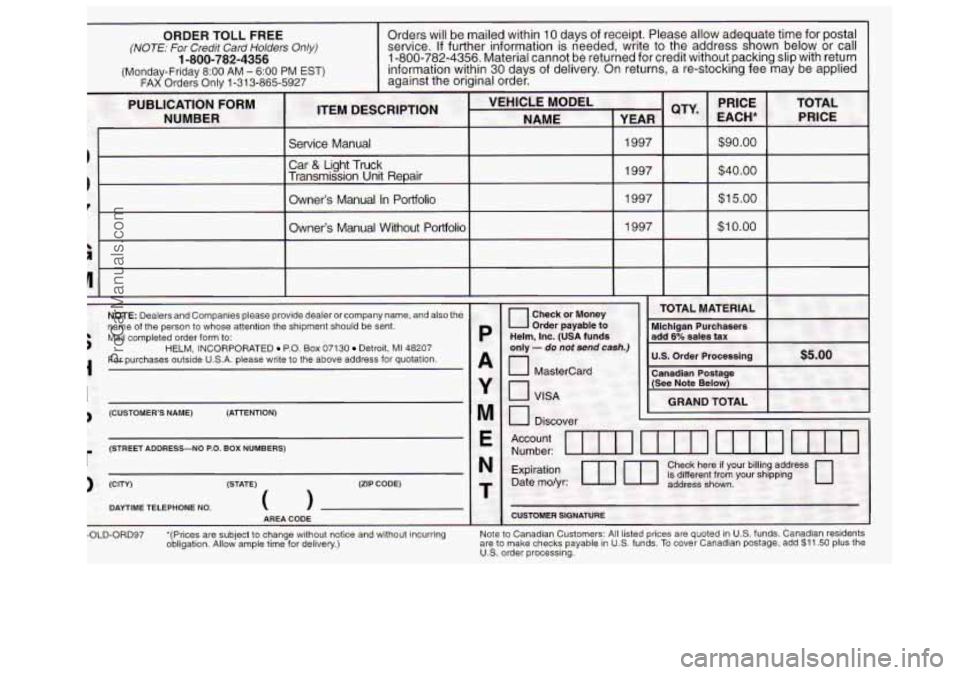
L
Service Manual 1997 $90.00
Car
& Light Truck
Transmission Unit Repair 1997 $40.00
Owner's Manual In Portfolio
1997 $1 5.00
Owner's Manual Without Portfolio 1997 $1 0.00
9
9
7.
G
M
NOTE: Dealers and Companies please provide dealer or company name, and also the
name of the person to whose attention the shipment should be sent.
~~
s Mail completed order form to:
H
I
P
HELM, INCORPORATED P.O. Box 07130 Detroit, MI 48207 For purchases outside U.S.A. please write to the above address for quotation.
(CUSTOMER'S NAME) (ATTENTION)
T
(STREET ADDRESS-NO P.O. BOX NUMBERS)
(STATE) (ZIP CODE)
DAYTIME TELEPHONE NO.
0 AREA CODE
GM-OLD-ORD97 "(Prices are subject to change without notice and without incurring
obligation. Allow ample time for delivery.)
Check or Maney Order payable to Helm, Inc. (USA funds only - do hot send cash.)
[L1 Mastercard
Note to Canadian Customers: All listed prices are quoted in U.S. funds. Canadian residents
are to make checks payable in U.S. funds. To cover Canadian postage, add $11.50 plus the US. order processing.
ProCarManuals.com