Page 209 of 358
Turn the wheel wrench counterclockwise to lower the
spare tire. Keep turning the wheel wrench
until the spare
tire can be pulled out from under the vehicle.
When the tire has been completely lowered,
tilt the
retainer at the end
of the cable and pull it through the
wheel opening. Pull the tire out from under the vehicle.
I NOTICE:
To help avoid vehicle damage, do not drive the
vehicle before the cable is restored.
A
Put the spare tire near the flat tire.
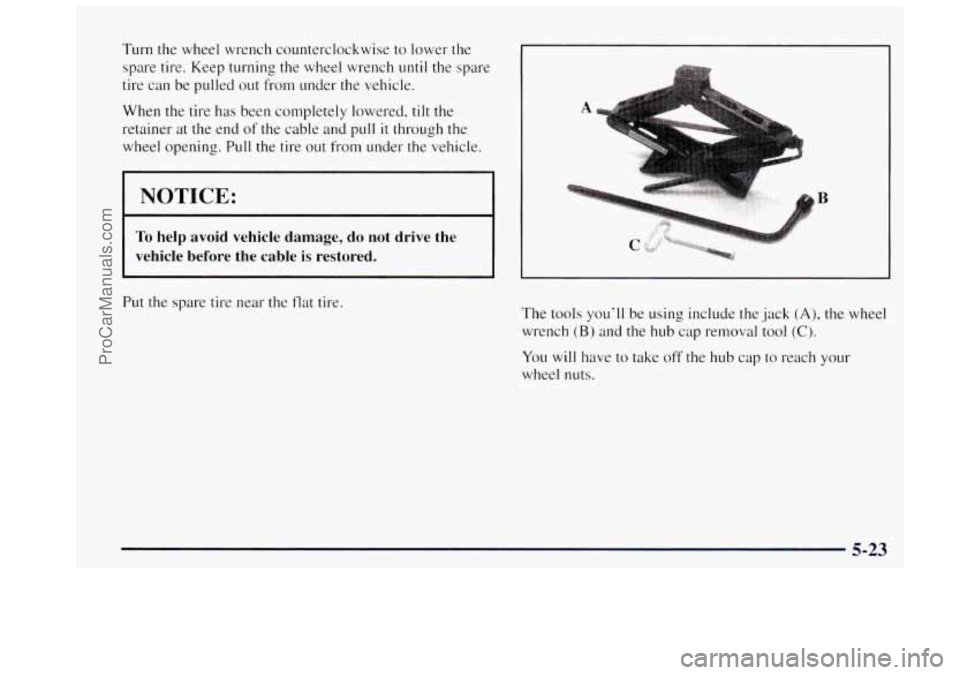
The tools you'll be using include the jack (A), the wheel
wrench
(B) and the hub cap removal tool (C).
You will have to take off the hub cap to reach your
wheel nuts.
5-23
ProCarManuals.com
Page 210 of 358
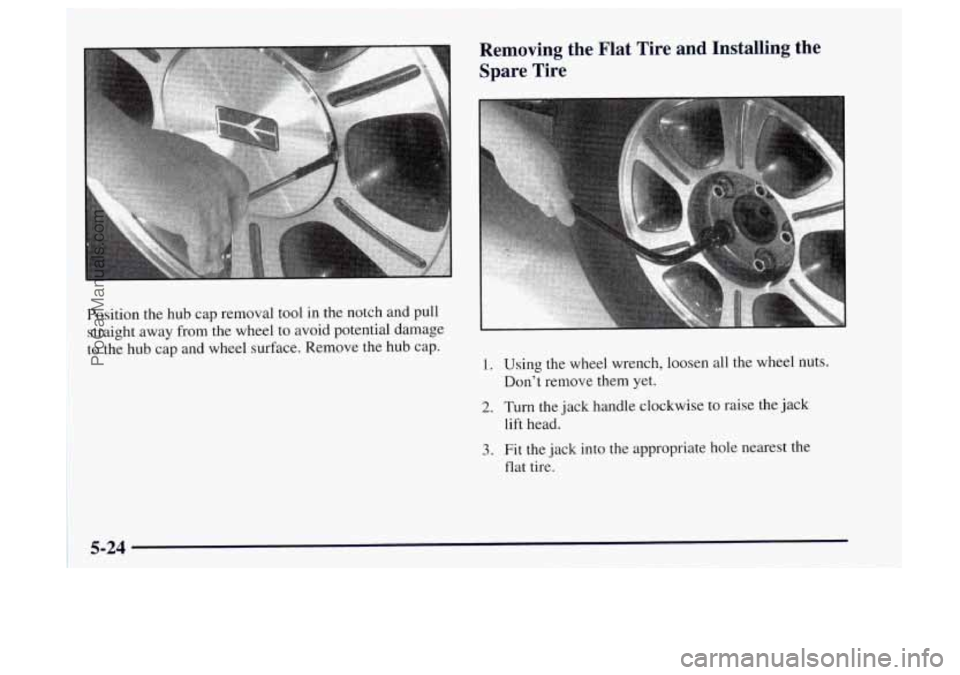
Position the hub cap removal tool in the notch and pull
straight away from the wheel to avoid potential damage
to the hub cap and wheel surface. Remove the hub cap.
Removing the Flat Tire and Installing the
Spare Tire
1. Using the wheel wrench, loosen all the wheel nuts.
Don’t remove them yet.
2. Turn the jack handle clockwise to raise the jack
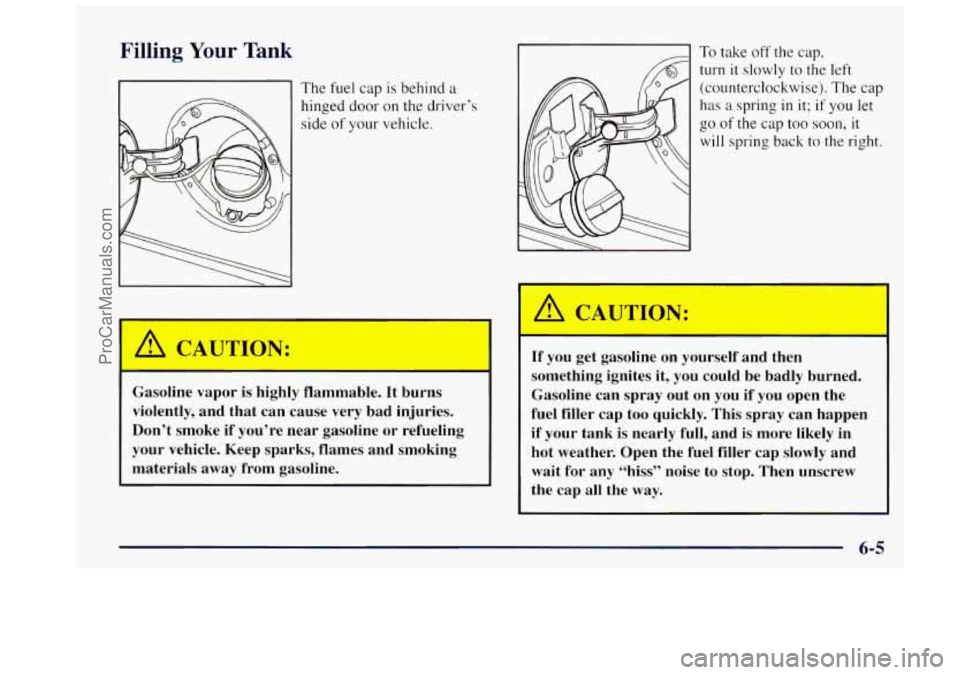
lift head.
3. Fit the jack into the appropriate hole nearest the
flat tire.
5-24
ProCarManuals.com
Page 212 of 358
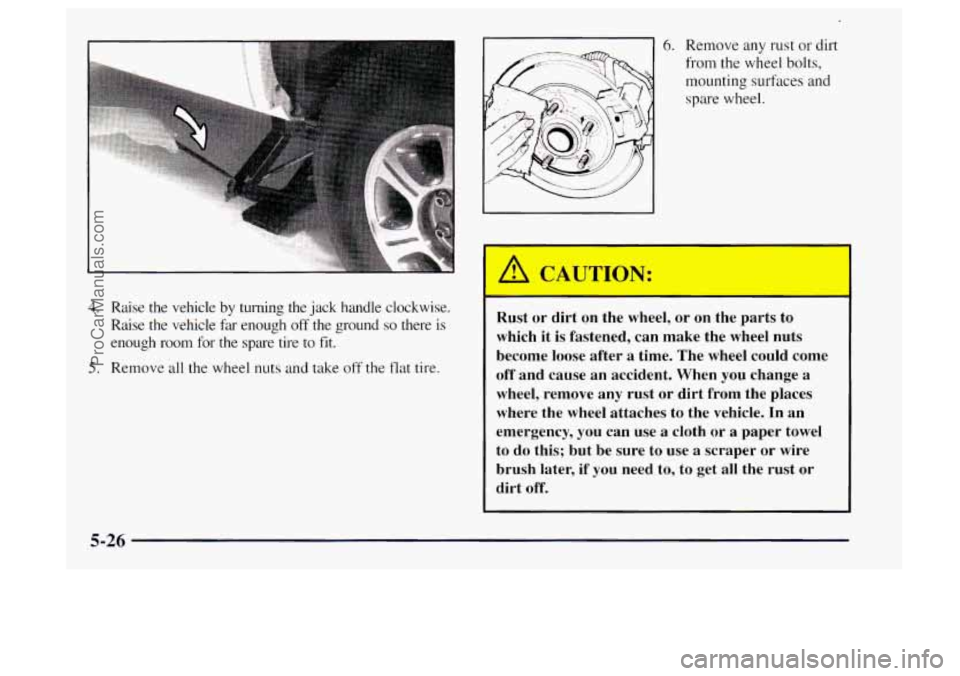
4. Raise the vehicle by turning the jack handle clockwise.
Raise the vehicle
far enough off the ground so there is
enough
room for the spare tire to fit.
5. Remove all the wheel nuts and take off the flat tire.
6. Remove any rust or dirt
from the wheel bolts,
mounting surfaces and
spare wheel.
'
A CAUT 3%
I
Rust or dirt on the wheel, or on the parts to
which it is fastened, can make the wheel nuts
become loose after a time. The wheel could come
off and cause an accident. When
you change a
wheel, remove any rust or dirt from the places
where the wheel attaches to the vehicle.
In an
emergency, you can use a cloth or a paper towe
to do this; but be sure to use a scraper or wire
brush later,
if you need to, to get all the rust or
dirt
off.
!I
5-26
ProCarManuals.com
Page 213 of 358
A CAUTION:
I - -
Never use oil or grease on studs or nuts. If YOU
do, the nuts might come loose. Your wheel could
fall off, causing
a serious accident.
1
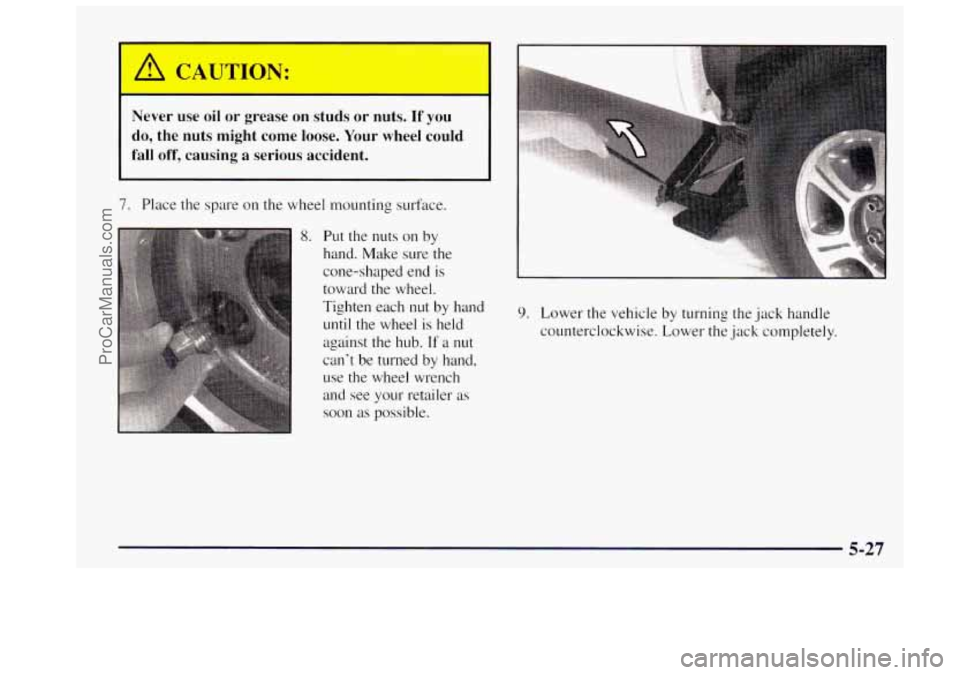
7. Place the spare on the wheel mounting surface.
8. Put the nuts on by
hand. Make sure the
cone-shaped end
is
toward the wheel.
Tighten each
nut by hand
until the wheel
is held
against the hub.
If a nut
can’t be turned by hand,
use the wheel wrench
and see your retailer
as
soon as possible.
I
9. Lower the vehicle by turning the jack handle
counterclockwise. Lower the jack completely.
5-27
-
ProCarManuals.com
Page 215 of 358
Storing a Flat or Spare Tire and Tools
' CAT' I ION:
Storing a jack, a tire or other equipment in the
passenger compartment of the vehicle could
cause in.jury. In a sudden stop
or collision, loose
equipment could strike someone. Store
all these
in the proper place.
An aluminum wheel with a flat tire should always
be stored under the vehicle with the hoist.
However, storing it that way for an extended
period could damage the wheel.
To avoid this,
have the wheel repaired as soon as possible. Follow this diagram
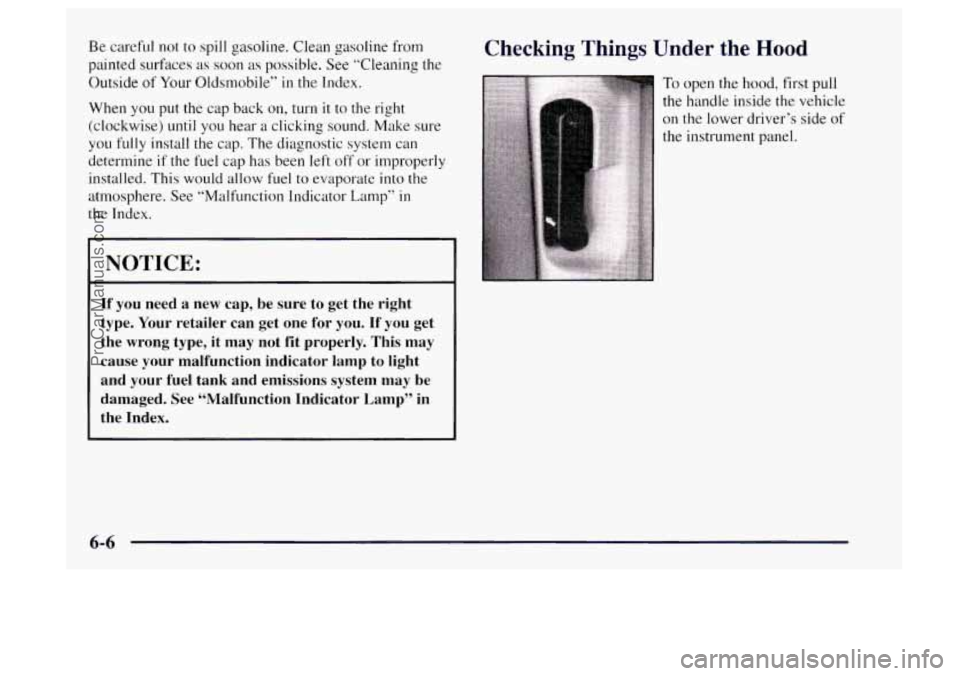
to store the spare or flat tire.
BJ
A. Retainer
B. Valve
Stem
(Pointed Down)
C. Spare Tire
D. Spring
E. Wheel Wrench
F. Lower
G. Raise
H. Hoist
Arm
1. Put the tire on the ground at the rear of the vehicle.
with the valve stem pointed down and to the rear.
2. P~dl the retainer through the wheel.
3. Put the chisel end of the wheel wrench. on an angle,
through the hole
in the rear bumper and into the hoist
shaft. Turn the wheel wrench clockwise
until the tire
is raised against the underside of the vehicle.
You will hear two "clicks" when the tire is secure,
but pull on the tire to make sure.
Return
the jack. wheel wrench and wheel blocks to the
proper location
in your vehicle's rear area. Secure the
items and replace the
jack cove]:
5-29
- _-
ProCarManuals.com
Page 216 of 358
h CAUTION:
--
Make sure the tire and carrier are secure.
Driving with the tire or carrier unlatched could
injure pedestrians or damage the vehicle.
rA
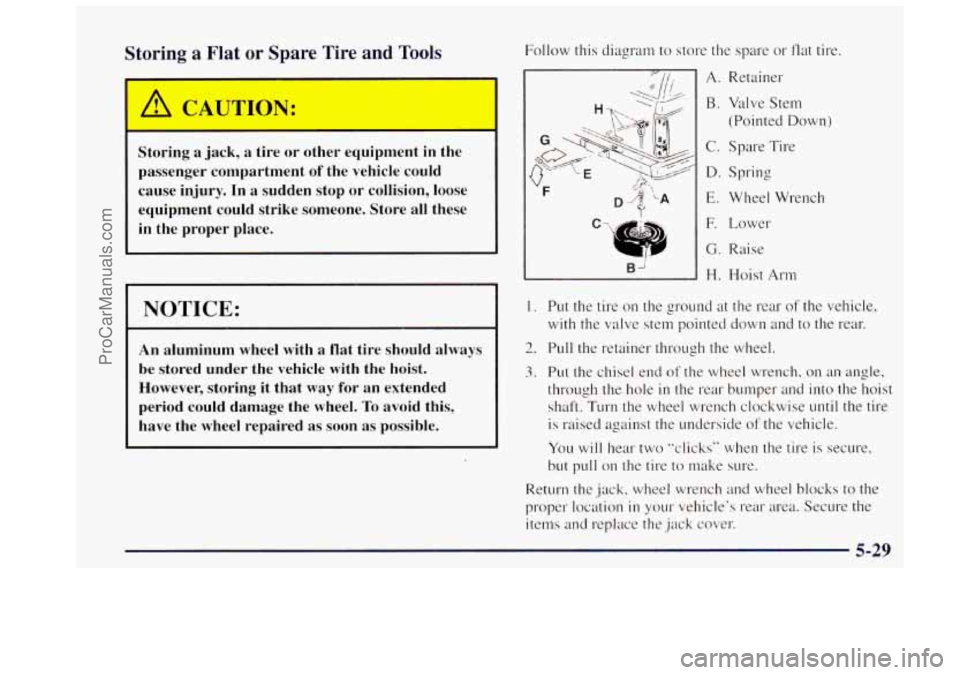
A. Retainer
B. Rubber Band
(Some Models)
C. Work Gloves
D. Mat
E. Jack Storage Cover
E Wheel Blocks
G. Hub Cap
Removal Tool
H. Wheel Wrench
I. Jack
J. Jacking Instructions
Compact Spare Tire (If Equipped)
Alt.hough the compact spare tire was fully inflated
when your vehicle was new, it can lose air after
a
time. Check the inflation pressure regularly. It should
be
60 psi (420 kPa).
After installing the compact spare on your vehicle,
you should stop as soon as possible and make sure
your spare tire
is correctly inflated. The compact
spare is made to perform well at speeds up to
65 mph
(105 km/h) for distances up to 3,000 miles (5 000 km),
so you can finish your trip and have your full-size tire
repaired or replaced where you want. Of course, it’s best
to replace your spare with a full-size tire as soon as you
can. Your spare will last longer and be
in good shape in
case you need it again.
5-30
ProCarManuals.com
Page 225 of 358
Filling Your Tank
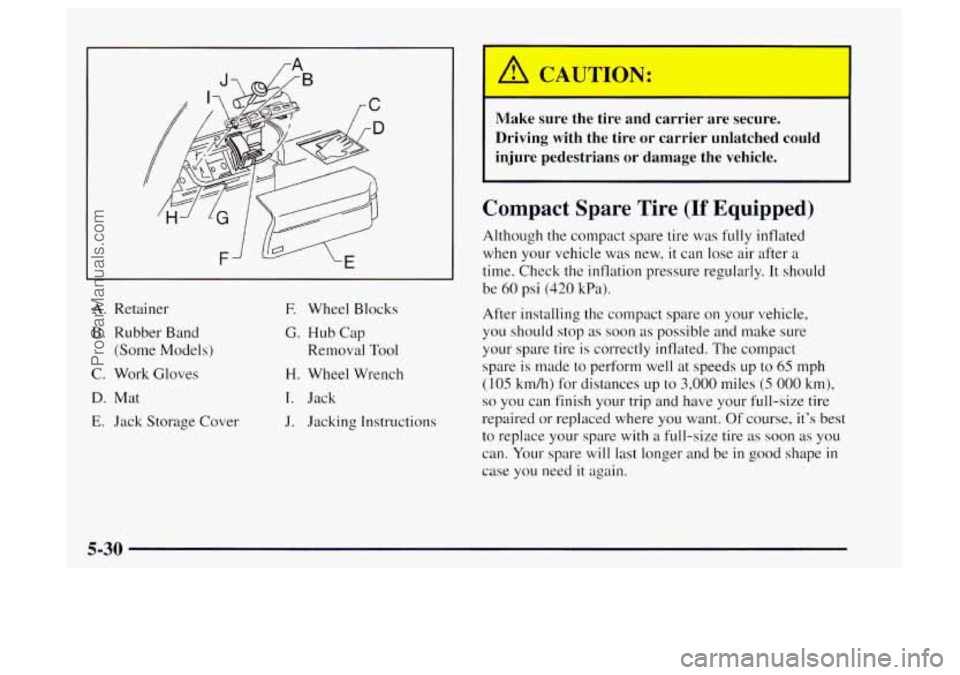
The fuel cap is behind a
hinged door
on the driver’s
side
of your vehicle.
’
I A CAUTION: I
Gasoline vapor is highly flammable. It burns
violently, and that can cause very bad injuries.
Don’t smoke
if you’re near gasoline or refueling
your vehicle. Keep sparks, flames and smoking
materials away from gasoline.
To take off the cap,
turn
it slowly to the left
(counterclockwise). The cap
has a spring in it; if you let
go of the cap too soon, it
will
spring back to the right.
I A CAUTION:
If you get gasoline on yourself and then
something ignites it, you could be badly burned.
Gasoline can spray out on you if you open the
fuel filler cap too quickly. This spray can happen
if your tank is nearly full, and is more likely in
hot weather. Open the fuel filler cap slowly and
wait for any “hiss” noise to stop. Then unscrew
the cap
all the way.
ProCarManuals.com
Page 226 of 358
Be careful not to spill gasoline, Clean gasoline from
painted surfaces as soon
as possible. See “Cleaning the
Outside
of Your Oldsmobile” in the Index.
When you put
the cap back on, turn it to the right
(clockwise) until
you hear a clicking sound. Make sure
you fully install the cap. The diagnostic system can
determine
if the fuel cap has been left off or improperly
installed.
This would allow fuel to evaporate into the
atmosphere. See “Malfunction Indicator Lamp” in
the Index.
I I
I NOTICE:
If you need a new cap, be sure to get the right
type. Your retailer can get one for you.
If you get
the wrong type, it may not fit properly. This may
cause your malfunction indicator lamp to light and your fuel tank and emissions system may be
damaged. See “Malfunction Indicator Lamp’’ in
the Index.
Checking Things Under the Hood
To open the hood, first pull
the handle inside the vehicle
on the lower driver’s side
of
the instrument panel.
6-6
ProCarManuals.com