1997 OLDSMOBILE BRAVADA tires
[x] Cancel search: tiresPage 178 of 358
Three importmt considerations have to do with weight:
the weight of the trailer,
the weight of the trailer tongue
* and the weight on your vehicle’s tires.
Weight of the Trailer
How heavy can a trailer safely be?
It should never weigh more than
5,000 lbs. (2 270 kg).
But
even that can be too heavy.
It depends
on how you plan to use your rig. For
example, speed, altitude, road grades, outside
temperature and how much your vehicle is used to pull
a
trailer are all important. And, it can also depend on any
special equipment that
you have on your vehicle.
You can ask your retailer for our trailering information
or advice, or you can write us at
Oldsmobile Customer Assistance
P.O. Box 30095
Lansing, MI 48909
In Canada, write to:
General Motors of Canada Limited
Customer Communication Centre
1908 Colonel Sam Drive
Oshawa, Ontario LlH
8P7
Weight of the Trailer Tongue
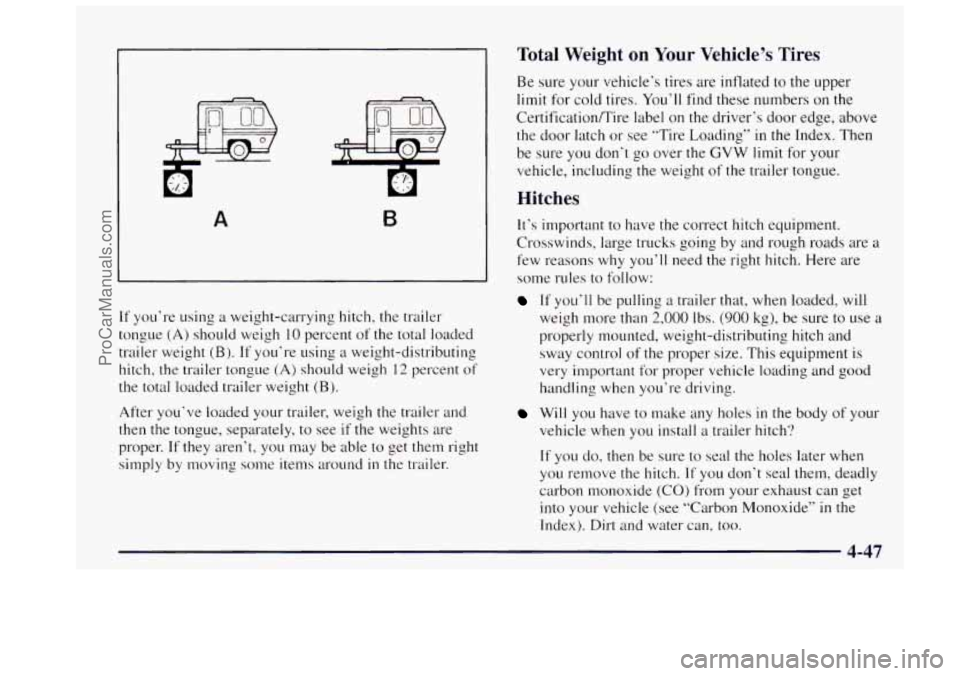
The tongue load (A) of any trailer is an important
weight
to measure because it affects the total or gross
weight of your vehicle. The Gross Vehicle Weight
(GVW) includes the curb weight
of the vehicle, any
cargo you may carry
in it, and the people who will be
riding
in the vehicle. And if you will tow a trailer, you
must add the tongue load to the GVW because your
vehicle will be carrying that weight, too. See “Loading
Your Vehicle”
in the Index for more information about
your vehicle’s maximum load capacity.
4-46
ProCarManuals.com
Page 179 of 358
A B
If you’re using a weight-carrying hitch, the trailer
tongue
(A) should weigh 10 percent of the total loaded
trailer weight
(B). If you’re using a weight-distributing
hitch, the trailer tongue
(A) should weigh 12 percent of
the total loaded trailer weight
(B).
After you’ve loaded your trailer, weigh the trailer and
then the tongue, separately, to see
if the weights are
proper.
If they aren’t, you may be able to get them right
simply by moving some items around
in the trailer.
Total Weight on Your Vehicle’s Tires
Be sure your vehicle’s tires are inflated to the upper
limit
for cold tires. You’ll find these numbers on the
Certification/Tire label
on the driver’s door edge, above
the door latch or see “Tire Loading”
in the Index. Then
be sure
you don’t go over the GVW limit for your
vehicle, including the weight
of the trailer tongue.
Hitches
It’s important to have the correct hitch equipment.
Crosswinds, large trucks going by and rough roads are
a
few reasons why you’ll need the right hitch. Here are
some rules
to follow:
If you’ll be pulling a trailer that, when loaded, will
weigh more than 2,000 Ibs. (900 kg), be sure to use a
properly mounted, weight-distributing hitch and
sway control of the proper size. This equipment is
very important for proper vehicle loading and good
handling when you’re driving.
Will you have to make any holes in the body of your
vehicle when you install a trailer hitch?
If you do, then be sure to seal the holes later when
you relnove the hitch.
If you don’t seal them, deadly
carbon monoxide (CO) from your exhaust can get
into your vehicle (see “Carbon Monoxide”
in the
Index). Dirt and water can, too.
4-47
ProCarManuals.com
Page 181 of 358

Driving with a Trailer
mmm
If you have a rear-most window open and you
pull a trailer with your vehicle, carbon monoxide
(CO) could come into your vehicle. You can’t see
or smell
CO. It can cause unconsciousness or
death. (See “Engine Exhaust” in the Index.)
To
maximize your safety when towing a trailer:
Have your exhaust system inspected for
leaks, and make necessary repairs before
starting on your trip.
Keep the rear-most windows closed.
If exhaust does come into your vehicle
through a window in the rear or another
opening, drive with your front, main
heating or cooling system
on and with the
fan on any speed. This will bring fresh,
outside air into your vehicle.
Do not use
MAX A/C because it only recirculates the
air inside your vehicle. (See
“ Comfort
Controls”
in the Index.) Towing
a trailer requires a certain amount
of experience.
Before setting out for the open road, you’ll want to get
to know your rig. Acquaint yourself with the feel of
handling and braking with the added weight of the
trailer. And always keep
in mind that the vehicle you are
driving
is now a good deal longer and not nearly as
responsive as your vehicle is by itself.
Before you start, check the trailer hitch and platform
(and attachments), safety chains, electrical connector,
lamps, tires and mirror adjustment.
If the trailer has
electric brakes, start your vehicle and trailer moving and
then apply the trailer brake controller by hand to be sure
the brakes are working. This lets you check your
electrical connection at the same time.
During your trip, check occasionally to be sure that the
load is secure, and that the lamps and any trailer brakes
are still working.
Following Distance
Stay at least twice as far behind the vehicle ahead as you
would when driving your vehicle without a trailer. This
can help you avoid situations that require heavy braking
and sudden turns.
4-49
ProCarManuals.com
Page 193 of 358
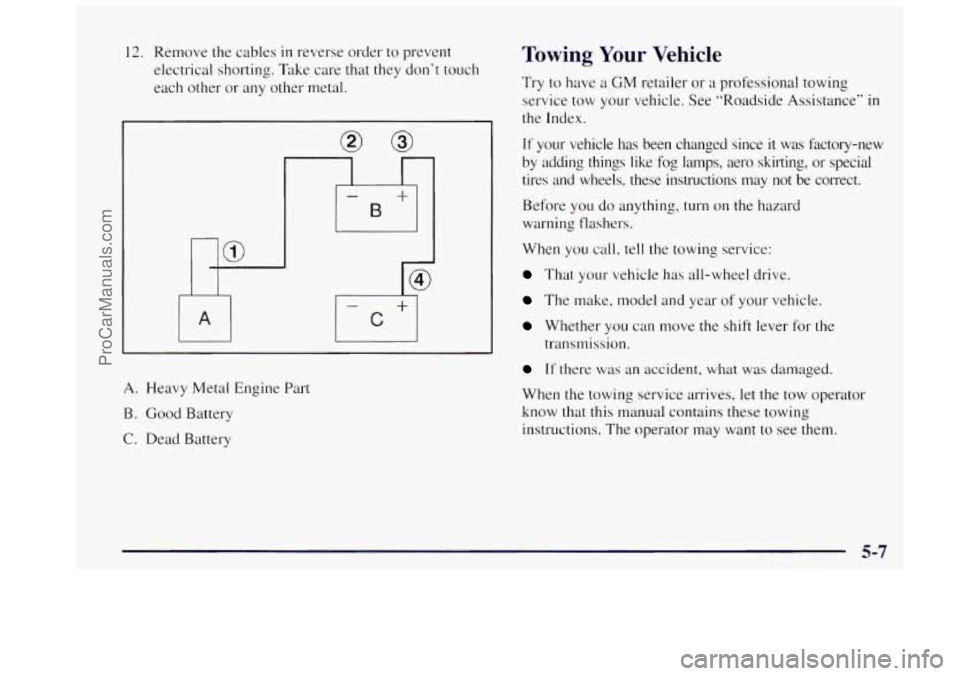
12. Remove the cables in reverse order to prevent
electrical shorting. Take care that they don’t touch
each other or any other metal. Towing Your Vehicle
Try to have a GM retailer or a professional towing
service tow your vehicle. See “Roadside Assistance”
in
the Index.
If your vehicle has been changed since it was factory-new
by adding things like
fog lamps, aero skirting, or special
tires and wheels, these instructions may not be conect.
Before you do anything, turn on the hazard
warning flashers.
When you call, tell the towing service:
That your vehicle has all-wheel drive.
The make, model and year of your vehicle.
Whether you can move the shift lever for the
transmission.
A. Heavy Metal Engine Part
B. Good Battery
C. Dead Battery
If there was an accident, what was damaged.
When the towing service arrives, let the tow operator
know that this manual contains these towing
instructions.
The operator may want to see them.
5-7
ProCarManuals.com
Page 207 of 358
If a Tire Goes Flat
It’s Llnusual for a tire to ”blow out.’ while you’re driving,
especially
if you maintain your tires properly. If air goes
out of a tire, it’s much more likely to leak out slowly.
But
if you should ever have a “blowout,” here are a few
tips about what to expect and what to do:
If a front tire fails, the flat tire will create a drag that
pulls the vehicle toward that side. Take your
f-bot off the
accelerator pedal and grip the steering wheel
firmly.
Steer to maintain lane position, and then gently brake to
a stop well out of the traffic lane.
A rear blowout. particularly on a curve, acts much like a
skid and may require the same conxxtion you’d use in a
skid. In any rear blowout, remove your foot from the
accelerator pedal. Get the vehicle under control by
steering the way
you want the vehicle to go. It may be
very bumpy and noisy, but
YOLI can still steer. Gently
brake to
a stop -- well off the road if possible.
If a tire goes flat, the next part shows how to use your
jacking equipment to change a flat tire safely.
Changing a Flat Tire
If a tire goes flat, avoid further tire and wheel damage
by driving slowly to
a level place. Turn on your hazard
warning flashers.
c
A CAUTION:
Changing a tire can cause an injury. The vehicle
can slip off the jack and roll over you
or other
people. You and they could be badly injured.
Find a level place to change your tire.
To help
prevent the vehicle from moving:
1. Set the parking brake firmly.
2. Put the shift lever in PARK (P).
3. Turn off the engine.
To be even more certain the vehicle won’t move,
you can put blocks at the front and rear of the
tire farthest away from the one being changed.
That would be the tire on the other side of the
vehicle, at the opposite end.
The following steps
will tell you how to use the jack and
change
a tire.
5-21
ProCarManuals.com
Page 217 of 358
NOTICE:
When the compact spare is installed, don’t take
your vehicle through an automatic
car wash with
guide rails. The compact spare can get caught on
the rails. That can damage the tire and wheel,
and maybe other parts
of your vehicle.
Don’t use your compact spare on other vehicles.
And don’t
mix your compact spare tire or wheel with
other wheels or tires. They won’t fit. Keep your spare
tire and its wheel together.
NOTICE:
Tire chains won’t fit your compact spare. Using
them can damage your vehicle and can damage
the chains too. Don’t use tire chains on your
compact spare.
If You’re Stuck: In Sand, Mud,
Ice or Snow
What YOU don’t want to do when your vehicle is stuc
to spin your wheels too fast. The method known
as
:k is
“rocking” can help you get out when you’re stuck, but
you must use caution.
If you let your tires spin at high speed, they can
explode, and
you or others could be injured.
And, the transmission or other parts
of the
vehicle can overheat. That could cause an engine
compartment fire or other damage. When you’re
stuck, spin the wheels as little as possible. Don’t
spin the wheels above
35 mph (55 km/h) as shown
on the speedometer.
I
5-31
ProCarManuals.com
Page 218 of 358
NOTICE:
Spinning your wheels can destroy parts of your
vehicle as well as the tires. If you spin the wheels
too fast while shifting your transmission back
and forth, you can destroy your transmission.
For information about using tire chains on your vehicle,
see "Tire Chains''
in the Index.
Rocking Your Vehicle To Get It Out
First, turn your steering wheel left and right. That will
clear the area around your front wheels. Then shift back
and forth between REVERSE
(R) and a forward gear,
spinning the wheels as little as possible. Release the
accelerator pedal while you shift, and press lightly on
the accelerator pedal when the transmission is
in gear.
If that doesn't get you out after a few tries, you may
need to
be towed out. Or, you can use your recovery
hooks
if your vehicle has them. If you do need to be
towed out,
see "Towing Your Vehicle" in the Index.
Using the Recovery Hooks
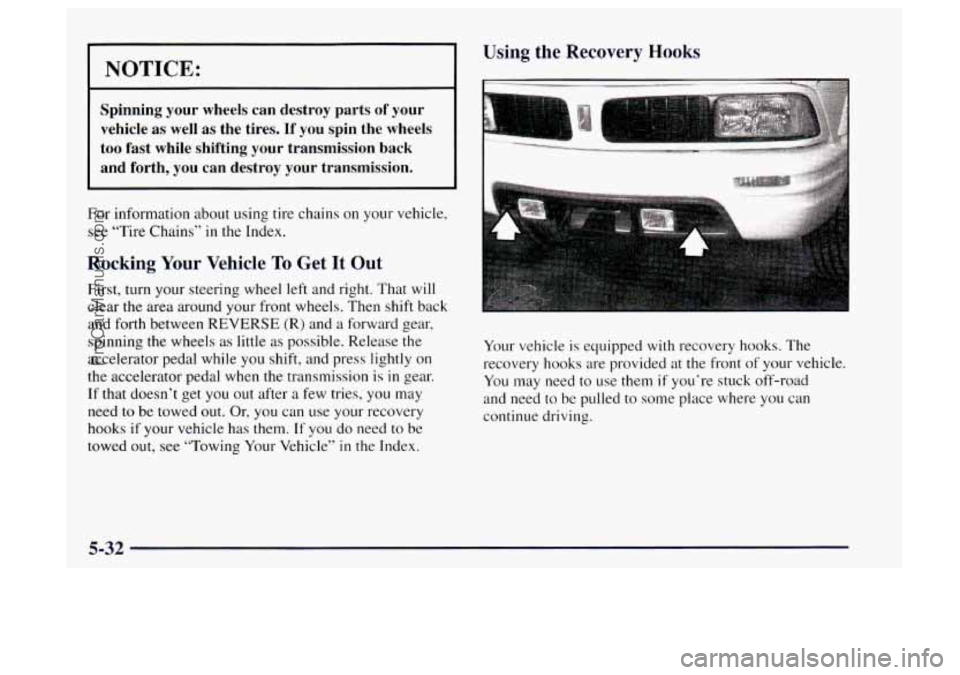
Your vehicle is equipped with recovery hooks. The
recovery hooks are provided at the front
of your vehicle.
You may need to use them
if you're stuck off-road
and need to be pulled to some place where you can
continue driving.
ProCarManuals.com
Page 221 of 358

Section 6 Service and Appearance Care
Here you will find information about the care of your Oldsmobile. This section begins with service and fuel
information, and then it shows how to check important fluid and lubricant levels. There is also technical information
about
your vehicle, and a part devoted to its appearance care.
6-
2
6- 3
6-4
6-5
6-6
6-9
6- 14
6-20
6- 24
6-25
6-29
6-29
6-30
6-34
6-37 Doing
Your Own Service Work
What Kind of Fuel to Use
Using Fuel
in Foreign Countries
Where to Put the Fuel and Filling
the Tank
Checking Things Under the Hood
Checking Your Engine Oil
Automatic Transmission Fluid
Engine Coolant
Where to Fill
the Windshield Washer Fluid
Important Brake Information
Information
on Your Vehicle’s Battery
Tips
on Vehicle Storage
Bulb Replacement Procedures
Windshield Wiper Blade Replacement How and When
to Check Tire Inflation 6-39
6-42
6-44
6-47
6-48
6-50
6-5
1
6-52
6-53
6-54
6-55 6-59
6-60
6-60
6-6
I
When it is Time to Buy New Tires
Wheel Alignment
Cleaning the Inside
of Your Oldsmobile
Care
of the Safety Belts
Cleaning the Outside
of Your Oldsmobile
How to Clean Aluminum Wheels
Underbody Maintenance
Recommended Appearance Care Materials
Your Vehicle Identification Number
(VIN)
The Electrical System
Fuses and Circuit Breakers
Replacement Bulb Types for Your Vehicle
Capacities and Specifications
Normal Replacement Parts
Air Conditioning Specifications
6-1
- -~ -
ProCarManuals.com