1997 NISSAN SENTRA boot
[x] Cancel search: bootPage 140 of 194
WARNING
Be sure the engine and ignition switch
are off and that the parking brake is
engaged securely.
CAUTION
Be sure to use the correct socket to
remove the plugs. An incorrect socket
can cause damage.
GA16DE Engine
1. Remove brackets as necessary to give
access to the high tension cables and
spark plugs.
2. Disconnect the spark plug cables from
the spark plugs.
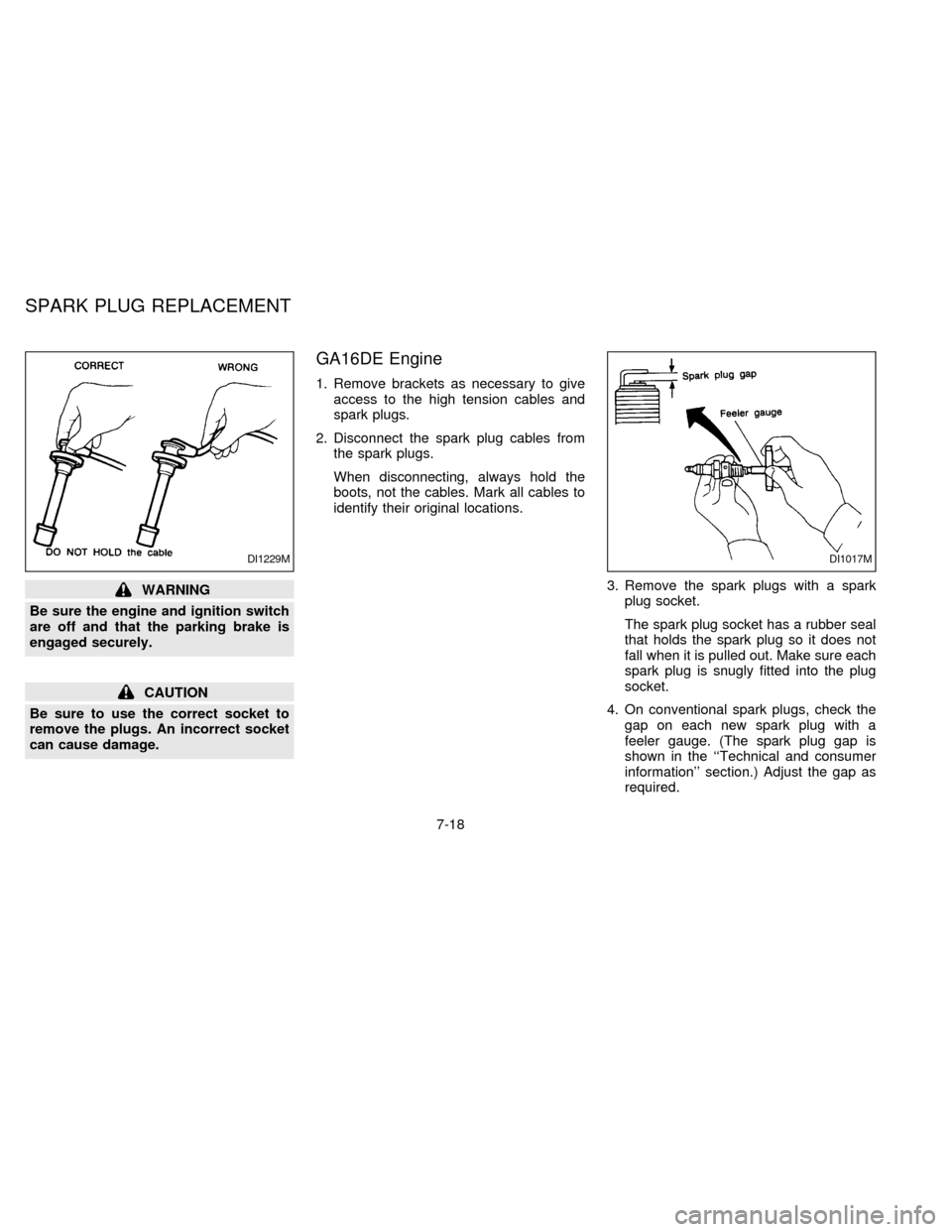
When disconnecting, always hold the
boots, not the cables. Mark all cables to
identify their original locations.
3. Remove the spark plugs with a spark
plug socket.
The spark plug socket has a rubber seal
that holds the spark plug so it does not
fall when it is pulled out. Make sure each
spark plug is snugly fitted into the plug
socket.
4. On conventional spark plugs, check the
gap on each new spark plug with a
feeler gauge. (The spark plug gap is
shown in the ``Technical and consumer
information'' section.) Adjust the gap as
required.
DI1229MDI1017M
SPARK PLUG REPLACEMENT
7-18
ZX
Page 141 of 194
5. Fit the new plugs, one at a time, into the
spark plug socket and install them. Turn
each plug in several full turns by hand,
then tighten with a spark plug socket to
the correct torque. Do not overtighten.
Spark plug tightening torque:
14 to 22 ft-lb (20 to 29 N²m)
6. Holding the boot, reconnect each high
tension cable to its proper spark plug by
pushing it on until you feel a snap.
7. Reinstall all brackets as necessary.
SR20DE Engine
Platinum-tipped spark plug
It is not necessary to replace platinum-
tipped spark plugs as frequently as conven-
tional type spark plugs because they last
much longer. Follow the maintenance
schedule, but do not reuse the spark plugs
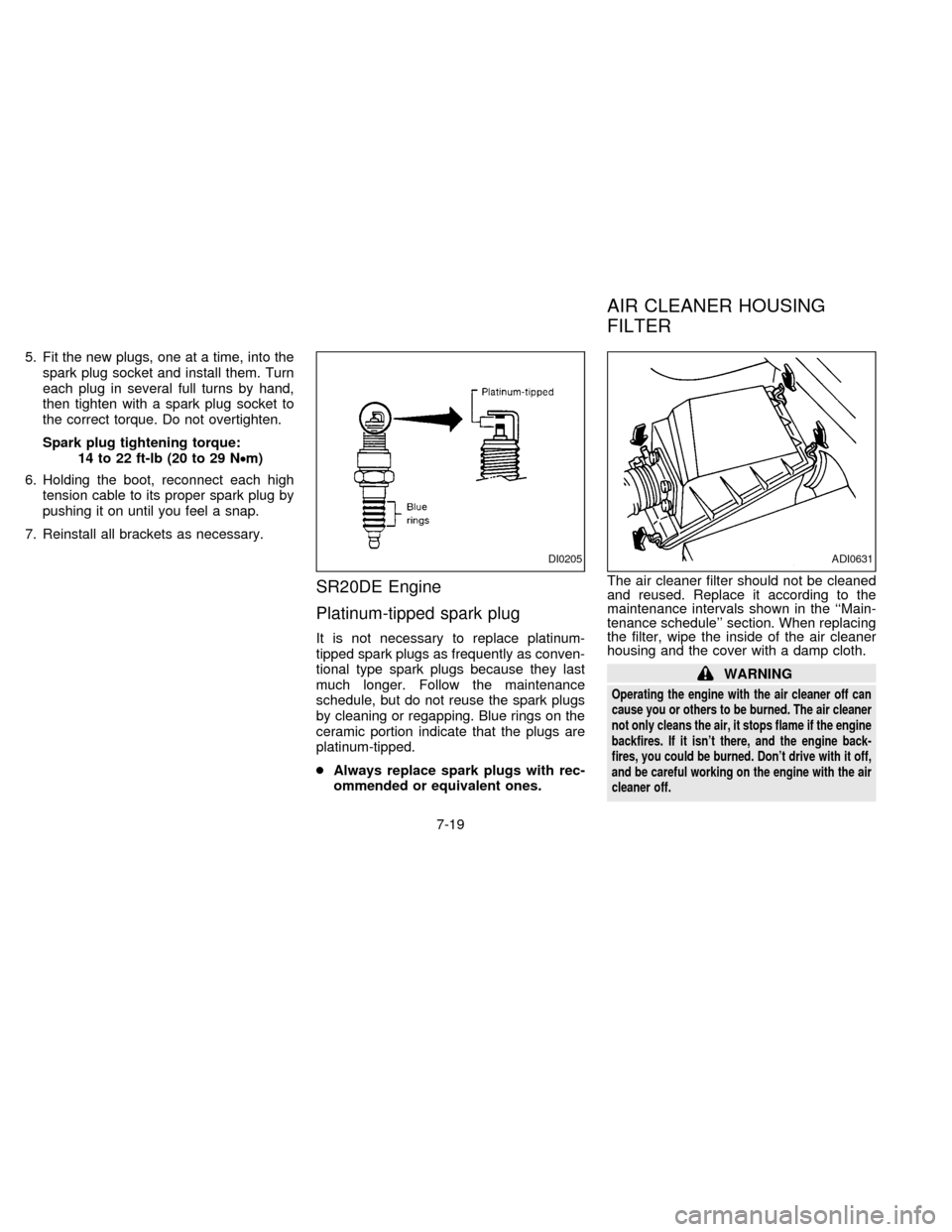
by cleaning or regapping. Blue rings on the
ceramic portion indicate that the plugs are
platinum-tipped.
cAlways replace spark plugs with rec-
ommended or equivalent ones.The air cleaner filter should not be cleaned
and reused. Replace it according to the
maintenance intervals shown in the ``Main-
tenance schedule'' section. When replacing
the filter, wipe the inside of the air cleaner
housing and the cover with a damp cloth.
WARNING
Operating the engine with the air cleaner off can
cause you or others to be burned. The air cleaner
not only cleans the air, it stops flame if the engine
backfires. If it isn't there, and the engine back-
fires, you could be burned. Don't drive with it off,
and be careful working on the engine with the air
cleaner off.
DI0205ADI0631
AIR CLEANER HOUSING
FILTER
7-19
ZX
Page 165 of 194
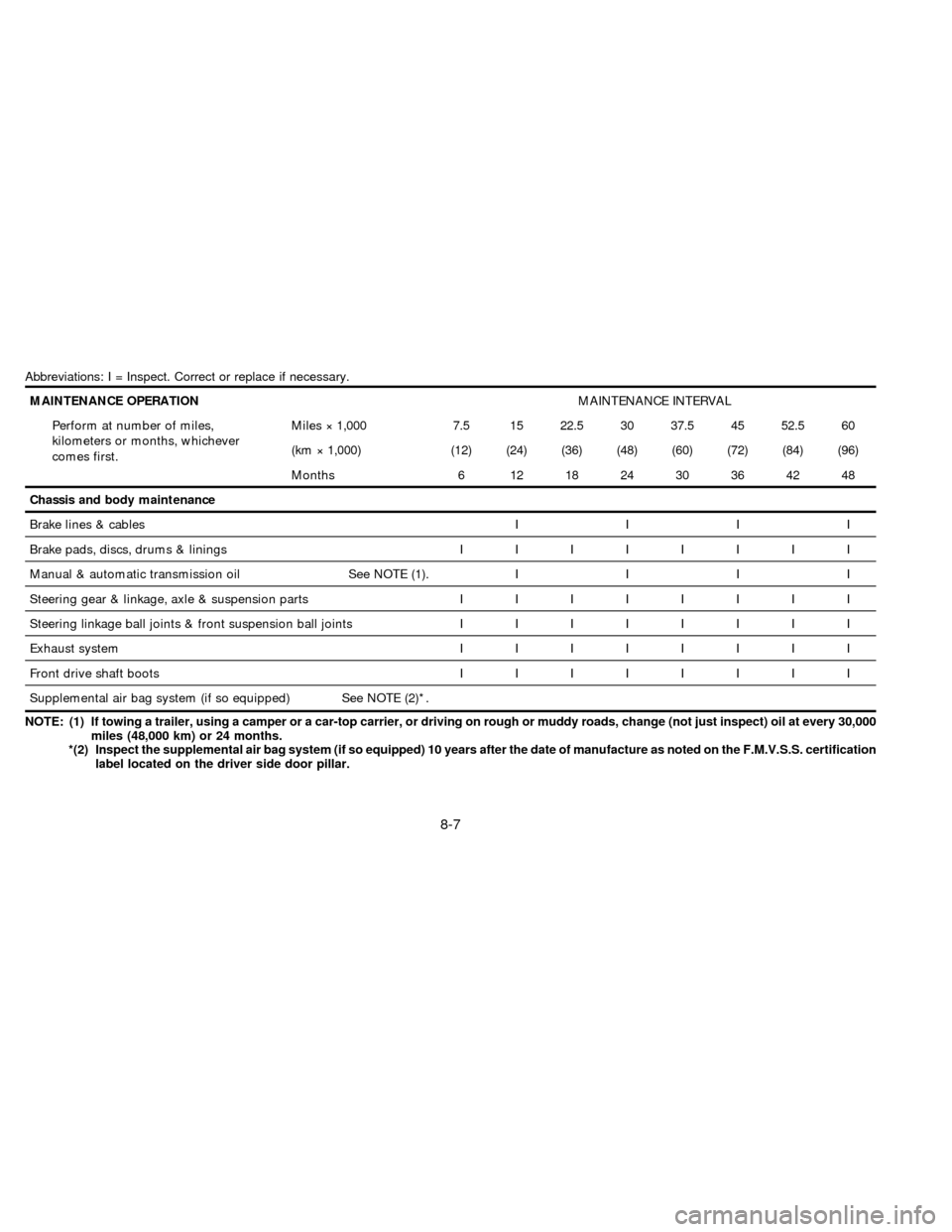
Abbreviations: I = Inspect. Correct or replace if necessary.
MAINTENANCE OPERATIONMAINTENANCE INTERVAL
Perform at number of miles,
kilometers or months, whichever
comes first.Miles ý 1,000 7.5 15 22.5 30 37.5 45 52.5 60
(km ý 1,000) (12) (24) (36) (48) (60) (72) (84) (96)
Months 6 12 18 24 30 36 42 48
Chassis and body maintenance
Brake lines & cablesIIII
Brake pads, discs, drums & liningsIIIIIIII
Manual & automatic transmission oil See NOTE (1).IIII
Steering gear & linkage, axle & suspension partsIIIIIIII
Steering linkage ball joints & front suspension ball jointsIIIIIIII
Exhaust systemIIIIIIII
Front drive shaft bootsIIIIIIII
Supplemental air bag system (if so equipped) See NOTE (2)*.
NOTE: (1) If towing a trailer, using a camper or a car-top carrier, or driving on rough or muddy roads, change (not just inspect) oil at every 30,000
miles (48,000 km) or 24 months.
*(2) Inspect the supplemental air bag system (if so equipped) 10 years after the date of manufacture as noted on the F.M.V.S.S. certification
label located on the driver side door pillar.
8-7
ZX
Page 167 of 194
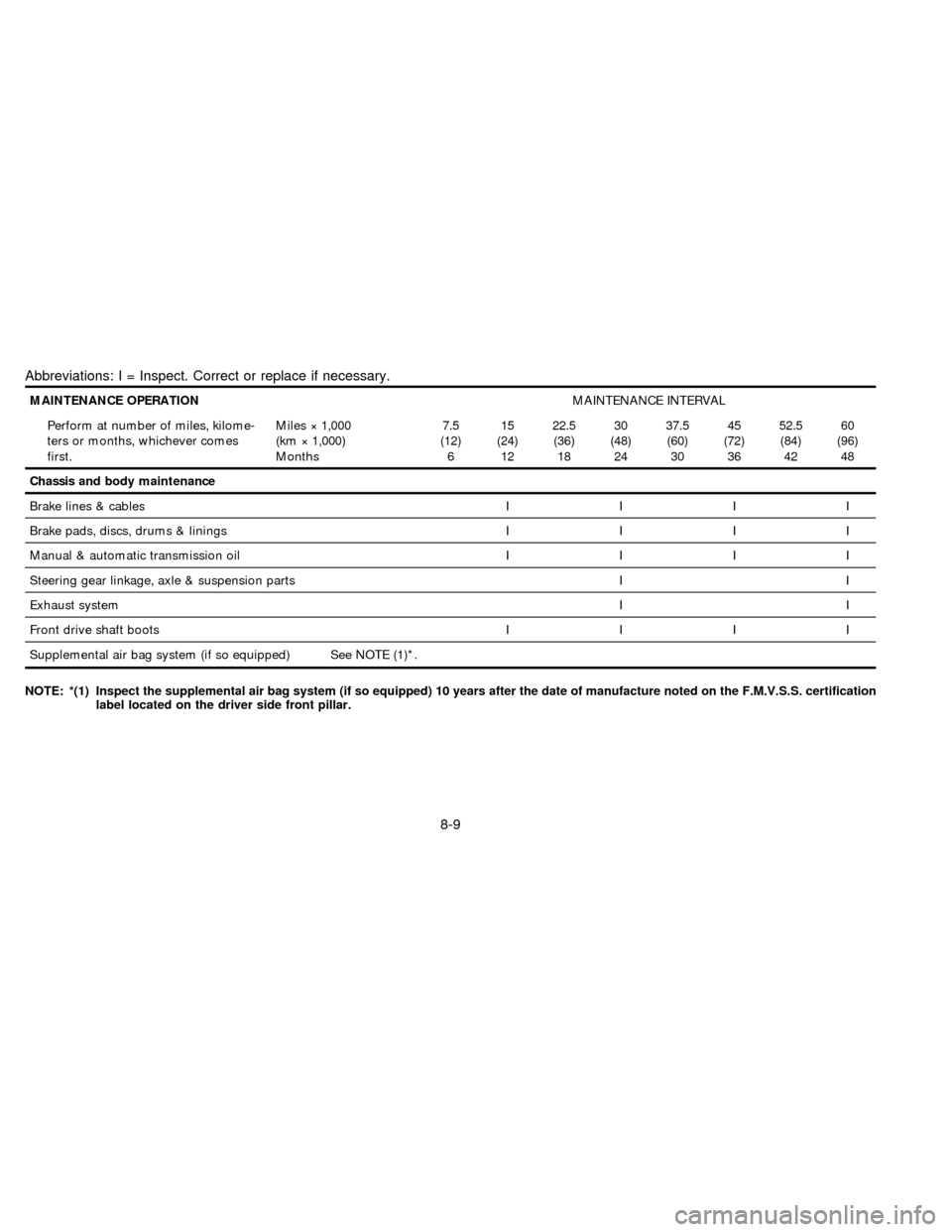
Abbreviations: I = Inspect. Correct or replace if necessary.
MAINTENANCE OPERATIONMAINTENANCE INTERVAL
Perform at number of miles, kilome-
ters or months, whichever comes
first.Miles ý 1,000
(km ý 1,000)
Months7.5
(12)
615
(24)
1222.5
(36)
1830
(48)
2437.5
(60)
3045
(72)
3652.5
(84)
4260
(96)
48
Chassis and body maintenance
Brake lines & cablesIIII
Brake pads, discs, drums & liningsIIII
Manual & automatic transmission oilIIII
Steering gear linkage, axle & suspension parts I I
Exhaust systemII
Front drive shaft bootsIIII
Supplemental air bag system (if so equipped) See NOTE (1)*.
NOTE: *(1) Inspect the supplemental air bag system (if so equipped) 10 years after the date of manufacture noted on the F.M.V.S.S. certification
label located on the driver side front pillar.
8-9
ZX
Page 168 of 194

Additional information on the following
items with ``*'' is found in the ``Do-it-
yourself operations'' section.
Emission control system
maintenance
Drive belts* ÐCheck drive belts for wear,
fraying or cracking and also for proper tension.
Replace the drive belts if found damaged.
Air cleaner filter ÐUnder normal driving
conditions, the air cleaner filter should be
replaced in accordance with the maintenance
schedule. However, driving the vehicle in
dusty areas may cause more rapid clogging
of the element. Consequently, the element
may have to be replaced more frequently.
Vapor lines ÐCheck vapor lines and con-
nections for failure or looseness. If leaks are
found, replace them.
Fuel lines ÐCheck the fuel hoses, piping
and connections for leaks, looseness or
deterioration. Replace any parts if they are
damaged.
Fuel filter ÐIf the vehicle is operated under
extremely adverse weather conditions or in
areas where ambient temperatures are ei-
ther extremely low or extremely high, thefilter might become clogged. In such an
event, replace the filter immediately.
Engine coolant* ÐDrain and flush the
cooling system.
Engine oil & oil filter* ÐUnder normal
driving conditions, the engine oil and oil filter
should be replaced in accordance with the
maintenance schedule. However, under se-
vere driving conditions, they may have to be
replaced more frequently.
Spark plugs* ÐReplace with new plugs
having the correct heat range.
Intake & exhaust valve clearance Ð
Check and adjust the valve clearance.
Chassis and body maintenance
Brake lines & cables ÐCheck the brake
lines and hoses (including brake booster
vacuum hoses, connections & check valve)
and parking brake cables for proper attach-
ment, leaks, cracks, chafing, abrasion, de-
terioration, etc.
Brake pads, discs, drums & linings Ð
Check these and the other neighboring brake
components for wear, deterioration and
leaks. Under severe driving conditions, they
may have to be inspected more frequently.
Manual & automatic transmission fluid*
ÐCheck the fluid level and visually inspect
for signs of leakage.
Under severe driving conditions, the fluid
should be replaced at the specified interval.
Steering gear & linkage, axle & suspen-
sion parts, and drive shaft boots Ð
Check for damage, looseness and leakage
of oil or grease. Under severe driving con-
ditions, more frequent inspection should be
performed.
Steering linkage ball joints & front sus-
pension ball joints ÐCheck the ball joints
for damage, looseness and grease leakage.
Exhaust system ÐVisually check the ex-
haust pipes, muffler, and hangers for proper
attachment, leaks, cracks, chafing, abra-
sion, deterioration, etc. Under severe
driving conditions, inspection should be per-
formed more frequently.
Supplemental air bag system (if so
equipped) ÐCheck the supplemental air
bag system components for proper attach-
ment, damage, deformities, cracks, rust,
etc. Work around and on the supplemental
air bag system should be done by an autho-
rized NISSAN dealer.
EXPLANATION OF
MAINTENANCE ITEMS
8-10
ZX