1997 NISSAN SENTRA instrument panel
[x] Cancel search: instrument panelPage 51 of 194
unit, supplemental air bag modules and all
related wiring.
When the ignition key is in the ON or START
position, the supplemental air bag warning
light illuminates for about 7 seconds and
then turns off. This means the system is
operational.
If any of the following conditions occur, the
supplemental air bag needs servicing:
1. The supplemental air bag light does not
come on and remain on for 7 seconds
and then go off as described above.
2. The supplemental air bag light flashes
intermittently or remains on.
3. The supplemental air bag light does not
come on at all.
Under these conditions, the Supplemental
Restraint System Air Bag may not operate
properly. It must be checked and repaired.
Take your vehicle to the nearest authorized
NISSAN dealer.
WARNING
If the supplemental air bag warning light
is on, it could mean that the supplemen-
tal air bag will not operate in an accident.
Repair and replacement procedure
The supplemental air bag system is de-
signed to inflate on a one-time-only basis.
As a reminder, unless it is damaged, the
supplemental air bag light remains illumi-
nated after inflation has occurred. Repair
and replacement of the supplemental air
bag system should be done only by an
authorized NISSAN dealer.
After a supplemental air bag inflates, the
front instrument panel assembly should be
replaced by your NISSAN dealer if dam-
aged.
To ensure long-term functioning, the
system must be inspected 10 years after
the date of manufacture as noted on the
certification label located on the driver
side front pillar.
When maintenance work is required on the
vehicle, the supplemental air bag system
and related parts should be pointed out to
the person conducting the maintenance.
The ignition key should always be in the
LOCK position when working under the
hood or inside the vehicle.
WARNING
cOnce the supplemental air bag in-
flates, the supplemental air bag
module will not function again and
must be replaced. The supplemental
air bag module cannot be repaired.
cThe supplemental air bag system
should be inspected by an autho-
rized NISSAN dealer if there is any
damage to the front end portion of
the vehicle, or replaced if the supple-
mental air bag has inflated.
cIf you need to dispose of a supple-
mental air bag or scrap the vehicle,
contact an authorized NISSAN
dealer. Correct supplemental air bag
disposal procedures are set forth in
the appropriate NISSAN Service
Manual. Incorrect disposal proce-
dures could cause personal injury.
2-23
ZX
Page 64 of 194
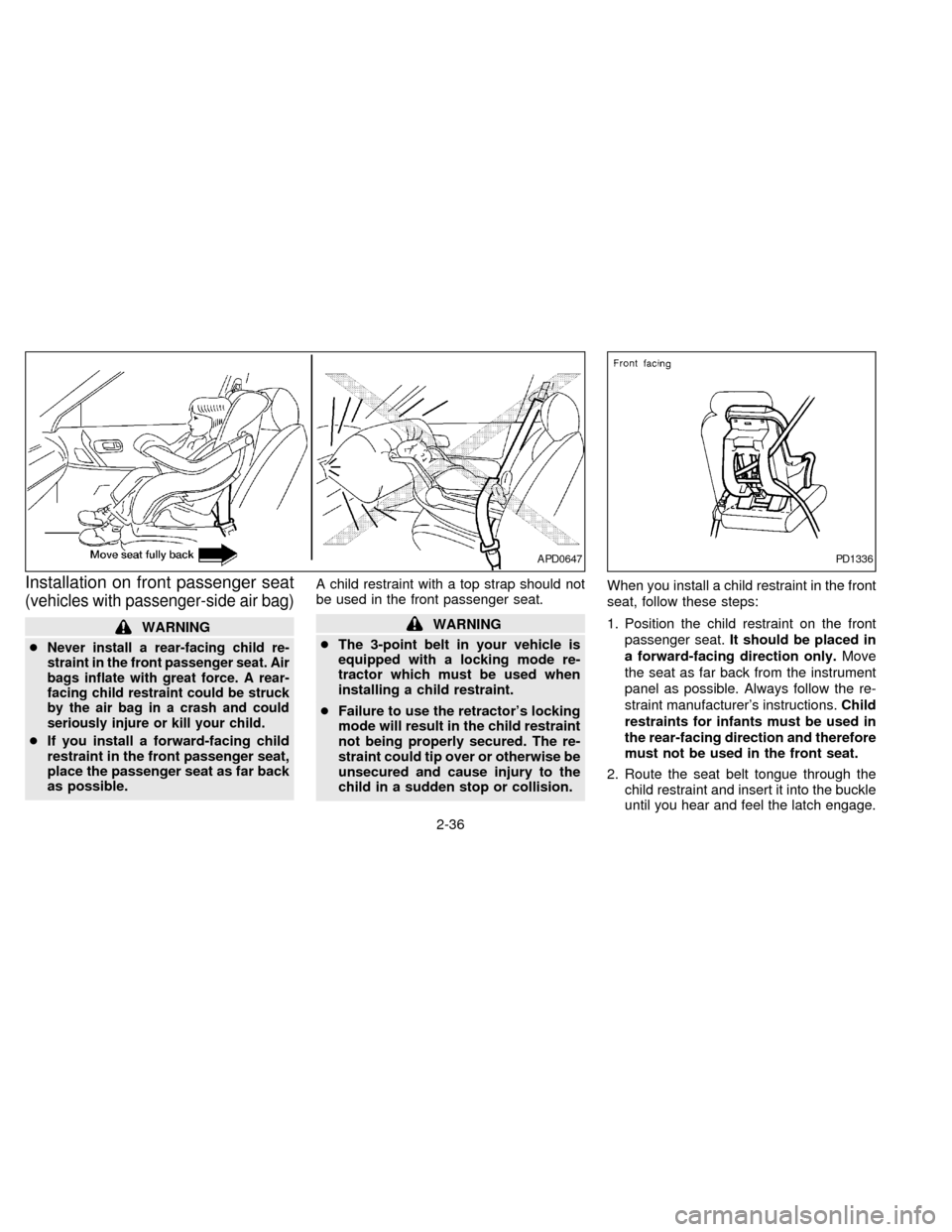
Installation on front passenger seat
(vehicles with passenger-side air bag)
WARNING
c
Never install a rear-facing child re-
straint in the front passenger seat. Air
bags inflate with great force. A rear-
facing child restraint could be struck
by the air bag in a crash and could
seriously injure or kill your child.
cIf you install a forward-facing child
restraint in the front passenger seat,
place the passenger seat as far back
as possible.A child restraint with a top strap should not
be used in the front passenger seat.
WARNING
cThe 3-point belt in your vehicle is
equipped with a locking mode re-
tractor which must be used when
installing a child restraint.
cFailure to use the retractor's locking
mode will result in the child restraint
not being properly secured. The re-
straint could tip over or otherwise be
unsecured and cause injury to the
child in a sudden stop or collision.When you install a child restraint in the front
seat, follow these steps:
1. Position the child restraint on the front
passenger seat.It should be placed in
a forward-facing direction only.Move
the seat as far back from the instrument
panel as possible. Always follow the re-
straint manufacturer's instructions.Child
restraints for infants must be used in
the rear-facing direction and therefore
must not be used in the front seat.
2. Route the seat belt tongue through the
child restraint and insert it into the buckle
until you hear and feel the latch engage.
APD0647PD1336
2-36
ZX
Page 92 of 194

2 (Second gear):
Use for hill climbing or engine braking on
downhill grades.
Do not shift into the 2 position at speeds
over 68 MPH (110 km/h). Do not exceed 68
MPH (110 km/h) in the 2 position.
1 (Low gear):
Use this position when climbing steep hills
slowly or driving slowly through deep snow,
sand or mud, or for maximum engine brak-
ing on steep downhill grades.
Do not shift into the 1 position at speeds
over 34 MPH (55 km/h).
Do not exceed 34 MPH (55 km/h) in the 1
position.
Accelerator downshift
Ð In D position Ð
For rapid passing or hill climbing, fully de-
press the accelerator pedal to the floor. This
shifts the transmission down into third gear,
second gear or first gear, depending on the
vehicle speed.
Overdrive switch
ON: For normal driving, push the over-
drive switch ON with the shift lever in
the D position. The transmission is
upshifted into OVERDRIVE as the
vehicle speed increases.
The overdrive does not engage until the
engine has warmed up.
OFF: For driving up and down long slopes
where engine braking would be ad-
vantageous, push the switch OFF.
When cruising at a low speed or
climbing a gentle slope, you may feeluncomfortable shift shocks as the
transmission shifts between 3rd and
overdrive repeatedly. In this case,
set the overdrive switch in the
OFF position. The indicator
light in the instrument panel comes
on at this time.
When driving conditions change, reset the
overdrive switch in the ON position.
Remember not to drive at high speeds for
extended periods of time with the overdrive
switch set in the OFF position. This reduces
fuel economy.
ASD0613
4-8
ZX
Page 97 of 194
b) Tap the brake pedal; the CRUISE light
goes out.
c) Turn the main switch off. Both the ON
indicator and CRUISE lights go out.
The cruise control is automatically can-
celled and the CRUISE light goes out if:
cYou depress the brake pedal while push-
ing the ACCEL set switch.
cThe vehicle slows down more than 8
MPH (13 km/h) below the set speed.
cYou depress the clutch pedal (manual
transmission), or move the shift lever to
N (automatic transmission).
To reset at a faster cruising speed,use
one of the following three methods:
a) Depress the accelerator pedal. When the
vehicle attains the desired speed, push
and release the COAST/SET switch.
b) Push and hold the ACCEL set switch.
When the vehicle attains the speed you
desire, release the switch.
c) Push and quickly release the ACCEL set
switch. Each time you do this, the set
speed increases by about 1 MPH (1.6
km/h).To reset at a slower cruising speed,use
one of the following three methods:
a) Lightly tap the brake pedal. When the
vehicle attains the desired speed, push
the COAST/SET switch and release it.
b) Push and hold the COAST/SET switch.
Release the switch when the vehicle
slows down to the desired speed.
c) Push and quickly release the
COAST/SET switch. Each time you do
this, the set speed decreases by about 1
MPH (1.6 km/h).
To resume the preset speed,push and
release the RESUME switch. The vehicle
returns to the last set cruising speed when
the vehicle speed is over 30 MPH (48 km/h).
Precautions
cIf the cruise control system malfunctions,
it cancels automatically. The cruise indi-
cator light in the instrument panel then
blinks to warn the driver.
cIf the cruise indicator light blinks, turn the
cruise control main switch off and have
the system checked by your NISSAN
dealer.cThe cruise indicator light may blink when
the cruise control main switch is turned
ON while pushing the RES/ACCEL,
COAST/SET, or CANCEL switch (lo-
cated on the steering wheel). To properly
set the cruise control system, perform the
steps above in the order indicated.
WARNING
Do not use the cruise control when
driving under the following conditions:
cit is not possible to keep the vehicle
at a set speed.
cin heavy traffic or in traffic that var-
ies in speed.
con winding or hilly roads.
con slippery roads (rain, snow, ice,
etc.).
cin very windy areas.
Doing so could cause a loss of vehicle
control and result in an accident.
4-13
ZX
Page 178 of 194

When planning to travel in another coun-
try,you should first find out if the fuel
available is suitable for your vehicle's en-
gine.
Using fuel with too low an octane/cetane
rating may cause engine damage. All gaso-
line vehicles must be operated with un-
leaded engine gasoline. Therefore, avoid
taking your vehicle to areas where appropri-
ate fuel is not available.
When transferring the registration of
your vehicle to another country, state,
province or district,it may be necessary to
modify the vehicle to meet local laws and
regulations.
The laws and regulations for motor vehicle
emission control and safety standards vary
according to the country, state, province or
district; therefore, vehicle specifications
may differ.
When any vehicle is to be taken into
another country, state, province or dis-
trict and registered, its modifications,
transportation, and registration are the
responsibility of the user. NISSAN is not
responsible for any inconvenience that
may result.
VEHICLE IDENTIFICATION
NUMBER (VIN) PLATE
The vehicle identification number (VIN)
plate is attached to the top of the instrument
panel on the driver's side. This number is
the identification for your vehicle and is
used in the vehicle registration.
VEHICLE IDENTIFICATION
NUMBER (Chassis number)
The chassis number is stamped as shown.
TI1050MATI0605
REGISTERING YOUR VEHICLE
IN ANOTHER COUNTRYVEHICLE IDENTIFICATION
9-10
ZX
Page 189 of 194

10 Index
A
Air bag (See supplemental restraint
system) ...................................................... 2-16
Air bag warning light .......................... 1-6, 2-22
Air cleaner housing filter ............................ 7-19
Air conditioner
Air conditioner operation ........................ 3-5
Air conditioner specification label ......... 9-12
Air conditioner system refrigerant and
lubrication recommendations.................. 9-7
Heater and air conditioner controls ........ 3-3
Servicing air conditioner ......................... 3-9
Air flow charts .............................................. 3-6
Alarm system (See theft warning) ............... 1-9
Anchor point locations ............................... 2-35
Antenna (manual) ...................................... 3-14
Anti-lock brake system (ABS).................... 4-17
Anti-lock brake warning light ....................... 1-7
Ashtray (See cigarette lighter and
ashtray) ...................................................... 1-14
Audio system
AM-FM radio with cassette
player........................................... 3-11, 3-13
Automatic
Automatic power window switch .......... 1-17
Automatic transmission fluid (ATF) ...... 7-11
Driving with automatic transmission ....... 4-6B
Battery........................................................ 7-15
Before starting the engine ........................... 4-5
Belts (See drive belts) ............................... 7-17
Brake
Anti-lock brake system (ABS) .............. 4-17
Brake booster ....................................... 7-22
Brake fluid............................................. 7-14
Brake light (See stop light) ................... 7-26
Brake pedal .......................................... 7-21
Brake system ........................................ 4-17
Brake warning light ................................. 1-7
Brake wear indicators ................... 1-8, 7-22
Parking brake check ............................. 7-21
Parking brake operation ....................... 4-11
Break-in schedule ...................................... 4-14
Bulb check/instrument panel ....................... 1-5
C
Capacities and recommended fuel/
lubricants...................................................... 9-2
Cargo (See vehicle loading
information) ................................................ 9-13
Cassette player (See audio
system) ............................................. 3-11, 3-13
CB radio or car phone ............................... 3-15Check engine indicator light (See
malfunction indicator light) ........................... 1-8
Child restraints for infants and small
children ...................................................... 2-31
Child safety rear door lock .......................... 2-6
Cigarette lighter (accessory)
and ashtray ................................................ 1-14
Cleaning exterior and interior ...................... 6-2
Clock-radio ................................................. 3-11
Clutch
Clutch pedal.......................................... 7-23
Cold weather driving .................................. 4-19
Controls
Audio controls ....................................... 3-11
Heater and air conditioner controls ........ 3-3
Coolant
Capacities and recommended fuel/
lubricants ................................................ 9-2
Changing engine coolant........................ 7-6
Checking engine coolant level ............... 7-5
Engine coolant temperature gauge ........ 1-3
Corrosion protection .................................... 6-5
Cruise control............................................. 4-12
Cup holder ................................................. 1-15
ZX
Page 191 of 194

Heater
Heater and air conditioner controls ........ 3-3
Heater operation ..................................... 3-4
Heater operation .......................................... 3-4
Hood release ............................................... 2-7
I
Ignition switch .............................................. 4-4
Increasing fuel economy............................ 4-14
Indicator lights and chimes (See warning/
indicator lights and chimes) ......................... 1-5
Inside mirror ............................................... 2-39
Instrument brightness control .................... 1-13
Interior light ................................................ 1-18
J
Jump starting ............................................... 5-7
K
Key ............................................................... 2-2
Keyless entry system (See multi-remote
control system) ............................................ 2-3L
Labels
Air conditioner specification label ......... 9-12
Emission control information label........ 9-12
Engine serial number ........................... 9-11
F.M.V.S.S. certification label ................ 9-11
Vehicle identification number (VIN)
plate ...................................................... 9-10
Warning labels (for SRS) ..................... 2-22
License plate
Installing the license plate .................... 9-13
Light
Air bag warning light ..................... 1-6, 2-22
Brake light (See stop light) ................... 7-26
Bulb check/instrument panel .................. 1-5
Front fog light switch ............................ 1-13
Headlight aiming adjustment ................ 7-26
Headlight and turn signal switch .......... 1-12
Headlights ............................................. 7-25
Interior light ........................................... 1-18
Light bulbs ............................................ 7-25
Trunk light ............................................. 1-19
Warning/indicator lights and chimes ...... 1-5
Lock
Child safety rear door lock ..................... 2-6
Door locks............................................... 2-2
Fuel filler lid lock opener lever ............. 2-10
Power door lock...................................... 2-3
Trunk lid lock opener lever ..................... 2-8
Luggage (See vehicle loading
information ................................................. 9-13M
Maintenance
General maintenance ............................. 8-2
Inside the vehicle.................................... 8-3
Maintenance precautions ....................... 7-2
Outside the vehicle ................................. 8-2
Periodic maintenance schedules ............ 8-5
Seat belt maintenance.......................... 2-30
Under the hood and vehicle ................... 8-4
Malfunction indicator light ............................ 1-8
Manual antenna ......................................... 3-14
Manual windows ........................................ 1-16
Meters and gauges ...................................... 1-2
Mirror
Inside mirror.......................................... 2-39
Outside mirror control ........................... 2-38
Vanity mirror ......................................... 2-39
Multi-remote control system ........................ 2-3
O
Octane rating (See fuel octane rating) ........ 9-3
Oil
Capacities and recommended fuel/
lubricants ................................................ 9-2
Changing engine oil................................ 7-9
Changing engine oil filter...................... 7-10
Checking engine oil level ....................... 7-8
Engine oil ................................................ 7-8
10-3
ZX