1997 NISSAN QUEST technical and consumer
[x] Cancel search: technical and consumerPage 6 of 247
ContentsInstruments and controls
Pre-driving checks and adjustments
Heater, air conditioner and audio system
Starting and driving
In case of emergency
Appearance and interior care
Do-it-yourself operations
Maintenance schedule
Technical and consumer information
Index
1
2
3
4
5
6
7
8
9
10
Page 47 of 247
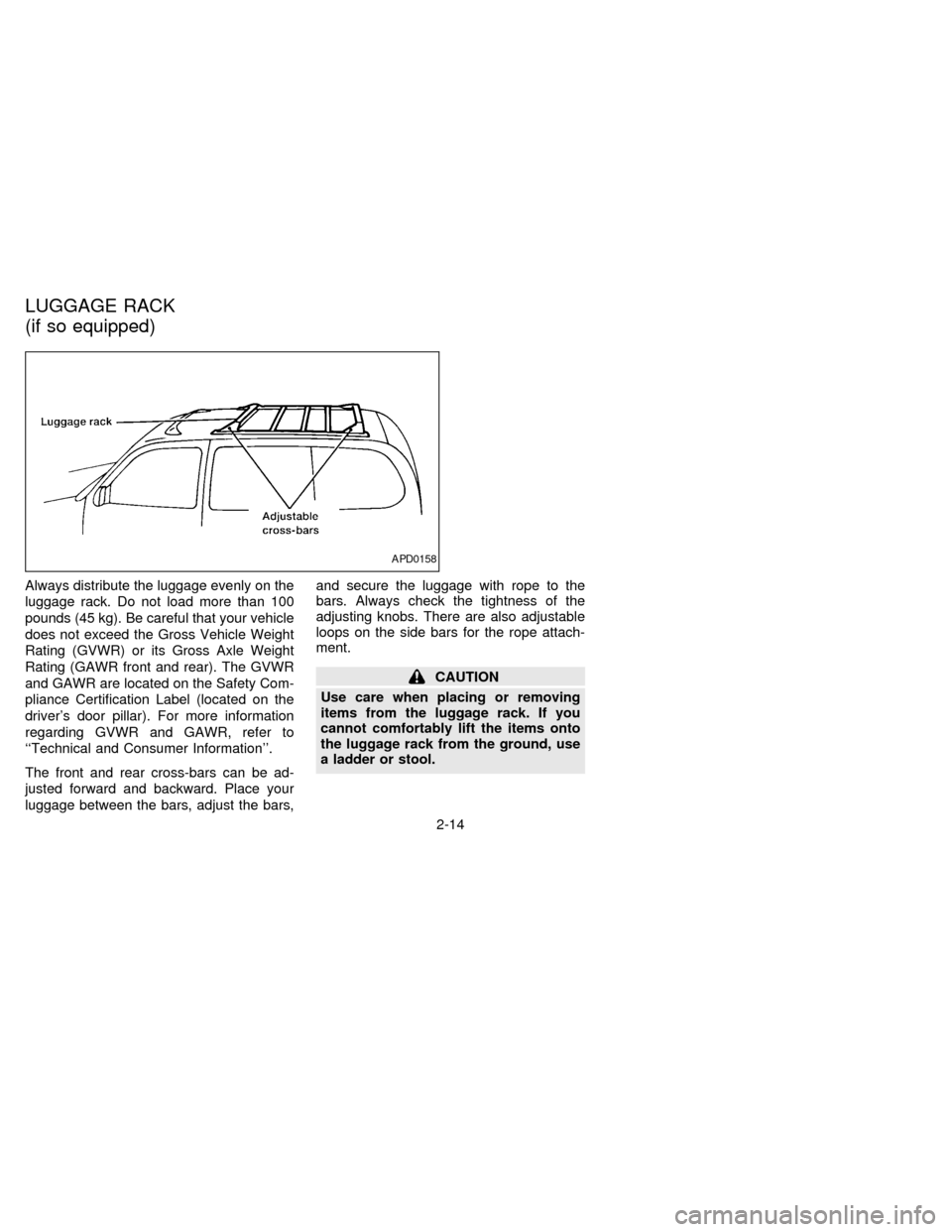
Always distribute the luggage evenly on the
luggage rack. Do not load more than 100
pounds (45 kg). Be careful that your vehicle
does not exceed the Gross Vehicle Weight
Rating (GVWR) or its Gross Axle Weight
Rating (GAWR front and rear). The GVWR
and GAWR are located on the Safety Com-
pliance Certification Label (located on the
driver's door pillar). For more information
regarding GVWR and GAWR, refer to
``Technical and Consumer Information''.
The front and rear cross-bars can be ad-
justed forward and backward. Place your
luggage between the bars, adjust the bars,and secure the luggage with rope to the
bars. Always check the tightness of the
adjusting knobs. There are also adjustable
loops on the side bars for the rope attach-
ment.
CAUTION
Use care when placing or removing
items from the luggage rack. If you
cannot comfortably lift the items onto
the luggage rack from the ground, use
a ladder or stool.
APD0158
LUGGAGE RACK
(if so equipped)
2-14
ZX
Page 184 of 247
Drain plug tightening torque:
22 to 29 ft-lb
(29 to 39 Nzm)
Do not use excessive force.
7. Refill the engine with a recommended oil
and install the cap securely. See the
``Technical and consumer information''
section for refill capacity.
8. Start the engine. Check for leakage
around the drain plug. Correct as re-
quired.
9. Turn the engine off and wait several
minutes. Check the oil level with the
dipstick. Add engine oil if necessary.
CHANGING ENGINE OIL FILTER
1. Park the vehicle on a level surface and
apply the parking brake.
2. Turn the engine off.
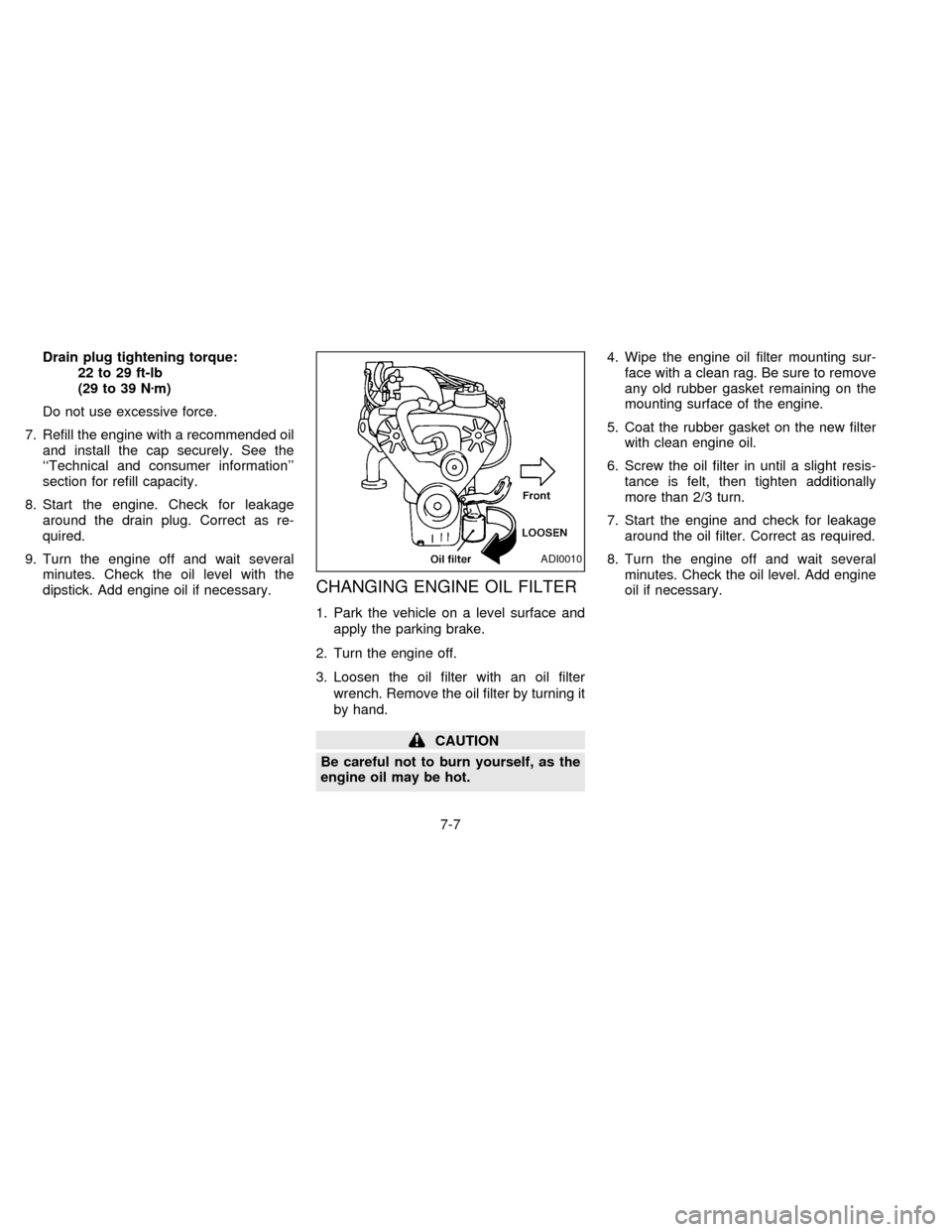
3. Loosen the oil filter with an oil filter
wrench. Remove the oil filter by turning it
by hand.
CAUTION
Be careful not to burn yourself, as the
engine oil may be hot.4. Wipe the engine oil filter mounting sur-
face with a clean rag. Be sure to remove
any old rubber gasket remaining on the
mounting surface of the engine.
5. Coat the rubber gasket on the new filter
with clean engine oil.
6. Screw the oil filter in until a slight resis-
tance is felt, then tighten additionally
more than 2/3 turn.
7. Start the engine and check for leakage
around the oil filter. Correct as required.
8. Turn the engine off and wait several
minutes. Check the oil level. Add engine
oil if necessary.
ADI0010
7-7
ZX
Page 187 of 247
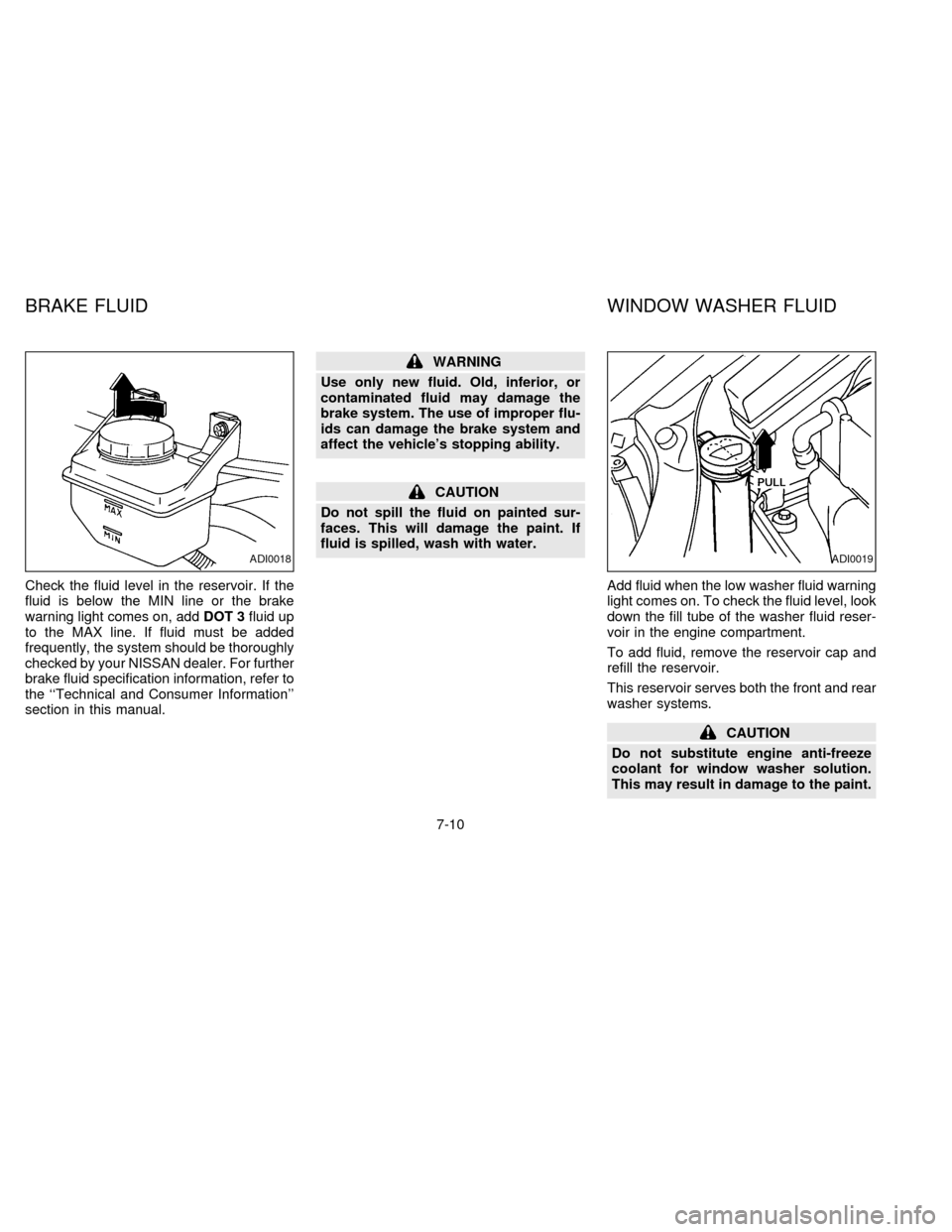
Check the fluid level in the reservoir. If the
fluid is below the MIN line or the brake
warning light comes on, addDOT 3fluid up
to the MAX line. If fluid must be added
frequently, the system should be thoroughly
checked by your NISSAN dealer. For further
brake fluid specification information, refer to
the ``Technical and Consumer Information''
section in this manual.
WARNING
Use only new fluid. Old, inferior, or
contaminated fluid may damage the
brake system. The use of improper flu-
ids can damage the brake system and
affect the vehicle's stopping ability.
CAUTION
Do not spill the fluid on painted sur-
faces. This will damage the paint. If
fluid is spilled, wash with water.
Add fluid when the low washer fluid warning
light comes on. To check the fluid level, look
down the fill tube of the washer fluid reser-
voir in the engine compartment.
To add fluid, remove the reservoir cap and
refill the reservoir.
This reservoir serves both the front and rear
washer systems.
CAUTION
Do not substitute engine anti-freeze
coolant for window washer solution.
This may result in damage to the paint.
ADI0018ADI0019
BRAKE FLUID WINDOW WASHER FLUID
7-10
ZX
Page 190 of 247

1. Disconnect the spark plug cables from
the spark plugs.
When disconnecting, always hold the boots,
not the cables.
2. Remove the spark plugs with a spark
plug socket. The plug socket has a rub-
ber seal that holds the spark plug so it
does not fall when it is pulled out. Make
sure each spark plug is snugly fitted into
the plug socket.
3. Check the gap on each new spark plug
with a feeler gauge. (The spark plug gap
is shown in the ``Technical and consumerinformation'' section.) Adjust it as re-
quired.
4. Fit the new plugs, one at a time, into the
spark plug socket and install them. Turn
each plug several full turns by hand, then
tighten with a spark plug socket to the
correct torque. Do not overtighten.
Spark plug tightening torque:
14 to 22 ft-lb (20 to 29 Nzm)
5. Holding the boot, re-connect each high
tension cable to its proper spark plug by
pushing it on until you feel a snap.
The filter should not be cleaned and reused.
Replace it according to the maintenance
intervals shown in the ``Maintenance sched-
ule'' section. When replacing the filter, un-
clip the four clamps and remove the filter.
Wipe the inside of the air cleaner housing
and the cover with a damp cloth when
replacing filter.
DI1017MADI0579
AIR CLEANER HOUSING
FILTER
7-13
ZX
Page 205 of 247
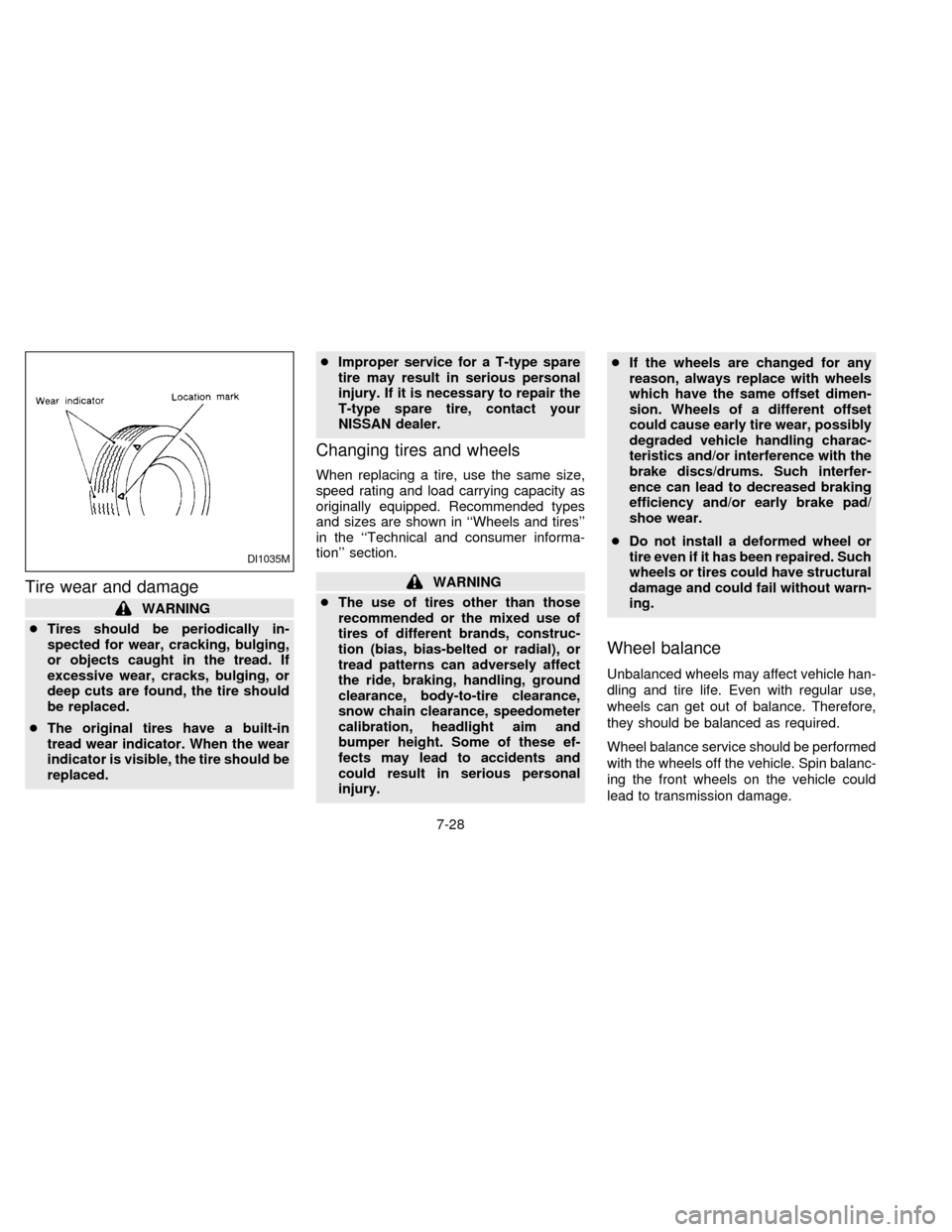
Tire wear and damage
WARNING
cTires should be periodically in-
spected for wear, cracking, bulging,
or objects caught in the tread. If
excessive wear, cracks, bulging, or
deep cuts are found, the tire should
be replaced.
cThe original tires have a built-in
tread wear indicator. When the wear
indicator is visible, the tire should be
replaced.cImproper service for a T-type spare
tire may result in serious personal
injury. If it is necessary to repair the
T-type spare tire, contact your
NISSAN dealer.
Changing tires and wheels
When replacing a tire, use the same size,
speed rating and load carrying capacity as
originally equipped. Recommended types
and sizes are shown in ``Wheels and tires''
in the ``Technical and consumer informa-
tion'' section.
WARNING
cThe use of tires other than those
recommended or the mixed use of
tires of different brands, construc-
tion (bias, bias-belted or radial), or
tread patterns can adversely affect
the ride, braking, handling, ground
clearance, body-to-tire clearance,
snow chain clearance, speedometer
calibration, headlight aim and
bumper height. Some of these ef-
fects may lead to accidents and
could result in serious personal
injury.cIf the wheels are changed for any
reason, always replace with wheels
which have the same offset dimen-
sion. Wheels of a different offset
could cause early tire wear, possibly
degraded vehicle handling charac-
teristics and/or interference with the
brake discs/drums. Such interfer-
ence can lead to decreased braking
efficiency and/or early brake pad/
shoe wear.
cDo not install a deformed wheel or
tire even if it has been repaired. Such
wheels or tires could have structural
damage and could fail without warn-
ing.
Wheel balance
Unbalanced wheels may affect vehicle han-
dling and tire life. Even with regular use,
wheels can get out of balance. Therefore,
they should be balanced as required.
Wheel balance service should be performed
with the wheels off the vehicle. Spin balanc-
ing the front wheels on the vehicle could
lead to transmission damage.
DI1035M
7-28
ZX
Page 220 of 247

9Technical and consumer information
Capacities and recommended fuel/lubricants ........9-2
Fuel recommendation.............................................9-2
Engine oil and oil filter recommendation................9-4
Recommended SAE viscosity number...................9-6
Air conditioner system refrigerant and
lubricant recommendations ....................................9-6
Engine ....................................................................9-7
Wheel/tire size ........................................................9-8
Dimensions and weights ........................................9-8
Registering your vehicle in another country ..........9-9
Vehicle identification ..............................................9-9
Vehicle identification number (VIN) plate...............9-9
Engine serial number .............................................9-9F.M.V.S.S. certification label ................................9-10
Emission control information label .......................9-10
Tire placard ..........................................................9-11
Air conditioner specification label.........................9-11
Installing the license plate ....................................9-11
Vehicle loading information ..................................9-12
Trailer towing ........................................................9-13
Uniform tire quality grading ..................................9-18
Emission control system warranty .......................9-19
Reporting safety defects (USA) ...........................9-19
Readiness for inspection/maintenance (I/M)
test ........................................................................9-20
ZX
Page 247 of 247

Recommended fuel:
Unleaded gasoline, at least 87 AKI number
(RON 91).
For further details such as gasohol, see
``Fuel recommendation'' in the ``Technical
and consumer information'' section.
Recommended engine oil:
cAPI SG or SH and Energy Conserving II
cAPI Certification Mark
cSAE 5W-30 viscosity oil is preferred for
all ambient temperatures
See ``Engine oil and oil filter recommenda-
tion'' in the ``Technical and consumer infor-
mation'' section.
Cold tire pressure:
See tire placard affixed to the glove com-
partment lid.
Recommended new vehicle
break-in procedure:
During the first 1,000 miles (1,600 km) of
vehicle use, follow the recommendations
outlined in the ªBreak-in schedule'' informa-
tion found in the ªStarting and Drivingº sec-
tion of this Owner's Manual. Follow these
recommendations for the future reliability
and economy of your new vehicle. Failure to
follow these recommendations may result in
vehicle damage or shortened engine life.
AGS0501
GAS STATION INFORMATION QUICK REFERENCE
ZX