1997 NISSAN FRONTIER Load
[x] Cancel search: LoadPage 155 of 204
snow traction than All Season tires and may
be more appropriate in some areas.
Summer tires
NISSAN specifies summer tires on some
models to provide superior performance on
dry roads. Summer tire performance in
snow and ice will be substantially reduced.
Summer tires do not have the tire traction
rating ``M&S'' on the tire sidewall.
If you plan to operate your vehicle in snowy
or icy conditions, NISSAN recommends the
use of ``SNOW'' or ``ALL SEASON'' tires on
all four wheels.
Snow tires
If snow tires are needed, it is necessary to
select tires equivalent in size and load rating
to the original equipment tires. If you do not,
it can adversely affect the safety and han-
dling of your vehicle.
Generally, snow tires will have lower speed
ratings than factory equipped tires and may
not match the potential maximum vehicle
speed. Never exceed the maximum speed
rating of the tire.
For additional traction on icy roads, studded
tires may be used. However, some prov-inces and states prohibit their use. Check
local, state and provincial laws before in-
stalling studded tires. Skid and traction ca-
pabilities of studded snow tires on wet or dry
surfaces may be poorer than that of non-
studded snow tires.
4-wheel drive model
If you install snow tires, they must be the
same size, brand, construction and tread
pattern on all four wheels.
CAUTION
ONLY use spare tires specified for each
4-wheel drive model.
Tire chains
Use of tire chains may be prohibited accord-
ing to location. Check the local laws before
installing tire chains. When installing tire
chains, make sure they are the proper size
for the tires on your vehicle and are installed
according to the chain manufacturer's sug-
gestions.Use only SAE class ``S'' chains.
Other types may damage your vehicle. Use
chain tensioners when recommended by
the tire chain manufacturer to ensure a tight
fit. Loose end links of the tire chain must besecured or removed to prevent the possibil-
ity of whipping action damage to the fenders
or undercarriage. If possible, avoid fully
loading your vehicle when using tire chains.
In addition, drive at a reduced speed. Oth-
erwise, your vehicle may be damaged
and/or vehicle handling and performance
may be adversely affected.
Never install tire chains on a TEMPORARY
USE ONLY spare tire.
Tire chains must be installed only on the
rear wheels and not on the front wheels.
Do not use tire chains on dry roads. Driving
with chains in such conditions can cause
damage to the various mechanisms of the
vehicle due to some overstress. When driv-
ing on clear paved roads, be sure to change
to 2WD.
7-26
ZX
Page 157 of 204
cImproper service for a TEMPORARY
USE ONLY spare tire may result in
serious personal injury. If it is nec-
essary to repair the TEMPORARY
USE ONLY spare tire, contact your
NISSAN dealer.
Changing tires and wheels
When replacing a tire, use the same size,
speed rating and load carrying capacity as
originally equipped. Recommended types
and sizes are shown in ``Wheel/tire size'' in
the ``Technical and consumer information''
section.
WARNING
c
The use of tires other than those
recommended or the mixed use of
tires of different brands, construction
(bias, bias-belted or radial), or tread
patterns can adversely affect the ride,
braking, handling, ground clearance,
body-to-tire clearance, snow chain
clearance, speedometer calibration,
headlight aim and bumper height.
Some of these effects may lead to
accidents and could result in serious
personal injury.cIf the wheels are changed for any
reason, always replace with wheels
which have the same offset dimen-
sion. Wheels of a different offset
could cause early tire wear, poor ve-
hicle handling characteristics and/or
interference with the brake discs/
drums. Such interference can lead to
decreased braking efficiency and/or
early brake pad/shoe wear.
cDo not install a deformed wheel or
tire even if it has been repaired. Such
wheels or tires could have structural
damage and could fail without warn-
ing.
4-WHEEL DRIVE MODELS
CAUTION
Always use tires of the same size,
brand, construction (bias, bias-belted
or radial), and tread pattern on all four
wheels. Failure to do so may result in a
circumference difference between tires
on the front and rear axles which will
cause excessive tire wear and may
damage the transmission, transfer
case and differential gears.If excessive tire wear is found, it is recom-
mended that all four tires be replaced with
tires of the same size, brand, construction
and tread pattern. The tire pressure and
wheel alignment should also be checked
and corrected as necessary. Contact your
NISSAN dealer.
CAUTION
ONLY use spare tires specified for each
4-wheel drive model.
Wheel balance
Unbalanced wheels may affect vehicle han-
dling and tire life. Even with regular use,
wheels can get out of balance. Therefore,
they should be balanced as required.
Wheel balance service should be performed
with the wheels off the vehicle. Spin balanc-
ing the front wheels on the vehicle could
lead to transmission damage.
Care of wheels
cWash the wheels when washing the ve-
hicle to maintain their appearance.
cClean the inner side of the wheels when
the wheel is changed or the underside of
the vehicle is washed.
7-28
ZX
Page 172 of 204

9Technical and consumer information
Capacities and recommended fuel/lubricants ........9-2
Fuel recommendation.............................................9-4
Engine oil and oil filter recommendation................9-6
Recommended SAE viscosity number...................9-7
Air conditioner system refrigerant and
lubricant recommendations ....................................9-8
Engine ....................................................................9-9
Wheel/tire size ......................................................9-10
Dimensions and weights ......................................9-11
Registering your vehicle in another country ........9-12
Vehicle identification ............................................9-12
Vehicle identification number (VIN) plate.............9-12
Vehicle identification number (chassis
number) ................................................................9-12
Engine serial number ...........................................9-13Fmvss certification label .......................................9-13
Emission control information label .......................9-14
Tire placard ..........................................................9-14
Air conditioner specification label.........................9-14
Vehicle loading information ..................................9-15
Securing the load .................................................9-16
Truck-camper loading...........................................9-16
Trailer towing ........................................................9-18
Towing load/specification chart ............................9-20
Uniform tire quality grading ..................................9-23
Emission control system warranty .......................9-24
Reporting safety defects (USA) ...........................9-24
Readiness for inspection/maintenance (I/M)
test ........................................................................9-25
ZX
Page 176 of 204

Octane rating tips
In most parts of North America, you should
use unleaded gasoline with an octane rating
of at least 87 AKI (Anti-Knock Index). How-
ever, you may use unleaded gasoline with
an octane rating as low as 85 AKI in high
altitude areas (over 4,000 ft [1,219 m]) such
as: Colorado, Montana, New Mexico, Utah,
Wyoming, northeastern Nevada, southern
Idaho, western South Dakota, western Ne-
braska, and that part of Texas which is
directly south of New Mexico.
Using unleaded gasoline with an octane
rating lower than stated above can cause
persistent, heavy ``spark knock.'' (``Spark
knock'' is a metallic rapping noise.) If
severe, this can lead to engine damage. If
you detect a persistent heavy spark
knock even when using gasoline of the
stated octane rating, or if you hear steady
spark knock while holding a steady speed
on level roads, have your dealer correct
the condition. Failure to correct the con-
dition is misuse of the vehicle, for which
NISSAN is not responsible.
Incorrect ignition timing results in knocking,
after-run and/or overheating. This in turn
may cause excessive fuel consumption ordamage to the engine. If any of the above
symptoms are encountered, have your ve-
hicle checked at a NISSAN dealer or other
competent service facility.
However, now and then you may notice
light spark knock for a short time while
accelerating or driving up hills. This is
no cause for concern, because you get
the greatest fuel benefit when there is
light spark knock for a short time under
heavy engine load.
9-5
ZX
Page 186 of 204
CAUTION
cIt is extremely dangerous to ride in a
cargo area inside of a vehicle. In a
collision, people riding in these ar-
eas are more likely to be seriously
injured or killed.
cDo not allow people to ride in any
area of your vehicle that is not
equipped with seats and seat belts.
c
Be sure everyone in your vehicle is in a
seat and using a seat belt properly.
Terms
It is important to familiarize yourself with the
following terms before loading your vehicle:
cCurb Weight (actual weight of your ve-
hicle) - - vehicle weight including: stan-
dard and optional equipment, fluids,
emergency tools, and spare tire assem-
bly. This weightdoes notinclude pas-
sengers and cargo.
cGVW (Gross Vehicle Weight) - - curb
weight plus the combined weight of pas-
sengers and cargo.cGVWR (Gross Vehicle Weight Rating) - -
maximum total weight (load) limit speci-
fied for the vehicle.
cGAWR (Gross Axle Weight Rating) - -
maximum weight (load) limit specified for
the front or rear axle.
Determining Vehicle Load Capacity
The load capacity of this vehicle is deter-
mined by weight, not by available cargo
space. For example, a luggage rack, bike
carrier, cartop carrier or similar equipment
does not increase load carrying capacity of
your vehicle.
To determine vehicle load capacity:
Vehicle weight can be determined by using
a commercial-grade scale, found at places
such as a truck stop, gravel quarry, grain
elevator, or a scrap metal recycling facility.
1) Determine the curb weight of your ve-
hicle.
2) Compare the curb weight amount to the
GVWR specified for your vehicle to de-
termine how much more weight your
vehicle can carry.
3) After loading (cargo and passengers),reweigh your vehicle to determine if ei-
ther GVWR or GAWR for your vehicle is
exceeded. If GVWR is exceeded, re-
move cargo as necessary. If either the
front or rear GAWR is exceeded, shift the
load or remove cargo as necessary.
Loading Tips
cThe GVW must not exceed GVWR or
GAWR as specified on the FMVSS Cer-
tification Label.
cDo not load the front and rear axle to the
GAWR. Doing so will exceed the GVWR.
cLoads should be spread out, and cargo
should be properly secured. Large or
heavy objects should be placed toward
the front of the trunk box to help prevent
sliding or shifting.
VEHICLE LOADING
INFORMATION
9-15
ZX
Page 187 of 204
SECURING THE LOAD
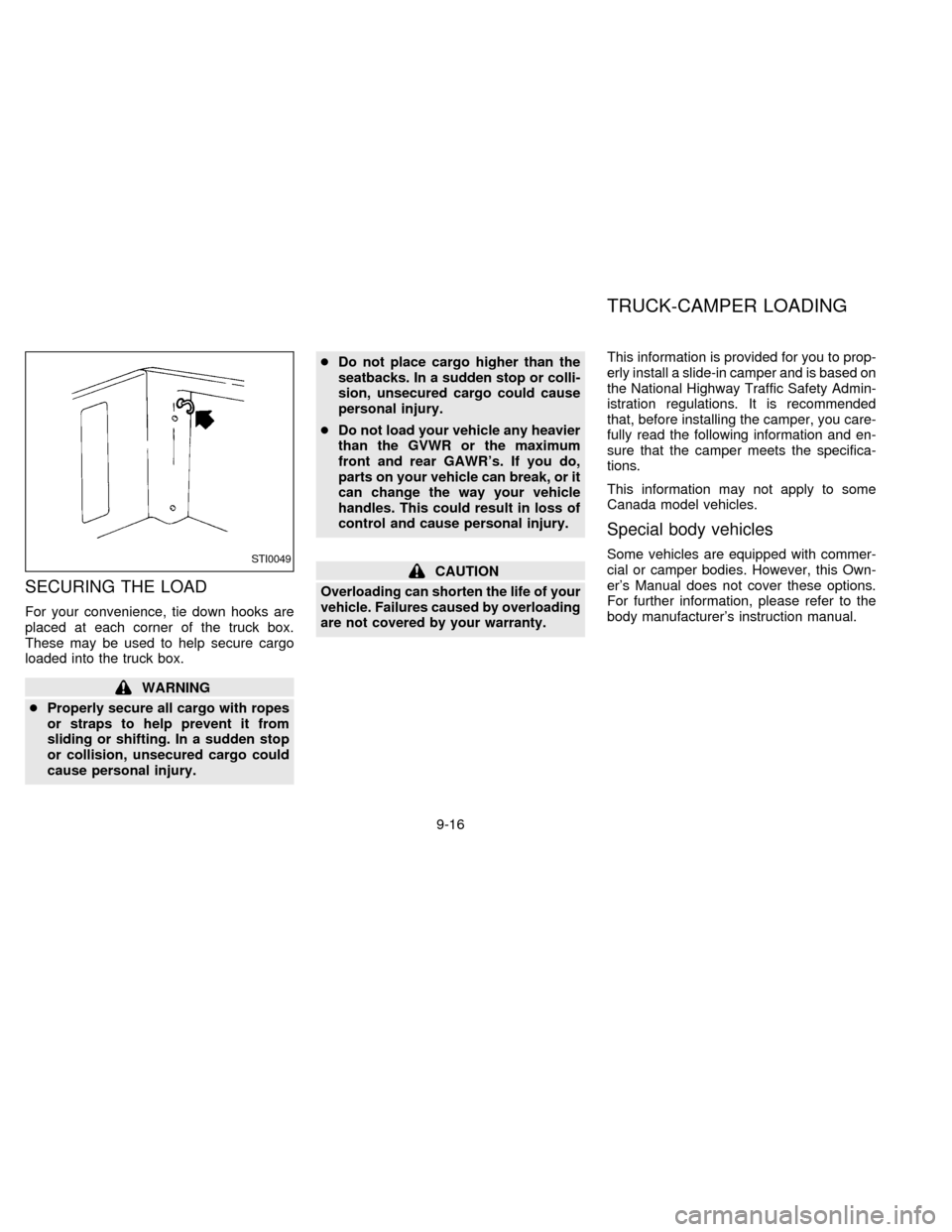
For your convenience, tie down hooks are
placed at each corner of the truck box.
These may be used to help secure cargo
loaded into the truck box.
WARNING
cProperly secure all cargo with ropes
or straps to help prevent it from
sliding or shifting. In a sudden stop
or collision, unsecured cargo could
cause personal injury.cDo not place cargo higher than the
seatbacks. In a sudden stop or colli-
sion, unsecured cargo could cause
personal injury.
cDo not load your vehicle any heavier
than the GVWR or the maximum
front and rear GAWR's. If you do,
parts on your vehicle can break, or it
can change the way your vehicle
handles. This could result in loss of
control and cause personal injury.
CAUTION
Overloading can shorten the life of your
vehicle. Failures caused by overloading
are not covered by your warranty.
This information is provided for you to prop-
erly install a slide-in camper and is based on
the National Highway Traffic Safety Admin-
istration regulations. It is recommended
that, before installing the camper, you care-
fully read the following information and en-
sure that the camper meets the specifica-
tions.
This information may not apply to some
Canada model vehicles.
Special body vehicles
Some vehicles are equipped with commer-
cial or camper bodies. However, this Own-
er's Manual does not cover these options.
For further information, please refer to the
body manufacturer's instruction manual.STI0049
TRUCK-CAMPER LOADING
9-16
ZX
Page 188 of 204
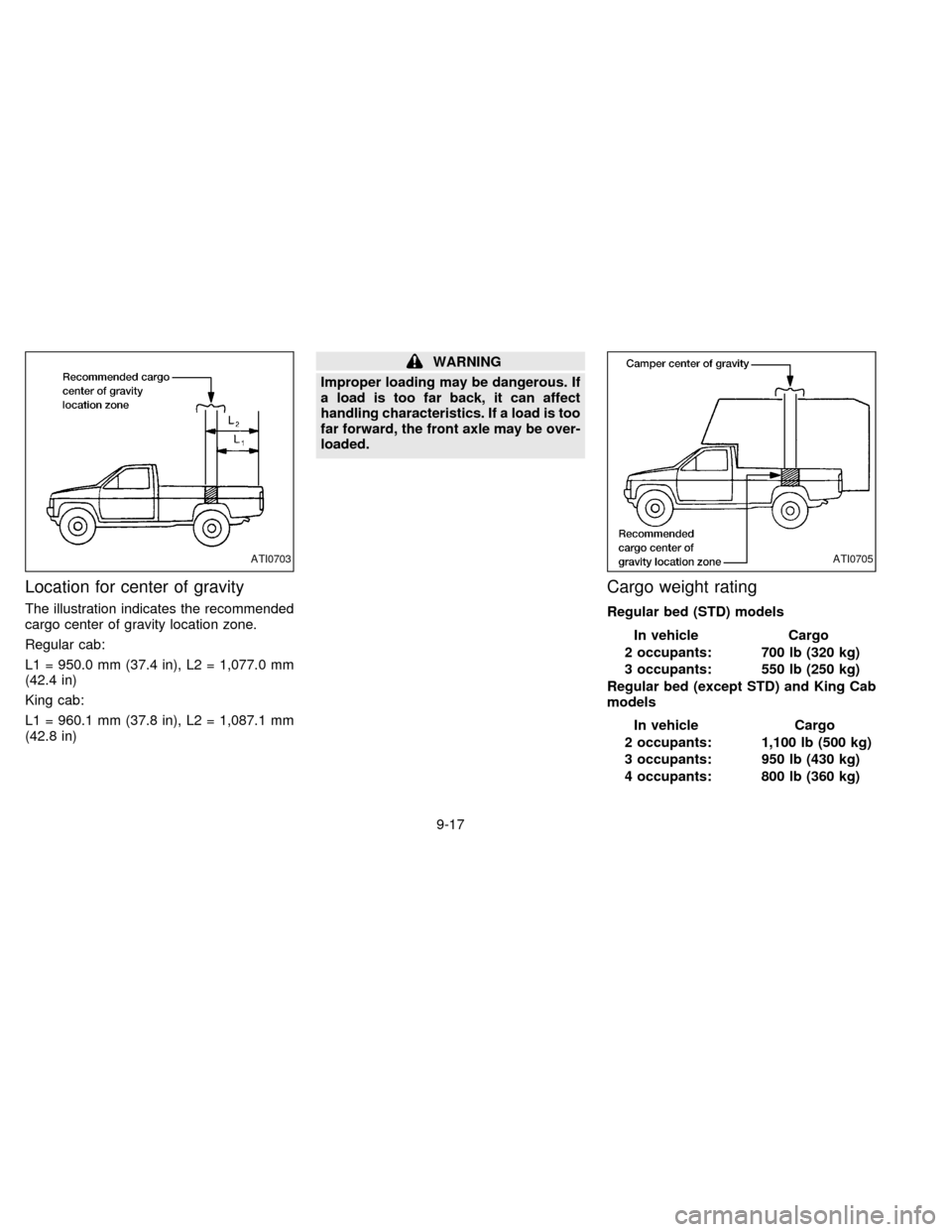
Location for center of gravity
The illustration indicates the recommended
cargo center of gravity location zone.
Regular cab:
L1 = 950.0 mm (37.4 in), L2 = 1,077.0 mm
(42.4 in)
King cab:
L1 = 960.1 mm (37.8 in), L2 = 1,087.1 mm
(42.8 in)
WARNING
Improper loading may be dangerous. If
a load is too far back, it can affect
handling characteristics. If a load is too
far forward, the front axle may be over-
loaded.
Cargo weight rating
Regular bed (STD) models
In vehicle Cargo
2 occupants: 700 lb (320 kg)
3 occupants: 550 lb (250 kg)
Regular bed (except STD) and King Cab
models
In vehicle Cargo
2 occupants: 1,100 lb (500 kg)
3 occupants: 950 lb (430 kg)
4 occupants: 800 lb (360 kg)
ATI0703ATI0705
9-17
ZX
Page 189 of 204
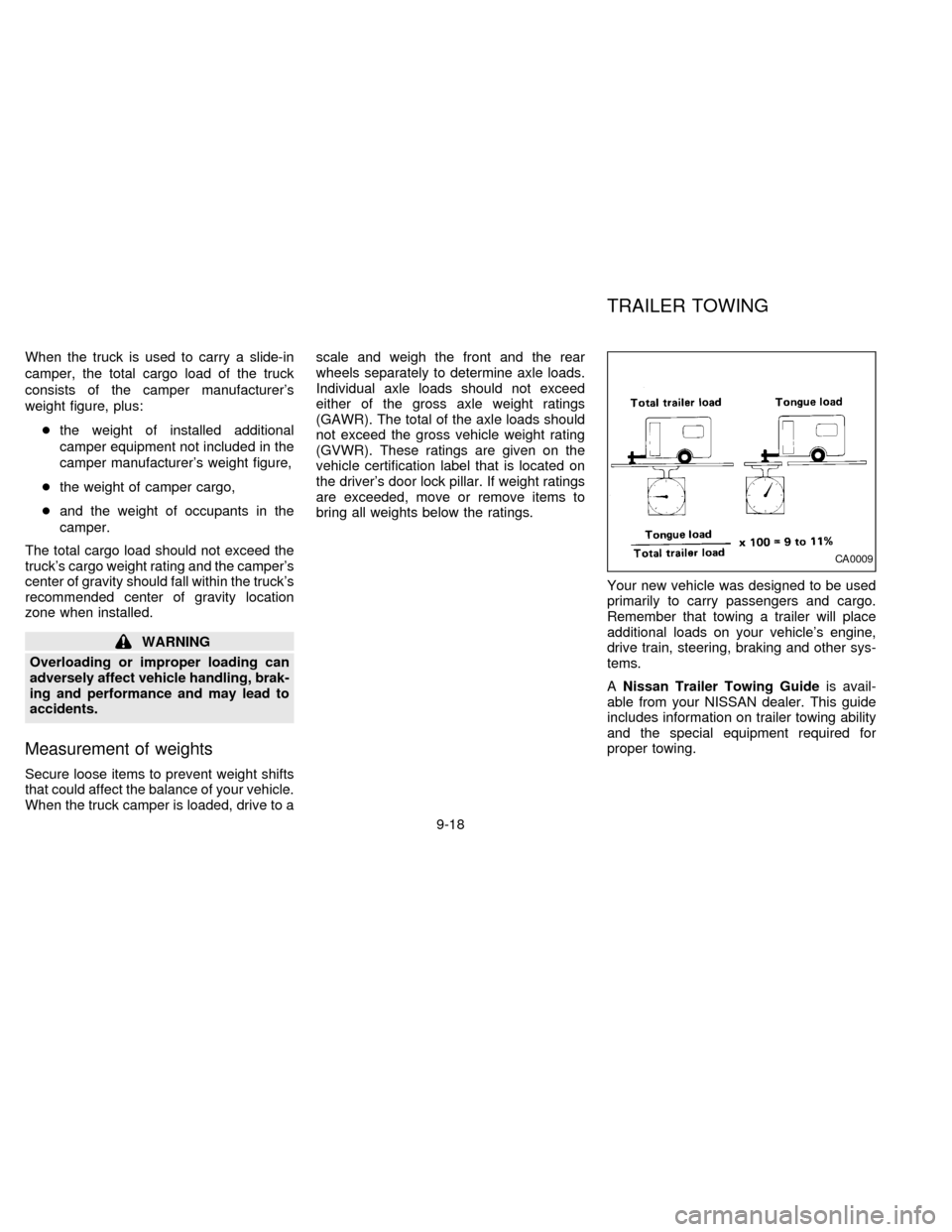
When the truck is used to carry a slide-in
camper, the total cargo load of the truck
consists of the camper manufacturer's
weight figure, plus:
cthe weight of installed additional
camper equipment not included in the
camper manufacturer's weight figure,
cthe weight of camper cargo,
cand the weight of occupants in the
camper.
The total cargo load should not exceed the
truck's cargo weight rating and the camper's
center of gravity should fall within the truck's
recommended center of gravity location
zone when installed.
WARNING
Overloading or improper loading can
adversely affect vehicle handling, brak-
ing and performance and may lead to
accidents.
Measurement of weights
Secure loose items to prevent weight shifts
that could affect the balance of your vehicle.
When the truck camper is loaded, drive to ascale and weigh the front and the rear
wheels separately to determine axle loads.
Individual axle loads should not exceed
either of the gross axle weight ratings
(GAWR). The total of the axle loads should
not exceed the gross vehicle weight rating
(GVWR). These ratings are given on the
vehicle certification label that is located on
the driver's door lock pillar. If weight ratings
are exceeded, move or remove items to
bring all weights below the ratings.
Your new vehicle was designed to be used
primarily to carry passengers and cargo.
Remember that towing a trailer will place
additional loads on your vehicle's engine,
drive train, steering, braking and other sys-
tems.
ANissan Trailer Towing Guideis avail-
able from your NISSAN dealer. This guide
includes information on trailer towing ability
and the special equipment required for
proper towing.
CA0009
TRAILER TOWING
9-18
ZX