1997 MERCEDES-BENZ ML320 oil temperature
[x] Cancel search: oil temperaturePage 699 of 4133
232
Engine compartment
Te ch n ica l
data
Instruments
and controls Operation Driving
Instrument
cluster display Practical hints
Car care Index
Wa r n i n g !
To help prevent personal injury, stay clear of
moving parts when the hood is open and the engine
is running. Be sure the hood is properly closed
before driving. When closing hood, use extreme
caution not to catch hands or fingers.The radiator fan may continue to run for
approximately 30 seconds or even restart after the
engine has been turned off. Stay clear from fan
blades.
The engine is equipped with a transistorized
ignition system. Because of the high voltage it is
dangerous to touch any components (ignition coils,
spark plug sockets, diagnostic socket) of the
ignition system
• with the engine running,
• while starting the engine,
• if ignition is “on” and the engine is turned manually.If you see flames, steam or smoke coming from the
engine compartment, or if the coolant temperature
gauge indicates that the engine is overheated, do
not open the hood. Move away from vehicle and do
not open the hood until the engine has cooled. If
necessary, call a fire department.
Page 700 of 4133
233
Engine compartment
Te ch n ica l
data
Instruments
and controls Operation Driving
Instrument
cluster display Practical hints
Car care Index
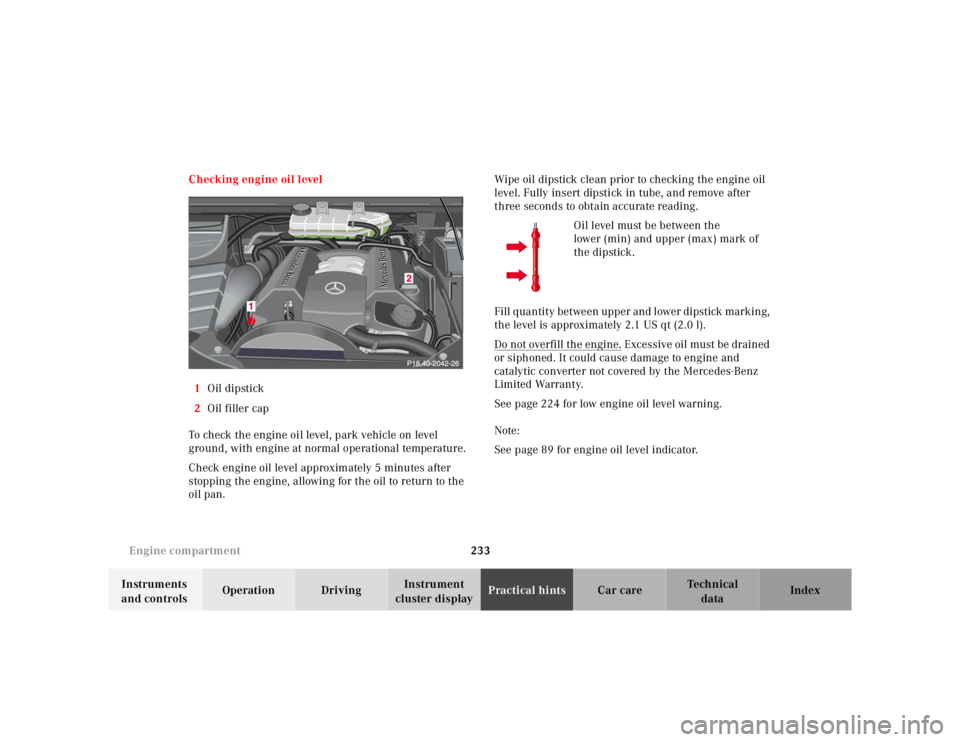
Checking engine oil level
1 Oil dipstick
2 Oil filler cap
To check the engine oil level, park vehicle on level
ground, with engine at normal operational temperature.
Check engine oil level approximately 5 minutes after
stopping the engine, allowing for the oil to return to the
oil pan. Wipe oil dipstick clean prior to checking the engine oil
level. Fully insert dipstick in tube, and remove after
three seconds to obtain accurate reading.
Oil level must be between the
lower (min) and upper (max) mark of
the dipstick.
Fill quantity between upper and lower dipstick marking,
the level is approximately 2.1 US qt (2.0 l).
Do not overfill the engine.
Excessive oil must be drained
or siphoned. It could cause damage to engine and
catalytic converter not covered by the Mercedes-Benz
Limited Warranty.
See page 224 for low engine oil level warning.
Note:
See page 89 for engine oil level indicator.
Page 749 of 4133
282
Cleaning and care of the vehicle
Te ch n ica l
data
Instruments
and controls Operation Driving
Instrument
cluster display Practical hints
Car care Index
Cup holder
Use a gentle dishwashing detergent or mild detergent
for delicate fabrics as a washing solution. Wipe with a
cloth moistened in lukewarm solution. Do not use
scouring agents.
Seat belts
The webbing must not be treated with chemical
cleaning agents. Use only clear, lukewarm water and
soap. Do not dry the webbing at temperatures above
176 °F (80 °C) or in direct sunlight.
Headliner
Clean with soft bristle brush, or use a dry-shampoo
cleaner in case of excessive dirt. Upholstery
Using aftermarket seat covers or wearing clothing that
have the tendency to give off coloring (e.g. when wet
etc.) may cause the upholstery to become permanently
discolored. By lining the seats with a proper
intermediate cover, contact-discoloration will be
prevented.
Leather Upholstery
Wipe leather upholstery with a damp cloth and dry
thoroughly or clean with Mercedes-Benz approved
Leather Care. Exercise particular care when cleaning
perforated leather as its underside should not become
wet.
Cloth Upholstery
Clean with soft bristle brush, or use a dry-shampoo
cleaner in case of excessive dirt.
Hard plastic trim items
Pour Mercedes-Benz approved Interior Care onto soft
lint-free cloth and apply with light pressure.
Plastic and rubber parts
Do not use oil or wax on these parts.
Wa r n i n g !
Do not bleach or dye seat belts as this may severely
weaken them. In a crash they may not be able to
provide adequate protection.
Page 759 of 4133
292
Fuels, coolants, lubricants etc. - capacities
Te ch n ica l
data
Instruments
and controls Operation Driving
Instrument
cluster display Practical hints Car care Index
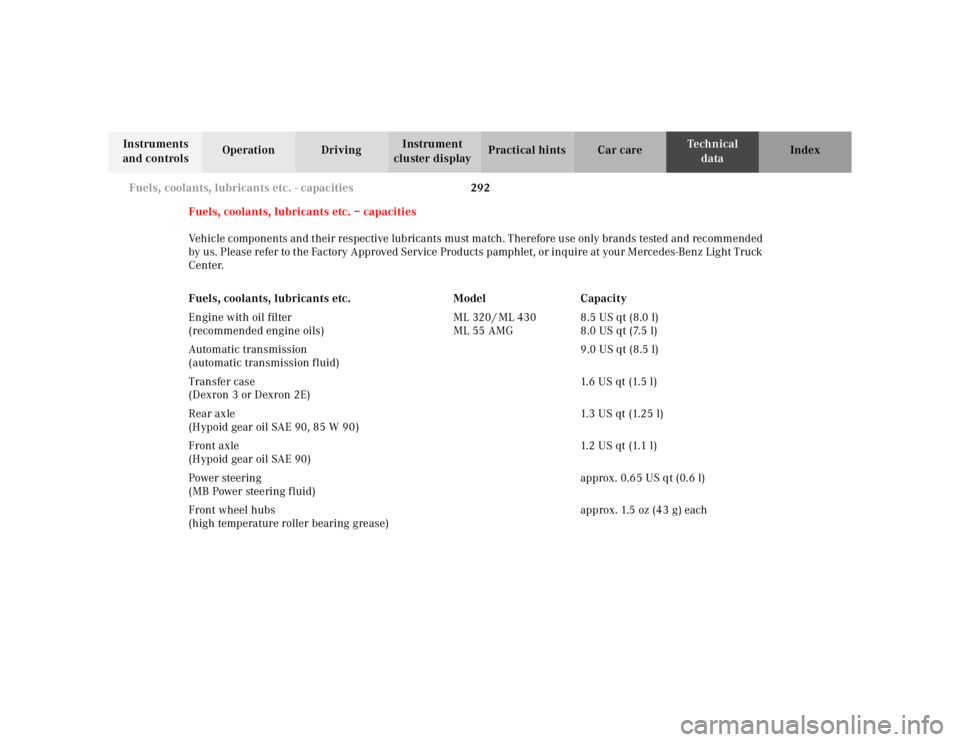
Fuels, coolants, lubricants etc. – capacities
Vehicle components and their respective lubricants must match. Therefore use only brands tested and recommended
by us. Please refer to the Factory Approved Service Products pamphlet, or inquire at your Mercedes-Benz Light Truck
Center.
Fuels, coolants, lubricants etc. Model Capacity
Engine with oil filter
(recommended engine oils) ML 320 / ML 430
ML 55 AMG 8.5 US qt (8.0 l)
8.0 US qt (7.5 l)
Automatic transmission
(automatic transmission fluid) 9.0 US qt (8.5 l)
Transfer case
(Dexron 3 or Dexron 2E) 1. 6 U S q t (1. 5 l )
Rear axle
(Hypoid gear oil SAE 90, 85 W 90) 1.3 US qt (1.25 l)
Front axle
(Hypoid gear oil SAE 90) 1. 2 U S q t (1. 1 l )
Power steering
(MB Power steering fluid) approx. 0.65 US qt (0.6 l)
Front wheel hubs
(high temperature roller bearing grease) approx. 1.5 oz (43 g) each
Page 784 of 4133
DO NOT expose any SRS component to temperatures in excess of 212°F (100°C).
DO NOT expose any SRS component to grease, oil or cleaning agents.
DISABLING & ACTIVATING AIR BAG SYSTEM
DISABLING SYSTEM
Turn ignition off and remove key. Disconnect negative battery cable and shield cable end. Disconnect SRS
control module electrical connector.
ACTIVATING SYSTEM
Connect SRS control module electrical connector. Ensure no one is in vehicle. Turn ignition on. Connect
negative battery cable. Go to SYSTEM OPERATION CHECK
.
DISPOSAL PROCEDURES
Several situations may arise requiring some form of disposal action, including:
Scrapping a vehicle containing deployed air bag modules and ETRs.
Scrapping a vehicle with live air bag modules and ETRs.
Disposal of a live but electrically faulty air bag module and/or ETR.
Disposal of a deployed air bag module and/or ETR.
DEPLOYED AIR BAG OR ETR
Deployed air bag modules and ETRs can be disposed of like any other part.
SCRAPPED VEHICLE
Undeployed air bag modules and ETRs CANNOT be disposed of without first being deployed. Contact
manufacturer for additional information.
UNDEPLOYED AIR BAG OR ETR
Undeployed air bag modules and Emergency Tensioning Retractor (ETR) seat belts CANNOT be disposed of
without first being deployed. Contact manufacturer for additional information.
POST-COLLISION INSPECTION
When a vehicle has been involved in a collision, certain components of the passive restraint system must be
inspected or replaced. See AIR BAG/SRS COMPONENT INSPECTION & REPLACEMENT TABLES
article in the GENERAL INFORMATION section.
REMOVAL & INSTALLATION
2003 Mercedes-Benz ML320
2003 ACCESSORIES/SAFETY EQUIPMENT Mercedes-Benz - Air Bag Restraint Systems
me
Saturday, October 02, 2010 3:32:07 PMPage 3 © 2006 Mitchell Repair Information Company, LLC.
Page 787 of 4133
Observe these precautions when servicing the air bag system:
When working around SRS components and before any re pairs are performed, disable air bag system. See
DISABLING & ACTIVATI NG AIR BAG SYSTEM
.
Before straightening any damage to body, or before performing electrical arc-welding, disable air bag
system. See DISABLING & ACTIVATING AIR BAG SYSTEM
.
Always wear safety glasses and gloves when ha ndling a deployed air bag module. Air bag module may
contain sodium hydroxide deposits wh ich are irritating to the skin.
Always use control module and impact sensors made by same manufacturer. Using components produced
by different manufacturers could cause acc idental air bag or ETR deployment.
DO NOT repair any portion of SRS wiring harness.
If any SRS component is dropped from a height greater than 1.6 feet (0.5 m), it must be replaced.
If SRS components show signs of damage, they must be replaced.
Always handle air bag module with tr im cover facing away from your body.
Always place air bag module on workbench with trim cover up, away from loose objects.
DO NOT expose any SRS component to temperatures in excess of 212°F (100°C ).
DO NOT expose any SRS component to grease, oil or cleaning agents.
DISABLING & ACTIVATI NG AIR BAG SYSTEM
DISABLING SYSTEM
Turn ignition off and remove key. Disconnect ne gative battery cable and shield cable end.
ACTIVATING SYSTEM
Ensure no one is in vehicle. Turn ignition on. Connect negative battery cable. Go to SYSTEM OPERATION
CHECK .
DISPOSAL PROCEDURES
Several situations may arise requiring so me form of disposal action, including:
Scrapping a vehicle containing deployed air bag modules and ETRs.
Scrapping a vehicle with live air bag modules and ETRs.
Disposal of a live but electrically faulty air bag module and/or ETR.
Disposal of a deployed air bag module and/or ETR.
DEPLOYED AIR BAG MODULE OR EMERGENCY TENSIONING RETRACTOR (ETR)
Deployed air bag modules and ETRs can be disposed of like any other part.
SCRAPPED VEHICLE
2004 Mercedes-Benz ML350
2004 ACCESSORIES/SAFETY EQUIPMENT Merce des-Benz - Air Bag Restraint Systems
me
Saturday, October 02, 2010 3:40:40 PMPage 2 © 2006 Mitchell Repair Information Company, LLC.
Page 810 of 4133

ContentsOperation......................................... 191
The first 1000 miles (1500 km) ......... 192
Driving instructions ............................ 193
Drive sensibly – save fuel ............. 193
Drinking and driving ..................... 193
Pedals .......................................... 193
Power assistance ......................... 193
Brakes .......................................... 194
Driving off..................................... 195
Parking ......................................... 196
Tires ............................................. 196
Hydroplaning ................................ 197
Tire traction .................................. 197
Tire speed rating .......................... 198
Winter driving instructions ........... 198
Standing water ............................. 200
Off-road driving ............................ 200
Trailer towing ............................... 206
Passenger compartment .............. 211
Driving abroad .............................. 211
Control and operation of
radio transmitters......................... 211
Catalytic converter ....................... 212
Emission control........................... 212
Coolant temperature .................... 213At the gas station .............................. 214
Refueling ...................................... 214
Check regularly and before
a long trip ..................................... 215
Engine compartment ......................... 217
Hood ............................................ 217
Engine oil ..................................... 218
Transmission fluid level ................ 222
Coolant ........................................ 222
Battery ......................................... 223
Windshield washer system and
headlamp cleaning system* ......... 224
Tires and wheels ................................ 226
Important guidelines .................... 226
Life of tire..................................... 227
Direction of rotation ..................... 227
Checking tire inflation pressure ... 227
Rotating wheels ........................... 228
Winter driving .................................... 230
Winter tires .................................. 230
Block heater (Canada only) .......... 231
Snow chains ................................. 231Maintenance...................................... 232
Clearing the service indicator ...... 232
Service term exceeded ................ 233
Calling up the service indicator .... 233
Resetting the service indicator .... 233
Vehicle care....................................... 234
Cleaning and care of the vehicle .. 234
Practical hints................................. 241
What to do if … .................................. 242
Lamps in instrument cluster ........ 242
Additional indicators in the
speedometer display.................... 256
Where will I find ...? ........................... 257
First aid kit ................................... 257
Vehicle tool kit ............................. 257
Spare wheel (space-saver tire) ..... 259
Unlocking / locking in an emergency . 261
Unlocking the vehicle................... 261
Locking the vehicle ...................... 262
Changing batteries in the
remote control ............................. 262
Fuel filler flap ............................... 263
Manually unlocking the
transmission gear selector lever .. 264
Page 811 of 4133

Contents
Opening / closing in an emergency .... 265
Sliding / pop-up roof* ................... 265
Replacing bulbs ................................. 266
Bulbs ............................................ 266
Replacing bulbs for front lamps ... 268
Replacing bulbs for rear lamps..... 270
Adjusting headlamp aim............... 272
Replacing wiper blades ...................... 273
Removing ..................................... 273
Installing ...................................... 273
Flat tire .............................................. 274
Mounting the spare wheel............ 274
Battery ............................................... 278
Disconnecting the battery ............ 279
Removing the batteries ................ 279
Charging and reinstalling
batteries....................................... 279
Reconnecting the batteries .......... 279
Jump starting ..................................... 281
Towing the vehicle ............................. 283
Front towing eye .......................... 285
Rear towing eye ........................... 285
Stranded vehicle .......................... 286Fuses .................................................. 287
Fuse box in engine
compartment ................................ 287
Auxiliary fuse box in front
passenger footwell........................ 288
Technical data.................................. 289
Spare parts service............................. 290
Warranty coverage ............................. 291
Loss of Service and Warranty
Information Booklet ...................... 291
Identification labels ............................ 292
Layout of poly-V-belt drive .................. 293
Engine ................................................ 294
Rims and tires .................................... 295
Rims and tires ............................... 295
Spare wheel .................................. 296
Electrical system ................................ 297
Main Dimensions ................................ 298
Weights .............................................. 299Fuels, coolants, lubricants etc............ 300
Capacities ..................................... 300
Engine oils .................................... 302
Engine oil additives ....................... 302
Air conditioning refrigerant ........... 302
Brake fluid .................................... 302
Premium unleaded gasoline.......... 303
Fuel requirements......................... 303
Gasoline additives......................... 303
Coolants ....................................... 304
Anticorrosion / antifreeze.............. 305
Windshield washer system and
headlamp cleaning system* ......... 307
Windshield and headlamp
washer fluid mixing ratio............... 307
Consumer information........................ 308
Uniform tire quality grading .......... 308
Temperature ................................. 309
Technical terms............................... 311Index................................................. 317