1997 MERCEDES-BENZ ML320 oil additives
[x] Cancel search: oil additivesPage 1141 of 4133
337 Index
Sun visor 132
Supplemental Restraint System
(SRS) 314
Switching off
Automatic climate control 137
ESP 81
Hazard warning flasher 112
Headlamps 54
Rapid seat heating 99
Transmission control – LOW RANGE
mode 125
Switching on
Automatic climate control 137
ESP 82
Front fog lamps 111
Front fog lamps, rear fog lamp 111
Hazard warning flasher 112
Headlamps 48
High beams 110
Rapid seat heating* 98
Seat heating* 98
Transmission control – LOW RANGE
mode 125
Trip computer* 186
Windshield wipers 49Synchronizing
ESP 246
Power windows 146
Remote control 263
Sliding/pop-up roof* 149
T
Tachometer 26, 118
Displaying gear range 121
Tail lamps 270
Cleaning 236
Replacing bulbs 267Tar stains 235
Technical data 302
Brake fluid 302
Coolants 304
Electrical system 297
Engine 294
Engine oil 302
Engine oil additives 302
Fuel requirements 303
Gasoline additives 303
Main dimensions 298
Premium unleaded gasoline 303
Rims and tires 295
Weights 299
Windshield and headlamp washer
system 307
Tele Aid System* 315
Page 3146 of 4133
1. Hypoid gear oils
Hypoid gear oils contain a high level of EP/AW additives (Extreme Pressure/Antiwear) and a highly
viscous base oil to prevent seizure when the hypoid gears mesh (mixed and boundary friction conditions)
and to ensure a high degree of protection against wear. The compatibility with radial shaft seals is
regarded as critical with such high concentrations of additives because the P/S additive systems become
thermally unstable at temperatures from 130°C to 140°C and this may lead to sludging of the hypoid oil.
The resultant deposits on the radial shaft seals then generally lead to thermal overload and this in turn
leads to leakage in this component.
The tooth engagement conditions of the hypoid gears result in a high proportion of sliding and a low
hydrodynamic proportion of tooth engagement between the pinion and ring gear. Due to the high
tribological load compared to adhesive wear (seizure) and pitting, the performance of hypoid gear oils
must be particularly high with respect to these types of wear. The formula of the oils is therefore
determined by a high concentration of EP/AW additives and a highly viscous base oil. Alternative oils,
e.g. engine oils, cannot be used for these drive types. Proof of performance that an oil fulfills the
requirements of DaimlerChrysler AG is provided by internal tests. However, the hypoid gear oils must at
least correspond to the US military specification MIL-L-2105 B/C/D and must be classed GL-5 in the
quality grade according to API (American Institute of Petroleum).
1.7 Viscosity requirements
The cold flow behavior is only specified for SAE, ... oils. Here, the limits apply according to SAE J 306
c, according to which the dynamic viscosity may be max. 150,000 mPas at -40°C for oils and at -12°C for
oils. As a result of the tendency to form deposits in the transmission, the polymer content is limited to
max.
1 percent by weight for pour point reducers. Polymers as VI improvers for thickening low-viscosity base
oils are not permitted. The kinematic viscosity at 100°C must be at least 16.5 mm
2 /s.
2. Transmission oils, sheet 235.1
The additive and viscosity properties of the transmission oils are adjusted so that they meet all the
requirements placed on manual transmissions with steel/molybdenum synchronization, spur gear axles,
MB and ZF transfer cases and reversing gears. Among other things, this results in the fact that the oils
ensure a defined friction coefficient of the synchronizer elements, even after a high number of shift
operations, without crunching noises.
With gear drives and roller bearings, the adhesive wear (seizure) and pitting in particular should be
minimized as far as possible.
2.1 Viscosity requirements
The cold flow behavior is only specified for SAE, 80W, ...oils. Here, the limits according to SAE J 306 c
apply, according to which the dynamic viscosity may be max. 150,000 mPas at -40°C for oils, at -26°C
for oils and at -12°C for oils. Due to the formation of deposits in the transmission, the polymer content is
limited to max. 1 percent b
y weight for pour point reducers. Polymers as VI improvers for thickening
2004 Mercedes-Benz ML350
1998-2005 GENINFO Overall vehicle - 163 Chassis
me
Saturday, October 02, 2010 3:47:56 PMPage 501 © 2006 Mitchell Repair Information Company, LLC.
Page 3168 of 4133
etc. of these coolant specifications also apply. It is imperative that the correct concentration (50/50) is
used in their application and, of course, further dilution is not permitted!
Approval status:
Coolants for all vehicle and engines (Basis 325.0) Sheet 326.0
Coolants for commercial vehicle and industrial engines (Basis 325.2) Sheet 326.2
Coolants for commercial vehicle and industrial engines (Basis 325.3) Sheet 326.3
The regulations for each respective Sheet 325.x are to be transferred correspondingly to Sheet
326.x.
At the time of compiling these regulations it is possible that not all the Sheets 326.x are represented with
approved products.
2.Coolant additives (General information)
Normally, coolant consists of water and anticorrosion/antifreeze agents. The anticorrosion/antifreeze
agents (ethylene glycol with corrosions inhibitors) in the cooling system have to fulfill, among other
things, the following functions:
to provide sufficient corrosion and cavitation protection for all cooling system components
freezing point depression (antifreeze)
increasing boiling point
For corrosion protection purposes the coolant
approx. 50 vol.-% Anticorrosion/antifreeze agents are added if the expected ambient temperatures do not
require an even higher concentration. This concentration (50 vol %) offers frost protection up to approx. -
37°C. A higher concentration is only necessary if the ambient temperatures are even lower.
Even with extremely low ambient temperatures, not more than 55 vol.-% anticorrosion/antifreeze agent
should be used, because at this level the maximum antifreeze protection is reached and a greater
concentration reduces the antifreeze protection again and decreases the heat dissipation (55 vol.-%
corresponds to antifreeze protection down to approx. -45°C).
Should these coolant regulations fail to be observed then corrosion and damage to the cooling
system are inevitable.
The admixture of anticorrosion/antifreeze agent serves to increase the boiling point. By raising the
pressure the boiling temperature can be increased yet further. Both physical relationships are put to use in
modern cooling systems - the maximum coolant temperature is raised, without increasing the danger of
boiling. In keeping with the higher temperature level the cooling performance is also greater. Only
approved products (Sheet 325.0/326.0 or 325.2 or 326.2, 325.3 or 326.3 as well as 312.0 or 311.0)
2004 Mercedes-Benz ML350
1998-2005 GENINFO Overall vehicle - 163 Chassis
me
Saturday, October 02, 2010 3:47:57 PMPage 523 © 2006 Mitchell Repair Information Company, LLC.
Page 3169 of 4133
provide reliable cooling system protection. In special cases (commercial-vehicle engines, no antifreeze
specification) coolant additives can be used that are primarily corrosion protection additives. In this case
item 2.3 is valid.
As an exception, if neither anticorrosion/antifreeze agent conforming to Sheet 325.0 nor coolant additives
without addition of antifreeze conforming to Sheet 312.0 are available, proceed according to point 2.4
(exception: OM 500 and OM 900). The systems described under items 2.2/2.3/2.4 are not compatible
with each other. It is recommended to mix the entire coolant quantity outside the engine.
2.1 Anticorrosion/antifreeze agent for passenger-car engines
Alongside the correct constitution of the cooling water (point 1.2.2), care must be taken to ensure that
only anticorrosion/antifreeze agents as approved for all engines in accordance with Sheet 325.0 are used.
These products serve to guarantee that, in particular, an effective protection against corrosion is provided
for all light-alloy parts in the cooling system and they are also specified for all passenger-car engines.
In order to ensure that the protection against corrosion is effective, the anticorrosion/antifreeze agent must
remain in the cooling system throughout the year - including when in tropical climates - and regardless of
the operating conditions. In countries with high outside temperatures this is also important in terms of
raising the boiling point.
In the event that these regulations are not observed the cooling system may suffer from damage by
corrosion. As a consequence of corrosion deposits there is a danger that ducts in the radiators (engine
overheating) and heat exchangers (poor heat output) get plugged up thus causing damage to the engine.
As a result of the optimizations we have carried out on the system of engine/coolant/cooling system, in
the majority of our newer passenger cars, a replacement of coolant is not necessary until reaching 15
operating years or 250,000 km (whichever comes first). This may not apply to some models; in these
cases the maintenance booklet will stipulate another regulation.
2.2 Anticorrosion/antifreeze agent for commercial-vehicle engines (normal case)
(not: BR 600, BR 100 and BR 200)
The coolant in commercial-vehicle engines is made up of both water and anticorrosion/antifreeze agent
(refer to item 1.1.1) and as such offers ideal protection against corrosion and cavitation.
All the approved products on the Sheets 325.2, 325.3 or 325.0 which are part of the Specifications for
Operating Fluids can be used to select an anticorrosion/antifreeze agent. However, it should be noted that
passenger vehicle engines built into commercial vehicles must be filled like passenger vehicles (e.g. OM
601 in T1), i.e. a product conforming to Sheet 325.0 and 326.0 must be used.
Products that are not listed in Sheets 325.0 and 326.0, or 325.2 and 326.2, or 325.3 and 326.3 are not
approved and are therefore not to be used under any circumstances.
Anticorrosion/antifreeze agents or coolants conforming to Sheet 325.3 or 326.3 may be used for
longer than other products due to their composition. The change interval is set at 5 years (refer to
2004 Mercedes-Benz ML350
1998-2005 GENINFO Overall vehicle - 163 Chassis
me
Saturday, October 02, 2010 3:47:57 PMPage 524 © 2006 Mitchell Repair Information Company, LLC.
Page 3170 of 4133
Overview Section 5). However, it should always be remembered that anticorrosion/antifreeze
a
gents or coolants conforming to Sheet 325.3 and 326.3 must not be mixed with those conforming to
Sheet 325.0 or 326.0 or 325.2 and 326.2.
2.3 Coolant additives for commercial-vehicle en
gines without antifreeze specifications (refer to item
1.1.2) (not: BR 600, BR 100 and BR 200)
In those application cases where no antifreeze is necessary, coolant for commercial-vehicle engines as
under item 1.1.2 can be mixed to suit. It is impossible to cite generalized mixing proportions because the
application concentrations of products included in Sheet 312.0 may be different. If the tolerances exceed
or fall below those given in Sheet 312.0, then appropriate adjustments must be made. The coolant's
boiling point is only insignificantly increased by these additives. The starting-off water underlies the
more stringent regulations as under point 1.2.3. The usage period for this coolant is shorter than usual (see
position 3). If it is necessary to refill, the same product must be used and at the same concentration level.
The blending of different products is not permitted as stated in Sheet 312.0.
2.4 Coolant regulations for commercial vehicle engines (exception, not for engines OM 500, OM
900, OM 457 and OM 460)
In the event that neither an approved anticorrosion/antifreeze agent is available, nor a coolant additive in
accordance with sheet 312.0 and if temperatures do not drop below freezing then it is possible in this
exceptional case to use a coolant refining agent to 1 vol % if it is approved in sheet 311.0 (soluble
corrosion protection oil). This will not raise the boiling point. The starting-off water itself underlies the
more stringent regulations as under point 1.2.3.
The period of usage for this coolant, which may only be used in exceptional circumstances, is shorter than
usual (refer to position 3).
Water that is too hard may impair the emulsion resistance, with the result that the emulsion
breaks down (oil separation) and the engine's water jackets are contaminated.
2.4.1 Applying water refining mixture
When carrying out a new filling (initial filling or filling after a cleansing operation) an emulsion of 1.0-
1.5 vol % should be used. When refilling, an emulsion of 0.5-1.0 vol % should be used. Concentrations
that are too high (>1.5 vol %) do not improve the corrosion protection capability and may exert a negative
influence on seals and hoses.
3.Monitoring coolant operation
It is very important to monitor the coolant constantly if the engine is to run trouble free.
The concentration level should be checked every six months.
The inspection should be conducted with suitable apparatus. If, when monitoring the concentration of the
coolant, it is determined that the concentration of anticorrosion/antifreeze agent has reached 40 vol.% or
less or an antifreeze protection of -28°C is no lon
ger guaranteed, the concentration must be increased to
2004 Mercedes-Benz ML350
1998-2005 GENINFO Overall vehicle - 163 Chassis
me
Saturday, October 02, 2010 3:47:57 PMPage 525 © 2006 Mitchell Repair Information Company, LLC.
Page 3191 of 4133
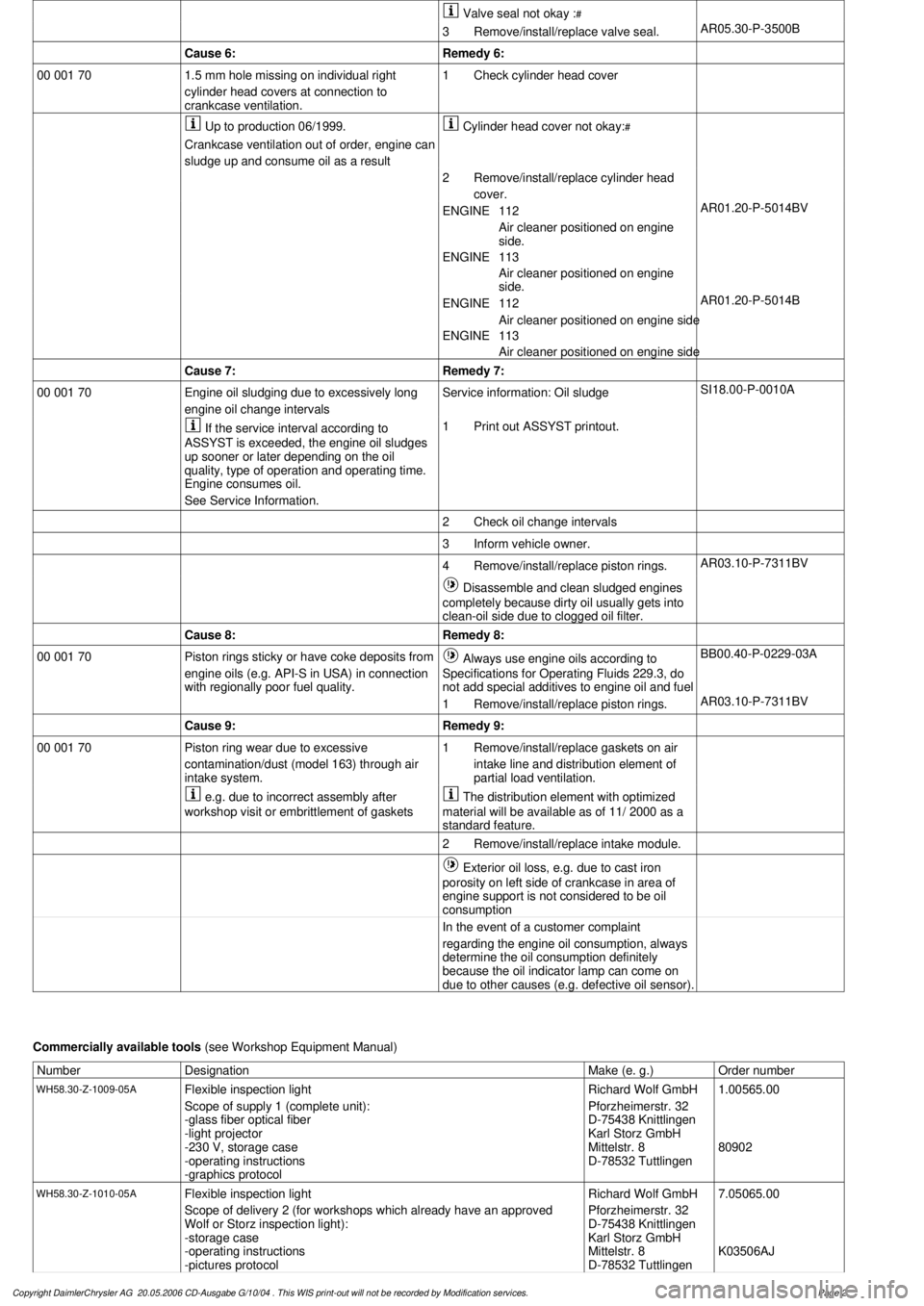
Valve seal not okay :
#
3
Remove/install/replace valve seal.
AR05.30-P-3500B
Cause 6:
Remedy 6:
00 001 70
1.5 mm hole missing on individual right
cylinder head covers at connection to
crankcase ventilation.
1
Check cylinder head cover
Up to production 06/1999.
Crankcase ventilation out of order, engine can
sludge up and consume oil as a result
Cylinder head cover not okay:
#
2
Remove/install/replace cylinder head
cover.
ENGINE
112
Air cleaner positioned on engine
side.
ENGINE
113
Air cleaner positioned on engine
side.
AR01.20-P-5014BV
ENGINE
112
Air cleaner positioned on engine side
ENGINE
113
Air cleaner positioned on engine side
AR01.20-P-5014B
Cause 7:
Remedy 7:
00 001 70
Engine oil sludging due to excessively long
engine oil change intervals
Service information: Oil sludge
SI18.00-P-0010A
If the service interval according to
ASSYST is exceeded, the engine oil sludges
up sooner or later depending on the oil
quality, type of operation and operating time.
Engine consumes oil.
See Service Information.
1
Print out ASSYST printout.
2
Check oil change intervals
3
Inform vehicle owner.
4
Remove/install/replace piston rings.
AR03.10-P-7311BV
Disassemble and clean sludged engines
completely because dirty oil usually gets into
clean-oil side due to clogged oil filter.
Cause 8:
Remedy 8:
00 001 70
Piston rings sticky or have coke deposits from
engine oils (e.g. API-S in USA) in connection
with regionally poor fuel quality.
Always use engine oils according to
Specifications for Operating Fluids 229.3, do
not add special additives to engine oil and fuel
BB00.40-P-0229-03A
1
Remove/install/replace piston rings.
AR03.10-P-7311BV
Cause 9:
Remedy 9:
00 001 70
Piston ring wear due to excessive
contamination/dust (model 163) through air
intake system.
1
Remove/install/replace gaskets on air
intake line and distribution element of
partial load ventilation.
e.g. due to incorrect assembly after
workshop visit or embrittlement of gaskets
The distribution element with optimized
material will be available as of 11/ 2000 as a
standard feature.
2
Remove/install/replace intake module.
Exterior oil loss, e.g. due to cast iron
porosity on left side of crankcase in area of
engine support is not considered to be oil
consumption
In the event of a customer complaint
regarding the engine oil consumption, always
determine the oil consumption definitely
because the oil indicator lamp can come on
due to other causes (e.g. defective oil sensor).
Commercially available tools
(see Workshop Equipment Manual)
Number
Designation
Make (e. g.)
Order number
WH58.30-Z-1009-05A
Flexible inspection light
Scope of supply 1 (complete unit):
-glass fiber optical fiber
-light projector
-230 V, storage case
-operating instructions
-graphics protocol
Richard Wolf GmbH
Pforzheimerstr. 32
D-75438 Knittlingen
Karl Storz GmbH
Mittelstr. 8
D-78532 Tuttlingen
1.00565.00
80902
WH58.30-Z-1010-05A
Flexible inspection light
Scope of delivery 2 (for workshops which already have an approved
Wolf or Storz inspection light):
-storage case
-operating instructions
-pictures protocol
Richard Wolf GmbH
Pforzheimerstr. 32
D-75438 Knittlingen
Karl Storz GmbH
Mittelstr. 8
D-78532 Tuttlingen
7.05065.00
K03506AJ
Copyright DaimlerChrysler AG 20.05.2006 CD-Ausgabe G/10/04 . This WIS print-out will not be recorde
d by Modification services.
Page 2
Page 3835 of 4133
SI18.00-P-0010A
Service Information: oil sludge
26.3.01
ENGINE
111 in MODELS 124, 163, 170, 202, 203, 208, 210
ENGINE
112 in MODELS 129, 163, 170, 202, 203, 208, 210, 220
ENGINE
112, 113 in MODEL 463
ENGINE
113 in MODELS 129, 163, 202, 208, 210, 215, 220
ENGINE
137 in MODEL 215, 220
ENGINE
166 in MODEL 168
Oil sludging in gasoline engines with ASSYST maintenance
system
Recently we have determined that time and time again oil
sludging occurs in gasoline engines with an ASSYST maintenance
system.
Oil sludging can lead to the following complaints:
D
engine oil consumption
D
engine smoke (white/blue)
D
influencing of oil level indicator
D
clogged oil filter, engine oil thickened like jelly
D
Check engine lamp illuminated
D
oil sludge visible during assembly job, e.g. in oil filter, in cylinder
head covers, condensation sludging
(engine 166) etc.
-----------------------------------------------------------------------------------------
The following list of causes may lead individually or as a combination
to engine oil sludging:
D
Crankcase ventilation inoperable, function orifices, bores,
passages in cylinder head cover, cylinder head, crankcase etc.
are mechanically sealed. A nonfunctioning crankcase
ventilation boosts loads on the engine oil through organic
nitrates. The risk of oil sludging increases.
The mechanical condition of the engine is always to be
checked, i.e. all engine oil drain orifices on the cylinder head
and crankcase and all crankcase ventilation ducts must be free
of obstacles. Crankcase breather lines may not be kinked.
Check the ventilation bores in the cylinder head covers.
-----------------------------------------------------------------------------------------
D
The engine oil used does not comply with the specifications in
Sheet 229.1 or 229.3 of the Specifications for Service Products.
The additive process, e.g. dirt-carrying capability, neutralization
capability and oxidation resistance as well as the quality of the
base stock influence sludging time.
Use of engine oils with best possible resistance to formation of
sludge, i.e. use only tested and approved engine oils (from
Sheet 229.1 or 229.3). The best protection is afforded by the
engine oils on Sheet 229.3, which fulfill more stringent
specifications with regard to preventing sludge and deposits
(see Sheet 221.0, page 11). These oils have a distinctly better
anti-sludge characteristic than other engine oils.
D
Sludging after adding a fuel or engine oil special additive.
Do not use fuel or engine oil special additives. More information
hereto is available on Sheet 219.0 of the Specifications for
Service products. Reference to customer not to use special
additives.
D
Engine oil change not performed according to ASSYST
specifications. At driven distances
exceeding > approx. 3000 km, engine oil sludging may occur.
-----------------------------------------------------------------------------------------
Comply with engine oil and filter change as under ASSYST
specifications. Observe remaining distance.
D
Fuel grade lies outside standard (regionally contingent). If
contaminated, deficient fuel is used, then engine oil sludging
may occur even where approved engine oil is used.
Operation with fuel, e.g. as under DIN EN 228. Clarify refueling
behavior of customer. If engine operation regional, is
temporarily possible with deficient oil only, then the startup
distance has to be individually reduced, i.e. the oil change
temporarily performed at an interval of, e.g. 10,000 km.
D
Radiator antifreeze penetration into engine oil, e.g. through an
internal engine leak (cylinder head gasket, casting porosity).
The engine oil sludges within a short period. The crankcase
ventilation clogs up and stops functioning. Condensation
sludging clogs up the oil separator cells
(engine 166).
Rectify coolant leakage. Clean all sludged engine parts, in
particular the crankcase ventilation parts. If the occurrence
repeats, and casting porosity is suspected, e.g. replace
crankcase.
-----------------------------------------------------------------------------------------
Copyright DaimlerChrysler AG 20.05.2006 CD-Ausgabe G/10/04 . This WIS print-out will not be recorde
d by Modification services.
Page 1
Page 3836 of 4133
Measures for slightly sludged engine:
Oil and filter change. Purge engine, i.e. normal engine operation
in neutral, or while driving, using oil from Sheet 229.3, 228.3, or
228.5. Drain off scavenging oil after purging process (approx. 1
hour). Repeat purging process if necessary. Refill using engine oil
from Sheet 229.3, or 229.1. The first oil change after clearing the
sludge should be performed after approx. 10,000 km or beforehand;
when doing so use engine oil from Sheet 229.3.
Measures for severely sludged engine:
Engines with severe oil sludging and caking onto engine parts
and into bores have to be dismantled and mechanically cleaned.
Tough sludge residue must not enter the clean side of the oil circuit,
as otherwise, e.g. the piston oil spray and the hydraulic
compensation elements may have their functionality impaired. Refill
using engine oil from Sheet 229.3, or 229.1.
The first oil change after sludging should be performed after approx.
10,000 km; when doing so use engine oil from
Sheet 229.3.
Warranty/goodwill regulations
If in combination with engine oil sludging a warranty/goodwill claim is
submitted, then a regular documentation of maintenance must be
presented. The ASSYST printout is to be filed carefully for further
reference.
Oil sludging in combination with an exceeded oil change interval, or
because of special additives in the fuel/engine oil are costs to be
borne by the customer.
Copyright DaimlerChrysler AG 20.05.2006 CD-Ausgabe G/10/04 . This WIS print-out will not be recorde
d by Modification services.
Page 2