Page 1 of 8
55
SECTION 1 ± 6
INSTRUMENTS AND CONTROLS
Comfort adjustment
Front seats 56
Trunk storage extension 59
Head restraints 59
Tilt steering wheel 60
Outside rear view mirrors 61
Inside rear view mirror 62
Seat belts 63
SRS airbags 69
Child restraint 76
Driving position memory system 90
Page 2 of 8
COMFORT ADJUSTMENT
56
FRONT SEATS
Seat adjustment precautions
Adjust the driver's seat so that the foot pedals, steering
wheel and instrument panel controls are within easy reach
of the driver.
CAUTION!
�Do not adjust the seat while the vehicle is moving
as the seat may unexpectedly move and cause the
driver to lose control of the vehicle.
�Be careful not to hit the seat against a passenger,
luggage or the rear seat.
NOTICE
Do not operate the control switch in more than one
dimension at a time. It may cause electrical
overload.
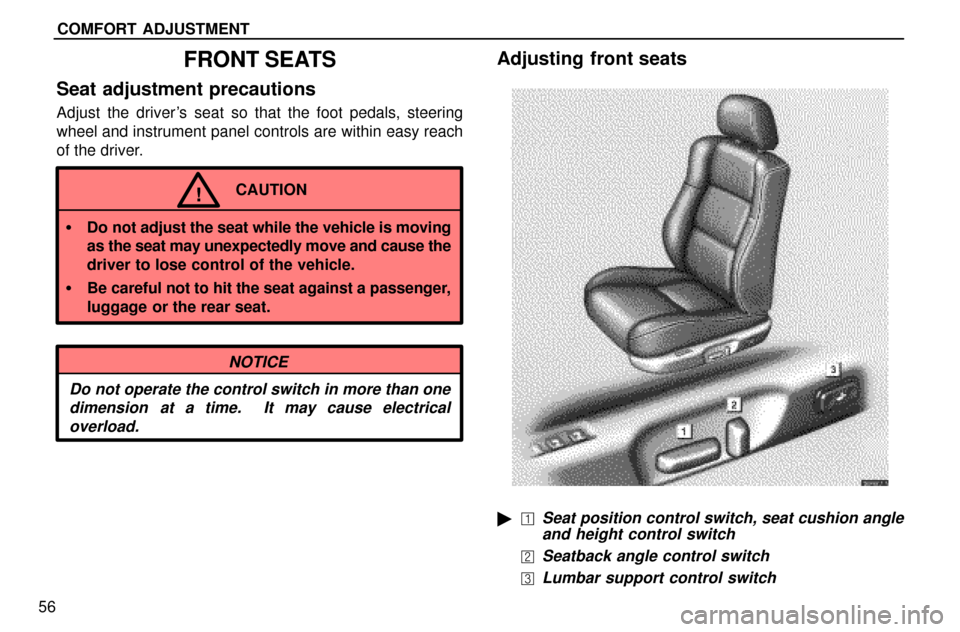
Adjusting front seats
��Seat position control switch, seat cushion angle
and height control switch
�Seatback angle control switch
�Lumbar support control switch
Page 3 of 8
COMFORT ADJUSTMENT
57
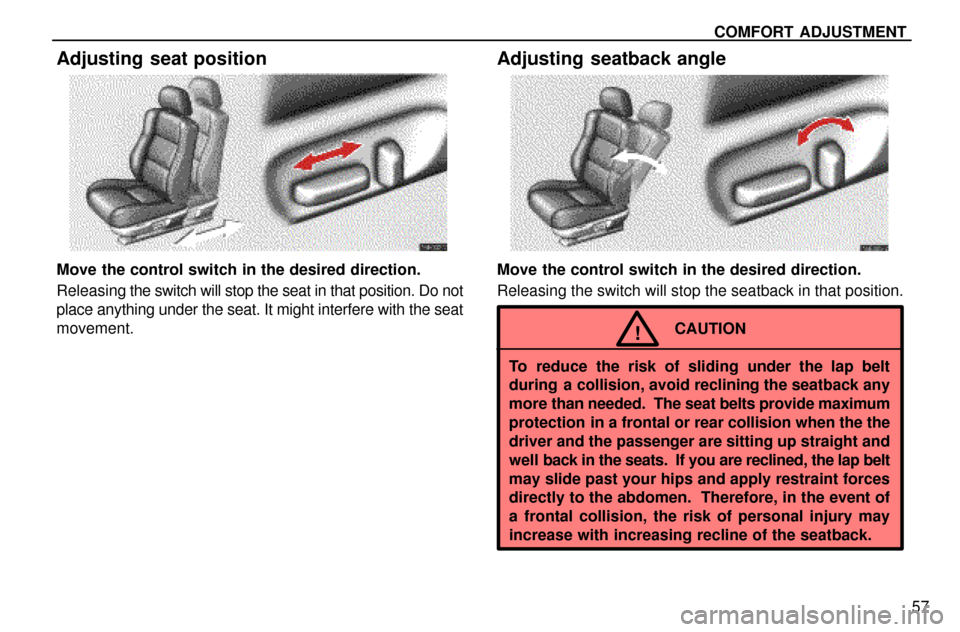
Adjusting seat position
Move the control switch in the desired direction.
Releasing the switch will stop the seat in that position. Do not
place anything under the seat. It might interfere with the seat
movement.
Adjusting seatback angle
Move the control switch in the desired direction.
Releasing the switch will stop the seatback in that position.
CAUTION!
To reduce the risk of sliding under the lap belt
during a collision, avoid reclining the seatback any
more than needed. The seat belts provide maximum
protection in a frontal or rear collision when the the
driver and the passenger are sitting up straight and
well back in the seats. If you are reclined, the lap belt
may slide past your hips and apply restraint forces
directly to the abdomen. Therefore, in the event of
a frontal collision, the risk of personal injury may
increase with increasing recline of the seatback.
Page 5 of 8
COMFORT ADJUSTMENT
59
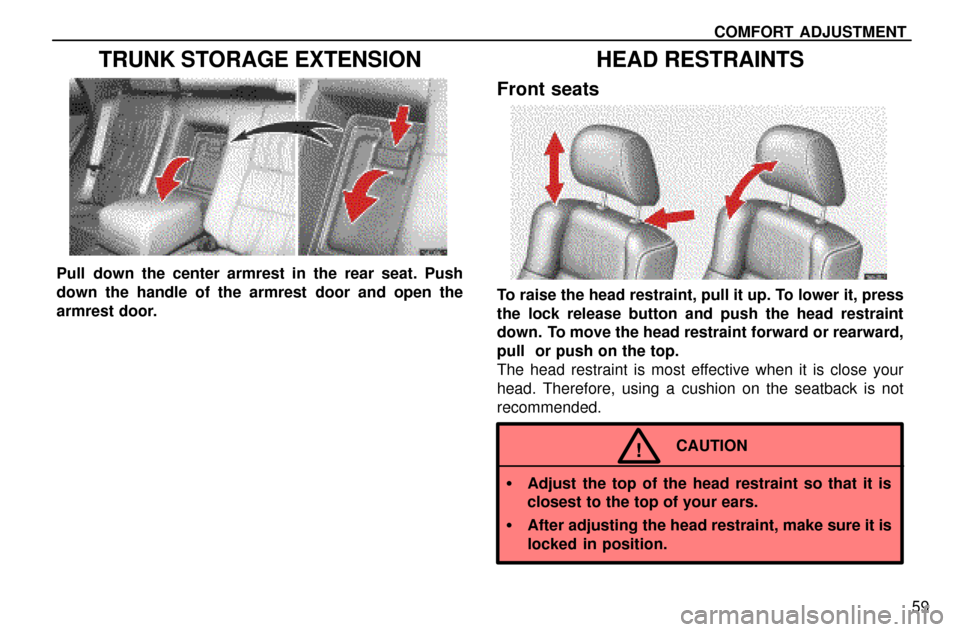
TRUNK STORAGE EXTENSION
Pull down the center armrest in the rear seat. Push
down the handle of the armrest door and open the
armrest door.
HEAD RESTRAINTS
Front seats
To raise the head restraint, pull it up. To lower it, press
the lock release button and push the head restraint
down. To move the head restraint forward or rearward,
pull or push on the top.
The head restraint is most effective when it is close your
head. Therefore, using a cushion on the seatback is not
recommended.
CAUTION!
�Adjust the top of the head restraint so that it is
closest to the top of your ears.
�After adjusting the head restraint, make sure it is
locked in position.
Page 6 of 8
COMFORT ADJUSTMENT
60
�Do not drive with the head restraints removed.
Rear seats
To raise the head restraint, pull it up. To lower it, press
the lock release button and push the head restraint
down.
The head restraint is most effective when it is close your
head. Therefore, using a cushion on the seatback is not
recommended.
CAUTION!
�Adjust the top of the head restraint so that it is
closest to the top of your ears.
�After adjusting the head restraint, make sure it is
locked in position.
�Do not drive with the head restraints removed.
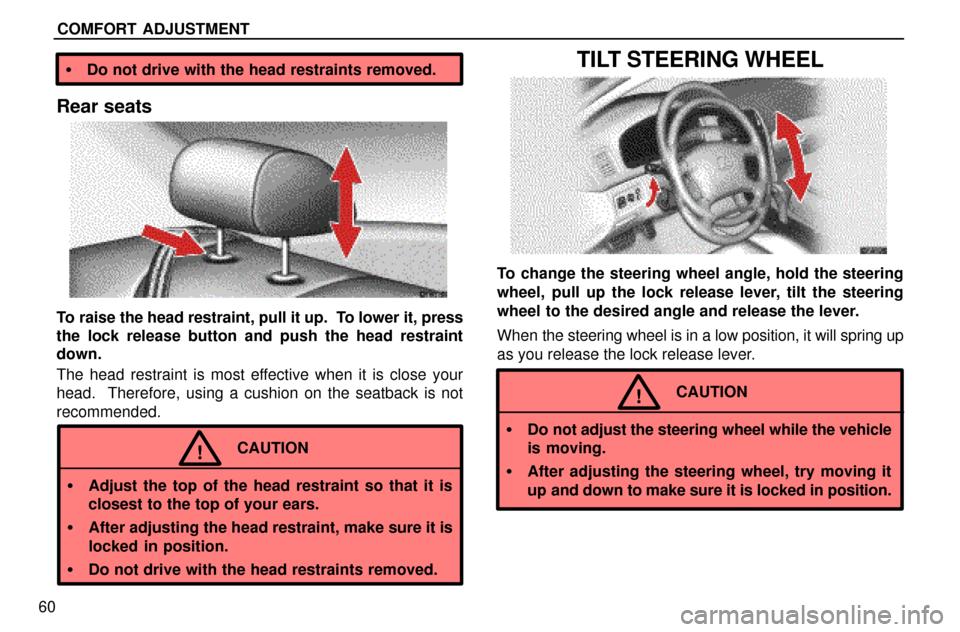
TILT STEERING WHEEL
To change the steering wheel angle, hold the steering
wheel, pull up the lock release lever, tilt the steering
wheel to the desired angle and release the lever.
When the steering wheel is in a low position, it will spring up
as you release the lock release lever.
CAUTION!
�Do not adjust the steering wheel while the vehicle
is moving.
�After adjusting the steering wheel, try moving it
up and down to make sure it is locked in position.