1997 JAGUAR XJ6 seat removal
[x] Cancel search: seat removalPage 107 of 227

Refitting
7Insert the distributor into the engine in
exactly the same relationship to the block that
it was in when removed.
8If the distributor does not seat completely,
recheck the alignment marks between the
distributor base and the block to verify that
the distributor is in the same position it was in
before removal. Also check the rotor to see if
it’s aligned with the mark you made on the
edge of the distributor base.
9Refit the distributor hold-down bolt(s).
10The remainder of refitting is the reverse of
removal.
10 Charging system- general
information and precautions
The charging system includes the alternator,
an internal voltage regulator, a charge
indicator light, load dump module, the battery,
an ignition ON relay, an in-line fuse and the
wiring between all the components (see
illustration). The charging system supplies
electrical power for the ignition system, the
lights, the radio, etc. The alternator is driven by
a drivebelt at the front of the engine.
The purpose of the voltage regulator is to
limit the alternator’s voltage to a preset value.
This prevents power surges, circuit overloads,
etc., during peak voltage output.
The alternator load dump module protects
the electrical circuits from excessive voltage
surges. When the battery cables are removed
large amounts of transient voltage is released
through the electrical circuits. This device
diverts up to 30 load volts of excess voltage to
earth by way of a voltage dependent resistor.
The in-line fuse is a special fuse installed
into the circuit with the engine compartment
wiring harness (see Chapter 12). The in-line
fuse protects the electrical system in the
event of excess voltage surges or a power to
earth short circuit. Refer to Chapter 12 for
additional information concerning the in-line
fuses and their locations.
1993 and 1994 models have a Starter Logic
Relay. This microprocessor (computer)
gathers information from the ignition switch,
linear gear position switch, park/neutral
switch, the security switch and the electronic
door lock system. If all the conditions are in
order, the computer allows battery voltage to
be transferred from the ignition switch to the
starter/solenoid assembly.
The charging system doesn’t ordinarily
require periodic maintenance. However, the
drivebelt, battery and wires and connections
should be inspected at the intervals outlined
in Chapter 1.
The dashboard warning light should come
on when the ignition key is turned to Start,
then should go off immediately. If it remains
on, there is a malfunction in the charging
system. Some vehicles are also equipped with
a voltage gauge. If the voltage gaugeindicates abnormally high or low voltage,
check the charging system (see Section 11).
Be very careful when making electrical
circuit connections to a vehicle equipped with
an alternator and note the following:
a) When reconnecting wires to the alternator
from the battery, note their polarity.
b) Before using arc welding equipment to
repair any part of the vehicle, disconnect
the wires from the alternator and the
battery terminals.
c) Never start the engine with a battery
charger connected.
d) Always disconnect both battery leads
before using a battery charger.
e) The alternator is driven by an engine
drivebelt which could cause serious injury
if your hand, hair or clothes become
entangled in it with the engine running.
f) Because the alternator is connected
directly to the battery, it could arc or
cause a fire if overloaded or shorted out.
g) Wrap a plastic bag over the alternator and
secure it with rubber bands before steam
cleaning the engine.
11 Charging system- check
2
Note:1993 and 1994 models are equipped
with a Starter Logic Relay. This microprocessor
(computer) gathers information from theignition switch, linear gear position switch,
park/neutral switch, the security switch and the
electronic door lock system. If all the conditions
are in order, the computer allows battery
voltage to be transferred from the ignition
switch to the starter/solenoid assembly. If all
the components of the charging system are
working properly and the system still does not
charge properly, have the Starter Logic Relay
diagnosed by a dealer service department.
1If a malfunction occurs in the charging
circuit, don’t automatically assume that the
alternator is causing the problem. First check
the following items:
a) Check the drivebelt tension and its
condition. Renew it if worn or damaged.
b) Make sure the alternator mounting and
adjustment bolts are tight.
c) Inspect the alternator wiring harness and
the electrical connectors at the alternator
and voltage regulator. They must be in
good condition and tight.
d) Check the fusible link (if equipped)
located between the starter solenoid and
the alternator or the large main fuses in
the engine compartment. If it’s burned,
determine the cause, repair the circuit
and renew the link or fuse (the vehicle
won’t start and/or the accessories won’t
work if the fusible link or fuse blows).
e) Check all the in-line fuses that are in series
with the charging system circuit (see
Chapter 12).The location of these fuses
and fusible links may vary from year and
Engine electrical systems 5•5
5
10.1 Schematic of a typical charging system
3261 Jaguar XJ6
Page 126 of 227
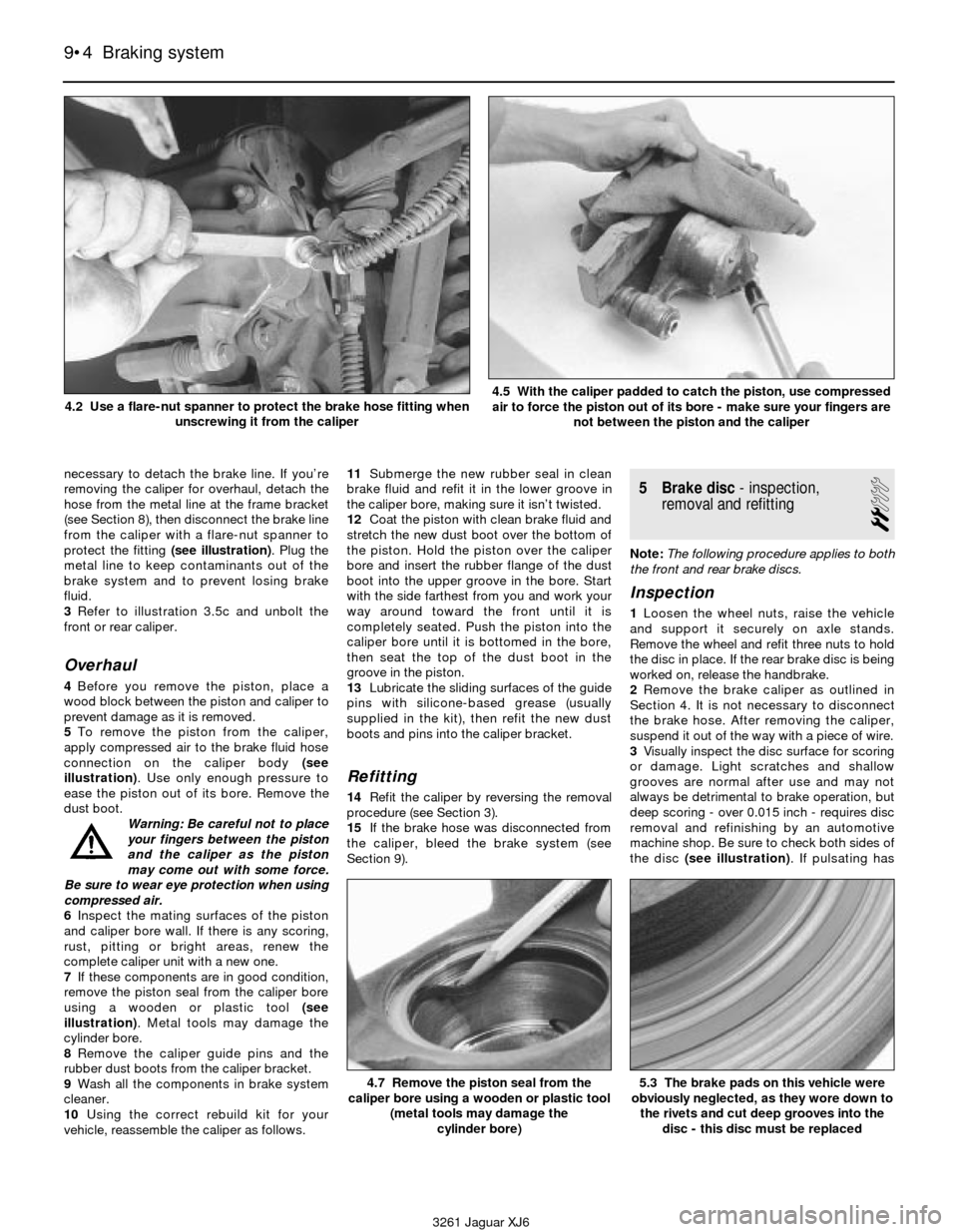
necessary to detach the brake line. If you’re
removing the caliper for overhaul, detach the
hose from the metal line at the frame bracket
(see Section 8), then disconnect the brake line
from the caliper with a flare-nut spanner to
protect the fitting (see illustration). Plug the
metal line to keep contaminants out of the
brake system and to prevent losing brake
fluid.
3Refer to illustration 3.5c and unbolt the
front or rear caliper.
Overhaul
4Before you remove the piston, place a
wood block between the piston and caliper to
prevent damage as it is removed.
5To remove the piston from the caliper,
apply compressed air to the brake fluid hose
connection on the caliper body (see
illustration). Use only enough pressure to
ease the piston out of its bore. Remove the
dust boot.
Warning: Be careful not to place
your fingers between the piston
and the caliper as the piston
may come out with some force.
Be sure to wear eye protection when using
compressed air.
6Inspect the mating surfaces of the piston
and caliper bore wall. If there is any scoring,
rust, pitting or bright areas, renew the
complete caliper unit with a new one.
7If these components are in good condition,
remove the piston seal from the caliper bore
using a wooden or plastic tool (see
illustration). Metal tools may damage the
cylinder bore.
8Remove the caliper guide pins and the
rubber dust boots from the caliper bracket.
9Wash all the components in brake system
cleaner.
10Using the correct rebuild kit for your
vehicle, reassemble the caliper as follows.11Submerge the new rubber seal in clean
brake fluid and refit it in the lower groove in
the caliper bore, making sure it isn’t twisted.
12Coat the piston with clean brake fluid and
stretch the new dust boot over the bottom of
the piston. Hold the piston over the caliper
bore and insert the rubber flange of the dust
boot into the upper groove in the bore. Start
with the side farthest from you and work your
way around toward the front until it is
completely seated. Push the piston into the
caliper bore until it is bottomed in the bore,
then seat the top of the dust boot in the
groove in the piston.
13Lubricate the sliding surfaces of the guide
pins with silicone-based grease (usually
supplied in the kit), then refit the new dust
boots and pins into the caliper bracket.
Refitting
14Refit the caliper by reversing the removal
procedure (see Section 3).
15If the brake hose was disconnected from
the caliper, bleed the brake system (see
Section 9).
5 Brake disc- inspection,
removal and refitting
2
Note:The following procedure applies to both
the front and rear brake discs.
Inspection
1Loosen the wheel nuts, raise the vehicle
and support it securely on axle stands.
Remove the wheel and refit three nuts to hold
the disc in place. If the rear brake disc is being
worked on, release the handbrake.
2Remove the brake caliper as outlined in
Section 4. It is not necessary to disconnect
the brake hose. After removing the caliper,
suspend it out of the way with a piece of wire.
3Visually inspect the disc surface for scoring
or damage. Light scratches and shallow
grooves are normal after use and may not
always be detrimental to brake operation, but
deep scoring - over 0.015 inch - requires disc
removal and refinishing by an automotive
machine shop. Be sure to check both sides of
the disc (see illustration). If pulsating has
9•4 Braking system
4.7 Remove the piston seal from the
caliper bore using a wooden or plastic tool
(metal tools may damage the
cylinder bore)5.3 The brake pads on this vehicle were
obviously neglected, as they wore down to
the rivets and cut deep grooves into the
disc - this disc must be replaced
3261 Jaguar XJ6 4.2 Use a flare-nut spanner to protect the brake hose fitting when
unscrewing it from the caliper
4.5 With the caliper padded to catch the piston, use compressed
air to force the piston out of its bore - make sure your fingers are
not between the piston and the caliper
Page 130 of 227

will be necessary to apply pressure to the
master cylinder piston and, at the same time,
control flow from the brake line outlets, it is
recommended that the master cylinder be
mounted in a vice. Use caution not to clamp
the vice too tightly, or the master cylinder
body might crack.
10Insert threaded plugs into the brake line
outlet holes and snug them down so that
there will be no air leakage past them, but not
so tight that they cannot be easily loosened.
11Fill the reservoir with brake fluid of the
recommended type (see Recommended
lubricants and fluidsin Chapter 1).
12Remove one plug and push the piston
assembly into the master cylinder bore to
expel the air from the master cylinder. A large
Phillips screwdriver can be used to push on
the piston assembly.
13To prevent air from being drawn back into
the master cylinder, the plug must be
replaced and tightened before releasing the
pressure on the piston assembly.
14Repeat the procedure until only brake
fluid is expelled from the brake line outlet
hole. When only brake fluid is expelled, repeat
the procedure with the other outlet hole and
plug. Be sure to keep the master cylinder
reservoir filled with brake fluid to prevent the
introduction of air into the system.
15Since high pressure is not involved in the
bench bleeding procedure, an alternative to
the removal and renewal of the plugs witheach stroke of the piston assembly is
available. Before pushing in on the piston
assembly, remove the plug as described inStep 12. Before releasing the piston, however,
instead of replacing the plug, simply put your
finger tightly over the hole to keep air from
9•8 Braking system
6.7m Apply some clean brake fluid to the
secondary piston and refit it with the slot
oriented with the stopper pin hole, so that
the stopper pin will go through the slot6.7n Apply a coat of clean brake fluid to
the primary piston and refit it into the bore6.7o Using the same technique as in
illustration 6.7f, depress the pistons and
refit the stopper pin
6.7p Refit the end plate as shown, with the
bend in the plate flange aligned with the
groove in the master cylinder flange6.7q Using a hammer and punch, stake
the end plate as shown (there’s a dimple in
the side of the plate for this purpose)6.7r Refit the grommets
3261 Jaguar XJ6
6.7s Align the reservoir pipes with the
grommets as shown . . .
6.7u Refit the reservoir roll pin . . .6.7v . . . and tap it into place
6.7t . . . and squeeze the reservoir and
master cylinder together; make sure the
reservoir is fully seated
Page 139 of 227

1 General information
Warning: Whenever any of the
suspension or steering fasteners
are loosened or removed, they
must be inspected and if
necessary, replaced with new ones of the
same part number or of original equipment
quality and design. Torque wrench settings
must be followed for proper reassembly
and component retention. Never attempt
to heat, straighten or weld any suspension
or steering component. Instead, renew any
bent or damaged part.
The front suspension (see illustrations)
consists of unequal-length upper and lower
control arms, shock absorbers and coil
springs. The upper ends of the shocks are
attached to the body; the lower ends
are attached to the lower control arms. The
upper ends of the coil springs are seated
against the suspension crossmember; the
lower ends are seated against removable
plates which are bolted to the lower control
arms. The steering knuckles are attached to
balljoints in the upper and lower control arms.
An anti-roll bar is attached to the suspension
crossmember with a pair of bushing brackets
and to the lower control arms via a connecting
link at each end.The independent rear suspension (see
illustration)uses control arms and integral
shock absorber/coil spring units. The upper
ends of the shocks are attached to the body;
the lower ends are connected to the control
arms.
The steering system consists of the
steering wheel, a steering column, a universal
joint on the lower end of the steering shaft, a
rack-and-pinion power steering gear, a power
steering pump and a pair of tie-rods which
connects the steering gear to the steering
knuckles (see illustration).
2 Self-levelling rear
suspension system
1988 to 1992 models were equipped with a
system that provided hydraulic power for the
rear suspension and for the power brakes. As
the vehicle is loaded or unloaded, the rear
suspension is automatically adjusted to
maintain a constant ride height.
The system was discontinued on 1993 and
later models, which are equipped with
conventional shock absorber/coil spring units.
A kit is available from your Jaguar dealer
should you decide to retrofit the later,
conventional shocks to a pre-1993 vehicle.
Complete instructions for refitting the kit are
included in Section 10.
3 Anti-roll bar (front)-
removal and refitting
2
1Raise the front of the vehicle and support it
securely on axle stands.
2Remove the bolts from the anti-roll bar
brackets that attach the anti-roll bar to the
suspension crossmember (see illustration).
3Remove the nuts that attach the anti-roll
bar to the links (see illustration). If you’re
replacing the links themselves, or removing
the control arm, remove the nuts attaching the
links to the lower control arms.
Suspension and steering systems 10•3
10
1.3 Rear suspension
1 Hub carrier 2 Control arms 3 Crossmember mounting brackets 4 Crossmember
3.2 To detach the anti-roll bar from the
suspension crossmember, remove these
two bolts (arrowed) from each bushing
bracket
3261 Jaguar XJ6
Page 149 of 227

3261 Jaguar XJ6
11
Chapter 11
Bodywork and fittings
Body - maintenance . . . . . . . . . . . . . . . . . . . . . . . . . . . . . . . . . . . . . 2
Body repair - major damage . . . . . . . . . . . . . . . . . . . . . . . . . . . . . . . 6
Body repair - minor damage . . . . . . . . . . . . . . . . . . . . . . . . . . . . . . . 5
Bonnet - removal, refitting and adjustment . . . . . . . . . . . . . . . . . . . . 10
Bonnet and boot lid support struts - removal and refitting . . . . . . . . 9
Bonnet release latch and cable - removal and refitting . . . . . . . . . . . 11
Boot lid - removal, refitting and adjustment . . . . . . . . . . . . . . . . . . . 16
Boot lid latch and lock cylinder - removal and refitting . . . . . . . . . . . 17
Bumpers - removal and refitting . . . . . . . . . . . . . . . . . . . . . . . . . . . . 14
Centre console - removal and refitting . . . . . . . . . . . . . . . . . . . . . . . 24
Cowl cover - removal and refitting . . . . . . . . . . . . . . . . . . . . . . . . . . 28
Dashboard trim panels - removal and refitting . . . . . . . . . . . . . . . . . 26
Door - removal, refitting and adjustment . . . . . . . . . . . . . . . . . . . . . . 19
Door latch, lock cylinder and handles - removal and refitting . . . . . . 20
Door trim panel - removal and refitting . . . . . . . . . . . . . . . . . . . . . . . 18Door window glass - removal and refitting . . . . . . . . . . . . . . . . . . . . 22
Door window glass regulator - removal and refitting . . . . . . . . . . . . . 21
Front spoiler - removal and refitting . . . . . . . . . . . . . . . . . . . . . . . . . 13
Front wing - removal and refitting . . . . . . . . . . . . . . . . . . . . . . . . . . . 15
General information . . . . . . . . . . . . . . . . . . . . . . . . . . . . . . . . . . . . . . 1
Hinges and locks - maintenance . . . . . . . . . . . . . . . . . . . . . . . . . . . . 7
Instrument cluster housing - removal and refitting . . . . . . . . . . . . . . 25
Outside mirrors - removal and refitting . . . . . . . . . . . . . . . . . . . . . . . 23
Radiator grille - removal and refitting . . . . . . . . . . . . . . . . . . . . . . . . 12
Seats - removal and refitting . . . . . . . . . . . . . . . . . . . . . . . . . . . . . . . 29
Steering column cover - removal and refitting . . . . . . . . . . . . . . . . . 27
Upholstery and carpets - maintenance . . . . . . . . . . . . . . . . . . . . . . . 4
Vinyl trim - maintenance . . . . . . . . . . . . . . . . . . . . . . . . . . . . . . . . . . 3
Windscreen and fixed glass - replacement . . . . . . . . . . . . . . . . . . . . 8
11•1
Contents
Easy,suitable for
novice with little
experienceFairly easy,suitable
for beginner with
some experienceFairly difficult,
suitable for competent
DIY mechanic
Difficult,suitable for
experienced DIY
mechanicVery difficult,
suitable for expert DIY
or professional
Degrees of difficulty
54321
1 General information
These models feature a “unibody”
construction, using a floor pan with front and
rear frame side rails which support the body
components, front and rear suspension
systems and other mechanical components.
Certain components are particularly vulnerable
to accident damage and can be unbolted and
repaired or replaced. Among these parts are
the body mouldings, bumpers, front wings,
bonnet and boot lids and all glass.
Only general body maintenance practices
and body panel repair procedures within the
scope of the do-it-yourselfer are included in
this Chapter.
2 Body- maintenance
1
1The condition of your vehicle’s body is very
important, because the resale value depends
a great deal on it. It’s much more difficult to
repair a neglected or damaged body than it is
to repair mechanical components. The hidden
areas of the body, such as the wheel wells,
the frame and the engine compartment, areequally important, although they don’t require
as frequent attention as the rest of the body.
2Once a year, or every 12,000 miles, it’s a
good idea to have the underside of the body
steam cleaned. All traces of dirt and oil will be
removed and the area can then be inspected
carefully for rust, damaged brake lines, frayed
electrical wires, damaged cables and other
problems. The front suspension components
should be greased after completion of this job.
3At the same time, clean the engine and the
engine compartment with a steam cleaner or
water soluble degreaser.
4The wheel wells should be given close
attention, since undercoating can peel away
and stones and dirt thrown up by the tyres
can cause the paint to chip and flake, allowing
rust to set in. If rust is found, clean down to
the bare metal and apply an anti-rust paint.
5The body should be washed about once a
week. Wet the vehicle thoroughly to soften the
dirt, then wash it down with a soft sponge and
plenty of clean soapy water. If the surplus dirt
is not washed off very carefully, it can wear
down the paint.
6Spots of tar or asphalt thrown up from the
road should be removed with a cloth soaked
in solvent.
7Once every six months, wax the body and
chrome trim. If a chrome cleaner is used to
remove rust from any of the vehicle’s plated
parts, remember that the cleaner also removes
part of the chrome, so use it sparingly.
3 Vinyl trim- maintenance
1
Don’t clean vinyl trim with detergents,
caustic soap or petroleum-based cleaners.
Plain soap and water works just fine, with a
soft brush to clean dirt that may be ingrained.
Wash the vinyl as frequently as the rest of the
vehicle.
After cleaning, application of a high quality
rubber and vinyl protectant will help prevent
oxidation and cracks. The protectant can also
be applied to weather-stripping, vacuum lines
and rubber hoses (which often fail as a result
of chemical degradation) and to the tyres.
4 Upholstery and carpets-
maintenance
1
1Every three months remove the carpets or
mats and clean the interior of the vehicle
(more frequently if necessary). Vacuum the
upholstery and carpets to remove loose dirt
and dust.
2Leather upholstery requires special care.
Stains should be removed with warm water
and a very mild soap solution. Use a clean,
damp cloth to remove the soap, then wipe
Page 150 of 227

again with a dry cloth. Never use alcohol,
petrol, nail polish remover or thinner to clean
leather upholstery.
3After cleaning, regularly treat leather
upholstery with a leather wax. Never use car
wax on leather upholstery.
4In areas where the interior of the vehicle is
subject to bright sunlight, cover leather seats
with a sheet if the vehicle is to be left out for
any length of time.
5 Body repair- minor damage
3
Repair of minor scratches
1If the scratch is superficial and does not
penetrate to the metal of the body, repair is
very simple. Lightly rub the scratched area
with a fine rubbing compound to remove
loose paint and built-up wax. Rinse the area
with clean water.
2Apply touch-up paint to the scratch, using a
small brush. Continue to apply thin layers of
paint until the surface of the paint in the
scratch is level with the surrounding paint.
Allow the new paint at least two weeks to
harden, then blend it into the surrounding
paint by rubbing with a very fine rubbing
compound. Finally, apply a coat of wax to the
scratch area.
3If the scratch has penetrated the paint and
exposed the metal of the body, causing the
metal to rust, a different repair technique is
required. Remove all loose rust from the
bottom of the scratch with a pocket knife,
then apply rust inhibiting paint to prevent the
formation of rust in the future. Using a rubber
or nylon applicator, coat the scratched area
with glaze-type filler. If required, the filler can
be mixed with thinner to provide a very thin
paste, which is ideal for filling narrow
scratches. Before the glaze filler in the scratch
hardens, wrap a piece of smooth cotton cloth
around the tip of a finger. Dip the cloth in
thinner and then quickly wipe it along the
surface of the scratch. This will ensure that
the surface of the filler is slightly hollow. The
scratch can now be painted over as described
earlier in this section.
Repair of dents
4When repairing dents, the first job is to pull
the dent out until the affected area is as close
as possible to its original shape. There is no
point in trying to restore the original shape
completely as the metal in the damaged area
will have stretched on impact and cannot be
restored to its original contours. It is better to
bring the level of the dent up to a point which
is about 1/8-inch below the level of the
surrounding metal. In cases where the dent is
very shallow, it is not worth trying to pull it out
at all.
5If the back side of the dent is accessible, it
can be hammered out gently from behindusing a soft-face hammer. While doing this,
hold a block of wood firmly against the
opposite side of the metal to absorb the
hammer blows and prevent the metal from
being stretched.
6If the dent is in a section of the body which
has double layers, or some other factor makes
it inaccessible from behind, a different
technique is required. Drill several small holes
through the metal inside the damaged area,
particularly in the deeper sections. Screw
long, self-tapping screws into the holes just
enough for them to get a good grip in the
metal. Now the dent can be pulled out by
pulling on the protruding heads of the screws
with locking pliers.
7The next stage of repair is the removal of
paint from the damaged area and from an
inch or so of the surrounding metal. This is
done with a wire brush or sanding disc in a
drill motor, although it can be done just as
effectively by hand with sandpaper. To
complete the preparation for filling, score the
surface of the bare metal with a screwdriver or
the tang of a file, or drill small holes in the
affected area. This will provide a good grip
for the filler material. To complete the repair,
see the subsection on filling and painting later
in this Section.
Repair of rust holes or gashes
8Remove all paint from the affected area and
from an inch or so of the surrounding metal
using a sanding disc or wire brush mounted in
a drill motor. If these are not available, a few
sheets of sandpaper will do the job just as
effectively.
9With the paint removed, you will be able to
determine the severity of the corrosion and
decide whether to replace the whole panel, if
possible, or repair the affected area. New
body panels are not as expensive as most
people think and it is often quicker to refit a
new panel than to repair large areas of rust.
10Remove all trim pieces from the affected
area except those which will act as a guide to
the original shape of the damaged body, such
as headlight shells, etc. Using metal snips or a
hacksaw blade, remove all loose metal and
any other metal that is badly affected by rust.
Hammer the edges of the hole in to create a
slight depression for the filler material.
11Wire brush the affected area to remove
the powdery rust from the surface of the
metal. If the back of the rusted area is
accessible, treat it with rust inhibiting paint.
12Before filling is done, block the hole in
some way. This can be done with sheet metal
riveted or screwed into place, or by stuffing
the hole with wire mesh.
13Once the hole is blocked off, the affected
area can be filled and painted. See the
following subsection on filling and painting.
Filling and painting
14Many types of body fillers are available,
but generally speaking, body repair kits which
contain filler paste and a tube of resinhardener are best for this type of repair work.
A wide, flexible plastic or nylon applicator will
be necessary for imparting a smooth and
contoured finish to the surface of the filler
material. Mix up a small amount of filler on a
clean piece of wood or cardboard (use the
hardener sparingly). Follow the
manufacturer’s instructions on the package,
otherwise the filler will set incorrectly.
15Using the applicator, apply the filler paste
to the prepared area. Draw the applicator
across the surface of the filler to achieve the
desired contour and to level the filler surface.
As soon as a contour that approximates the
original one is achieved, stop working the
paste. If you continue, the paste will begin to
stick to the applicator. Continue to add thin
layers of paste at 20-minute intervals until the
level of the filler is just above the surrounding
metal.
16Once the filler has hardened, the excess
can be removed with a body file. From then
on, progressively finer grades of sandpaper
should be used, starting with a 180-grit paper
and finishing with 600-grit wet-or-dry paper.
Always wrap the sandpaper around a flat
rubber or wooden block, otherwise the
surface of the filler will not be completely flat.
During the sanding of the filler surface, the
wet-or-dry paper should be periodically rinsed
in water. This will ensure that a very smooth
finish is produced in the final stage.
17At this point, the repair area should be
surrounded by a ring of bare metal, which in
turn should be encircled by the finely
feathered edge of good paint. Rinse the repair
area with clean water until all of the dust
produced by the sanding operation is gone.
18Spray the entire area with a light coat of
primer. This will reveal any imperfections in
the surface of the filler. Repair the
imperfections with fresh filler paste or glaze
filler and once more smooth the surface with
sandpaper. Repeat this spray-and-repair
procedure until you are satisfied that the
surface of the filler and the feathered edge of
the paint are perfect. Rinse the area with
clean water and allow it to dry completely.
19The repair area is now ready for painting.
Spray painting must be carried out in a warm,
dry, windless and dust free atmosphere.
These conditions can be created if you have
access to a large indoor work area, but if you
are forced to work in the open, you will have
to pick the day very carefully. If you are
working indoors, dousing the floor in the work
area with water will help settle the dust which
would otherwise be in the air. If the repair area
is confined to one body panel, mask off the
surrounding panels. This will help minimise
the effects of a slight mismatch in paint
colour. Trim pieces such as chrome strips,
door handles, etc., will also need to be
masked off or removed. Use masking tape
and several thickness of newspaper for the
masking operations.
20Before spraying, shake the paint can
thoroughly, then spray a test area until the
11•2 Bodywork and fittings
3261 Jaguar XJ6
Page 153 of 227

7Attach a piece of thin wire or string to the
end of the cables to help aid the refitting
process.
8Working in the engine compartment, pull
the cables and grommet out of the bulkhead
until you can see the wire or string. Ensure
that the new cable has a grommet attached
then remove the old cable from the wire or
string and replace it with the new cable.
9Working from passenger compartment pull
the wire or string back through the bulkhead.
10Refitting is the reverse of removal.Note:
Push on the grommet with your fingers from
the engine compartment to seat the grommet
in the bulkhead.
12 Radiator grille-
removal and refitting
1
1Using a Phillips screwdriver, detach the
right and left hand grille inserts from the grille
assembly (see illustration).Note: The grille
can be removed without removing the inserts,
but reaching the mounting screws from above
is quite difficult.
2Working through the grille insert openings,
remove the retaining screws securing both
ends of the grille frame (see illustration).
3Pull the grille frame forward and remove it
from the vehicle.
4Refitting is the reverse of removal.
13 Front spoiler-
removal and refitting
1
1Working on the left side of the vehicle,
remove the front spoiler lower cover (see
illustration).
2Remove the screws securing the front air
dam panels in the left and right wheel
openings (see illustration), then detach the
air dam panels from the vehicle. Note:It will
probably be necessary to turn the wheels to
the right and left for access to the screws.
3Detach the retaining bolts securing the
sides of the spoiler (see illustration).
4Working through the grille area of thespoiler, detach the retaining screws securing
the front of the spoiler (see illustration).
5Pull the spoiler forward and detach it from
the vehicle.
6Refitting is the reverse of removal.
14 Bumpers-
removal and refitting
1
1Detach the direction indicator and side
marker light assemblies from the bumper(s)
(see illustrations).
2Disconnect all wire harness connectors
attached to the bumper or light assemblies
that would interfere with removal.
Bodywork and fittings 11•5
11
12.1 Removing one side at a time, remove
the grille insert retaining screws (arrowed)
- tilt the top edge of the grille insert
forward, then lift up and out to remove it12.2 Working through the grille insert
openings, remove the retaining screws
from each edge of the grille frame
13.4 Working through the grille area of the
spoiler, remove the screws (arrowed)
retaining the front of the spoiler14.1a Depress the retaining clips on each
side of the side marker lamp assemblies,
then gently prise forward to remove it . . .14.1b . . . then detach the direction
indicator assemblies from the bumper in
the same manner
13.1 Working underneath the vehicle,
remove the screws (arrowed) securing the
front spoiler lower cover13.2 Working in the front wheel openings,
remove the screws (arrowed) securing the
front air dam panels13.3 The retaining bolts (arrowed)
securing the sides of the front spoiler are
located behind the bumper
3261 Jaguar XJ6
Page 162 of 227

personal injury or damage to the airbag
system, DO NOT work in the vicinity of the
steering column or instrument panel. The
manufacturer recommends that, on airbag
equipped models, the following procedure
should be left to a dealer service
department or other repair workshop
because of the special tools and techniques
required to disable the airbag system.
1Remove the steering wheel (Chapter 10)
2Remove the knob from the rheostat
(dimmer) for the instrument panel lights (see
illustration).
3Remove the lower steering column cover
screws (see illustration), then detach the
lower cover.
4Working through the lower cover opening,
remove the four screws securing the upper
half of the cover, then pull the cover forward
and out to remove it (see illustration).
5Refitting is the reverse of removal.
28 Cowl cover-
removal and refitting
2
1Remove the windscreen wiper arms (see
Chapter 12).2Remove the retaining screws located along
the top of the cowl cover (see illustration).
3Lift the cowl cover up slightly, then detach
the electrical connectors and the spray nozzle
hoses from the backside of the cowl cover.
4Detach the cowl cover from the vehicle.
5Refitting is the reverse of removal.
29 Seats- removal and refitting
2
Front seat
1Position the seat all the way forward or all
the way to the rear to access the front seat
retaining bolts.
2Detach any bolt trim covers and remove the
retaining bolts (see illustration).
3Tilt the seat upward to access the
underneath, then unplug any electrical
connectors and lift the seat from the vehicle.
4Refitting is the reverse of removal.
Rear seat
5Remove retaining screws at the lower edge
of the seat cushion (see illustration). Then lift
up on the front edge and remove the cushion
from the vehicle.
6Detach the retaining bolts at the lower edge
of the seat back.
7Lift up on the lower edge of the seat back to
release the clips securing the top. Then
remove it from the vehicle.
8Refitting is the reverse of removal.
11•14 Bodywork and fittings
27.4 Remove the four screws securing the
upper half of the steering column cover
28.2 Remove the screws (arrowed)
located along the top of the cowl cover29.2 Use a Torx bit to remove the front
seat retaining bolts (arrowed)
3261 Jaguar XJ6 27.2 Pull off the knob from the instrument panel light rheostat
27.3 Remove the lower steering column cover screws
29.5 Detach the screws (arrowed) along
the lower edge of the seat cove