Page 134 of 241
Towing a Trailer
Towing Safety
Your car will not stop as quickly with a trailer in tow. Leave extra distance
between your car and other vehicles.
Avoid braking or turning suddenly.
This could cause the trailer to
jackknife or possibly turn over.
Keep in mind that your total vehicle
is now much longer. Leave more
room when making turns. The trailer
tracks a smaller arc than the car and
can hit or run over something that
the car misses. When passing another vehicle, make sure the
trailer is clear before changing lanes. The car/trailer combination is more
affected by crosswinds and buffeting.
When being passed by a large vehicle, keep a constant speed and steer straight ahead. If there is too
much wind buffeting, slow down to
get out of the other vehicle's air
turbulence.
Towing a trailer puts an extra load on your car. You should have your
car serviced according to the
"Maintenance Schedule under
severe driving conditions" on page 143. This extra load is magnified when
you are driving in hilly terrain.
Watch the temperature gauge closely when climbing hills. If it gets
near the hot area, turn off the air
conditioning (if it is on). If this does
not reduce the heat, it may be
necessary to pull to the side of the
road and wait for the engine to cool.
If the automatic transmission shifts
frequently between 3rd and 4th gears, put it in D3. This will help
prevent the transmission fromoverheating. Help keep the brakes
from overheating by shifting to a lower gear when going downhill.
DrivingProCarManuals.comMain Menu Table of Contents s t
Page 135 of 241
Towing a Trailer
If you have to stop while going uphill,
do not hold the car in place by
pressing on the accelerator. This can cause the automatic transmission to
overheat. Use the parking brake or
footbrake.
When parking your car and trailer, especially on a hill, be sure to follow
all the normal precautions. Turn
your front wheels into the curb, set the parking brake firmly, and put the
transmission in Park. In addition,
place wheel chocks at each of the
trailer's tires. Backing up with a trailer is difficult
and takes practice. Drive slowly,
make small movements with the
steering wheel, and have someone
stand outside to guide you. Grip the
steering wheel on the bottom (rather
than the usual position near the top).
Move your hand to the left to get the
trailer to move to the left, and right
to move the trailer right.
DrivingProCarManuals.comMain Menu Table of Contents s t
Page 142 of 241
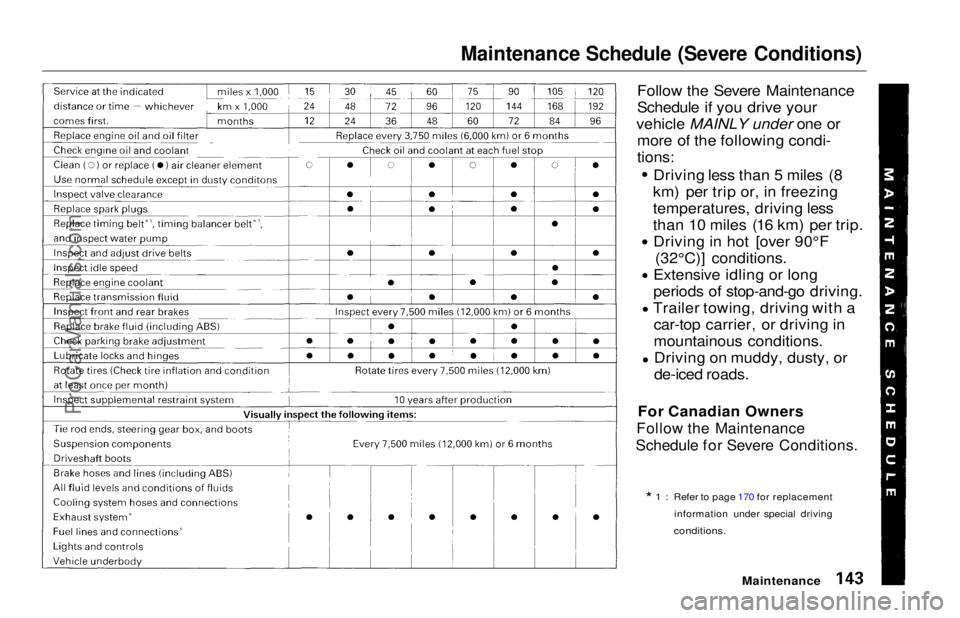
Maintenance Schedule (Severe Conditions)
Follow the Severe Maintenance
Schedule if you drive your
vehicle MAINLY under one or more of the following condi-
tions:
Driving less than 5 miles (8
km) per trip or, in freezing
temperatures, driving less
than 10 miles (16 km) per trip. Driving in hot [over 90°F (32°C)] conditions.
Extensive idling or long
periods of stop-and-go driving.
Trailer towing, driving with a car-top carrier, or driving in
mountainous conditions.Driving on muddy, dusty, or
de-iced roads.
For Canadian Owners
Follow the Maintenance
Schedule for Severe Conditions.
* 1 : Refer to page 170 for replacement
information under special driving
conditions.
MaintenanceProCarManuals.comMain Menu Table of Contents s t
Page 176 of 241
Lights
Check the operation of your car's
exterior lights at least once a month.
A burned out bulb can create an unsafe condition by reducing your
car's visibility and the ability tosignal your intentions to other
drivers.
Check the following:
Headlights (low and high beam)
Parking lights
Taillights Brake lightsHigh-mount brake light
Turn signals
Back-up lights
Hazard light function
License plate light
Side marker lights
Daytime running lights (Canadian models)
If you find any bulbs are burned out,
replace them as soon as possible. Refer to the chart on page 221 to
determine what type of replacement
bulb is needed.
Headlight Aiming
The headlights were properly aimed when your car was new. You should check their aim if you regularly carry
heavy items in the cargo area or pull a trailer. Each headlight assembly
has horizontal and vertical adjust-
ment indicators. These are set to
their "0" positions after the head-
lights are aimed at the factory.
To check these settings: 1. Make sure the fuel tank is full. Park the car on level ground.
2. The driver or someone who weighs the same should be sittingin the driver's seat for all checks
and adjustments.
Load your car with the items you
normally carry.
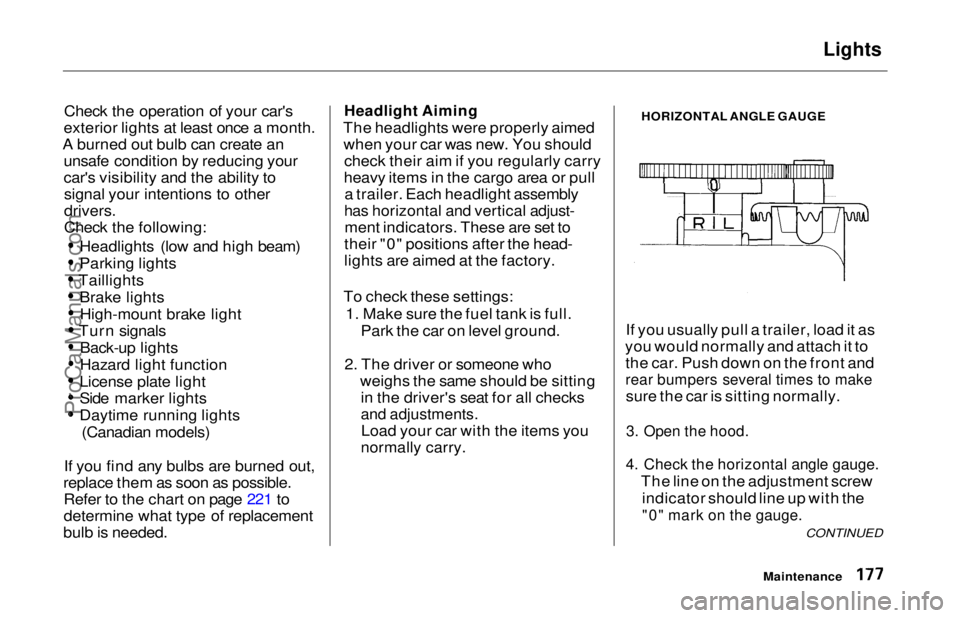
HORIZONTAL ANGLE GAUGE
If you usually pull a trailer, load it as
you would normally and attach it to the car. Push down on the front and
rear bumpers several times to make
sure the car is sitting normally.
3. Open the hood.
4. Check the horizontal angle gauge.
The line on the adjustment screwindicator should line up with the
"0" mark on the gauge.
Maintenance
CONTINUEDProCarManuals.comMain Menu Table of Contents s t
Page 240 of 241
Index
Tires Inspection................................... 173Replacing.................................... 174
Rotating....................................... 174
Snow............................................ 176
Specifications............................. 221
Transmission
Checking Fluid Level................ 157
Fluid Selection............................ 157
Identification Number............... 218
Shifting the Automatic.............. 120
Treadwear...................................... 223
Trip Meter........................................ 37
Turn Signals..................................... 41
Tools, Tire Changing.................... 195
Torn Seat Belts ................................ 11
Towing
A Trailer...................................... 130
Emergency Wrecker................. 215
Underside, Cleaning...................... 190
Unexpected, Taking Care
of the........................................... 193
Uniform Tire Quality Grading..... 223
Unleaded Gasoline......................... 108
Upholstery Cleaning...................... 188
Used Oil, How to Dispose of........ 151
Vanity Mirror................................... 68
Vehicle Capacity Load .................. 116
Vehicle Dimensions....................... 220
Vehicle Identification Number..... 218
Vehicle Storage.............................. 184
Ventilation......................................... 76
VIN.................................................. 218
Vinyl Cleaning................................ 188
Viscosity, Oil................................... 149 Operation...................................... 42
Washing.......................................... 186 Waxing and Polishing................... 187
Wheels Adjusting the Steering................ 44
Alignment and Balance............. 173
Compact Spare........................... 194
Wrench....................................... 197
Windows Cleaning...................................... 189
Operating the Power................... 62
Rear, Defogger............................ 44
Windshield Cleaning........................................ 42
Defroster...................................... 79
Wipers, Windshield Changing Blades........................ 166Operation...................................... 42
Rear Windshield Wiper and
Washer......................................43
Worn Tires..................................... 173
Wrecker, Emergency Towing...... 215
* : U. S. and Canada only
Warning Beepers
Key in Ignition.............................. 50
Seat Belts...................................... 34
WARNING, Explanation of.............. ii
Warning Labels, Location of.......... 30
Warranty Coverages*................... 233
Washer, Windshield Checking the Fluid Level......... 156ProCarManuals.comMain Menu s t