Page 66 of 241
Parking Brake
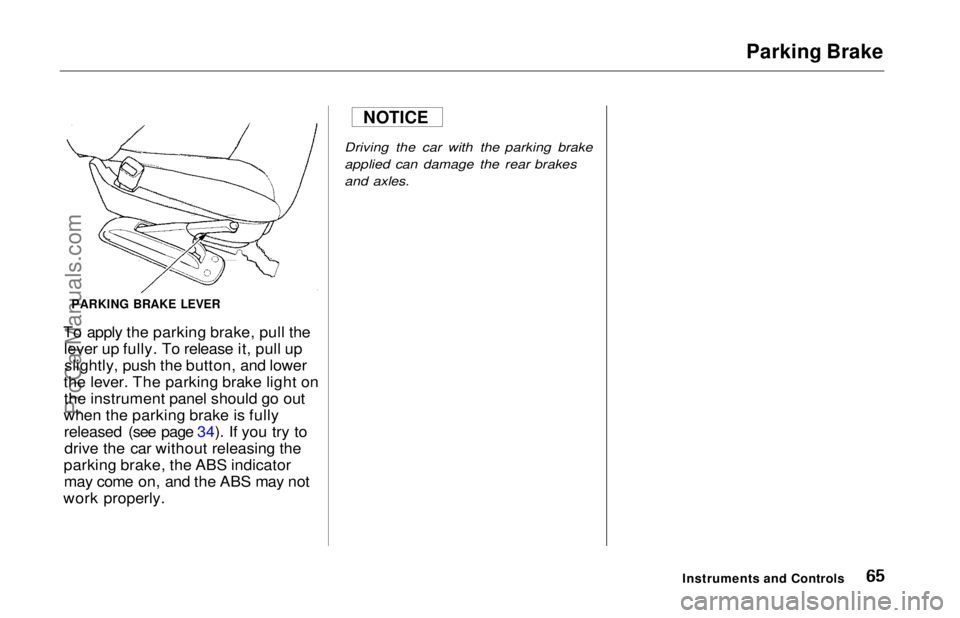
To apply the parking brake, pull the lever up fully. To release it, pull upslightly, push the button, and lower
the lever. The parking brake light on the instrument panel should go out
when the parking brake is fully released (see page 34). If you try todrive the car without releasing the
parking brake, the ABS indicator may come on, and the ABS may not
work properly.
Driving the car with the parking brake
applied can damage the rear brakes
and axles.
Instruments and Controls
PARKING BRAKE LEVER
NOTICEProCarManuals.comMain Menu Table of Contents s t
Page 108 of 241
Break-in Period, Gasoline
Break-in Period
Help assure your car's future
reliability and performance by paying
extra attention to how you drive
during the first 600 miles (1,000 km).
During this period:
Avoid full-throttle starts and rapidacceleration.
Avoid hard braking. New brakes need to be broken-in by moderate
use for the first 200 miles (300
km).
You should follow these same re-
commendations with an overhauled
or exchanged engine, or when the
brakes are relined.
Gasoline
Your Honda is designed to operate on unleaded gasoline with a pump
octane number of 86 or higher. Use
of a lower octane gasoline can cause
a persistent, heavy metallic rapping
noise in the engine that can lead to
mechanical damage.
We recommend gasolines containing detergent additives that help prevent
fuel system and engine deposits.
Using gasoline containing lead willdamage your car's emission controls.
This contributes to air pollution.
In Canada, some gasolines containan octane-enhancing additive called
MMT. If you use such gasolines,
your emission control system performance may deteriorate and
the Malfunction Indicator Lamp on
your instrument panel may turn on. If this happens, contact your
authorized Honda dealer for service. Oxygenated Fuels
Some conventional gasolines are
being blended with alcohol or an ether compound. These gasolines
are collectively referred to as oxygenated fuels. To meet clean air
standards, some areas of the United
States and Canada use oxygenated
fuels to help reduce emissions.
If you use an oxygenated fuel, besure it is unleaded and meets the
minimum octane rating requirement.
Before using an oxygenated fuel, try
to confirm the fuel's contents. Some
states/provinces require this
information to be posted on the
pump.
Before DrivingProCarManuals.comMain Menu Table of Contents s t
Page 111 of 241
Service Station Procedures
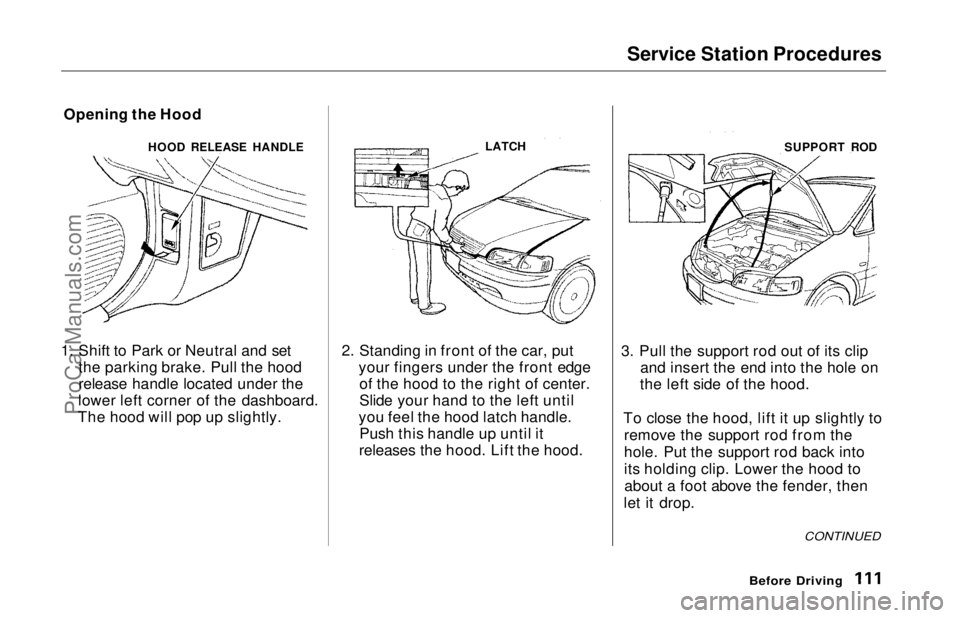
1. Shift to Park or Neutral and set the parking brake. Pull the hood
release handle located under the
lower left corner of the dashboard.
The hood will pop up slightly. 2. Standing in front of the car, put
your fingers under the front edgeof the hood to the right of center.
Slide your hand to the left until
you feel the hood latch handle. Push this handle up until it
releases the hood. Lift the hood. 3. Pull the support rod out of its clip
and insert the end into the hole on
the left side of the hood.
To close the hood, lift it up slightly to remove the support rod from the
hole. Put the support rod back into
its holding clip. Lower the hood toabout a foot above the fender, then
let it drop.
Before Driving
CONTINUED
Opening the Hood
HOOD RELEASE HANDLE
LATCH
SUPPORT RODProCarManuals.comMain Menu Table of Contents s t
Page 115 of 241

Accessories
Your Honda dealer has many Genuine Honda Accessories that
allow you to personalize your car.
These have all been approved for installation and use on your car, and
are covered by warranty.
Some non-Honda accessories you
can buy in the "aftermarket" are
designed for universal applications.
Although they may fit your Honda, they may not be within factoryspecifications. For example, after-
market wheels may not meet Honda's specifications for width and offset.
They could cause suspension problems that would not be covered
by your warranty. Improperly-designed accessories can adversely
affect your car's handling and stability. Your car has several computer-
controlled systems, including the
SRS system, the engine's fuel
injection, and the Anti-lock brake system. Strong electronic inter-
ference can affect their operation.
Electronic communications equip-
ment, such as cellular telephones
and two-way radios are regulated by
the FCC (DOC in Canada) and should not interfere with your car's
systems. Improper installation, or
using electrical equipment not in-
tended for mobile use may interfere
with your car's operation. If you want
to install a cellular telephone, other
mobile communications equipment
or even add-on stereo amplifiers,
please discuss it first with your Honda dealer. In many cases, improper installation
is the real cause of problems with
aftermarket accessories. Have these
accessories installed by qualified
technicians who are familiar with
your Honda. If possible, have your Honda dealer inspect the final
installation.
Before DrivingProCarManuals.comMain Menu Table of Contents s t
Page 117 of 241
Driving
This section gives you tips on starting the engine under various
conditions, and how to operate the
automatic transmission. It also
includes important information on
parking your car, the braking system and facts you need if you are plan-
ning to tow a trailer. Preparing to Drive......................... 118
Starting the Engine........................ 119
Starting in Cold Weatherat High Altitude ..................... 119
Automatic Transmission............... 120 Shift Lever Position Indicator.. 120
Shift Lever Positions................. 120
Maximum Speeds...................... 123
Shift Lock Release..................... 123
Parking............................................ 124
The Braking System...................... 124 Brake Wear Indicators.............. 125
Brake System Design................ 125
Anti-lock Brakes........................ 126 Important Safety Reminders.... 127
ABS Indicator............................. 127
Driving in Bad Weather................ 128
Towing a Trailer............................ 130
DrivingProCarManuals.comMain Menu s t
Page 119 of 241

Starting the Engine
1. Apply the parking brake.
2. In cold weather, turn off all electrical accessories to reduce
the drain on the battery.
3. Make sure the shift lever is in Park. Press on the brake pedal.
4. Without touching the accelerator pedal, turn the ignition key to theSTART (III) position. If the engine
does not start right away, do not
hold the key in START (III) for
more than 15 seconds at a time.
Pause for at least 10 seconds
before trying again.
5. If the engine does not start within 15 seconds, or starts but stalls
right away, repeat step 4 with the accelerator pedal pressed half-way
down. If the engine starts, release
pressure on the accelerator pedal so the engine does not race. 6. If the engine still does not start,
press the accelerator pedal all the
way down and hold it there while starting in order to clear flooding.
As before, keep the ignition key in the START (III) position for no
more than 15 seconds. Return tostep 5 if the engine does not start.
If it starts, lift your foot off the
accelerator pedal so the engine does not race.
Starting in Cold Weather at High
Altitude (Above 8,000 feet/ 2,400 meters)
An engine is harder to start in cold weather. The thinner air found athigh altitude above 8,000 feet (2,400
meters) adds to the problem.Use the following procedure:
1. Turn off all electrical accessories to reduce the drain on the battery. 2. Push the accelerator pedal half-
way to the floor and hold it there
while starting the engine. Do not hold the ignition key in START (III) for more than 15 seconds.
When the engine starts, release the accelerator pedal gradually as
the engine speeds up and smooths
out.
3. If the engine fails to start in step 2, push the accelerator pedal to the
floor and hold it there while you try to start the engine for no more
than 15 seconds. If the engine does not start, return to step 2.
DrivingProCarManuals.comMain Menu Table of Contents s t
Page 120 of 241
Automatic Transmission
Your Honda's transmission has fourforward speeds, and is electronically controlled for smoother shifting. It
also has a "lock-up" torque converter
for better fuel economy. You may
feel what seems like another shift
when the converter locks. Shift Lever Position Indicator
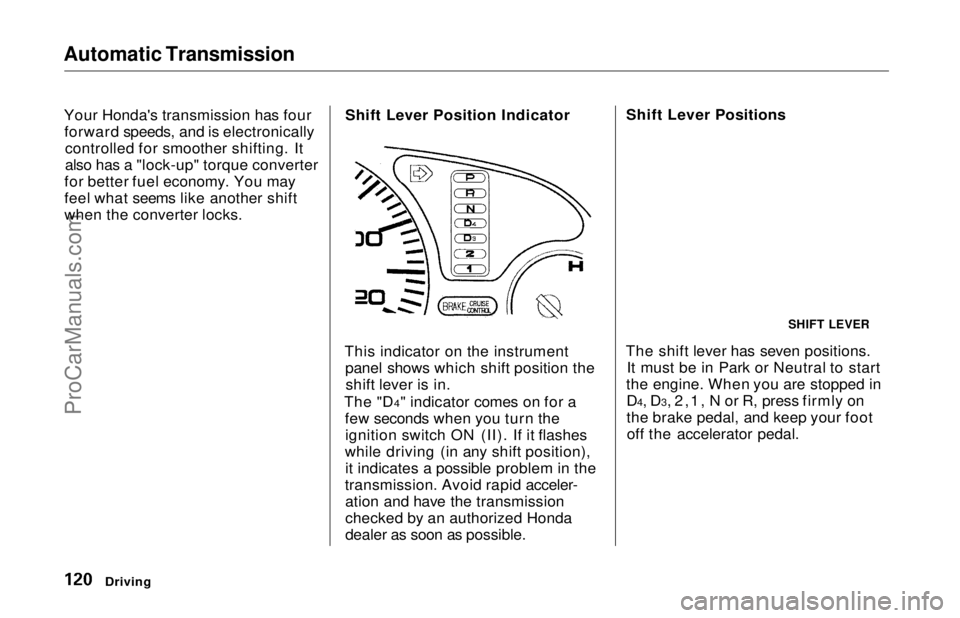
This indicator on the instrument panel shows which shift position theshift lever is in.
The "D4" indicator comes on for a few seconds when you turn theignition switch ON (II). If it flashes
while driving (in any shift position), it indicates a possible problem in the
transmission. Avoid rapid acceler- ation and have the transmission
checked by an authorized Honda
dealer as soon as possible. Shift Lever Positions
The shift lever has seven positions. It must be in Park or Neutral to start
the engine. When you are stopped in D4, D3, 2,1, N or R, press firmly on
the brake pedal, and keep your footoff the accelerator pedal.
Driving
SHIFT LEVERProCarManuals.comMain Menu Table of Contents s t
Page 121 of 241
Automatic Transmission
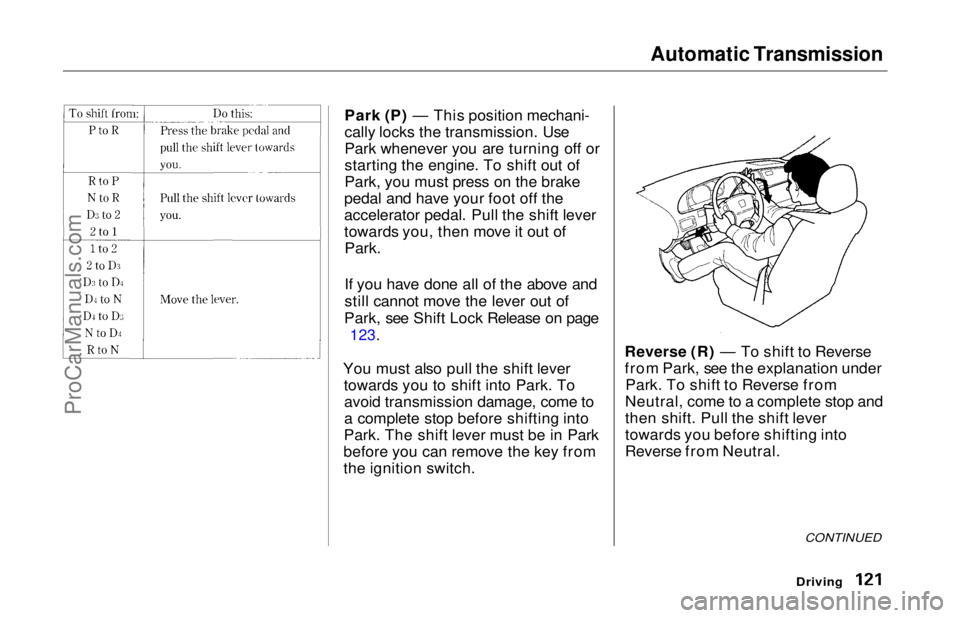
Park (P) — This position mechani-
cally locks the transmission. Use
Park whenever you are turning off or
starting the engine. To shift out of
Park, you must press on the brake
pedal and have your foot off the
accelerator pedal. Pull the shift lever
towards you, then move it out of
Park.
If you have done all of the above and
still cannot move the lever out of
Park, see Shift Lock Release on page
123.
You must also pull the shift lever towards you to shift into Park. Toavoid transmission damage, come to
a complete stop before shifting into
Park. The shift lever must be in Park
before you can remove the key from
the ignition switch. Reverse (R) — To shift to Reverse
from Park, see the explanation under
Park. To shift to Reverse from
Neutral, come to a complete stop and
then shift. Pull the shift lever
towards you before shifting into
Reverse from Neutral.
Driving
CONTINUEDProCarManuals.comMain Menu Table of Contents s t