1997 GMC SAVANA light
[x] Cancel search: lightPage 232 of 388

Rocking Your Vehicle To Get It Out
NOTICE: First, turn your steering wheel left and right. That will
clear the area around your front wheels. Then shift back
Spinning your wheels can destroy parts of your and forth between REVERSE (R) and a forward gear,
vehicle as well as the tires. If you spin the wheels
accelerator pedal while you shift, and press lightly on too fast while shifting your transmission back
spinning the wheels as little as possible. Release the
the accelerator pedal when the transmission is in gear.
and forth, you can destroy your transmission.
If that doesn’t get you out after a few tries, you may
’or information about using tire chains on your vehicle,
;ee “Tire Chains” in the Index. need
to be towed out. If you
do need to be towed out,
see “Towing Your Vehicle” in the Index.
5-38
ProCarManuals.com
Page 256 of 388
Rear Axle Engine Coolant
When to Check and Change Lubricant
Refer to the Maintenance Schedule to determine how
often to check the lubricant and when to change it. See
“Scheduled Maintenance Services” in the Index.
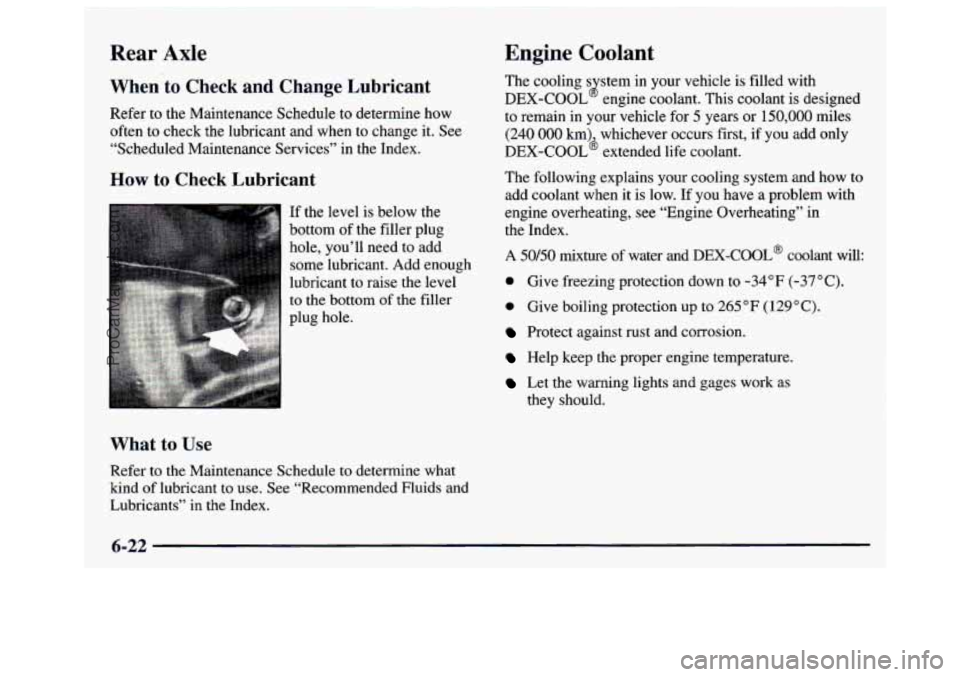
How to Check Lubricant
If the level is below the
bottom
of the filler plug
hole, you’ll need to add some lubricant. Add enough
lubricant to raise the level
to the bottom
of the filler
plug hole.
What to Use
Refer to the Maintenance Schedule to determine what
kind of lubricant to use. See “Recommended Fluids and
Lubricants” in
the Index. The cooling
s stem in your vehicle
is filled with
DEX-COOL
8 engine coolant. This coolant is designed
to remain in your vehicle for
5 years or 150,000 miles
(240 000 km) whichever occurs first, if you add only
DEX-COOL’ extended life coolant.
The following explains your cooling sysre~ And how to
add coolant when it is low. If
you have a problem with
engine overheating,
see “Engine Overheating” in
the Index.
A 50/50 mixture of water and DEX-COOL’ coolant will:
0 Give freezing protection down to -34°F (-37°C).
0 Give boiling protection up to 265 “F (129°C).
Protect against rust and corrosion.
Help keep the proper engine temperature.
Let the warning lights and gages work as
they should.
6-22
ProCarManuals.com
Page 265 of 388

Some driving conditions or climates may cause a brake
squeal when the brakes are first applied or lightly
applied. This does not mean something is wrong with
your brakes.
Properly torqued wheel nuts are necessary to help
prevent brake pulsation. When tires are rotated, inspect
brake pads for wear and evenly torque wheel nuts in the
proper sequence to
GM specifications.
Your rear drum brakes don’t have wear indicators, but
if you ever hear a rear brake rubbing noise, have the
rear brake linings inspected. Also, the rear brake drums should be removed and inspected each time the tires
are removed for rotation or changing. When you have
the front brake pads replaced, have the rear brakes
inspected, too.
Brake linings should always be replaced as complete
axle sets.
See “Brake System Inspection” in Section
7 of this
manual under Part
C “Periodic Maintenance
Inspections”.
Brake Pedal Travel
See your dealer if the brake pedal does not return to
normal height, or
if there is a rapid increase in pedal
travel. This could be a sign of brake trouble.
Brake Adjustment
Every time you make a brake stop, your disc brakes
adjust for wear.
If your brake pedal goes down farther than normal, your
rear drum brakes may need adjustment. Adjust them by
backing up and firmly applying the brakes a few times.
Replacing Brake System Parts
The braking system on a modern vehicle is complex.
Its many parts have to be of top quality and work well
together if the vehicle is to have really good braking.
Your vehicle was designed and tested with top-quality
GM brake parts. When you replace parts of your braking
system
-- for example, when your brake linings wear
down and you have to have new ones put in
-- be sure
you get new approved GM replacement parts. If you
don’t, your brakes may no longer work properly. For
example,
if someone puts in brake linings that are wrong
for your vehicle, the balance between your front and
rear brakes can change
-- for the worse. The braking
performance you’ve come to expect can change in many
other ways if someone puts in the wrong replacement
brake parts.
6-31
ProCarManuals.com
Page 280 of 388

Mixing tires could cause you to lose control while
driving.
If you mix tires of different sizes or types
(radial and bias-belted tires), the vehicle may not
handle properly, and
you could have a crash.
Using tires
of different sizes may also cause
damage to your vehicle.
Be sure to use the same
size and type tires
on all wheels.
Uniform Tire Quality Grading
The following information relates to the system developed
by the United States National Highway Traffic Safety
Administration, which grades tires by treadwear, traction
and temperature performance. (This applies
only to
vehicles sold in the United States.) The grades are molded
on the sidewalls of most passenger car
tires. The Uniform
Tire
Quality Grading system does not apply to deep tread,
winter-type snow tires, space-saver or temporary use spare
tires, tires with nominal
rim diameters of 10 to 12 inches
(25 to
30 cm), or to some limited-production tires.
While the tires available on General Motors passenger
cars and light trucks may vary with respect to these grades, they must
also conform
to Federal safety
requirements and additional General Motors Tire
Performance Criteria (TPC) standards.
Treadwear
The treadwear grade is a comparative rating based on
the wear rate of the tire when tested under controlled
conditions on a specified government test course.
For
example, a tire graded 150 would wear one and a half
(1 1/2) times as well on the government course as a tire
graded
.loo. The relative performance of tires depends
upon
the actual conditions of their use, however, and
may depart significantly from the norm due to variations
in driving habits, service practices and differences in
road characteristics and climate.
Traction -- A, B, C
The traction grades, from highest to lowest, are A, B, and
C, and they represent the tire’s ability to stop on wet
pavement as measured under controlled conditions
on
specified government test surfaces of asphalt and concrete.
A tire marked
C may have poor traction performance.
Warning: The traction grade assigned to this tire is based
on braking (straightahead) traction tests and does
not
include cornering (turning) traction.
6-46
ProCarManuals.com
Page 284 of 388

I
Don’t use any of these unless this manual says you can.
In many uses, these will damage your vehicle:
Alcohol
0 Laundry Soap
Bleach
Reducing Agents
Cleaning the Inside of Your Vehicle
Use a vacuum cleaner often to get rid of dust and loose
dirt. Wipe vinyl or leather with
a clean, damp cloth.
Your GM dealer has two cleaners, a solvent-type spot
lifter and
a foam-type powdered cleaner. They will clean
normal spots and stains very well.
Do not use them on
vinyl or leather.
Here
are some cleaning tips:
1. Always read the instructions on the cleaner label.
2. Clean up stains as soon as you can -- before they set.
3. Use a clean cloth or sponge, and change to a clean area
often.
A soft brush may be used if stains are stubborn.
4. Use solvent-type cleaners in a well-ventilated area
5. If a ring forms after spot cleaning, clean the entire
only. If you
use them, don’t saturate the stained area.
area immediately or it will set.
Using Foam-Type Cleaner on Fabric
1.
2.
3.
4.
5.
6.
7.
8.
9.
Vacuum and brush the area to remove any loose dirt.
Always clean a whole trim panel or section. Mask
surrounding trim along stitch or welt lines.
Mix Multi-Purpose Powdered Cleaner following the directions on the container label.
Use suds only and apply with a clean sponge. Don’t
saturate the material and don’t rub it roughly.
As soon as you’ve cleaned the section, use a sponge
to remove the suds.
Rinse the section with
a clean, wet sponge.
Wipe off what’s left with a slightly damp paper towel
or cloth.
Dry
it immediately with a blow dryer.
Wipe with a clean cloth.
ProCarManuals.com
Page 285 of 388

Using Solvent-Type Cleaner on Fabric
First, see if you have to use solvent-type cleaner at all.
Some spots and stains will clean off better with just
water and mild soap.
If you need to use a solvent:
1. Gently scrape excess soil from the trim material with
a clean, dull knife or scraper.
2. Use very little cleaner, light pressure and clean cloths
(preferably cheesecloth). Cleaning should start
at the
outside of the stain, “feathering” toward the center.
3. Keep changing to a clean section of the cloth.
4. When you clean a stain from fabric, immediately
dry the area with
a blow dryer to help prevent a
cleaning ring.
Fabric Protection
Your vehicle has upholstery and carpet that has been
treated with Scotchgard Fabric Protector, a
3M
product. It protects fabrics by repelling oil and water,
which are the carriers of most stains. Even with this
protection, you still need to clean your upholstery and
carpet often to keep it looking new.
Further information on cleaning is available by calling
1-800-433-3296 (in Minnesota, 1-800-642-6167).
Special Cleaning Problems
Greasy or Oily Stains
Stains caused by grease, oil, butter, margarine, shoe
polish, coffee with cream, chewing gum, cosmetic
creams, vegetable oils, wax crayon, tar and asphalt can
be removed as follows:
1. Carefully scrape
off excess stain.
2. Follow the solvent-type instructions described earlier.
Shoe polish, wax crayon, tar and asphalt will stain if left
on a vehicle’s seat fabric. They should be removed as
soon as possible. Be careful, because the cleaner will
dissolve them and may cause them to spread.
Non-Greasy Stains
Stains caused by catsup, coffee (black), egg, fruit, fruit
juice, milk, soft drinks, wine, vomit, urine and blood can
be removed as follows:
1. Carefully scrape off excess stain,
then sponge the
soiled area
with cool water.
2. If a stain remains, follow the foam-type instructions
described earlier.
ProCarManuals.com
Page 286 of 388

3. If an odor lingers after cleaning vomit or urine,
treat the area with a waterhaking soda solution:
1
teaspoon (5 ml) of baking soda to 1 cup (250 ml)
of lukewarm water.
4. If needed, clean lightly with solvent-type cleaner.
Combination Stains
Stains caused by candy, ice cream, mayonnaise, chili
sauce and unknown stains can be removed as follows:
1. Carefully scrape off excess stain.
2. Clean with cool water and allow to dry.
3. If a stain remains, clean it with solvent-type cleaner.
Cleaning Vinyl
Use warm water and a clean cloth.
0 Rub with a clean, damp cloth to remove dirt. You
may have to do it more than once.
Things like tar, asphalt and shoe polish will stain if you
don’t get them
off quickly. Use a clean cloth and a
vinyVleather cleaner.
See your dealer for this product.
Cleaning Leather I
Use a soft cloth with lukewarm water and a mild soap or I
saddle soap and wipe dry with a soft cloth. Then, let the
leather dry naturally.
Do not use heat to dry.
For stubborn stains, use a leather cleaner. See your
dealer for this product.
cleaners, furniture polish
or shoe polish on leather.
Never use oils, varnishes, solvent-based or abrasive
Soiled or stained leather should be cleaned
immediately. If dirt is allowed to work into the
finish,
it can harm the leather.
Cleaning the Top of the Instrument Panel
Use only mild soap and water to clean the top surfaces
of the instrument panel. Sprays containing silicones or
waxes may cause annoying reflections in the windshield
and even make it difficult to see through the windshield
under certain conditions.
6-52
ProCarManuals.com
Page 294 of 388

Instrument Panel Fuse Block
The fuse block access door
is
on the driver’s side of the
instrument panel above
the
hood release lever.
You can remove the cover
by turning the fastener
counterclockwise.
You can remove fuses with a fuse extractor. The
fuse
extractor is mounted to the fuse block access door.
To remove fuses if you don’t have a fuse extractor, hold
the end of the
fuse between your thumb and index finger
and pull straight out. Be
sure
to use the correct fuse. If you ever have a
problem on the road and don’t have a spare fuse,
you can “borrow” one of the correct value. Just pick
some feature of your vehicle that you can get along
without
-- like the radio or cigarette lighter -- and use
its fuse,
if it is of the value you need. Replace it as soon
as
you can. See “Fuses and Circuit Breakers” in the
Index for more information.
FUSE BLOCK INFORMATION
6-60
ProCarManuals.com