Page 122 of 167

CHECKING AND ADDING ENGINE OIL
Checking the engine oil
Check the engine oil each time you fuel your
vehicle.
To check the oil:
1. Make sure the vehicle is on level ground. If the
engine is warm, turn the engine off and wait a few
minutes for the oil to drain into the oil pan.
2. Set the parking brake and ensure the gearshift is
securely latched in P (Park).
3. Open the hood. Protect yourself from engine heat.
4. Locate and carefully
remove the engine oil
dipstick.
5. Wipe the dipstick clean. Insert the dipstick fully,
then remove it again. The oil level should be in the
range shown on the dipstick.
6. If the oil level is below the MIN line or the ADD 1
QUART line, add oil as necessary. If the oil level is
beyond the MAX or FULL line, engine damage or
high engine oil consumption may occur and some oil
must be removed from the engine by a service
technician.
7. Put the dipstick back in and ensure it is fully
seated.
Adding engine oil
1. Check the engine oil. For instructions, refer to
Checking the engine oilin this chapter.
2. If the fluid level is not within the normal range,
add only certified engine oil of the preferred
viscosity. Add engine oil through the oil filler cap.
ADD 1 QTFULL
Maintenance and care
123
ProCarManuals.com
Page 123 of 167
Remove the filler cap and use a funnel to pour oil in
the opening.
3. Recheck the oil level. Make sure the oil level is
not above the MAX or FULL mark on the dipstick.
ENGINE OIL RECOMMENDATIONS
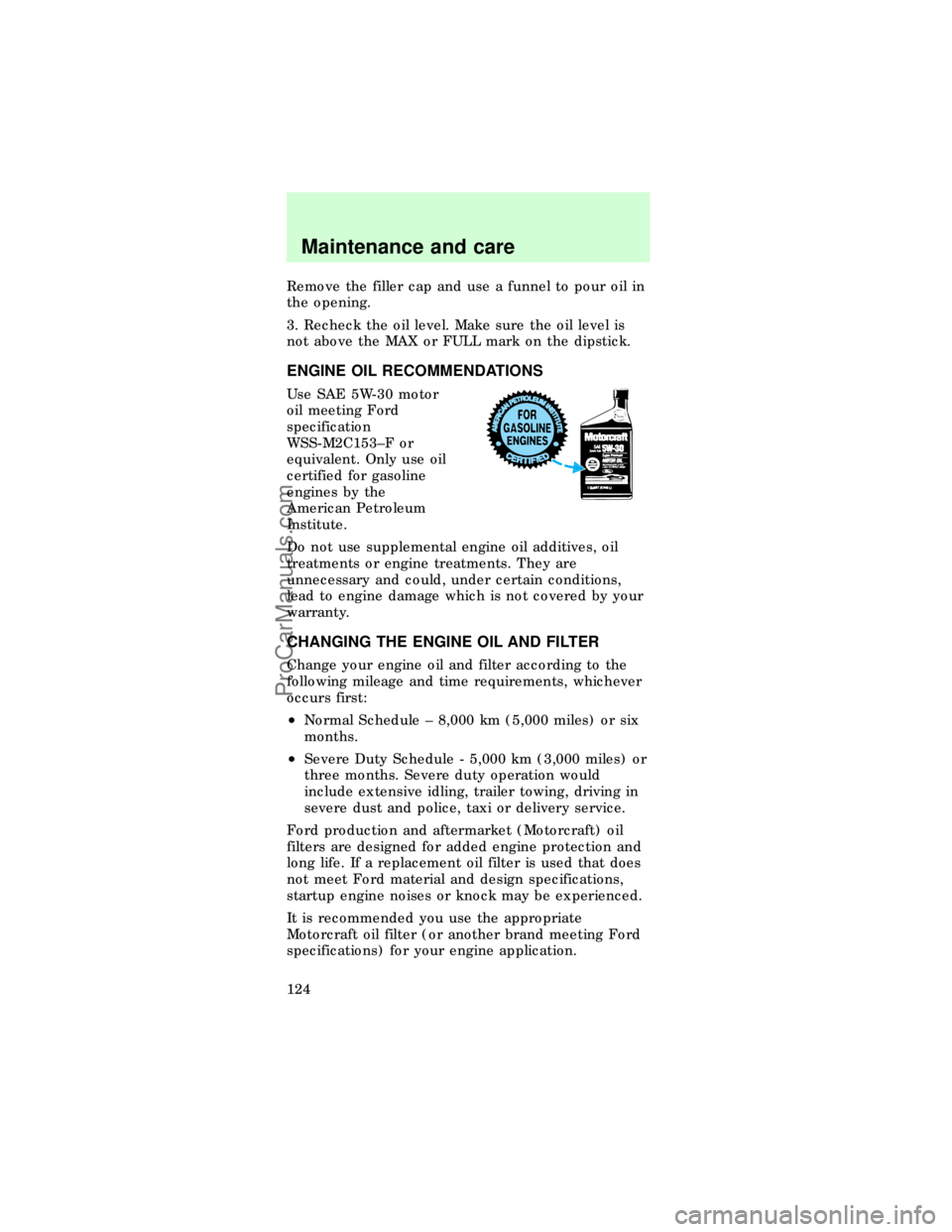
Use SAE 5W-30 motor
oil meeting Ford
specification
WSS-M2C153±F or
equivalent. Only use oil
certified for gasoline
engines by the
American Petroleum
Institute.
Do not use supplemental engine oil additives, oil
treatments or engine treatments. They are
unnecessary and could, under certain conditions,
lead to engine damage which is not covered by your
warranty.
CHANGING THE ENGINE OIL AND FILTER
Change your engine oil and filter according to the
following mileage and time requirements, whichever
occurs first:
²Normal Schedule ± 8,000 km (5,000 miles) or six
months.
²Severe Duty Schedule - 5,000 km (3,000 miles) or
three months. Severe duty operation would
include extensive idling, trailer towing, driving in
severe dust and police, taxi or delivery service.
Ford production and aftermarket (Motorcraft) oil
filters are designed for added engine protection and
long life. If a replacement oil filter is used that does
not meet Ford material and design specifications,
startup engine noises or knock may be experienced.
It is recommended you use the appropriate
Motorcraft oil filter (or another brand meeting Ford
specifications) for your engine application.
Maintenance and care
124
ProCarManuals.com
Page 129 of 167

3.0L Vulcan engine
4. Check the fluid level
on the dipstick. It
should be between the
arrows in the FULL
HOT range. Do not add
fluid if the level is
within this range.
5. If the fluid is low, add fluid in small amounts,
continuously checking the level until it reaches the
FULL HOT range. Be sure to put the dipstick back
in the reservoir.
3.0L Duratec engine and 3.4L SHO engine
4. Check the fluid level
in the reservoir. It
should be between the
MIN and MAX lines. Do
not add fluid if the
level is within this
range.
5. If the fluid is low, add fluid in small amounts,
continuously checking the level until it reaches the
range between the MIN and MAX lines. Be sure to
put the cap back on the reservoir.
AUTOMATIC TRANSAXLE FLUID
Under normal circumstances, the transaxle fluid
does not need to be checked. Refer to theService
Guidefor fluid replacement intervals. If the
transaxle is not working properly Ð for instance, the
transaxle may slip or shift slowly or even some fluid
leakage (red fluid under the vehicle) Ð the fluid
should be checked.
FULL HOT
MINMAX
Maintenance and care
130
ProCarManuals.com
Page 135 of 167
performance of tires depends upon the actual
conditions of their use, however, and may depart
significantly from the norm due to variations in
driving habits, service practices, and differences in
road characteristics and climate.
Traction A B C
The traction grades, from highest to lowest are A, B,
and C, and they represent the tire's ability to stop
on wet pavement as measured under test surfaces of
asphalt and concrete. A tire marked C may have
poor traction performance. Warning: The traction
grade assigned to this tire is based on braking
(straightahead) traction tests and does not include
cornering (turning) traction.
Temperature A B C
The temperature grades are A (the highest), B, and
C, representing the tire's resistance to the
generation of heat and its ability to dissipate heat
when tested under controlled conditions on a
specified indoor laboratory test wheel. Sustained
high temperature can cause the material of the tire
to degenerate and reduce tire life, and excessive
temperature can lead to sudden tire failure. The
grade C corresponds to a level of performance which
all passenger car tires must meet under the Federal
Motor Vehicle Safety Standard No. 109. Grades B
and A represent higher levels of performance on the
laboratory test wheel than the minimum required by
law.
The temperature grade for this tire is
established for a tire that is properly inflated
and not overloaded. Excessive speed,
underinflation, or excessive loading, either
separately or in combination, can cause heat
buildup and possible tire failure.
Maintenance and care
136
ProCarManuals.com
Page 136 of 167
SERVICING YOUR TIRES
Checking the tire pressure
²Use an accurate tire pressure gauge.
²Check the tire pressure when tires are cold, after
the vehicle has been parked for at least one hour
or has been driven less than 5 km (3 miles).
²Adjust tire pressure to recommended
specifications found on the Safety Compliance
Certification Label.
Improperly inflated tires can affect vehicle
handling and can fail suddenly, possibly
resulting in loss of vehicle control.
Tire rotation
Because your vehicle's tires perform different jobs,
they often wear differently. To make sure your tires
wear evenly and last longer, rotate them as indicated
in theService Guide. If you notice that the tires
wear unevenly, have them checked.
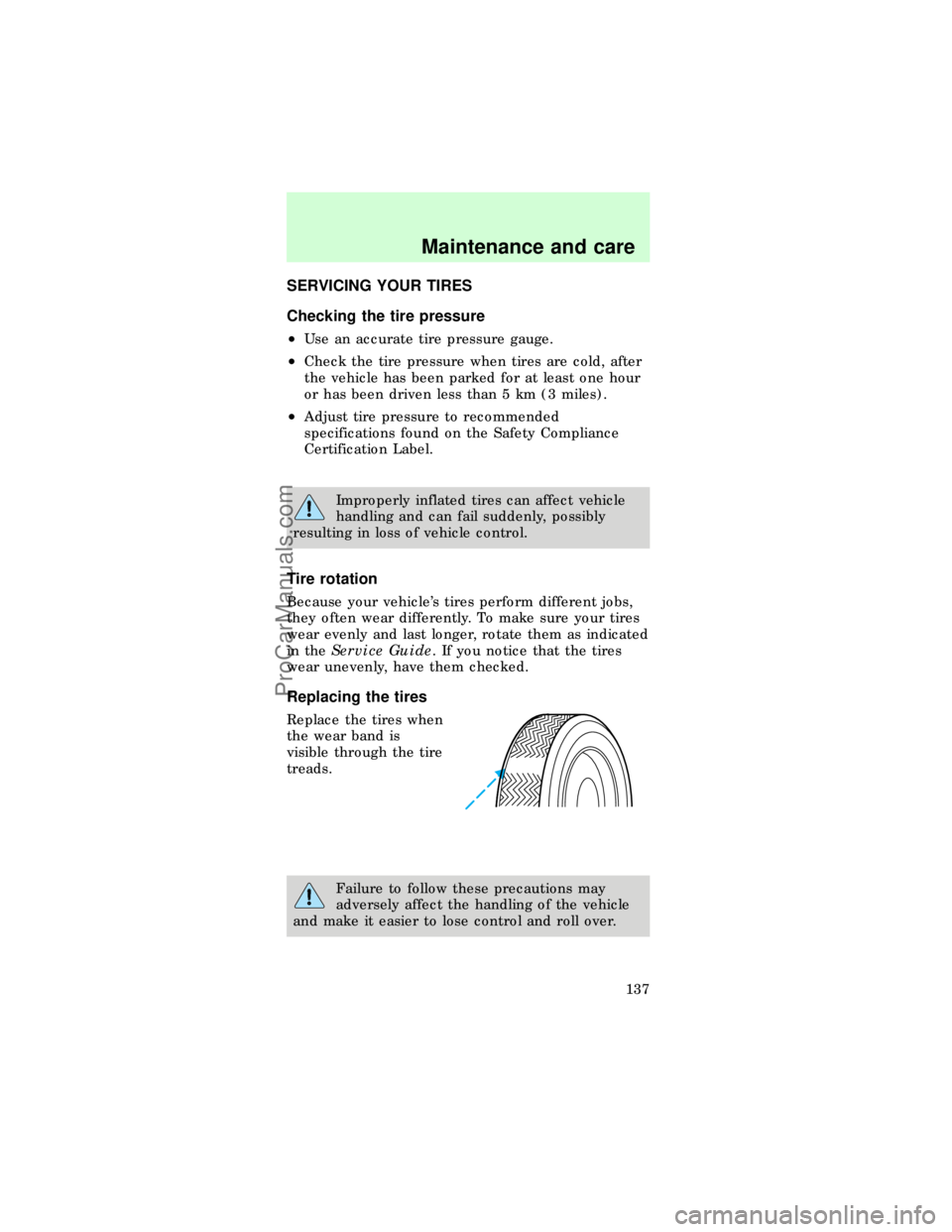
Replacing the tires
Replace the tires when
the wear band is
visible through the tire
treads.
Failure to follow these precautions may
adversely affect the handling of the vehicle
and make it easier to lose control and roll over.
Maintenance and care
137
ProCarManuals.com
Page 140 of 167
fuel, see your dealer or a qualified service technician
to prevent any engine damage.
SHO engines
Your vehicle is
designed to use
premium gasoline for
optimum performance
with an (R + M)/2 octane rating of 91 or higher.
Gasolines with lower octane ratings can be used but
performance may decrease. We do not recommend
gasolines labeled as ªpremiumº in high altitude areas
that are sold with octane ratings less than 91.
Fuel quality
If you are experiencing starting, rough idle or
hesitation problems try a different brand of fuel. If
the condition persists, see your dealer or a qualified
service technician.
The American Automobile Manufacturers Association
(AAMA) issued a gasoline specification to provide
information on high quality fuels that optimize the
performance of your vehicle. We recommend the use
of gasolines that meet the AAMA specification if
they are available.
It should not be necessary to add any aftermarket
products to your fuel tank if you continue to use a
high-quality fuel.
Cleaner air
Ford approves the use of gasolines to improve air
quality, including reformulated gasolines, that
contain oxygenates such as a maximum of 10%
ethanol or 15% MTBE. There should be no more
than 5% methanol with cosolvents and additives to
protect the fuel system.
Calculating fuel economy
To accurately calculate your vehicle's fuel economy:
91
Maintenance and care
141
ProCarManuals.com
Page 141 of 167

1. Fill the tank completely and record the initial
odometer reading.
2. Each time you fill the tank, record the amount of
fuel added (in liters or gallons).
3. After at least three to five fuel tank fill-ups, fill
the fuel tank and record the current mileage
reading.
4. Use one of the following equations to calculate
fuel economy.
Liters used x 1004Total kilometers traveled
Total miles traveled4Total gallons used
Keep a record for at least one month. This will
provide an accurate estimate of the vehicle's fuel
economy.
EMISSION CONTROL SYSTEM
Your vehicle is equipped with catalytic converters
which enable your vehicle to comply with applicable
exhaust emission requirements.
Exhaust leaks may result in the entry of
harmful and potentially lethal fumes into the
passenger compartment. Under extreme conditions
excessive exhaust temperatures could damage the
fuel system, the interior floor covering, or other
vehicle components, possibly causing a fire.
To make sure that the catalytic converter and the
other emission control parts continue to work
properly:
²Use only unleaded fuel.
²Avoid running out of fuel.
²Do not turn off the ignition while your vehicle is
moving, especially at high speeds.
²Have the services listed in yourService Guide
performed according to the specified schedule.
Maintenance and care
142
ProCarManuals.com
Page 142 of 167
The Scheduled Maintenance Services listed in the
Service Guideare required because they are
considered essential to the life and performance of
your vehicle and to its emissions system.
Ford strongly recommends the use of genuine Ford
replacement parts. If other than Ford or Motorcraft
parts or Ford authorized parts are used for
maintenance replacements or for the service of
components affecting emission control, such
non-Ford parts should be equivalent to genuine Ford
Motor Company parts in performance and durability.
It is the owner's responsibility to determine the
equivalency of such parts. Please consult your
Warranty Information Booklet for complete warranty
information.
Do not park, idle, or drive your vehicle in
dry grass or other dry ground cover. The
emission system heats up the engine compartment
and exhaust system, which can start a fire.
Watch for fluid leaks, strange odors, smoke, loss of
oil pressure, the charging system warning light, the
service engine soon light or the temperature warning
light. These sometimes indicate that the emissions
system is not working properly.
Do not make any unauthorized changes to your
vehicle or engine. Changes that cause more
unburned fuel to reach the exhaust system can
increase the temperature of the engine or exhaust
system.
By law, anyone who manufactures, repairs, services,
sells, leases, trades vehicles, or supervises a fleet of
vehicles is not permitted to intentionally remove an
emission control device or prevent it from working.
In some of the United States and Canada, vehicle
owners may be liable if their emission control device
is removed or prevented from working.
Maintenance and care
143
ProCarManuals.com